



Financial Freedom
Six steps to financial independence
Money is more than a means of making a living. It opens up opportunities and helps us make many of our dreams come true. But how do we achieve financial freedom, which allows us to live an independent and fulfilling life?
Everyone defines financial freedom differently, but saving and investing are usually essential for building wealth. Creating sources of passive income goes hand in hand with this, so you can leave the rat race early. Savings also provide financial security and help you weather unexpected setbacks.
In this guide, we’ll explore how to achieve financial freedom, how realistic this goal is, and the six steps you can take to get there.
The essentials in brief: Everything You Need to Know About Financial Freedom at a Glance
Explanation: You achieve financial freedom when you have enough money to maintain your standard of living without having to keep working.
Options: Financial freedom can usually be achieved by saving and investing your money. Also consider ways to increase your income and build passive income.
Minimal effort: Investments like ETFs can help you achieve financial freedom without spending a lot of time.
Starting capital: The more starting capital you have, the easier it is to achieve financial freedom. But even without a large sum, you can still start working towards financial freedom and independence.

Find and compare thousands of ETFs. Use powerful filters, detailed analytics, and independent data to discover the right ETF for your portfolio.
What does “financially independent” mean?
Financial independence means having enough passive income to maintain your standard of living without restrictions and without having to work.
In contrast, financial freedom is defined more broadly and personally. For example, some people feel financially free when they can work part-time without money worries. Others find it through self-employment, which allows them to pursue their passions, travel or set their own hours.
The following chart illustrates how important saving and investing are on the path to financial freedom:
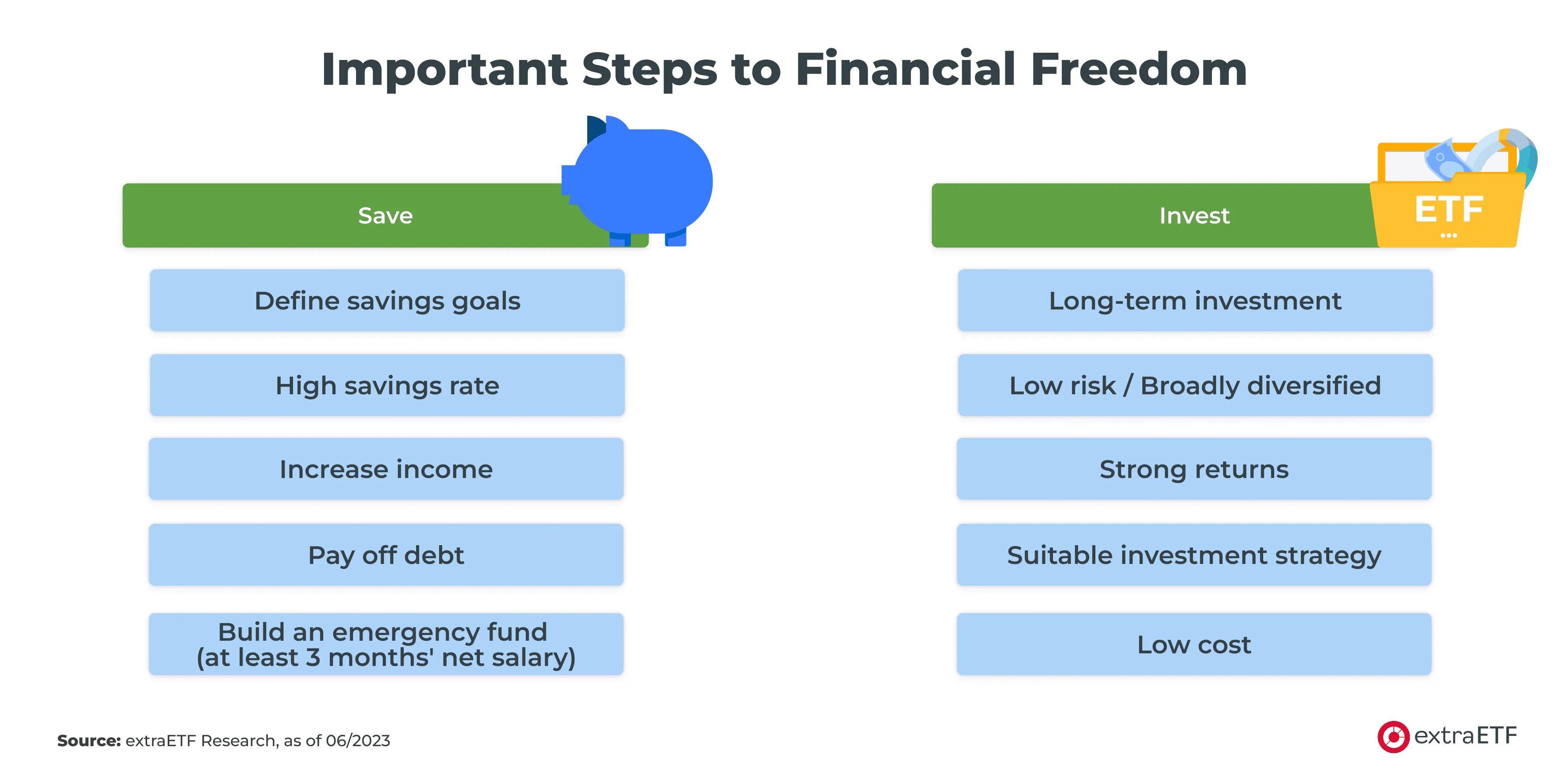
Overall, financial independence is a milestone on the path to financial freedom, enabling people to lead fulfilling, self-determined lives without financial constraints.
How do you achieve financial freedom?
Financial freedom cannot be guaranteed. Your best chance is a high savings rate, specific savings goals, a suitable investment strategy and passive income streams. A high, steady income helps, and long-term, well-diversified investments – such as ETFs tracking the global stock market – make sense.
Achieving financial freedom usually takes effort, and how much depends on your chosen investments and sources of income.
Strategic financial planning, discipline and perseverance can bring you closer to financial freedom. Follow these steps:
- Step 1: Current Situation
- Step 2: Set Goals
- Step 3: Build Up Savings
- Step 4: Invest for the Long Term
- Step 5: Build Passive Income
- Step 6: Reduce Your Spending (Optional)
Let’s look at each step in more detail.
Step 1: Current Situation
Start by looking at your current financial situation. Take a detailed inventory of your savings, investments and assets, as well as your income and expenses. Don’t forget to include any debts.
Budget planners, budgeting apps or the 50-30-20 rule can help you take stock. Under this rule, for example, a monthly net income of £2,000 would be divided as follows:
- £1,000 for essentials (50 per cent)
- £600 for hobbies and personal spending (30 per cent)
- £400 for savings and debt repayment (20 per cent)
Analysing your finances often reveals areas where you can cut back and save.
Step 2: Set Goals
Financial freedom or independence means something different to each person, depending on their situation. That’s why you should define your own goal.
This isn’t just about how much money you want, but also about when, or at what age, you want to achieve it. A specific goal gives you clear direction and motivates you to work towards it.
Examples of goals include achieving financial freedom within the next 10 years, so that you are independent by 40, 50 or another age. More specific goals, such as funding a trip around the world or securing a comfortable retirement, are also possible.
Step 3: Build Up Savings
Before you start investing, save up a financial cushion, such as an emergency fund of at least three months’ net salary. An emergency fund means you won’t have to sell shares or ETFs to cover unexpected costs. The right size depends on your monthly fixed costs and standard of living.
One simple way to build up savings is to set up a monthly standing order into a savings account. Our savings challenges show that saving can even be fun.
Step 4: Invest for the Long Term
Building wealth over the long term is essential for financial freedom. As part of a balanced asset allocation strategy, spread your portfolio across different asset classes to diversify risk broadly.
ETFs offer a cost-effective way to do all of this, with numerous advantages for long-term investing. Because you can reinvest returns with both accumulating and distributing ETFs, compounding can have a significant effect over the long term and boost your returns.
Join the extraETF community
Explore the world of ETFs and make informed investment decisions.
- Find ETFs that match your criteria with our ETF Search.
- Compare costs, performance, and risk side by side.
- Save your favourites to a watchlist and receive price alerts.
- Explore detailed ETF profiles with key metrics and holdings.
Step 5: Build Passive Income
If you want not only a substantial net worth but also a monthly income, you can build passive income through investments such as ETFs. This means earning a regular income without active work.
Suitable options include:
- Dividend-paying shares
- Dividend-paying ETFs
- Other dividend-paying investment funds
Besides investing, there are other ways to earn passive income, such as writing a book, collecting rental income from property, earning advertising revenue from your own website, or selling your own designs and art. Each takes some time upfront. Investing does too, when you research your options and make a decision. Once your money is invested, the time commitment usually falls.
Step 6: Reduce Your Spending (Optional)
If you want to reach financial freedom faster, consider cutting your monthly expenses. You can apply the 50-30-20 rule flexibly without sacrificing too much quality of life.
By contrast, members of the FIRE (Financial Independence, Retire Early) movement save for financial independence and early retirement by adopting frugalism, cutting their expenses and lowering their standard of living even further. The drawback is that too many sacrifices can significantly reduce quality of life.
How much money do you need to be financially free?
How much money you need to be financially free depends largely on your individual goals and the lifestyle you plan to lead, but also on your income and expenses. The 25x Rule and the 4 Per Cent Rule can serve as rough guidelines; for example, if your total monthly expenses are £2,000, you’ll need a starting capital of £600,000.
The 25x rule: Multiply your total annual expenses by 25 to determine your starting capital for financial freedom.
The 4 per cent rule: Using the starting capital from the 25x rule, you can withdraw 4 per cent of your invested savings each year without depleting the principal.
Overall, the money should be invested for the long term, at low cost and diversified globally, with a focus on returns. Suitable ETFs can achieve this, for example. These rules do not take account of tax or the fluctuating returns and performance of ETFs, such as sequence-of-returns risk.

Financial freedom means something different to everyone

Financial Freedom by Age 30: Is It Possible?
Yes, it is generally possible to achieve financial freedom by the age of 30. This usually requires the highest possible income, a high savings rate and high-yield, sufficiently diversified investments with low risk and a long investment horizon. However, there is no guarantee that you will achieve financial freedom by that age.
For example, disciplined saving in suitable ETFs can help you build wealth over the long term. A dividend strategy can also help you create passive income.
The following chart shows examples of investments that can help you on your path to financial freedom by age 30 (or later):
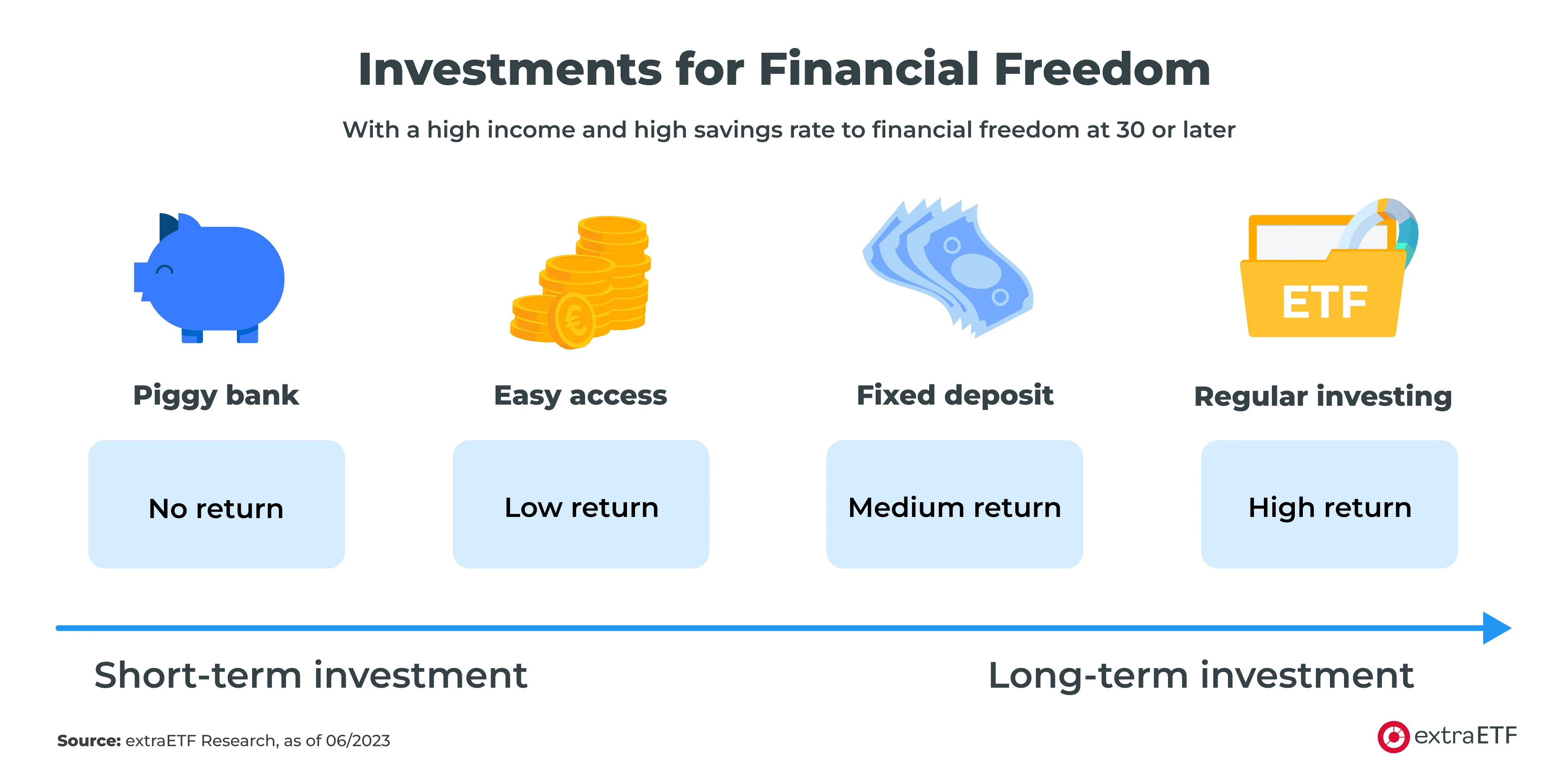
Overall, achieving financial freedom by age 30 depends on many individual factors, in part because everyone’s financial situation, standard of living, and definition of financial freedom vary. Either way, the goal is worth pursuing at any age.
Financial Freedom in 10 Years: How Do I Do It?
You can work towards financial freedom through disciplined saving and long-term, sufficiently diversified investing. Low-cost, globally diversified equity ETFs are particularly well suited to this purpose.
Example: An investor wants £450,000 in starting capital after 10 years to cover total monthly expenses of £1,500. The investor worked out these figures using the 25x rule and the 4 per cent rule from the section “How Much Money Do You Need to Be Financially Free?”
Using extraETF’s Financial Goals Calculator, you can work out the monthly savings amount for a regular ETF investment plan based on these figures, assuming an annual return of 7 per cent. To reach the savings goal, you would need to save £2,659.15 a month. Our example does not factor in tax, but the Financial Goals Calculator can include it too.
Note that ETF returns cannot be guaranteed, and the investment horizon should be at least 15 years when using a suitable, sufficiently diversified global equity ETF.
Conclusion: Financial freedom doesn't have to remain a dream
Whether you achieve financial freedom depends largely on your goals and financial situation. It depends not only on income or existing assets, but above all on saving and creating passive income through long-term, sufficiently diversified, low-cost investments.
ETFs are one such option. They can generate attractive long-term returns with a high degree of diversification, and the risk associated with ETFs is relatively low.
Financial freedom doesn’t have to remain a dream, even if it isn’t possible for everyone. Either way, saving and investing can help you build more wealth over the long term.
We'll answer any other questions you have about financial freedom
- Everything You Need to Know About Financial Freedom at a Glance
- What does “financially independent” mean?
- How do you achieve financial freedom?
- How much money do you need to be financially free?
- Financial Freedom by Age 30: Is It Possible?
- Financial Freedom in 10 Years: How Do I Do It?
- Financial freedom doesn't have to remain a dream
- We'll answer any other questions you have about financial freedom