ETFs: Accumulating vs Distributing
Differences Between ETFs Explained

Investing in ETFs has become increasingly popular in recent years. There are many ETFs to choose from, all aiming to generate returns for investors. But how do we actually benefit from those returns? How can we make the most of compound interest? And does it matter whether an ETF is distributing or accumulating?
When choosing an ETF, you can pick between two types: accumulating and distributing. In this article, you’ll learn what these terms mean, how they differ and what their advantages are.

The essentials in brief: What You Should Know About Accumulation and Distribution ETFs
Definition: What does "reinvesting dividends" mean in the context of an ETF?
Reinvesting ETFs do not distribute their returns. Instead, the income stays in the ETF and is automatically reinvested. This increases the value of the ETF shares, so investors can benefit significantly from the power of compound interest, especially over long investment horizons. You can only access the returns by selling shares in your ETF.
Compound interest works not only with ETFs but also with actively managed funds. As with distributing ETFs, returns come from share dividends or bond interest. The longer investors hold a reinvesting ETF, the faster its value can grow through reinvestment.
The following example shows just how powerful the exponential growth of compound interest can be over long periods. What stands out is how large the share of interest and compound interest can become relative to the initial investment, and how much it contributes to the total return.
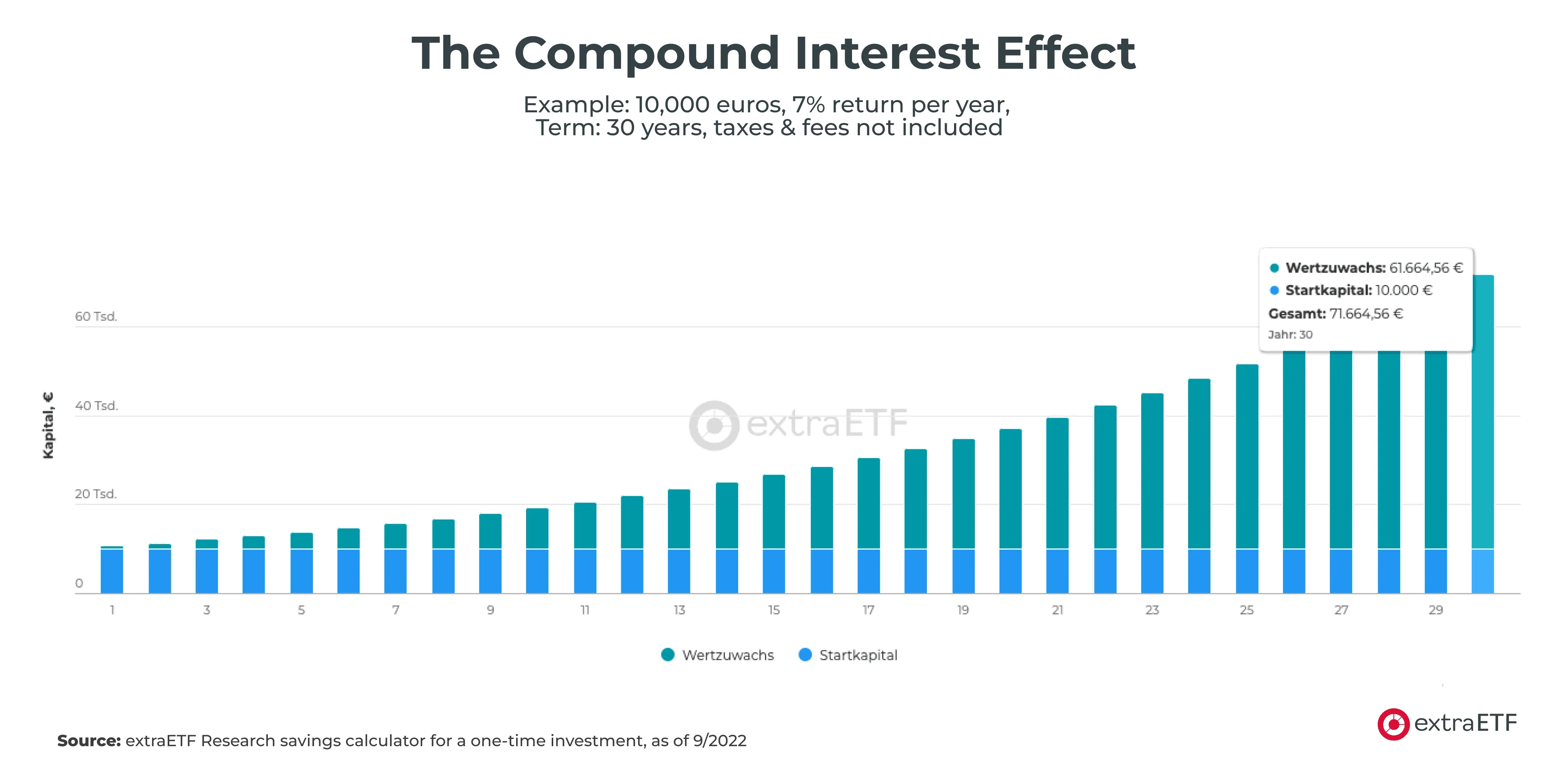
However, whether investors choose a reinvesting or a distributing ETF, the underlying mechanism – for example, tracking the MSCI World Index – remains the same.
Accumulating ETFs are therefore particularly well suited to long investment horizons, such as saving for retirement, where compound interest can have an especially strong effect. Investors also don’t have to worry about reinvesting the returns themselves, which saves time and avoids unnecessary transaction costs.
You can usually spot an accumulating ETF by the abbreviation “Acc” in its name, which stands for “accumulating” – in other words, dividends are reinvested.
If you’re unsure which ETF suits your needs, our ETF recommendations may give you some ideas.
When is a reinvesting ETF subject to tax?
Even though a reinvesting ETF does not pay out its income, you may still owe tax on it each year if you hold it outside an ISA or pension.
Tax may be triggered by:
- Selling ETF shares at a profit (Capital Gains Tax)
- Income reinvested by the fund, known as reportable income (Income Tax)
For accumulating ETFs held outside an ISA or pension, income that the fund reinvests (known as reportable income, for funds with UK reporting status) is generally taxable in the year it arises, even though you receive no cash. It is taxed as dividend or interest income, depending on the fund’s holdings, and any gains are subject to Capital Gains Tax when you sell. Holding ETFs in a Stocks and Shares ISA or a SIPP shelters them from these taxes.

With reinvesting ETFs held outside an ISA or pension, you may owe tax on reinvested income even though you receive no cash, including if you invest through a regular investment plan. That’s why you should set aside enough money to cover any tax bill when it falls due.
Investors are responsible for paying tax on ETF income and gains, usually through Self Assessment, as UK brokers do not normally withhold it. How much tax is due depends on whether the ETF is held in a taxable account or sheltered in an ISA or pension.
Tax-free allowances, such as the Dividend Allowance and the Capital Gains Tax annual exempt amount, mean your earnings are not taxed until you have used them up. Holding ETFs in a Stocks and Shares ISA shelters them entirely.
Explanation: What is a distributing ETF?
A distributing ETF pays out the income generated by the securities it holds. How often this happens – monthly, quarterly, every six months or annually – depends on the ETF. The payment is credited to your investment account without UK tax being deducted. If you hold the ETF outside an ISA or pension, you are responsible for declaring the income. Dividend income is covered by your Dividend Allowance, and interest income by your Personal Savings Allowance, so you only pay tax on income above these limits.
You can then use the returns however you like – spend them or reinvest them in the ETF. Distributing ETFs are therefore well suited, for example, as a source of passive income, since they pay out automatically at regular intervals – though, as with dividend-paying shares, the amount can vary. Reinvesting the returns yourself may also incur extra costs, such as transaction fees. You can usually identify a distributing ETF by the abbreviation “Dist” in its name, which stands for “distributing”.
Let’s look at an example of how the way returns are paid out can affect portfolio growth and total return:
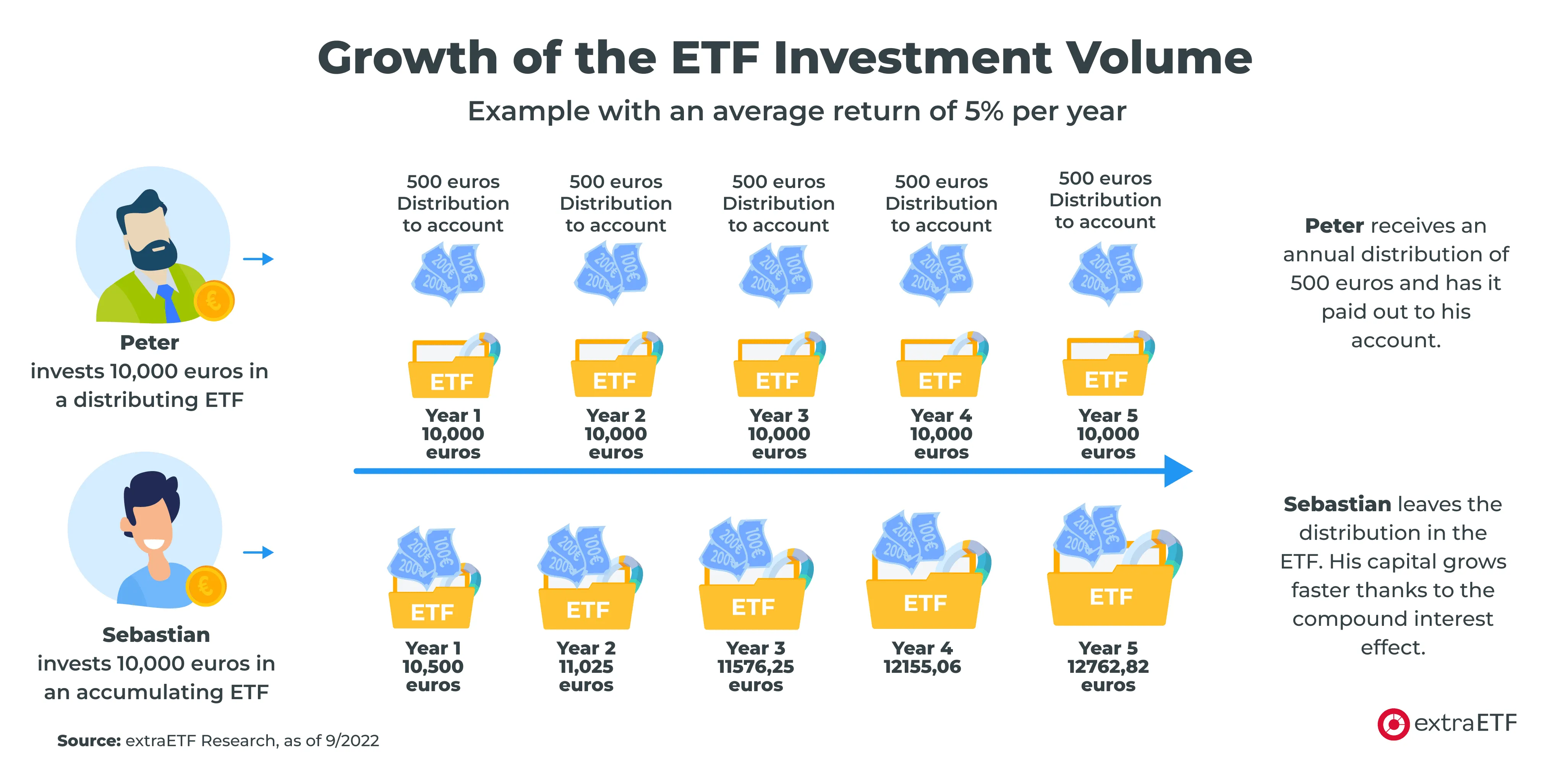
With a reinvesting ETF, by contrast, the income is not paid out but stays in the fund. It is reinvested automatically, increasing the fund’s value so that compound interest can have a stronger effect.

ETFs are ideal for personal retirement planning
Is it an advantage that distributed income is taxed straight away?
Yes, a distributing ETF can be an advantage if you haven’t yet used up your Dividend Allowance. This allowance means no tax is due on dividend income up to the annual limit – and it renews every tax year. In addition, regular distributions can motivate you to stick to your long-term investment strategy and help you avoid panic selling when stock markets fall.
On the other hand, a reinvesting ETF offers the advantage that your money can benefit more from the power of compound interest over the long term, since tax on capital growth is generally deferred until you sell your shares. The returns also stay in the ETF and are reinvested automatically, so you save effort and avoid the costs of reinvesting yourself. However, if you realise a large gain many years later, you can only offset it against the Capital Gains Tax annual exempt amount for that tax year.
Example: A Direct Comparison of Accumulation and Distribution ETFs
To better compare the returns of a distributing ETF with those of a reinvesting ETF, let’s look at a simplified example.
We’ll assume that both ETFs track the same index – such as the MSCI World – and that £200 is invested in each one every month for 25 years. That makes total contributions of £60,000 to each of the two ETFs.
If we now assume that both the distributing and the reinvesting ETF achieve an average return of 7 per cent per year – and ignore taxes and fees – we get the following table:
| After | Total Contributions | Total Returns (Distributing) | Total Returns (Reinvestment) |
|---|---|---|---|
| 1 year | £2,400.00 | £91.00 | £91.00 |
| 5 years | £12,000.00 | £2,135.00 | £2,325.09 |
| 10 years | £24,000.00 | £9,240.00 | £10,416.77 |
| 15 years | £36,000.00 | £20,160.00 | £26,596.39 |
| 20 years | £48,000.00 | £33,740.00 | £54,119.77 |
| 25 years | £60,000.00 | £52,675.00 | £97,553.35 |
| Total assets (savings + returns) | £112,675.00 | £157,553.35 |
This example shows that the distributing ETF generated £52,675 in returns after 25 years, while the reinvesting ETF generated significantly more: £97,553.35. That is despite the same amount being invested in both. Investors in the reinvesting ETF benefited far more from compound interest over the whole period and achieved a much higher total return.
Nevertheless, this does not mean that reinvesting ETFs are always the better choice for every investor. The right choice depends on your individual investment goals. Other criteria may also play a role when selecting ETFs.

Conclusion: Which ETF is better: a reinvesting ETF or a distributing ETF?
Whether a reinvesting or distributing ETF is better depends on your individual investment goals. Reinvesting ETFs can help you build wealth over the long term, as automatic reinvestment lets you benefit fully from the power of compound interest.
However, if you’re looking for passive income, a distributing ETF may be the right choice – particularly if you haven’t yet used up your Dividend Allowance.
When selecting ETFs, you’re free to include both types in your portfolio. Many ETFs are also available in both versions.
The type of income distribution can affect your return, particularly because of the timing of taxation. And while passive income from a distributing ETF can be motivating, manually reinvesting the taxed dividends can incur extra fees and dampen the compounding effect.
To help you keep track of your many distributions, a portfolio tracking tool can provide a distribution overview and a distribution calendar.
Frequently Asked Questions About Accumulating and Distributing ETFs

- What You Should Know About Accumulation and Distribution ETFs
- Definition: What does "reinvesting dividends" mean in the context of an ETF?
- Explanation: What is a distributing ETF?
- Example: A Direct Comparison of Accumulation and Distribution ETFs
- Which ETF is better: a reinvesting ETF or a distributing ETF?
- Frequently Asked Questions About Accumulating and Distributing ETFs