
How to Choose an ETF: 12 Key Criteria
The criteria you should consider when selecting ETFs

The ETF industry is growing steadily, as ETFs are a popular investment vehicle. ETFs (Exchange-Traded Funds) are index funds traded on the stock exchange that track an existing index. Many different ETF providers are active in the market, offering their own ETFs based on various indices. This gives investors a wide range of options for pursuing their personal investment strategies. However, it also creates a dilemma: How can you choose the right one from so many ETFs?
We’ll list and explain the most important criteria that play a role in selecting an ETF.

The essentials in brief: The Most Important Criteria for Choosing an ETF
Choosing an ETF: What Criteria Should You Consider?
To make the right decision when choosing an ETF, there are several criteria you should consider. These include, among others:
- Costs
- Fund size
- Fund age
- Performance and tracking quality
- Taxes
- Distribution Policy
- Replication Method
- Investment Strategy
However, these are by no means all the criteria for selecting an ETF. We also distinguish between criteria that should be evaluated the same way by every investor (objective criteria) and those where you can make a decision based on your personal preferences (subjective criteria). Before we go into more detail about the criteria for selecting ETFs, here’s a summary of them in the chart below:
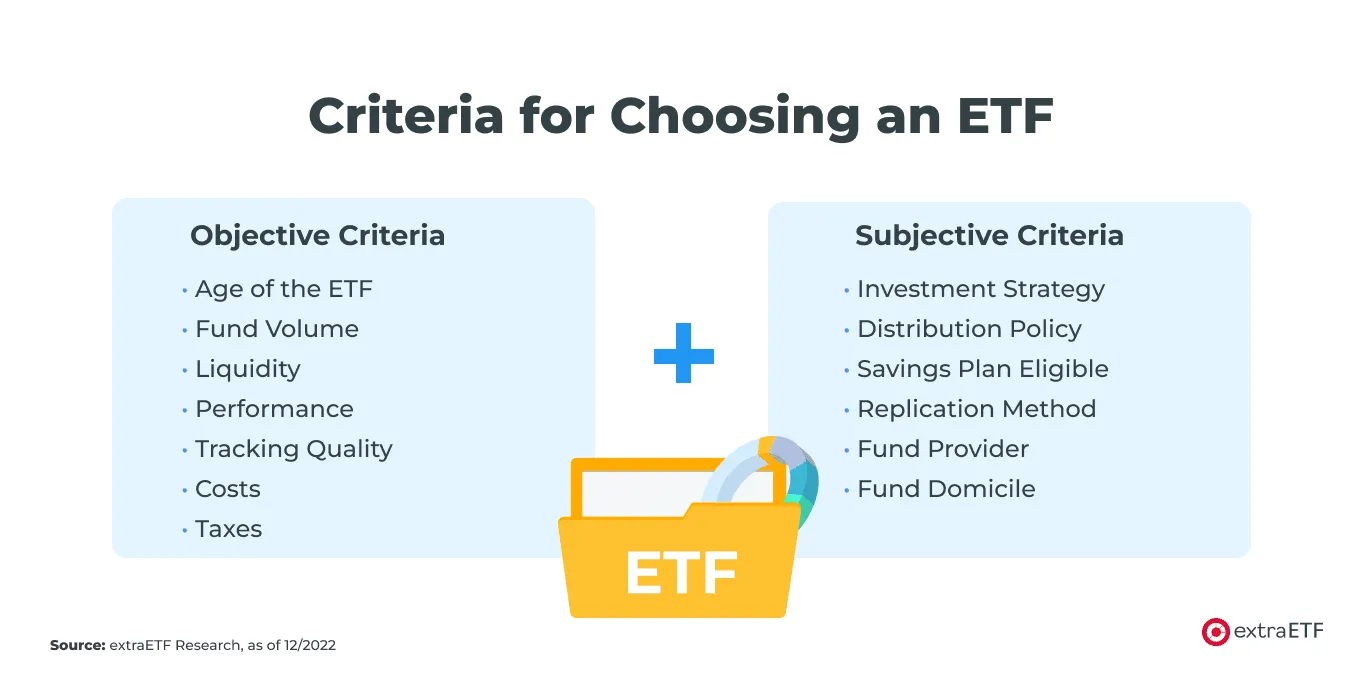
Objective Selection Criteria for ETFs
Broadly speaking, objective ETF selection criteria revolve around numbers, data, and facts. They are easy to compare, can be precisely defined, and carry the same weight for every investor. We’ll walk you through them.
Age of the ETF
In fact, age is an important factor when selecting an ETF. The older an ETF is, the more firmly established it is in the market. This generally leads automatically to high fund volume and liquidity. In addition, older ETFs provide more data that investors can use to compare the ETF’s past performance with that of other funds of this type. An ETF should therefore be at least 5 years old so that investors can see how well the fund has tracked the underlying index during that time.
So does that mean older is always better? No – even an older ETF can deliver below-average performance. If an ETF is older but has a low fund size, this may indicate that the fund isn’t in high demand among investors and could therefore potentially be closed in the near future. The transparency of ETFs works to your advantage in this situation, allowing you to examine each ETF closely to see how it has performed so far and whether it meets all relevant selection criteria.
Fund Size and Liquidity
Fund size is an important factor in selecting an ETF. Experts estimate that an ETF can only be operated profitably if its fund size is at least £50 million. With a fund size exceeding £100 million, profitability is virtually guaranteed. In addition, a high-volume ETF is usually cheaper and more liquid.
A large fund size also increases the number of market participants who quote binding bid and ask prices on the capital market or on the stock exchange. This automatically increases the ETF’s liquidity, which is also an important quality characteristic. It is essential for companies to raise capital as cost-effectively as possible and, at the same time, ensures that the market can sufficiently meet investors’ trading interest.
Performance and Tracking Quality
The goal of an ETF is to track its underlying index as closely as possible. By looking at the tracking error, investors can see how well this objective has actually been met. This is because there are several factors that can prevent an exact replication from always being possible. These include, among other things, costs, taxes, and dividends.
The tracking difference makes it easy to see to what extent the ETF’s performance matches that of the index, which in turn allows for a simple comparison of ETFs with one another. Be sure to compare the performance of ETFs over various time periods before making your selection so you can make a sound decision.
Important: Past performance may be an indicator of future results, but there is no guarantee of continued positive performance or an optimal tracking error.
Costs
Costs naturally play a major role in selecting an ETF. Although exchange-traded index funds are generally much less expensive than actively managed funds, it’s still worth comparing the costs of different ETFs. The total expense ratio (TER) represents the costs charged annually by the ETF provider. This includes all costs incurred in replicating the index, such as custody fees and licensing costs, as well as the marketing budget and other administrative fees. Unscheduled costs can also play a role here. These arise when the index itself changes, for example, due to mergers, bankruptcies, or acquisitions. Such costs can arise particularly with physically replicated ETFs – which hold the exact securities of the underlying index – in order to realign the ETF with the index.
Transaction costs are not included in the TER but are still very important to consider. Investors may incur costs for every purchase and sale of ETF shares. The amount of these costs varies from provider to provider. Furthermore, the TER does not account for the “spread,” which refers to the difference between the bid and ask prices. The size of the spread, in turn, depends on the ETF’s liquidity. As you can see, the various criteria for selecting ETFs are closely interrelated.

In the financial world, the spread refers to the difference between the bid and ask prices of securities. At the bid price, which is determined by demand, buyers are willing to purchase securities, while sellers are willing to sell securities at the ask price, which is determined by supply.
Taxes
ETF returns are subject to UK tax, but several allowances can reduce or eliminate your bill. Capital gains on ETFs held outside an ISA or pension are subject to Capital Gains Tax, although each investor has an annual tax-free allowance (£3,000 in 2024/25). Dividends from ETFs are taxed above the Dividend Allowance (£500 in 2024/25), and interest from bond ETFs may be covered by the Personal Savings Allowance (£1,000 for basic-rate taxpayers, £500 for higher-rate).
The simplest way to shelter your ETF returns from tax is to hold them in a Stocks and Shares ISA, where all gains, dividends and interest are tax-free.
Subjective Selection Criteria for ETFs
In addition to the objective criteria that play a role in ETF selection, there are also a number of subjective selection criteria. These are no less important, but they are tied to your personal preferences and your investment strategy for building wealth. Your opinion is needed when it comes to the following ETF criteria.
Investment Strategy
First, you need to decide which investment strategies you want to pursue with ETFs. Do you want to invest in specific sectors, countries, regions, or themes? With ETFs, you have a wide range of options for investing in your personal interests, promising markets, or emerging economies. To give you an overview of the themes you can invest in with ETFs, we’ve put together a list of thematic ETFs.
However, as you explore the various investment options, you should be careful not to focus too heavily on a single country, sector, or theme. Doing so creates what’s known as concentration risk. The more your selected ETFs concentrate on a single theme, industry, or region, the higher the risk of a bad investment.
Here’s an example: You invest in the industrial sector through several ETFs. If the industrial sector suffers economic damage due to a crisis, this will affect all of your ETFs, and you’ll very likely incur losses. If you had selected ETFs across different sectors and ensured better overall diversification, the risk of this happening to you would be significantly lower.
In addition to concentration risk, another factor you should consider when selecting ETFs is index breadth. The broader an index is – that is, the greater the number of constituent stocks, the more evenly they are weighted, and the lower their correlation with one another – the better the risk is diversified. The MSCI World Index, for example, offers broad diversification with nearly 1,700 constituents. However, this index is heavily focused on one country – namely, the U.S. – and covers only certain developed countries. For this reason, globally diversified world ETFs, whose indices also cover emerging markets, are a better choice.
Make it easy on yourself and use our ETF search tool. You can use a filter to set your most important criteria and quickly find suitable ETFs.
Distribution of Earnings
The next important criterion is deciding how returns are distributed. This is because there are both reinvesting and distributing ETFs. With reinvesting ETFs, investment income remains in the fund and is automatically reinvested. This increases the value of the ETF, allowing investors to benefit significantly from the power of compound interest. Distributing ETFs, on the other hand, pay out their income to investors at regular intervals.
You can decide for yourself which type best suits you and your investment strategy. Of course, you also have the option of using different ETFs to cover both distribution strategies and thus benefit from the advantages of each.
Did you know? With dividend ETFs, you can specifically invest in a portfolio of stocks that pay high dividends.
Suitability for Regular Investments
When it comes to building wealth, consumer advocates often rank Regular ETF Investments as the top choice. With just a few ETFs, investors can build a broadly diversified portfolio into which they invest monthly, accumulate wealth, and thereby advance their retirement planning. If you also value a regular investing as part of your wealth-building strategy, you should keep this in mind when selecting ETFs – because not all ETFs are eligible for regular investments. The bank or provider determines which ETFs can be included in a regular investing. Whether an Regular ETF Investing or a one-time investment is a better fit for you can depend on many individual factors, such as your financial situation.
Almost all direct banks now offer an Regular ETF Investing – and in most cases, even for free. We regularly review, compare, and evaluate the offerings from direct banks.
Replication Method
There are two different options not only for the distribution of returns but also for the types of index replication: physically and synthetically replicating ETFs.
With physical replication, the ETF invests in the securities included in the index. However, this is further divided into two distinct methods. In the case of fully physically replicated ETFs, the fund actually invests in all securities included in the index, weighted accordingly. With the sampling method, the ETF provider purchases only selected securities included in the index that most closely match the risk-return profile of the benchmark index. This method is typically used for ETFs or indices with a very large number of different securities.
The synthetic replication method is somewhat more abstract. Here, the performance of the benchmark index is replicated through a swap. This replication method is primarily used for niche markets and commodity ETFs.

We'll help you choose the right ETF
ETF Providers
When discussing the selection criteria for ETFs, the provider is frequently mentioned. The provider is a key market participant and plays an important role in the selection of ETFs. This is because more and more ETF providers are entering the market. This means there are often several ETFs that track the same index but are issued by different providers. Therefore, be sure to research a provider in advance. How transparently does the provider disclose all facts about an ETF and its costs? How often will you be informed about updates? If this isn’t a major factor for you when selecting an ETF, you can disregard this point.
Once you've decided on a specific index, you can easily compare the costs of ETFs from different providers that track the same index.
Important: Don't confuse the ETF provider with the index provider. MSCI, FTSE, etc., are providers that develop and continuously maintain an index. In return, they charge licensing fees that ETF providers must pay in order to be allowed to track one of these indices with an ETF.
The largest ETF providers in Germany are iShares and Amundi. They are followed by DWS (Xtrackers), UBS, Vanguard, and Invesco. Using our ETF search tool, you can compare the offerings from the various providers and select the ETF that’s right for you.
Fund Domicile
The fund domicile – that is, the location where a fund or ETF was launched – is also an important factor in the selection process. This is because not all ETFs available worldwide are authorized for distribution in Germany or tradable on a German stock exchange. For European investors, so-called UCITS ETFs – which are launched in Europe – are of primary interest, such as the Vanguard FTSE All-World UCITS ETF (Dist). Most of these ETFs are domiciled in Luxembourg or Ireland – primarily because the legal framework and tax advantages for investment funds are favourable there. However, there are also European ETFs that are domiciled in France or Germany.
Non-European ETFs, such as those from Canada or the U.S., are not traded by many European brokers due to legal reasons and additional tax disadvantages. You can easily identify ETFs not launched in Europe, however, because they do not include “UCITS” in their name, and their International Securities Identification Number (ISIN) begins, for example, with “US” for the U.S. or “CA” for Canada. Our comprehensive ETF list shows all ETFs authorized in Germany to make your ETF selection as easy as possible.
UCITS is the acronym for Undertakings for Collective Investment in Transferable Securities. This term refers to directives that apply to the European capital market and are intended to better protect investors. Before ETFs are allowed to be traded on the stock exchange, they are reviewed for compliance with the UCITS directives.

Here's how to do it: Choose the right ETF in just 3 steps
Now you know all the criteria that are important for choosing an ETF. But how exactly do you go about it? The selection of ETFs is huge. Which criteria are relevant at which stage of the decision-making process? Here’s how you can choose the right ETF in just three steps:
Here's a quick overview of our handy tools for selecting ETFs:
We'll answer any other questions you may have about choosing the right ETF

- The Most Important Criteria for Choosing an ETF
- Choosing an ETF: What Criteria Should You Consider?
- Objective Selection Criteria for ETFs
- Subjective Selection Criteria for ETFs
- Here's how to do it: Choose the right ETF in just 3 steps
- We'll answer any other questions you may have about choosing the right ETF