Regular Investing vs Lump Sum: Which Is Better?
Comparing the pros and cons of monthly investing and one-off investments

Saving and investing are key building blocks for a financially secure future. ETFs offer an efficient and cost-effective investment option for both building wealth and planning for retirement. This raises a common question: is it better to invest smaller amounts regularly through a regular investment plan, or to invest a larger sum in one go? Each approach has its pros and cons.
This article looks at these aspects in detail and explains whether you can combine a regular ETF investment plan with a lump-sum investment in ETFs.

The essentials in brief: A Summary of Options for Saving Through ETFs
Regular ETF investment plan: A regular ETF investment plan lets you invest automatically in one or more ETFs. A fixed amount is invested at set intervals, such as monthly.
ETFs as a lump sum: If you don't want to buy ETFs regularly through an investment plan, you can invest a larger lump sum and benefit from the ETFs' long-term returns.
Pros and cons: Both options have advantages and disadvantages. The best choice depends on your personal investment goals and strategies.
Combination: You can invest a lump sum in ETFs and also contribute a set amount each month through a regular investment plan. This way, you get the benefits of both.

Find and compare thousands of ETFs. Use powerful filters, detailed analytics, and independent data to discover the right ETF for your portfolio.
How does a regular ETF investment plan work?
In principle, a regular ETF investment plan works in exactly the same way as a regular investment plan for traditional mutual funds. You choose one or more ETFs whose shares you want to purchase regularly – for example, monthly. These ETFs are then bought automatically at your chosen frequency. Many banks and providers offer regular ETF investment plans that you can set up with small monthly contributions.
With a regular ETF investment plan, you can save and invest money to build wealth or plan for retirement. Many investors start with small amounts and save monthly over many years. The money is typically paid in via a standing order from your current account. If you end the plan after a set period, you could, in the best case, have built up a substantial sum.

With our regular investment calculator, you can easily work out the expected value of your plan. By the way, a regular investment plan isn’t limited to ETFs. You can also invest in traditional mutual funds or individual stocks in the same way.
Join the extraETF community

Explore the world of ETFs and make informed investment decisions.
- Find ETFs that match your criteria with our ETF Search.
- Compare costs, performance, and risk side by side.
- Save your favourites to a watchlist and receive price alerts.
- Explore detailed ETF profiles with key metrics and holdings.
What does "lump-sum investment" mean in the context of ETFs?
If you have a large sum at your disposal – for example, from an inheritance or a gift – you may want to invest the entire amount in ETFs in a single lump sum. To do this, you can open an investment account online and invest the amount in one go.
Many people wonder about the “right” time to buy. After all, timing can affect whether an investment makes a profit or a loss. However, pinpointing the optimal time to buy or sell is virtually impossible. There is one approach, though, that can help: staggering your entry and exit times. Instead of buying all your ETF shares at once, spread your purchases over several weeks or months. The same applies when selling your ETF holdings. Keep in mind, however, that fees are often charged on individual transactions, which is one reason to research the exact costs of ETFs beforehand.
Lump-sum investments in ETFs are usually designed for the long term. Because ETFs track an index, which naturally fluctuates, a short investment horizon could force you to sell at a loss if prices fall.
Regular ETF Investment Plan or Lump Sum: Which Is Better?
There is no definitive answer to whether a regular ETF investment plan or a lump-sum investment comes out on top. The best investment option for you depends, among other things, on your investable capital and your personal investment strategy. However, a clear difference emerges in the effect of compounding over longer periods. If you invest for the long term – for example, for retirement – a lump sum will probably end up worth more than a regular investment plan. That's because with a lump sum, the entire amount starts earning returns immediately, whereas with regular investing your money goes to work only gradually.
Example:
Two investors want to build wealth in ETFs over 30 years. Investor A invests £10,000 immediately as a lump sum, while Investor B invests £10,000 over 30 years in monthly instalments of £27.78. As both invest mainly in equity ETFs, we assume an annual return of 8%.
Because the lump sum earns returns on the full amount from day one, it grows roughly tenfold over 30 years. By contrast, the regular investment plan has only roughly quadrupled in value over the same period. Note that this example does not account for any fees or taxes.

Regular ETF Investing or One-Time Investment?
 Markus Jordan, Founder of extraETF
One-Time ETF Investment vs. Investment Plan: Pros and Cons of These Investment Options at a Glance
You can invest in ETFs either as a lump sum or through a regular investment plan. With a lump sum, you invest a larger amount in one go, whereas a regular plan spreads smaller amounts over regular intervals.
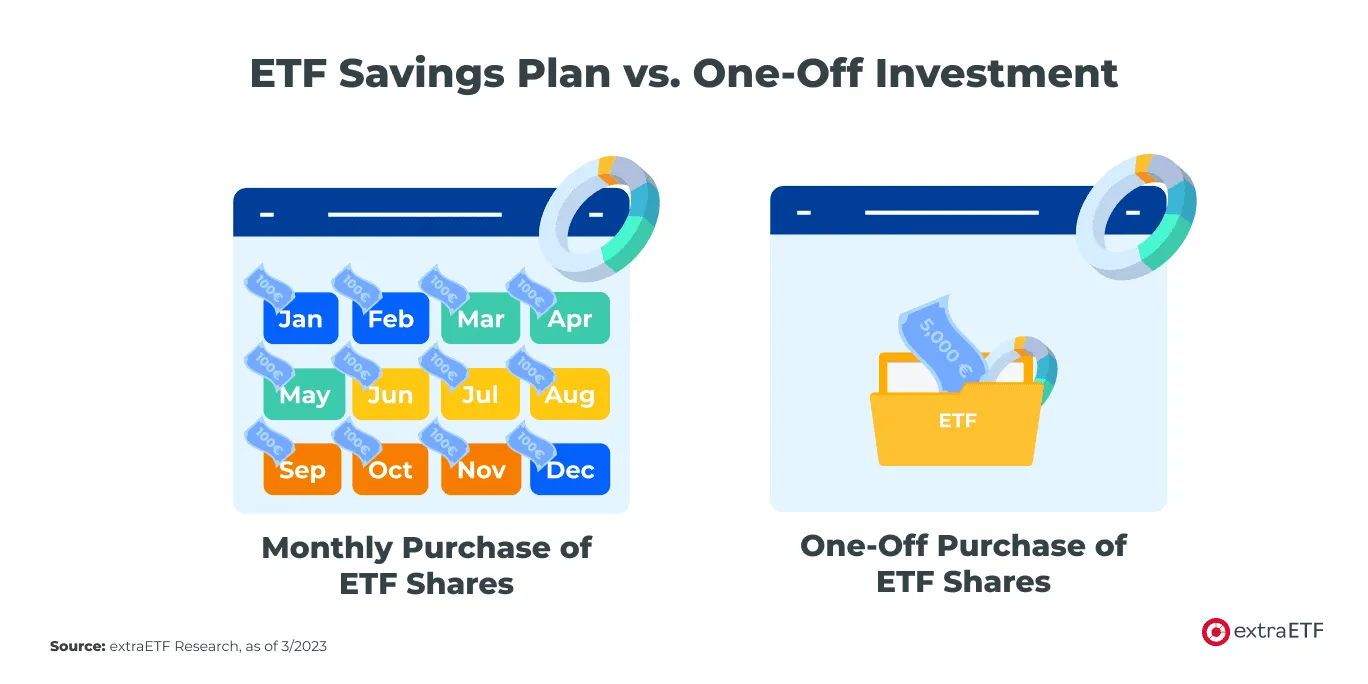
Both options offer a flexible and cost-effective way to invest, with the potential to benefit from long-term returns. However, there are risks to be aware of, such as the timing of your investment and market fluctuations. Careful planning of your contributions, along with sufficiently broad global diversification, can help minimise the risks associated with ETFs and support a successful long-term investment strategy.
We’ve summarised the pros and cons of both options:
| Regular ETF Investment Plan | Lump-Sum Investment in ETFs | |
|---|---|---|
| Advantages |
|
|
| Disadvantages |
|
|

Conclusion: Combining an Regular ETF Investing with a lump-sum investment
The ideal approach may be to combine a regular ETF investment plan with a lump-sum investment. This way, you benefit from the cost-averaging effect through regular investing and, with the lump sum, typically make more of the power of compounding. Whichever option you choose, assess your investor profile and define your investment strategy carefully before investing a lump sum in ETFs or setting up a regular plan. And if you invest in globally diversified equity ETFs over the long term, the same principle applies to both approaches: the longer your investment horizon, the lower the risk of loss and the greater the effect of returns on your wealth.
You can find the best offers in our regular ETF investment plan comparison.
For more information on investing with ETFs, visit our knowledge section.

- A Summary of Options for Saving Through ETFs
- How does a regular ETF investment plan work?
- What does "lump-sum investment" mean in the context of ETFs?
- Regular ETF Investment Plan or Lump Sum: Which Is Better?
- One-Time ETF Investment vs. Investment Plan: Pros and Cons of These Investment Options at a Glance
- Combining an Regular ETF Investing with a lump-sum investment