Stocks Explained
What is a stock? How can you invest in it?

Stocks are a key part of the modern financial system, allowing investors to take an ownership stake in a company and share in its success. A stock represents a share of a company’s equity and is traded as one of many securities. Trading takes place on stock exchanges or over the counter and is subject to a range of regulations and laws.
Stocks are a popular investment, offering the chance to benefit from long-term price growth and dividend payments. However, they also carry risks: prices can fluctuate and investors may lose money. It is therefore important to research your options thoroughly and weigh up the risks before you invest.
This guide explains the key facts about stocks and what investors should know before buying them.

The essentials in brief: Everything You Need to Know About Stocks
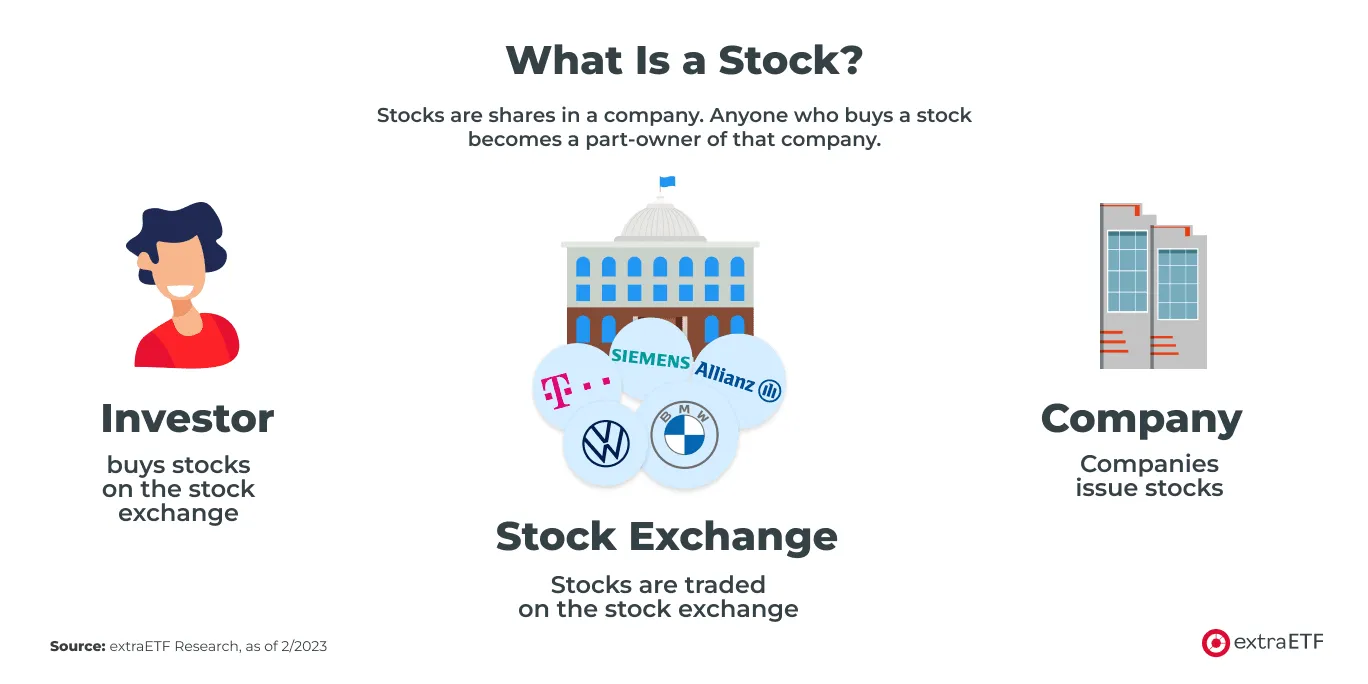
Definition: Stocks are shares in a company, which means shareholders collectively own the business. There are different types of stocks.
Company Value: The nominal value is purely a formality. What matters is a company’s stock market value, known as market capitalisation, which is a measure of its size.
Investments: Stocks are usually traded on a stock exchange, and their prices can fluctuate significantly in the short term. By buying stocks, investors hope to profit from price gains and a share of the company’s profits – the dividend.
Voting Rights: Shareholders have the right to take part in decision-making. At the annual general meeting, the company updates its shareholders, who can help shape its future direction.

Find and compare thousands of ETFs. Use powerful filters, detailed analytics, and independent data to discover the right ETF for your portfolio.
What are stocks?
Stocks are shares in a company. By purchasing a stock, investors become co-owners of the company and can have a say in its strategic direction. Each buyer acquires a fraction of the company’s share capital. The value attached to that fraction in the company’s accounts is known as the nominal value (or par value). The nominal value should not be confused with the market value. The market value is the current share price – that is, the price at which the share can be bought and sold on the stock exchange. The nominal value, on the other hand, is based on the share capital and the number of shares issued (exception: no-par shares). In practice, the market price of a share is what matters; the nominal value is a formality governed by the Companies Act 2006.
How is a company's market capitalisation calculated?
Investors generally focus on the share price. Multiplying the current share price by the number of shares in issue gives a company’s market value, known as market capitalisation. This figure allows comparisons between companies and indicates how the market values the business as a whole. Because the share price fluctuates constantly, market capitalisation changes continuously. It does not appear in a company’s balance sheet, however, which reports the share capital. Dividing the share capital by the number of shares in issue gives the nominal value of a share.
What is the difference between nominal value, share price and market capitalisation?
To calculate market capitalisation, you need the number of shares in issue and the current market price. Listed companies publish the number of shares they have issued in their annual reports.
A worked example illustrates the differences: Suppose a share is trading on the stock exchange at £35 and the company reports share capital of £1,000,000 on its balance sheet. The nominal value is £1, so there are 1,000,000 shares. In this case, the company’s market capitalisation is £35 million.
Formulas:
Number of shares = Share capital ÷ Nominal value
Market capitalisation = Number of shares × Market price per share
Join the extraETF community

Explore the world of ETFs and make informed investment decisions.
- Find ETFs that match your criteria with our ETF Search.
- Compare costs, performance, and risk side by side.
- Save your favourites to a watchlist and receive price alerts.
- Explore detailed ETF profiles with key metrics and holdings.
What are no-par shares?
Besides shares with a nominal value, some companies issue shares without one, known as no-par shares. Each represents a notional proportion of the company’s share capital. No-par shares are common in some other countries, which is why some companies opt for this type. Whether a share has a nominal value or not has no impact on its value. Investors can therefore safely ignore this distinction.
What is the difference between bearer shares and registered shares?
A company can decide whether to issue bearer shares or registered shares. For investors, this is purely a matter of form and makes no practical difference. Bearer shares are no longer permitted for UK companies, but they still exist elsewhere.
With registered shares, the owners are entered by name and address in the company’s share register. This allows the company to contact its shareholders directly. With bearer shares, this is much harder. However, investors generally receive important information through their broker anyway.
Why do some companies issue both ordinary and preferred shares?
A company may issue preferred shares in addition to ordinary shares. Preferred shares generally do not carry voting rights at the annual general meeting. To compensate, they typically pay a higher dividend than ordinary shares, which results in a higher dividend yield.
What is an IPO, and what happens during an initial public offering?
When a company is formed, its founders receive the shares. These shares are not initially traded on the stock exchange, but any investor can buy them once the company applies for a listing. The listing process is called an initial public offering (IPO). It is generally complex and often takes several months before the shares begin trading. During an IPO, new shares are issued and the proceeds go directly to the company. Whether the share price rises or falls after the IPO has no impact on the company’s finances, because the buyer pays the purchase price to the seller. In plain language: the company is not involved.
Who determines the value of a stock?
In short: investors. When many investors want to buy a company’s shares, the price rises because demand exceeds supply. Conversely, if many investors sell but only a few want to buy, the price falls. Prices are therefore driven by supply and demand: when many investors buy, prices rise – and vice versa.

The value of a stock is determined by supply and demand
 Markus Jordan, Founder of extraETF.com
What factors influence a stock's price?
Whether supply or demand for a stock rises or falls depends on various factors. The most important is investors’ assessment of the company’s future prospects. However, the share price can also be influenced by current news, rumours, earnings, expected dividend payments, the position of competitors, analysts’ buy recommendations, and the outlook for the industry and the wider economy.
How do you buy stocks?
Stocks are traded on stock exchanges. In the UK, the London Stock Exchange is the most important trading venue, with the largest trading volumes. There are also smaller trading venues, such as Cboe UK and Aquis.
To buy stocks on the stock exchange, you need an investment account and the necessary capital. You can find affordable investment account providers in our broker comparison service. Once you have both, you can place a buy order. At a minimum, you must specify how many shares you want to buy and how long the order should remain valid. You can also set a limit, which is the maximum price you are willing to pay as a buyer or the minimum price you want to receive as a seller.
What are dividends?
Dividends are to stocks what interest is to bonds: a return on invested capital. Dividends allow the company’s owners, the shareholders, to share in the company’s success. However, the amount of the dividend is not fixed, so it is not a guaranteed payment. Some companies, especially young, fast-growing ones, pay no dividends at all and prefer to reinvest their profits in growth. Others distribute part or all of their annual profits to shareholders.
When do you need to buy a stock to receive the dividend?
UK companies typically pay dividends twice a year, as an interim and a final dividend. Some companies pay quarterly, as is common with US stocks. To receive the dividend, you do not need to hold the share all year; you only need to own it before the ex-dividend date.
Interim dividends are decided by the board of directors. For the final dividend, the board makes a proposal, which shareholders usually approve at the annual general meeting (AGM). The dividend is then typically paid a few weeks after the ex-dividend date.
The dividend yield shows a company's annual dividend as a percentage of its stock price.
Did you know? Shareholders' Right to Participate in Decision-Making
Shareholders have a say in important decisions. Once a year, they meet at the annual general meeting and vote on resolutions. For example, they decide how profits are used – that is, whether the year’s net income is reinvested entirely in the company or partly paid out to shareholders as dividends.
What strategies are worthwhile when investing in stocks?
There are a number of different investment strategies. Individual strategies often perform very well over the course of several years but then lose ground to other strategies. Investors should first and foremost decide which strategy best aligns with their personal goals and market expectations.
For example, those looking to generate a regular income can use a dividend strategy. Other well-known strategies include value and growth investing. You can find more on this topic in our guide to investment strategies with ETFs.
What return opportunities do investors have with stocks?
Anyone who owns stocks has two potential sources of return: capital gains and dividends. First, the value of your investment increases when the share price rises. Second, if the company is profitable and distributes profits to its shareholders, investors receive a share of them.
What are the risks associated with investing in a stock?
There is a general market risk and an individual stock risk. General market risk affects more or less all stock investors when prices across the entire stock market plummet. This can be caused, for example, by an economic crisis or a natural disaster. In such cases, the effects often come unexpectedly and hit the entire market.
The situation is different with individual stock risk: A single stock can lose a significant amount of value against the general market trend, for example because management has made poor decisions. The greatest risk for investors is total loss. If a company becomes insolvent, its shares can become worthless. To reduce the risk associated with a single stock, investors can buy multiple stocks or ETFs, spreading the risk as widely as possible.
Investing in stocks involves various risks. The most important are:
- Economic risk and instability
- Company-specific risk (e.g. management errors)
- Price risk
- Risk of reduced or cancelled dividends
- Insolvency risk
- Liquidity risk
- Inflation risk
- Regulatory changes (e.g. tax changes)
- Political decisions (e.g. phase-out of coal)
- Currency risk (e.g. for overseas stocks)
Why are equity ETFs a good choice?
Stock ETFs are an easier alternative to buying individual stocks and taking on many individual risks. They track an index made up of a set number of stocks, which spreads risk broadly. This saves investors time and money, as ETFs are traded on the stock exchange just like stocks and have very low costs.
The returns and performance of ETFs also speak in their favour: academic studies and performance comparisons show that, in the vast majority of cases, even professional fund managers do not achieve higher long-term returns than ETF investors.

Conclusion: Stocks: A Lucrative Way to Build Wealth
Investing in stocks is an attractive way to benefit from long-term price growth and receive dividends. Investors acquire a stake in a company’s equity, usually in the form of shares traded on a stock exchange.
However, investing in stocks also involves risk: prices can fluctuate and investors may lose money. To reduce this risk, research any investment thoroughly and weigh up the potential downsides before you invest. Diversifying – spreading your money across multiple companies and sectors – can also help. Stock ETFs offer a simple, low-cost way to do this.
Overall, investing in stocks can be a lucrative way to grow your wealth, but it requires a certain level of knowledge and experience. Thorough research, a personalised investment strategy and a long-term perspective are therefore essential.
Use the extraETF stock search to find suitable stocks for your portfolio.
Important Questions About Stocks

- Everything You Need to Know About Stocks
- What are stocks?
- How is a company's market capitalisation calculated?
- What is an IPO, and what happens during an initial public offering?
- How do you buy stocks?
- What are dividends?
- Shareholders' Right to Participate in Decision-Making
- What strategies are worthwhile when investing in stocks?
- What return opportunities do investors have with stocks?
- What are the risks associated with investing in a stock?
- Why are equity ETFs a good choice?
- Stocks: A Lucrative Way to Build Wealth
- Important Questions About Stocks