What are bonds?
How can I invest in bonds?

When it comes to investing, most people think of shares first. However, bonds are another popular option that can offer stable returns and lower volatility than shares. Bonds are debt securities issued by companies or governments that pay the holder a fixed rate of interest and repay the principal at a set date. In this respect, bonds are a more conservative investment than shares. But not all bonds are the same.
In this guide, we explain how bonds differ from shares and other securities in a number of important ways.

The essentials in brief: Everything You Need to Know About Bonds
Definition: An investor lends money to a borrower and receives interest in return. The principal is repaid at the end of the term.
Types of bond: Corporate bonds are issued by companies, while government bonds (known as gilts in the UK) are issued by the government.
Price risk: Bond prices fall when interest rates rise, and vice versa. In short: when market interest rates rise, investors sell existing bonds to buy newer ones with higher yields.
Yield: The interest rate is not the same as the yield. When a bond’s price rises or falls, its yield changes too.
Credit risk: The biggest risk with bonds is that the issuer is unable to pay. Rating agencies assign credit ratings: AAA is the highest rating, and D indicates default.

Find and compare thousands of ETFs. Use powerful filters, detailed analytics, and independent data to discover the right ETF for your portfolio.
Definition: What exactly are bonds?
A bond is, at heart, a loan. A debtor borrows money, and when that debt is packaged as a tradable security, it is called a bond. The cost of borrowing is interest, so debtors pay interest for as long as the loan runs. At the end of the agreed term, the borrowed amount is repaid and the bond matures.
Government bonds are issued by governments and are the most significant type. Corporate bonds are issued by companies. Other common terms for bonds include debt securities, fixed-income securities and interest-bearing securities.
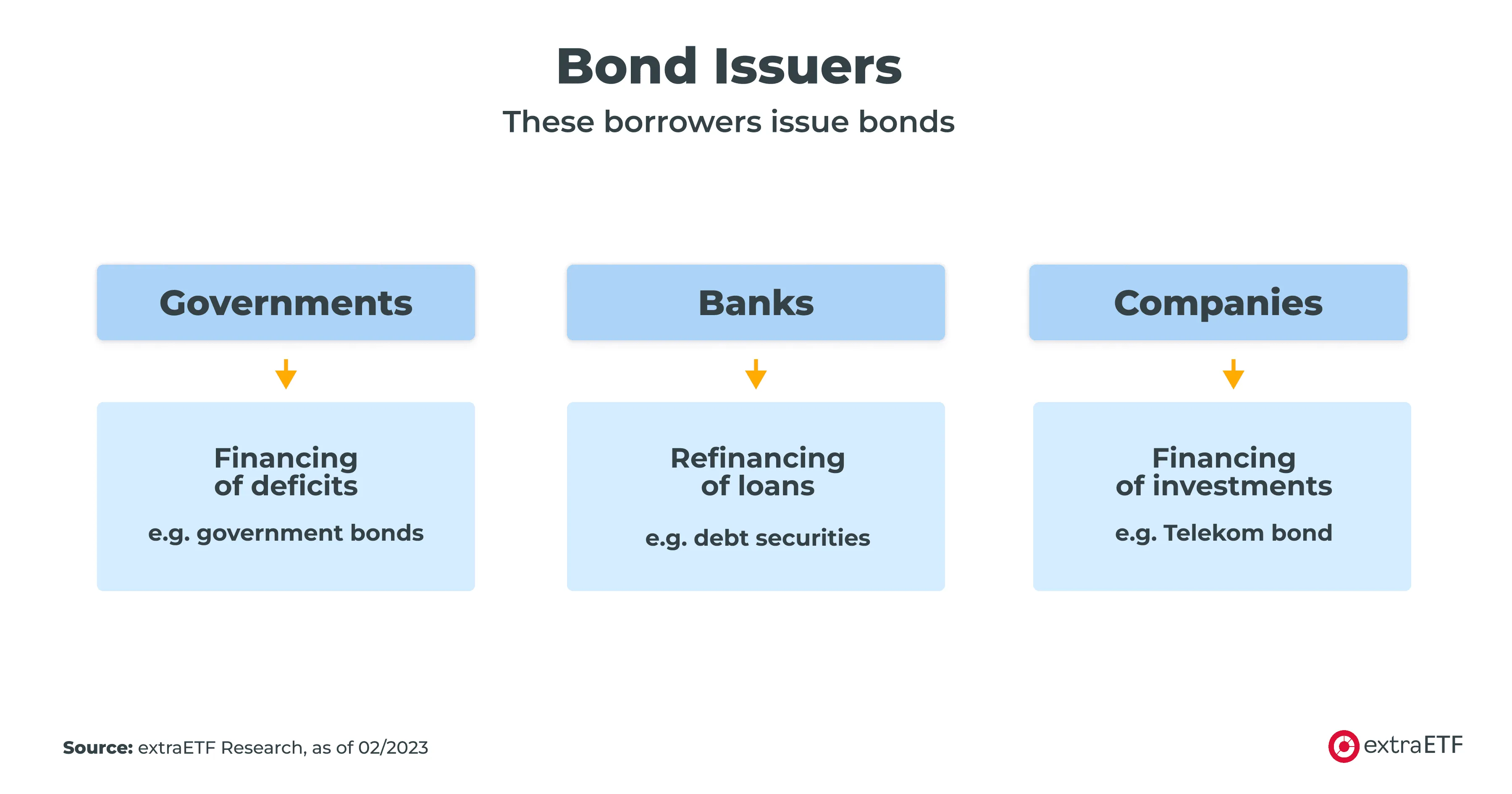
The debtor is also called the issuer, because they issue the bond. Buyers of the bond are creditors, and the amount owed is the face value, or nominal amount. The term “creditworthiness” – a debtor’s ability to pay – is also common in the bond market. Credit rating agencies assess creditworthiness.
Key Terms Related to Bonds Explained
| Term | Definition |
|---|---|
| Face Value | Bonds are not traded in units like shares, but by reference to their face value. The face value is set out in the bond’s terms of issue, for example £100. Some bonds, however, have a face value of £100,000, which is often the case with corporate bonds. |
| Issuance | The sale of new bonds is known as an issue or new issue. Investment banks typically manage the process and ensure that the issuer can place the entire issue. |
| Issuer | The issuer of a bond is also known as the debtor. Issuers can be governments, companies or financial institutions. |
| Coupon | A bond’s coupon sets the interest paid to bondholders. The coupon rate depends on the bond’s maturity, the issuer’s creditworthiness and the general level of interest rates. The coupon rate is not the same as the bond’s yield. |
| Yield | The yield is the bond’s effective rate of return and takes the purchase price into account. It is therefore the actual return an investor earns if they hold the bond until maturity. |
| Market Value | The market value is the bond’s current value. It is calculated by multiplying the current market price (quoted as a percentage) by the face value (example: £1,000 × 99% = £990). |
| Term | Bonds are issued for a fixed period. At the end of the term, the bond is redeemed at face value. Bonds are often described as short-, medium- or long-term. Short-term bonds have a maturity of up to three years, medium-term bonds three to seven years, and long-term bonds seven years or more. |
| Redemption Price | The redemption price at the end of a bond’s term is typically 100%. This means that a bond with a face value of £10,000 is redeemed for £10,000 at maturity. |
| Credit Rating | A credit rating reflects the financial standing of a bond’s issuer. Issuers with poor creditworthiness must pay higher interest than those with good creditworthiness. The rating also helps investors estimate the likelihood that the bond will be repaid at maturity. |
| Corporate Bond | Bonds issued by companies are known as corporate bonds. |
Join the extraETF community

Explore the world of ETFs and make informed investment decisions.
- Find ETFs that match your criteria with our ETF Search.
- Compare costs, performance, and risk side by side.
- Save your favourites to a watchlist and receive price alerts.
- Explore detailed ETF profiles with key metrics and holdings.
What types of bonds are there?
Typically, bonds have a fixed face value, a constant interest payment and a fixed term. However, there are other types too:
How do you buy bonds?
Unlike shares, bonds are quoted as a percentage of their face value rather than in units, so the face value is what matters when you buy. If a bond is trading at 101 per cent, buying £10,000 of face value costs a total of £10,100.
Face value × Price / 100
Example: (£10,000 × 101) / 100 = £10,100
Bank or broker fees and any accrued interest may be added to this amount.
If you buy at issue, no accrued interest is due. If the bond has already been on the market for several weeks or months, however, the buyer must pay the seller the interest accrued for that period. This is shown separately on the contract note. The calculation uses the standard interest formula:
Face value × coupon rate (%) × (number of days / 360) ÷ 100
Example: (£1,000 × 3 × 90) ÷ 360 ÷ 100 = £7.50
Interest payments and the repayment of the face value at the end of the term are made automatically, and the money is paid into your account without any action on your part.
Where are bonds traded?
Buying bonds is relatively simple. Banks and online brokers typically offer bonds for sale, and many bonds are also listed on a stock exchange. Unlike shares, however, bonds are often illiquid, meaning that only a few change hands on the exchange. In addition, corporate bonds are often issued with high minimum denominations of £50,000 or £100,000, which puts them out of reach for investors with smaller sums to invest.
Bond ETFs can therefore be an alternative to buying individual bonds directly.
What is the difference between interest and return?
The interest rate – also known as the nominal interest rate, coupon, or simply interest – is set at the time of issuance and, for a standard bond, remains unchanged throughout its term. The yield is different: it shows the investor’s return as a percentage.
Bond prices fluctuate, meaning they can be above or below 100 per cent. For example, if a bond with a one-year term and an interest rate of 3 per cent is purchased at a price of 101 per cent, the investor receives £3 in interest after one year plus the face value of £100, a total of £103. However, since the investor paid £101 at purchase, they have earned only £2. Roughly speaking, the yield in this case is 2 per cent. Our yield calculator provides exact figures.
Why do bond prices fluctuate?
Simply put, bond prices move with supply and demand. Demand depends on several factors, the most important of which is the level of interest rates. If market interest rates suddenly rise, investors try to buy new bonds with higher interest rates and sell bonds with lower coupons. The prices of lower-yielding bonds fall because they are less attractive than higher-yielding securities. Prices can also move for other reasons, such as when investors fear that an issuer is running into financial difficulties and may not be able to repay the bond.

Bonds bring stability to a portfolio
 Markus Jordan, Founder of extraETF
What are the risks associated with bonds?
Bonds are generally considered relatively safe. However, there are several risks you should be aware of.
What return potential do bonds offer?
Bonds pay a coupon that provides a regular return over the term. In addition, investors can benefit from potential capital gains if they sell their securities during the term. However, this opportunity exists only if interest rates fall during the term. Conversely, rising interest rates pose a risk of losses. Foreign-currency bonds offer an additional opportunity for returns. If the foreign currency appreciates against sterling during the term, the interest payments are worth more in pounds, and so is the redemption amount.
What are the advantages and disadvantages of bonds?
The overview below compares the advantages and disadvantages of bonds.

Advantages of Bonds
- Stable income: Bonds can be a stable source of income because they typically provide regular interest payments. This can be particularly attractive to conservative investors seeking a steady income, and to retirees.
- Capital preservation: Bonds generally have a fixed maturity date and a face value, which is repaid when the bond matures. This gives investors a degree of security and helps preserve their capital – provided, of course, that the issuer remains solvent.
- Diversification: Bonds can help investors increase the diversification of their portfolios. By investing in bonds from a wide range of industries, issuers and maturities, they can spread their risk further and improve their portfolio’s overall performance.
- Predictable returns: Bonds generally offer predictable interest payments, which depend on interest rates and maturities. This lets investors forecast future returns more reliably and makes financial planning easier.

Disadvantages of Bonds
- Lower returns: Bonds generally offer lower returns than riskier asset classes, such as shares, so investors’ capital may grow more slowly.
- Interest rate risk: Bond prices are sensitive to changes in interest rates. If rates rise, older bonds with lower coupons usually become less attractive, which can lead to price losses.
- Credit risk: The issuer may be unable to make the agreed interest payments or repay the principal. This risk is particularly high with lower-rated bonds.
- Liquidity risk: Bonds can be hard to sell in illiquid markets. If investors need to sell before maturity and cannot find buyers, or are forced to accept lower prices, this can quickly cause problems.
Why Should Investors Buy Bond ETFs?
A bond ETF holds a wide variety of bonds, which spreads risk broadly. ETFs allow investors to hold bonds with different maturities, from different regions, and so on, all in a single investment. In addition, ETFs are very cost-effective and can provide access to bond types that are not offered by all banks or online brokers. Accumulating bond ETFs also reinvest interest income automatically at no extra cost, so it’s worth choosing an accumulating ETF. You can find bond ETFs, with all the relevant information, in our ETF search tool, where you can quickly filter by criteria such as region, maturity, currency and rating.

Conclusion: Bonds are a good addition to a portfolio
Bonds are a popular asset class with a number of advantages. They typically provide stable, predictable returns through regular interest payments, which is particularly valuable when you need a reliable source of income. Bonds can also be an important component of a diversified portfolio and improve its asset allocation, as they tend to be less volatile than shares.
Before investing, however, it’s important to understand exactly which bonds you are buying, as different bonds carry different risks and returns.
extraETF has selected bond ETFs for specific bond markets.
Important Questions About Bonds

- Everything You Need to Know About Bonds
- Definition: What exactly are bonds?
- Key Terms Related to Bonds Explained
- What types of bonds are there?
- How do you buy bonds?
- Where are bonds traded?
- What is the difference between interest and return?
- Why do bond prices fluctuate?
- What are the risks associated with bonds?
- What return potential do bonds offer?
- What are the advantages and disadvantages of bonds?
- Why Should Investors Buy Bond ETFs?
- Bonds are a good addition to a portfolio
- Important Questions About Bonds