Asset Allocation
Allocate Assets by Asset Class

Optimal asset allocation – that is, sensibly distributing your money across different asset classes and assets – can increase returns and reduce portfolio risk over the long term. The key is balanced diversification.
But what role do ETFs and different asset classes play in such a portfolio? And how can investors find the asset allocation that best suits their investment strategy and risk tolerance?
This guide answers these questions and more. It is aimed at retail investors who want to reach their investment goals or build wealth over the long term while keeping risk under control.

The essentials in brief: Everything You Need to Know About Asset Allocation at a Glance
Definition: Asset allocation is how a portfolio is divided between different assets and asset classes. Its aim is to reduce risk and improve the potential for returns.
Asset Classes: Different asset classes add diversification to a portfolio. Investors can, for example, use ETFs to invest broadly in asset classes such as stocks, bonds or real estate.
Strategies: Several investment strategies can guide your asset allocation. Popular options include strategic, dynamic and tactical asset allocation, as well as the core-satellite strategy.

Find and compare thousands of ETFs. Use powerful filters, detailed analytics, and independent data to discover the right ETF for your portfolio.
Definition: Asset Allocation Explained Simply
Asset allocation is the term for how a portfolio is distributed across various assets and asset classes. Its goal is to spread risk broadly through diversification while still allowing for strong returns.
ETFs offer a particularly simple, cost-effective and convenient way to achieve broad diversification, as they allow investors to hold hundreds or even thousands of securities – even with small amounts. Possible additions to such an asset allocation include government bonds or commodities via ETCs.
Join the extraETF community

Explore the world of ETFs and make informed investment decisions.
- Find ETFs that match your criteria with our ETF Search.
- Compare costs, performance, and risk side by side.
- Save your favourites to a watchlist and receive price alerts.
- Explore detailed ETF profiles with key metrics and holdings.
What are the different asset classes?
The main asset classes are:
- Stocks: Company shares
- Bonds: e.g., corporate bonds, government bonds
- Real estate: e.g., property shares
- Money market: e.g., easy-access savings
- Commodities: e.g., precious metals, energy commodities, industrial metals
- Alternative investments: e.g., private equity (often via ELTIFs), hedge funds
Other asset classes include cryptocurrencies, art and peer-to-peer (P2P) loans.
But be careful: Each asset class has its own characteristics and risks, which investors should research thoroughly before investing.
You can reduce some of the risks of individual asset classes through sufficiently broad diversification and a long investment horizon, for instance by deliberately keeping the proportion of higher-risk asset classes low.
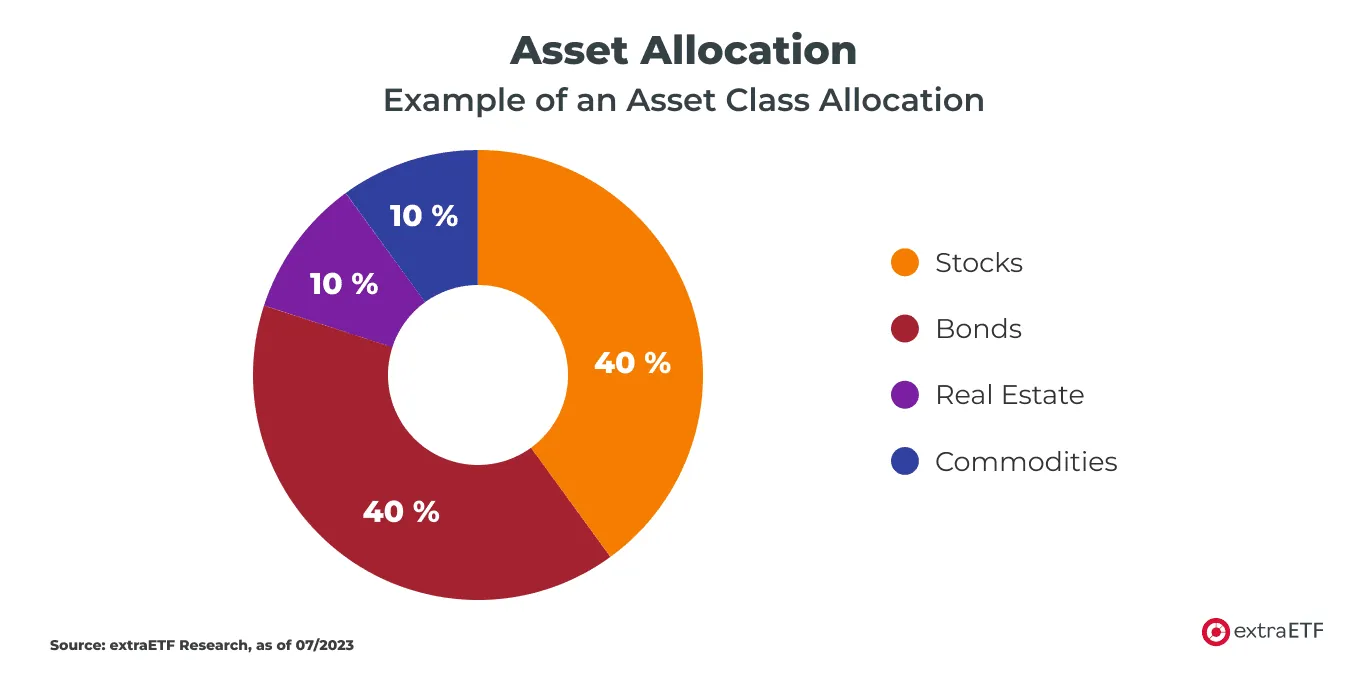
The following chart shows an example asset allocation, with several asset classes and their weightings in the portfolio:
What should you keep in mind when it comes to asset allocation?
A good asset allocation balances the following criteria:
Your asset allocation should reflect your financial situation, risk tolerance and investment goals. With sufficient diversification and a long-term investment horizon, this approach can also help individual investors pursue attractive returns without taking on excessive risk.
Before investing, it is essential to have an emergency fund of at least three months’ net salary as a safety net. Building on this foundation, investors can develop an asset allocation for their portfolio, planning it carefully and researching thoroughly before they invest.
What strategies are there for asset allocation?
Asset allocation strategies are based on investment objectives, risk tolerance, time horizon or diversification. The following are particularly common:
We'll now take a closer look at these investment strategies.
Strategic Asset Allocation
Strategic asset allocation aims to create a balanced mix of assets and asset classes – such as stocks or bonds – that offers an optimal balance between expected risk and return over a long-term investment horizon. This strategy is generally independent of economic cycles, so the weighting of investments stays the same even as economic or market conditions change.
Dynamic Asset Allocation
As with strategic asset allocation, dynamic portfolios are built from a mix of assets and asset classes that balances expected risk and expected return for a long-term investment strategy. They also largely maintain the risk profile of their original asset classes.
Unlike strategic asset allocation, however, the positions or weightings in dynamic portfolios are adjusted over time to adapt to changes in the economy or the markets. For investors, this usually means spending more time monitoring the market, trying to optimise returns and reacting to short-term trends, which can significantly increase risk – for example, compared with a buy-and-hold strategy.
Tactical Asset Allocation
Tactical asset allocation is a more active strategy in which positions and weightings are adjusted temporarily to capitalise on short-term market opportunities and aim for higher returns over short periods. As well as time to monitor the market, investors need specialised knowledge to interpret market indicators or carry out technical analysis.
Although this approach can improve the chances of outperforming the market, it also significantly increases risk.
Core-Satellite Strategy
A core-satellite strategy divides a portfolio into a core and several satellites. The core provides stability, while the satellites aim to generate higher returns.
The core-satellite strategy is a hybrid of the three strategies above: the core serves as the strategic component, while the satellites are dynamic or tactical holdings. It is therefore a flexible, customised approach that can offer broad diversification and the potential for higher returns, but it also carries higher risk and may require more active management.

Asset allocation can diversify the portfolio
 Martin Vogt, Education & Content Manager
How does rebalancing work in asset allocation?
Rebalancing an asset allocation is intended to restore the portfolio’s originally chosen breakdown and its original risk-return profile. This allows the varying performance of assets and asset classes to be brought back into balance over time. Rebalancing essentially involves buying or selling assets until the original weightings are restored. However, rebalancing can incur additional costs and may also trigger Capital Gains Tax on realised gains if the investments are held outside a tax wrapper such as an ISA or SIPP.
Rebalancing should fit your chosen investment strategy, risk tolerance and investment goals. For long-term investing in particular, it is usually carried out at regular intervals, such as once a year, if needed. You can also use rebalancing to add further assets or asset classes to the allocation if appropriate.
Here’s an example: An investor with money to invest decides on an asset allocation of 80 per cent stocks and 20 per cent real estate before they begin investing. They implement this cost-effectively using globally diversified ETFs. A year later, a severe real estate crisis strikes and the real estate allocation shrinks to 5 per cent because of the fall in value. To restore the original allocation, the investor rebalances by selling enough stocks and using the proceeds to buy real estate investments.

Conclusion: What is the optimal asset allocation?
There is no single “optimal” asset allocation, since the right mix of assets and asset classes varies from investor to investor. An allocation is ideal when it best suits the investor’s financial situation, risk tolerance, goals, investment horizon and strategy.
Asset allocation is no guarantee of profits or good returns, but it is a valuable tool for diversification and risk management.
Retail investors, like professionals, should consider their asset allocation carefully before investing.
Above all, successful investing depends on putting your asset allocation into practice with suitable assets and asset classes.
We'll answer any other questions you may have about asset allocation

- Everything You Need to Know About Asset Allocation at a Glance
- Definition: Asset Allocation Explained Simply
- What are the different asset classes?
- What should you keep in mind when it comes to asset allocation?
- What strategies are there for asset allocation?
- How does rebalancing work in asset allocation?
- What is the optimal asset allocation?
- We'll answer any other questions you may have about asset allocation