Core-Satellite Strategy: Boosting Your Portfolio Returns
A complement to your buy-and-hold portfolio

Building a portfolio – or searching for investment strategies using ETFs – always comes down to risk and return. Most investors want the perfect balance of safety and returns. But that’s surely impossible, or at least very difficult – isn’t it?
What if one approach combined the best of both worlds: the stability of large, proven investments and the growth potential of carefully selected ones? The core-satellite strategy promises exactly that. Let’s see whether it lives up to the promise and what you need to bear in mind.
This article shows you how to build a solid investment core that keeps your portfolio stable, while using targeted, higher-risk investments (satellites) to pursue additional returns.

The essentials in brief: Everything You Need to Know About the Core-Satellite Strategy at a Glance
Explanation: The core-satellite strategy divides your portfolio into two groups: the core and satellites. The core provides stability, while the satellites offer the potential for higher returns.
Allocation: An 80/20 split is often recommended: 80% of your assets go into the core and 20% into the satellites. Other allocations are also possible.
Diversification: The core already lays the foundation for a broadly diversified portfolio. Where possible, satellites should differ from the core to spread risk further.
Flexibility: Use the satellites to respond quickly to market changes, and adjust them at any time to suit your risk appetite, return expectations and investment horizon.

Find and compare thousands of ETFs. Use powerful filters, detailed analytics, and independent data to discover the right ETF for your portfolio.
How does the core-satellite strategy work?
The core-satellite strategy is an investment approach with two main components: the core and the satellites. The goal is to build a stable foundation with low-risk core investments, then boost returns with a selection of riskier ones. The core can also be seen as a typical buy-and-hold approach extended with satellites.
Core: The core is the largest, lowest-risk and most stable part of the portfolio. It typically consists of broadly diversified, low-cost investments such as index funds or ETFs (exchange-traded funds) that track many markets. For example, a global equity ETF could serve as your core, giving you broad exposure to the world’s stock markets. The core aims to generate consistent long-term returns and reduce risk through diversification. It typically accounts for between 60% and 80% of the total portfolio, depending on your risk tolerance and investment goals.
Satellites: Satellites make up the smaller, usually higher-risk part of the portfolio. They can hold a range of assets, from individual shares and bonds to sector, country or thematic ETFs, as well as alternatives such as property, commodities or even cryptocurrencies. They offer the chance of higher returns and let you benefit from specific market opportunities, but they generally carry more risk.
The chart below shows an example of what a core-satellite portfolio might look like and what it might include:
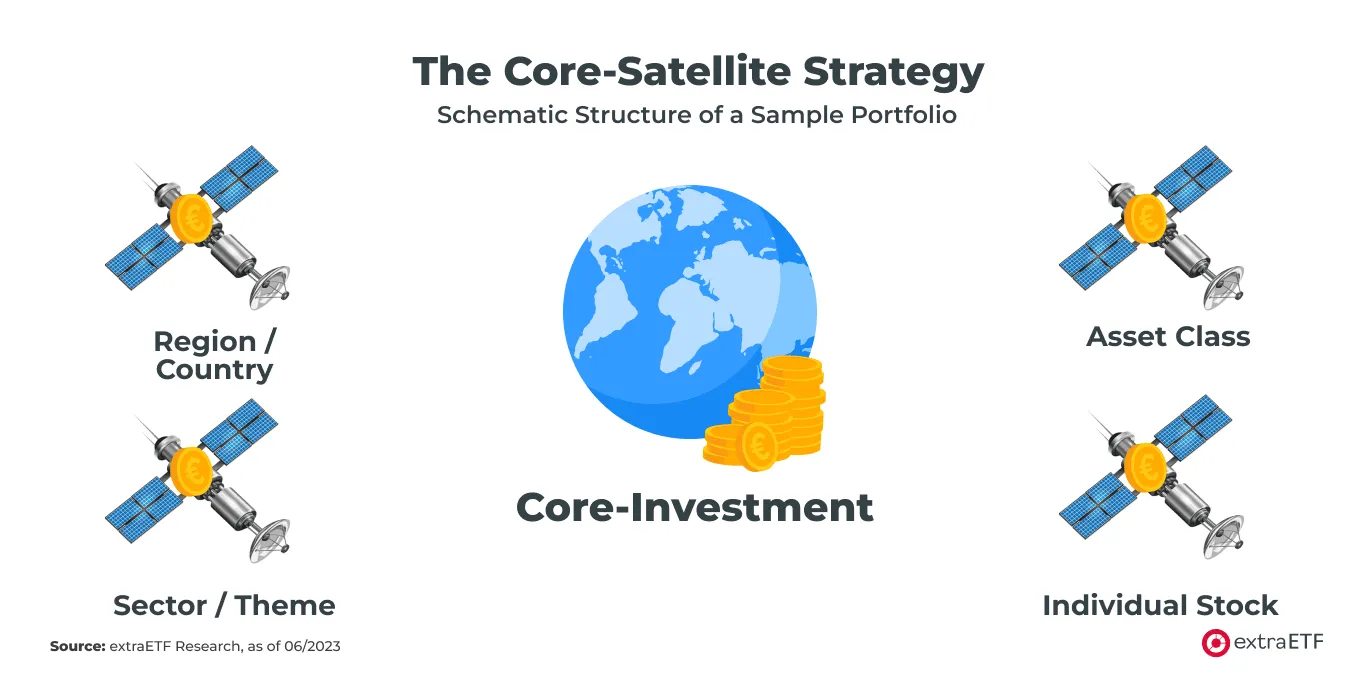
The core-satellite strategy therefore relies on a careful combination of core and satellites. The core aims to deliver steadier, more predictable returns, while the satellites let you pursue higher-risk, higher-reward opportunities or trends.

How do I apply the core-satellite strategy correctly?
The core-satellite strategy is a powerful portfolio management tool, but it can be tricky to implement well. These steps can help you apply it properly:
Define Your Investment Goals and Risk Tolerance: Before you start building your portfolio, you should clearly define your financial goals, investment horizon, and risk tolerance. These factors are crucial for determining the structure of your portfolio and selecting investments.
Determine the core of your portfolio: The core should make up the majority of your portfolio and serve as a stable foundation. Consider which index funds or ETFs best align with your investment goals. Globally diversified equity ETFs are a common choice.
Selecting Satellites: Once you’ve determined your core, you can select your satellites. Here, you can include more specialized or higher-risk investments that have the potential to generate higher returns. However, the actual selection of satellites depends heavily on your individual goals and risk tolerance. Also, be aware that satellites can reduce your overall return.
Review and Adjust: The core-satellite strategy requires regular monitoring and, if necessary, adjustment of the portfolio. Market developments can cause your portfolio to become unbalanced. By rebalancing, you can ensure that it continues to align with your investment goals. In addition, regularly reviewing your portfolio allows you to respond to changes in the markets.
Cost Management: Ideally, the core of your portfolio should consist of low-cost passive investments such as ETFs, while the satellites can tend to be more expensive. However, make sure that the potential returns from the satellites justify the additional costs and do not erode your returns.
Risk Management: Keep in mind that satellites usually pose a higher risk, even though they have the potential for higher returns. Make sure you can identify, understand, and manage the risk associated with each satellite and its impact on your overall portfolio.
Join the extraETF community

Explore the world of ETFs and make informed investment decisions.
- Find ETFs that match your criteria with our ETF Search.
- Compare costs, performance, and risk side by side.
- Save your favourites to a watchlist and receive price alerts.
- Explore detailed ETF profiles with key metrics and holdings.
How do I find the right cores and satellites for my ETF strategy?
Choosing the right core and satellite assets is key to the success of your strategy. So how do you decide? Since the core of your portfolio is the stable, diversified part, globally diversified stock indices are usually a good choice. ETFs that track an index such as the MSCI World or the FTSE All-World could serve as your core, giving you broad diversification across countries and sectors on their own. Also make sure your core carries no concentration risk and does not consist of investments that tend to move together. A mix of asset classes – such as shares, property and bonds – can spread your risk still further.
Once you’ve chosen a core, it’s time to select your satellites. These are meant to increase your portfolio’s return potential, letting you capitalise on market trends, though they involve more risk. For example, thematic ETFs or country ETFs can be good options for satellites. Individual shares or cryptocurrency exchange-traded notes (ETNs) can also work as satellites. Make sure your satellites differ from your core. For example, if your satellites include individual shares that are also held in your core, your portfolio may become too dependent on their performance. For the same reason, avoid concentrating your satellites on the same themes, countries or sectors as your core. This spreads your risk and lets you use other ETFs or investments to boost your potential returns.

Make sure your investments match your personal risk tolerance, especially your satellites. Higher potential returns usually mean higher risk, so the risk/return profile should suit you. For your core, choose investments with as little risk as possible, even if that means sacrificing some return. With satellites you can take a little more risk – but only as much as you can afford to lose.
Did you know? The idea of a core-satellite portfolio originated in the 1970s
During this period, US economists Fischer Black and Jack Treynor further developed the efficient-market hypothesis, originally proposed by Eugene Fama. The hypothesis holds that investors cannot achieve excess returns in the long run, because share prices already reflect all available market information, so no information advantage can lead to higher returns.
Black and Treynor, however, were convinced that certain shares in niche markets, or complementary investments, could indeed generate excess returns. They therefore advocated combining a core investment with satellite investments to capture those opportunities.
What mistakes should be avoided when using the core-satellite strategy?
The core-satellite strategy isn’t really for beginners, but even experienced investors can make mistakes. Here are the typical mistakes that crop up with this strategy, and what to watch out for.
- Don’t let greed get the better of you. Think carefully before making investment decisions. Reacting too quickly to a sudden surge in a share’s price can turn out to be a bad investment in hindsight. Always keep your risk tolerance in mind and put only a small portion of your assets, if any, into high-risk investments. That way, if something goes wrong, you won’t lose too much.
- Choose your investments wisely. Don’t invest in anything you don’t understand or feel uneasy about. Don’t blindly trust recommendations; check whether the investment actually suits you and your goals.
- It’s okay to experiment – but only with reasonable amounts. If an investment seems particularly lucrative but comes with very high risk, don’t rush in. Consider how much you could afford to lose if everything went wrong, and adjust your weighting if necessary. Boldness can bring high returns, but it can also cost you a significant amount.
- Don’t lose sight of the core. The core is the safety net of your portfolio, but that doesn’t mean it’s free from risk. Always monitor its performance and stick to your original weighting. Rebalancing restores the ratio between satellites and core, which can help reduce risk.
Here's what your core-satellite strategy could look like – an example
You can build a core-satellite strategy from ETFs, stocks, bonds and other asset classes. Ultimately, you decide which securities and assets to include.
Here’s an example. The chart below shows the portfolio of an investor who hopes to achieve excess returns by adding a Canada ETF and a battery ETF. This example is fictional and does not constitute investment advice, but it does illustrate how individual preferences and priorities can be reflected in a core-satellite strategy:
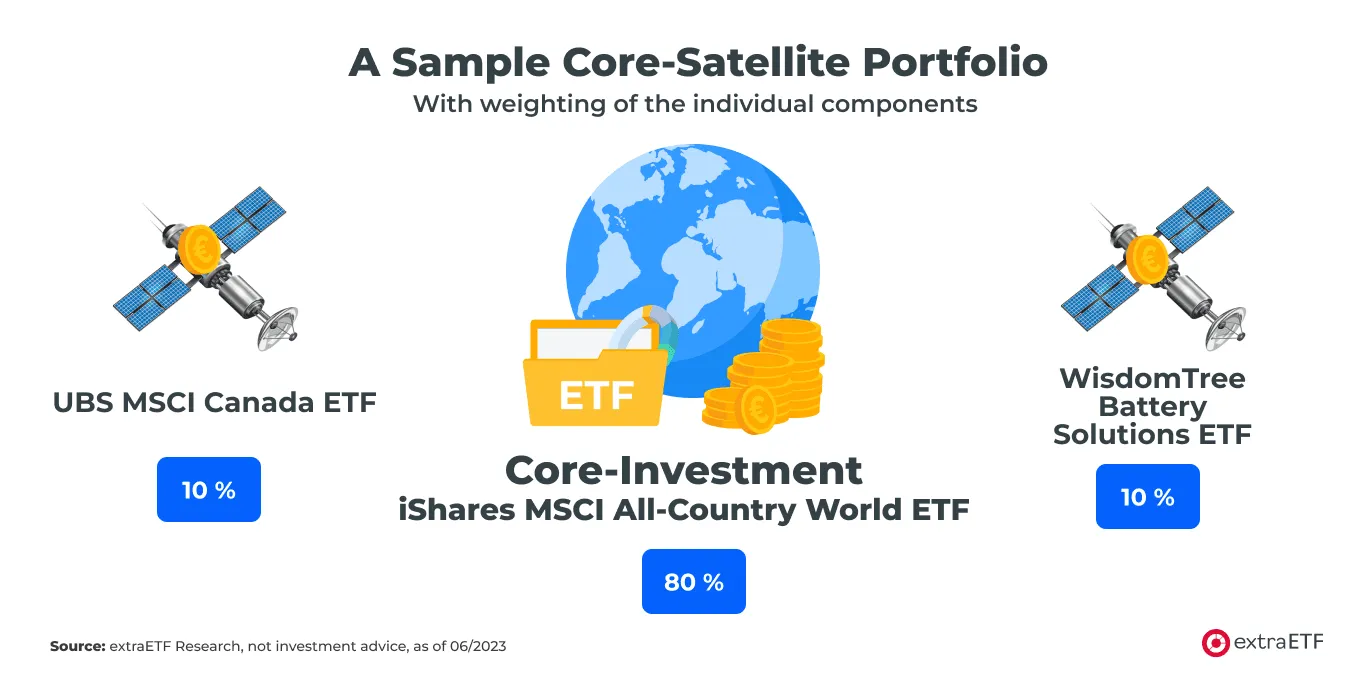
Above all, find your own investment strategy and build a portfolio that matches your risk tolerance and goals.
For the core, instead of an MSCI All-Country World ETF, you could choose two broadly diversified ETFs, such as the MSCI World and the MSCI Emerging Markets. You would still be invested in global stock markets, covering many developed and emerging markets in the proportions that suit you best. Weighting matters within the core too. A popular choice is to put more into the MSCI World ETF (for example, 70%) and less into the MSCI Emerging Markets ETF (for example, 30%), creating a solid long-term foundation.
There are several options for satellites. As in our example, you could select specific thematic or country ETFs. Or perhaps you have specialist knowledge and believe certain companies are undervalued and offer long-term potential. In that case, you can invest directly in their shares. However, individual shares carry very high risk, so be aware that the dream of beating the market could turn into a total loss. Even so, the core can still give your portfolio some stability, depending on how heavily the satellites are weighted.
Stick to the allocation of your core-satellite strategy. This applies not only to the overall weighting – for example, roughly 80% core and 20% satellites – but also to the split within the core and within the satellites. This keeps your portfolio stable and in line with your risk tolerance and investment goals.
An Overview of the Pros and Cons of the Core-Satellite Strategy
Like other ETF investment strategies, the core-satellite strategy has advantages and disadvantages. Let’s look at them in turn.

The Benefits of the Core-Satellite Strategy
- Diversification: The core of your portfolio typically consists of broadly diversified ETFs, giving you wide diversification.
- High return potential: The satellites can generate excess returns through more specialised or higher-risk investments.
- Stability and security: The core stabilises your portfolio and generally delivers a solid baseline return over the long term without excessive risk.
- Flexibility: The satellites can be easily adjusted or replaced to respond to market changes.
- Niche markets: You can invest in niche markets, sectors or asset classes that would be too risky to make up a large part of the portfolio.
- Active and passive approach: You can combine the benefits of active and passive investing. For example, the core can be held passively via ETFs to track the market and reduce costs, while the satellites are actively managed to pursue excess returns.

The Disadvantages of the Core-Satellite Strategy
- Complexity: The core-satellite strategy is complex and requires careful selection and regular review of investments. It is best suited to experienced investors.
- Time commitment: Managing and monitoring the strategy can be time-consuming, especially with multiple satellites.
- Risk: The satellites may carry higher risk and so increase the portfolio’s overall risk, even if they make up only a small part of it. Even the core, which serves as a safety net, is not immune to losses.
- Satellite costs: While the core typically consists of low-cost investments, satellites may cost more, especially if you replace or adjust them often.
- Market timing: To achieve excess returns, you need extensive market expertise and a keen sense of trends to enter or exit at the right time.

Conclusion: An Investment Strategy with High Potential
The core-satellite strategy is a sophisticated approach that can offer investors both stability and potential returns. By combining broadly diversified, cost-efficient core investments with more specialised, potentially higher-yielding satellites, it offers a high degree of flexibility and diversification. It has several advantages but demands significant time, expertise and experience. With careful selection and monitoring of both core and satellites, it can deliver attractive returns. As with any strategy, though, it’s crucial that it fits your investment goals and risk profile.
We'll answer any additional questions you may have about the core-satellite strategy

- Everything You Need to Know About the Core-Satellite Strategy at a Glance
- How does the core-satellite strategy work?
- How do I apply the core-satellite strategy correctly?
- How do I find the right cores and satellites for my ETF strategy?
- The idea of a core-satellite portfolio originated in the 1970s
- What mistakes should be avoided when using the core-satellite strategy?
- Here's what your core-satellite strategy could look like – an example
- An Overview of the Pros and Cons of the Core-Satellite Strategy
- An Investment Strategy with High Potential
- We'll answer any additional questions you may have about the core-satellite strategy