What is rebalancing, and how does it work?
Why Regular Rebalancing Makes Sense

Every long-term buy-and-hold strategy follows predefined goals, so it can make sense to rebalance your ETF portfolio by adjusting the weightings of individual securities, ETFs or asset classes. Over time, some holdings can grow to take up a disproportionate share of the portfolio.
If you neither monitor nor manage your ETF investments, you should expect your portfolio to behave very differently over time from how you originally planned. Rebalancing, however, keeps your risk profile predictable for years to come. In essence, it is the ongoing adjustment of your portfolio to your investment profile.
In this article, we explain why rebalancing matters and what investors need to bear in mind.

The essentials in brief: Everything You Need to Know About Rebalancing at a Glance
Definition: Rebalancing is the process of restoring the originally selected weightings of the securities in a portfolio. This ensures that the portfolio's risk profile remains unchanged.
How? You can rebalance your portfolio yourself by reallocating securities and other assets to restore the original weightings, or use a robo-advisor that handles it automatically.
Why? Regular rebalancing helps you stay on track towards your investment goals. A portfolio that has become much riskier because it was never rebalanced can lead to significant losses rather than the secure retirement you intended.
Frequency: How often to rebalance depends on the investor and the portfolio’s composition. As a rule, however, it is advisable to rebalance at least once a year.

Find and compare thousands of ETFs. Use powerful filters, detailed analytics, and independent data to discover the right ETF for your portfolio.
Definition: What is rebalancing?
Rebalancing is the process of adjusting the proportions of securities in a portfolio. It serves to restore the weightings of the individual components in order to maintain a predefined risk profile, depending on the chosen investment strategy. Rebalancing ensures that investment goals are achieved even over the long term.
The following chart shows how rebalancing might work for an example ETF portfolio:
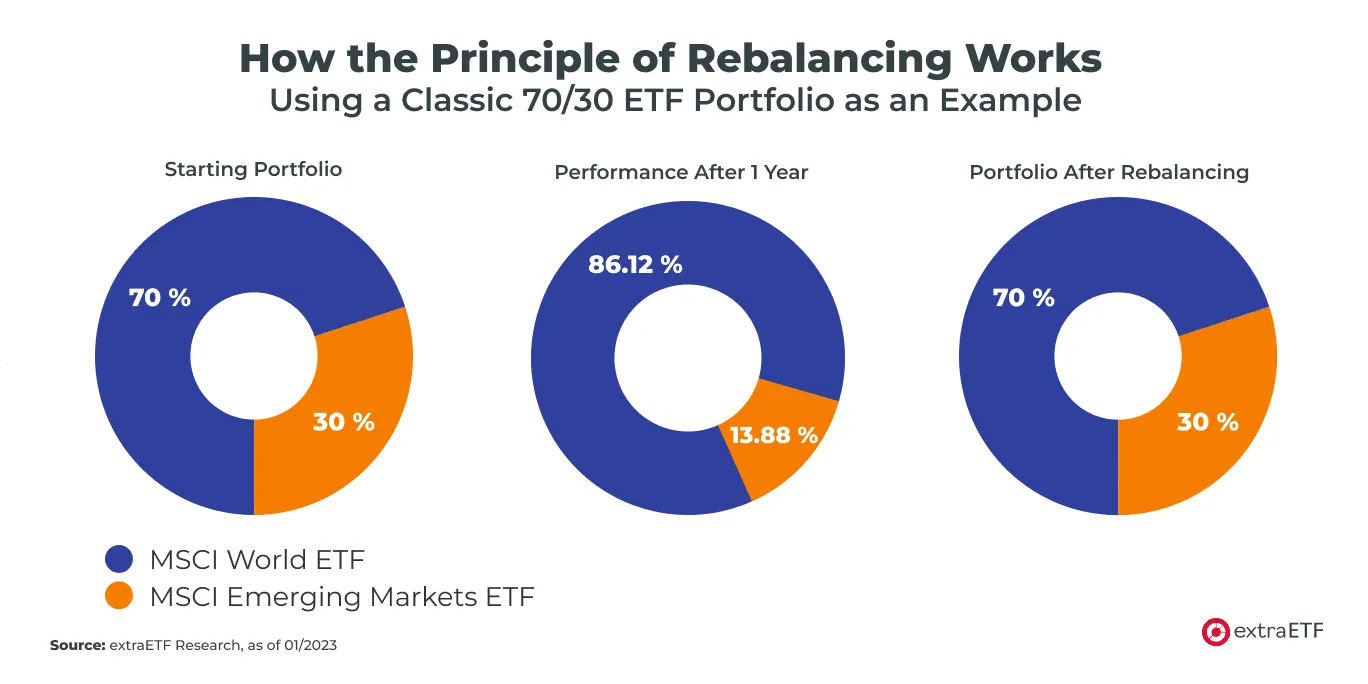
Here’s another example: An investor’s deliberately chosen risk profile might produce a portfolio of 60% stocks and 40% bonds. If market movements shift it to, say, 70% stocks and 30% bonds, the risk profile no longer matches the investor’s preferences. This is where rebalancing comes in: enough stocks are sold and enough bonds bought to restore the original 60/40 split. Put simply, rebalancing means “back to basics.”
What is portfolio rebalancing?
Rebalancing assumes that you already hold a portfolio. Its purpose is to maintain the original mix – or asset allocation – of stocks, bonds, real estate and commodities, even over long periods and when markets or personal investment goals (for example, sustainable investing or family planning) change.
What are the reasons for rebalancing?
Rebalancing restores a portfolio’s risk profile and original asset allocation, which supports risk management. In addition, rebalancing offers the opportunity to act countercyclically. It can also help avoid many psychologically driven investment mistakes, encourage long-term adherence to a strategy, and potentially yield a return advantage.
According to recent studies, investors have achieved annual returns about 0.5 percentage points higher over the long term through rebalancing. Long-term investment goals (for example, a conservative risk profile) and personal preferences (for example, sustainable investing) can often be met only through rebalancing. Why? Markets change over the years and decades – and so do personal circumstances.
Before building an ETF portfolio, however, investors should consider their own risk profile and understand the risks associated with ETFs. Depending on their risk tolerance, investment goals, time horizon and capacity for loss, they can then choose more or less “risky” ETFs.
What is a reasonable rebalancing interval?
There is no one-size-fits-all answer to which rebalancing interval makes sense, and experts disagree on the subject. It depends on individual circumstances, particularly the investment objective and the portfolio’s performance. In any case, investors should make sure the benefits of rebalancing outweigh the costs.
There are three main types of rebalancing:
- Time-based rebalancing
- Value-based rebalancing
- Value-based partial rebalancing
A robo-advisor can also handle rebalancing automatically, for example once a year.
Join the extraETF community

Explore the world of ETFs and make informed investment decisions.
- Find ETFs that match your criteria with our ETF Search.
- Compare costs, performance, and risk side by side.
- Save your favourites to a watchlist and receive price alerts.
- Explore detailed ETF profiles with key metrics and holdings.
What methods are there for rebalancing?
There are three main ways to rebalance:
| Rebalancing type | Brief description |
|---|---|
| Time-based rebalancing | Rebalancing on fixed dates |
| Value-based rebalancing | Rebalancing when holdings deviate by a set amount |
| Value-based partial rebalancing (Davis/Norman) | Rebalancing that takes transaction costs into account |
Here is a detailed overview of these methods:
How does rebalancing work with ETFs?
Rebalancing is also useful for ETFs, since their prices, like those of other securities, fluctuate. Price changes in the stock market can shift the weightings of individual ETFs and alter the risk profile you chose at the outset. Rebalancing your ETFs restores their proportions and the risk profile of the whole portfolio.
In general, rebalancing means selling assets that have outperformed the portfolio average and buying more of the positions that have lagged. The portfolio then returns to its original target allocation and once again matches the investor’s risk and return expectations.
Rebalancing is rarely easy emotionally, because investors must reduce their holdings in positions that have done well and increase their weighting in those that have recently underperformed. Many find this difficult. It is nonetheless important, especially to restore a risk-reward profile that feels right and secure. It also generally reduces the risk of setbacks and large swings in the portfolio.

The rebalancing calculator from extraETF.com can also help you work out the target allocation of your securities or ETFs quickly and easily.
What factors play a role in ETF rebalancing?
The following three factors play a role in ETF rebalancing:
- Age of the ETF investor
- Duration of the ETF investment
- Market-related factors
We’ll discuss these in more detail below.
Age of ETF investors
When building a portfolio, investors must balance and spread risk according to their personal needs. According to the classic rule of thumb, the younger you are, the more of your money you should put into asset classes with higher risk (such as stocks), but also greater return potential.
Conversely, as investors get older, it is advisable to reduce their original equity allocation. After all, many want to draw on their savings in retirement, so safety becomes increasingly important. The rule of thumb here is: the older you are, the more you should hold in low-risk asset classes (such as bonds).
Duration of the ETF investment
The longer you stay invested, the more likely it is that adjustments will be needed. Over time, a portfolio’s composition shifts automatically towards the asset classes with the highest returns. In particular, the share allocated to stocks grows significantly as share prices rise.
A portfolio that was once defensive can also turn aggressive within a relatively short time, increasing the risk of losses. Investors who do not rebalance may end up with a portfolio that no longer, or only partly, reflects their original ETF investment strategy and fails to meet their original objectives (for example, risk profile or sustainability criteria).
Market-related factors
Risk profiles vary greatly from person to person. They are typically defined at the start of an investment and follow a long-term plan – but only for as long as the portfolio is kept in line with it. Different markets move independently of one another, so weightings drift.
For example, if bonds underperform while stocks or commodities perform significantly better, the portfolio’s weightings shift. Because gains and losses differ, more of the invested capital ends up in the higher-returning asset classes.
Only restoring the original weightings at regular intervals can prevent this drift.
How much does rebalancing cost?
Rebalancing incurs costs, as each additional stock market trade may result in transaction fees and the spread. In addition, Capital Gains Tax may be due when securities held outside an ISA or pension are sold at a profit. Rebalancing is therefore only worthwhile if the deviations are already significant, and how often you rebalance should depend on the size of your portfolio.
You can also rebalance through regular ETF investing, directing new contributions to bring the portfolio closer to the original ETF weightings. Some brokers waive transaction costs on such plans, while many robo-advisors include them in the service fees for (automated) rebalancing.
As a general rule, rebalancing costs money, so it shouldn’t be done too often. Above all, always keep your personal investment goals in mind.
Example: Here's what rebalancing an ETF portfolio might look like
The following example shows that rebalancing is a simple way to invest countercyclically. It starts with a basic split of capital across different investments as part of a well-diversified asset allocation strategy, which is meant to be maintained throughout the investment period. Because the value of each investment fluctuates, however, the original weightings constantly change.
This simple example of classic rebalancing uses a portfolio of three ETFs. The weightings are set in advance and restored at defined intervals through rebalancing:
Initial Portfolio
| Number of ETFs | Price | Value | Weighting |
|---|---|---|---|
| 100 | £50 | £5,000 | 50% |
| 100 | £30 | £3,000 | 30% |
| 100 | £20 | £2,000 | 20% |
| £10,000 | 100% |
Portfolio on the rebalancing date
| Number of ETFs | Price | Value | Weighting |
|---|---|---|---|
| 100 | £45 | £4,500 | 42.45% |
| 100 | £33 | £3,300 | 31.13% |
| 100 | £28 | £2,800 | 26.42% |
| £10,600 | 100% |
Rebalancing now restores the original weightings by buying and selling the relevant ETFs:
| Number of ETFs | Price | Value | Weighting | Transaction |
|---|---|---|---|---|
| 118 | £45 | £5,300 | 50% | Buy 18 ETF shares |
| 96 | £33 | £3,180 | 30% | Sell 4 ETF shares |
| 76 | £28 | £2,120 | 20% | Sell 24 ETF shares |
| £10,600 | 100% |
This returns the portfolio to the originally desired weighting. At the same time, ETFs that have risen in price are sold at high prices and the proceeds are invested in “cheaper” ETFs.
You don't need to calculate the new weightings yourself: the rebalancing calculator at extraETF.com works out the new allocation quickly and easily.
What are the benefits of rebalancing for a portfolio?
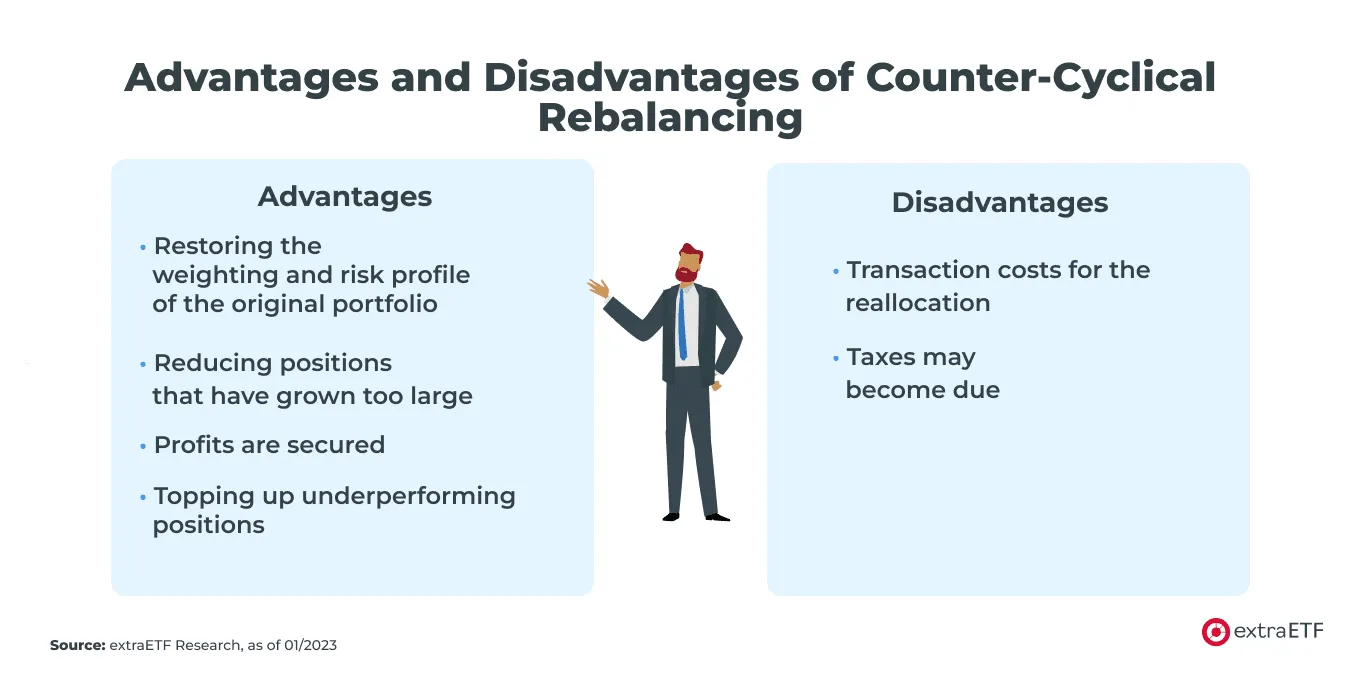
Rebalancing offers the advantage of maintaining the risk profile of the originally selected portfolio, thereby enabling countercyclical investing. Disadvantages may include transaction costs and taxes incurred on profitable sales.
This chart compares the pros and cons of countercyclical rebalancing:
Investing should always be based on a specific investment strategy. The following example illustrates the effect of rebalancing – an automated, countercyclical approach – on long-term portfolio performance:
We compare two simple portfolios of 50 per cent stocks and 50 per cent bonds. The data for the rebalanced 50/50 portfolio comes from the German robo-advisor growney. The investment period runs from 1 January 2004 to the end of December 2016, with €10,000 invested in each portfolio.
| Initial value | Final value | Capital gain | Annual return | |
|---|---|---|---|---|
| Without rebalancing | €10,000 | €21,293.62 | 112.90% | 5.99% |
| With rebalancing | €10,000 | €22,565.72 | 125.60% | 6.46% |
All transaction costs for the annual rebalancing are included. This backtest shows that rebalancing can help improve a portfolio’s long-term return.
However, the risk-adjusted effect matters more. Because the best-performing positions are the ones sold, rebalancing not only locks in gains but also reduces risk.
At the same time, investors buy more of the segments that have underperformed, benefiting from lower entry prices. This countercyclical approach also leaves investors less exposed to market excesses.

Conclusion: Consider Investment Objectives and Market Conditions When Rebalancing
Rebalancing restores a portfolio’s originally selected risk profile and so helps to manage risk. By returning to the initial weightings, investors can also act countercyclically, avoid many psychological pitfalls, stick to their investment strategy and potentially even gain a return advantage.
However, rebalancing usually involves costs, such as dealing fees or the spread, and Capital Gains Tax may be due on gains from selling assets held outside an ISA or pension. The cost-benefit ratio of rebalancing should therefore always be weighed up when investing in ETFs. The right rebalancing approach also depends on the size of the deviation, since very small departures from the original allocation are not worth the effort and cost.
Before investing, you should also research your investment and goals thoroughly; for ETFs, the ETF Guide from extraETF.com is a good starting point. The weightings for rebalancing can be calculated easily using our rebalancing calculator.
We'll answer any other questions you may have about rebalancing

- Everything You Need to Know About Rebalancing at a Glance
- Definition: What is rebalancing?
- What methods are there for rebalancing?
- How does rebalancing work with ETFs?
- What factors play a role in ETF rebalancing?
- How much does rebalancing cost?
- Example: Here's what rebalancing an ETF portfolio might look like
- What are the benefits of rebalancing for a portfolio?
- Consider Investment Objectives and Market Conditions When Rebalancing
- We'll answer any other questions you may have about rebalancing