Buy and Hold Strategy
Strategy for Long-Term Investment Success

Many investors use a buy-and-hold strategy, buying shares or other securities and holding them for the long term to generate returns. It works particularly well as an ETF investment strategy. As the legendary investor André Kostolany once said: “Buy shares, take sleeping pills, and don’t look at your portfolio again. After many years, you’ll see: you’re rich.”
This guide explains why buy-and-hold suits cautious, risk-averse investors as a passive investment strategy, what defines it, and what its advantages and disadvantages are.

The essentials in brief: Everything You Need to Know About "Buy and Hold" at a Glance
Definition: "Buy and hold" is a passive investment strategy in which investors buy suitable securities and hold them for the long term, without reacting to short-term price fluctuations.
Patience, discipline, and perseverance: Buy-and-hold investors take a long-term view, but they need patience, discipline, and perseverance to avoid selling, especially during short-term losses.
Investment horizon: Money is invested for the long term, spanning many years or decades. Securities such as ETFs or shares are held until enough time has passed and the investment goals have been met with a positive return.
Diversification: To achieve more stable returns, investors should reduce portfolio risk by spreading their money across a wide range of companies, industries, asset classes, regions, and company sizes.

Find and compare thousands of ETFs. Use powerful filters, detailed analytics, and independent data to discover the right ETF for your portfolio.
What is the "buy and hold" strategy?
The buy-and-hold strategy involves buying securities such as ETFs or shares and holding them for the long term, often for many years or even decades. It requires patience: investors avoid the difficulty of timing the market and focus on the long-term success of their securities rather than short-term price fluctuations.
Buy-and-hold avoids a lot of effort and frequent transactions, saving costs, time, and work. The long-term goal is to maximise returns and grow capital through price appreciation and reinvested dividends.
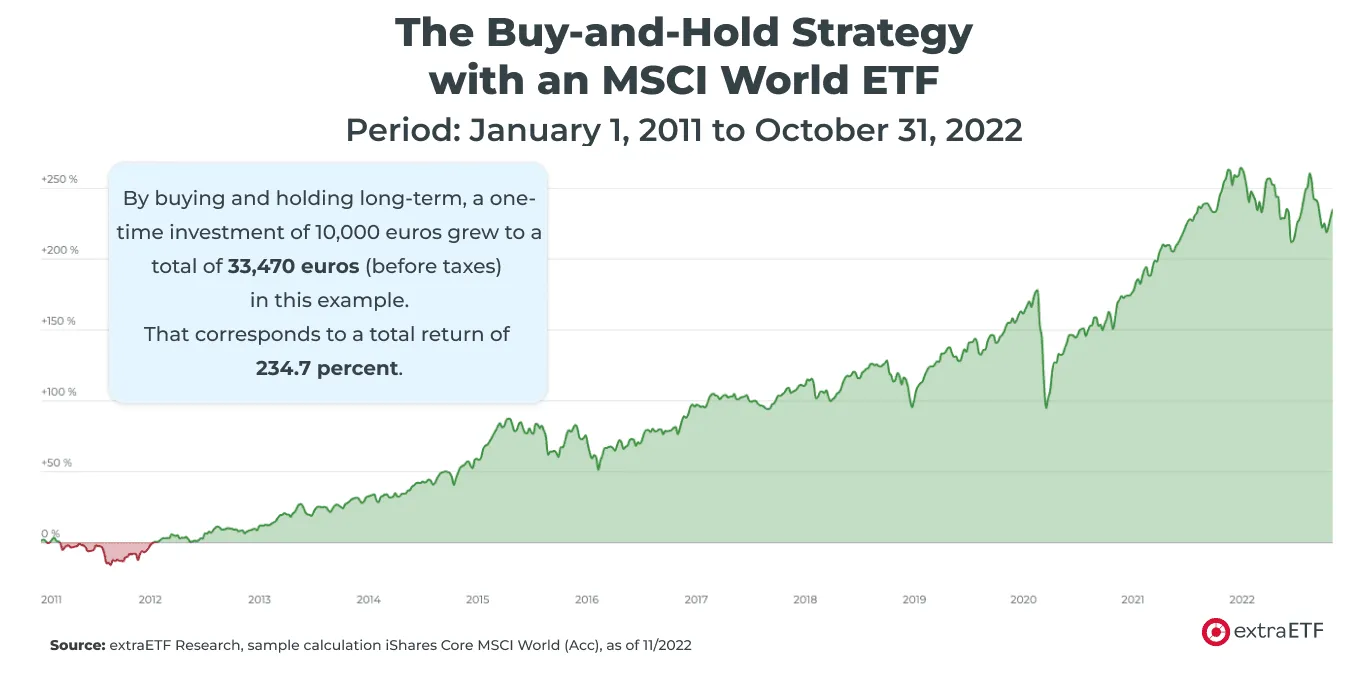
The following chart uses the performance of an MSCI World ETF to show how rewarding long-term buying and holding can be:
Did you know? A Side Note on the Buy-and-Hold Strategy
Benjamin Graham is considered a pioneer of the buy-and-hold strategy, advocating the careful selection of securities and holding them for the long term. Other proponents include Warren Buffett, who focused particularly on high-quality companies, and André Kostolany, who coined the following phrase:
“Buy shares, take sleeping pills, and don’t look at your portfolio again. After many years, you’ll see: you’re rich.”
Their long-term approach shows how backing companies with lasting potential, and having the patience to hold them, can deliver impressive returns. It is particularly important to select the right ETFs or companies and stick with them even when the stock market is performing poorly.
Join the extraETF community

Explore the world of ETFs and make informed investment decisions.
- Find ETFs that match your criteria with our ETF Search.
- Compare costs, performance, and risk side by side.
- Save your favourites to a watchlist and receive price alerts.
- Explore detailed ETF profiles with key metrics and holdings.
How does the "buy and hold" strategy work?
The buy-and-hold strategy involves buying and holding suitable securities, such as ETFs or shares, for the long term. However, this only makes sense if you have an investment horizon of many years or decades and can reasonably expect the prices of these securities to rise over that period. In that case, short-term price declines can be weathered with patience and confidence in the long-term trend.
Many buy-and-hold investors choose global equity ETFs, as these provide broad exposure to key segments of the global economy, which they expect to grow over the long term. Others target thematic ETFs or companies that they expect to deliver strong long-term business performance and rising share prices.
Another popular strategy among buy-and-hold ETF investors is the dividend strategy, in which investors buy shares or ETFs that pay dividends. These dividends are often reinvested to grow the portfolio and benefit from the power of compounding.
Diversification with Shares and ETFs in a Buy-and-Hold Strategy
Investors can reduce risk in a buy-and-hold strategy by focusing on diversification with ETFs and shares. Investors spread their money as widely as possible across companies, industries, asset classes, regions, and company sizes worldwide. If investors avoid large concentrations in individual securities – which create concentration risk – they can minimise company- and industry-specific risks over the long term.
ETFs are particularly well-suited to buy-and-hold because they offer broad diversification by holding numerous securities, such as shares, and passively tracking an index. This saves costs, time, and effort, and can often be done regularly, even with small amounts, through a regular investment plan.
Among its sample ETF portfolios, extraETF has compiled several beginner portfolios that suit a buy-and-hold strategy and can serve as a helpful guide for newcomers.

A "buy and hold" strategy can save you a lot of money, time, and effort
 Martin Vogt, Education & Content Manager
Important Adjustments Despite a Buy-and-Hold Approach
The goal of the buy-and-hold strategy is to purchase securities and hold them for the long term. Nevertheless, it can be wise to review your portfolio regularly – for example, every six or twelve months – and make adjustments as needed. This often involves a process known as rebalancing, which restores the originally selected asset allocation.
This resets the weightings, and with them the portfolio’s risk profile, to their original levels, helping you stay on track for your long-term investment goals.
A variation of the buy-and-hold strategy is the buy-hold-and-check method, which is used particularly for individual investments. With this approach, investors regularly check whether the original investment thesis still holds and adjust if necessary.

A helpful tool for rebalancing is the extraETF Rebalancing Calculator, which makes it easy to restore your original portfolio allocation.
Costs of the Buy-and-Hold Strategy
Buy-and-hold costs are often significantly lower than those of active investment strategies because trading is much less frequent. This avoids transaction costs and the premature taxation of realised gains, allowing compounding to have a greater impact over the long term.
There’s also a well-known stock market saying:
“Buying and selling back and forth empties your pockets.”
The costs of ETFs are also generally low, which benefits long-term returns, as passively tracking an index is very inexpensive and many brokers offer free regular investment plans.
The same applies to the difference between active funds and ETFs: active trading and fund management are generally more expensive, so over the long run very few active funds outperform comparable ETFs.
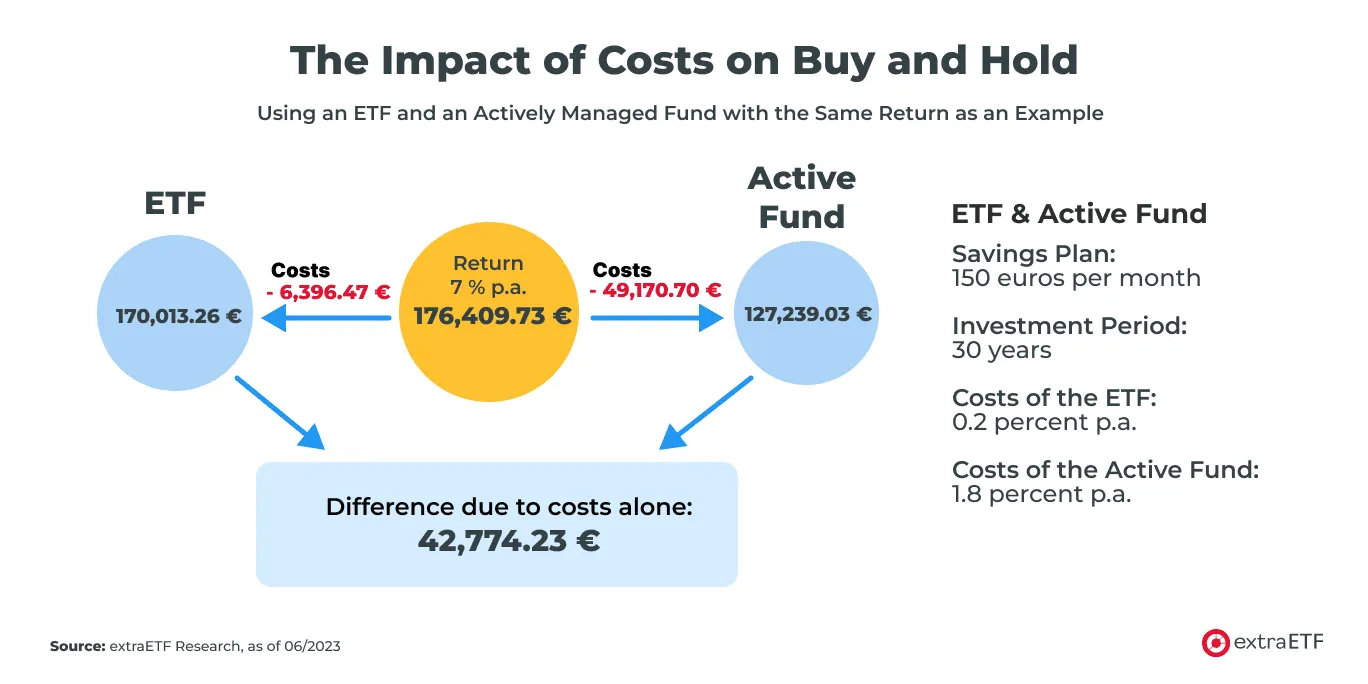
Our example below shows how significantly costs can affect returns:
However, buy-and-hold costs can vary, as investment products and brokers charge different fees. If platform fees apply – whether a fixed fee or a percentage of the portfolio’s value – they cannot be avoided even with buy-and-hold.
Expected Return on a Buy-and-Hold Portfolio
The following table shows the expected return of a buy-and-hold portfolio under different risk-return scenarios, as outlined by ETF expert Gerd Kommer.
| Portfolio 1 | Portfolio 2 | Portfolio 3 | Portfolio 4 | Portfolio 5 | |
|---|---|---|---|---|---|
| % risk-free investment | 10% | 30% | 50% | 70% | 90% |
| % Global Portfolio | 90% | 70% | 50% | 30% | 10% |
| Maximum loss | 22% | 17% | 9% | 6% | 2% |
| Expected return p.a. | 8.7% | 7.5% | 6.1% | 4.6% | 3.1% |
| Recommended minimum investment term | 10 years | 8 years | 6 years | 3 years | 2 years |
Advantages and Disadvantages of the Buy-and-Hold Strategy
The buy-and-hold strategy has advantages and disadvantages that are financial but, above all, psychological. Psychology matters because stock market swings affect us emotionally, and because buy-and-hold fits easily into many investors’ daily lives. Let’s take a closer look at the pros and cons.

Advantages of the Buy-and-Hold Strategy
- Backed by research: Studies support the effectiveness of the buy-and-hold strategy.
- Less risk: A long-term buy-and-hold strategy is usually less risky than short-term trading. It also tends to reduce portfolio volatility.
- Peace of mind: Less stress and time commitment, as you don’t need to monitor the markets constantly or make trades.
- Easy to understand: Simple to implement, even for beginners using suitable ETFs.
- Low costs: Avoids transaction costs and early tax payments, which can boost returns.
- Compounding: Without frequent trading, the exponential growth of compounding is not interrupted, and it works best over long holding periods.

Disadvantages of the Buy-and-Hold Strategy
- Perseverance: It’s often mentally challenging to ride out market downturns, but staying calm usually pays off.
- Not suitable for short-term investments: Buy-and-hold only suits a long-term investment horizon.
- Selecting the right investments: Only securities whose prices are expected to rise over the long term are suitable; otherwise, you risk losing value.
- Missing out on short-term profit opportunities: You may miss out on lucrative short-term gains.
- Poor timing: There is a risk of entering the market at the wrong time. However, this risk is usually higher with short-term trading. Regular investing often helps you benefit from pound-cost averaging.
- Patience and discipline: It can be very difficult to resist the temptations of short-term trading and supposedly quick profits.

Conclusion: How to Apply the Buy-and-Hold Strategy Correctly
In short, the buy-and-hold strategy involves buying securities such as shares or ETFs and holding them for the long term. Investors should aim for a high degree of diversification to reduce risk and choose solid securities whose value is expected to rise over the long term. The strategy is easy to implement, backed by research, and saves time, effort, and costs.
However, this strategy requires a great deal of patience, discipline, and perseverance. Investors should also review their portfolio regularly to ensure that the originally chosen asset allocation remains intact and that long-term investment goals are being met. If not, rebalance to make the necessary adjustments.
A portfolio tracking tool is particularly useful for monitoring your buy-and-hold strategy, giving you an instant overview of your portfolio.
We'll answer any other questions you may have about the buy-and-hold strategy

- Everything You Need to Know About "Buy and Hold" at a Glance
- What is the "buy and hold" strategy?
- A Side Note on the Buy-and-Hold Strategy
- How does the "buy and hold" strategy work?
- Costs of the Buy-and-Hold Strategy
- Expected Return on a Buy-and-Hold Portfolio
- Advantages and Disadvantages of the Buy-and-Hold Strategy
- How to Apply the Buy-and-Hold Strategy Correctly
- We'll answer any other questions you may have about the buy-and-hold strategy