



Dividend Strategy
Investment Strategy for Passive Income
There are many investment strategies. For many investors, passive income is the dream, and a dividend strategy can be one way to move closer to it.
But what exactly is a dividend strategy? How does it work? Can you build it into your own portfolio, and does it make sense?
This article answers these and other questions and shows how a dividend strategy can help you generate a steady, long-term income from shares in stable companies or dividend-paying ETFs.
The essentials in brief: Everything You Need to Know About Dividend Strategies at a Glance
Dividends: Companies pay dividends to give shareholders a share of their profits.
Dividend strategy: This means investing in dividend-paying shares and dividend ETFs to generate a steady stream of passive income.
Dividend yield: This metric shows the dividend payment as a percentage of the share price. Your personal dividend yield (based on your purchase price) can rise significantly over many years if dividends grow steadily.
Who it suits: A dividend strategy can be worthwhile for investors who want passive income, have the time and expertise to pick shares, and are motivated by dividends.

Find and compare thousands of ETFs. Use powerful filters, detailed analytics, and independent data to discover the right ETF for your portfolio.
What is a dividend strategy?
A dividend is a portion of a company’s profits that it distributes to its shareholders. It is a voluntary payment, generally based on annual profits, which the company can increase, reduce or scrap altogether.
A dividend strategy involves investing specifically in companies that pay dividends regularly and reliably and, ideally, increase them steadily over time. In this way, investors gradually build a dividend portfolio that generates passive income.
A dividend strategy aims not only to grow capital but also to generate cash flow through dividend payments. However, the share price falls by the amount of the dividend after the payout (dividend adjustment), so the payout does not increase your total return on its own. Dividends are also taxable.
Overall, a dividend strategy is a long-term approach for investors who value regular payouts and want to use them, for example, as a source of income.
How does the dividend strategy work?
A dividend strategy is based on investing in shares, funds or ETFs with a high dividend yield. The goal is to generate passive income from regular, reliable, sustainable and steadily increasing dividends or distributions, which, depending on the security or company, may be paid monthly, quarterly, half-yearly or annually. This approach lets you build a dividend portfolio.
Shares and ETFs that reinvest their profits, on the other hand, are not suitable for a dividend portfolio. A dividend strategy aims for high dividend yields that provide regular, stable income, which you can achieve with dividend-paying shares or distributing ETFs. Dividend ETFs are generally well suited to this.
Tip: Some brokers offer a Dividend Reinvestment Plan (DRIP), which automatically reinvests dividends or distributions. Check for minimum amounts, taxes and fees.
Join the extraETF community
Explore the world of ETFs and make informed investment decisions.
- Find ETFs that match your criteria with our ETF Search.
- Compare costs, performance, and risk side by side.
- Save your favourites to a watchlist and receive price alerts.
- Explore detailed ETF profiles with key metrics and holdings.
Dividend Yield: Which shares are worth considering for a dividend strategy?
For a dividend strategy, it is worth investing in shares that pay dividends regularly, reliably and consistently, and that increase those dividends over the long term. It is also important to consider the company’s business model, market position and long-term earnings growth.
A successful dividend strategy depends not only on the size of the dividend payments but also on the dividend yield. This metric expresses the dividend payment as a percentage of the share price and is calculated as follows:
Dividend yield (%) = (Dividend paid / Share price) × 100
Here’s an example: If you had owned one BASF share in 2010, you would have received a dividend of €1.70 for that year. BASF has paid a dividend every year since and raised it in many of them, regardless of where the share price stood. Anyone who has held BASF shares ever since would have received a dividend of €3.40 for 2023. However, dividends and their amounts are never guaranteed and a company’s performance is unpredictable, so this example is not an investment recommendation.
Using the share search tool, you can apply the following filters to find dividend-paying shares:

But keep in mind: However tempting a high dividend yield may be, always take a critical look at the company’s overall situation, balance sheet and key financial metrics. Be particularly cautious when a dividend yield reaches 10 per cent or more, as this can signal high risk and a possible fall in the share price. When selecting shares or ETFs for a dividend strategy, it is therefore advisable to weigh several factors.
Dividend Aristocrats and Dividend Kings
Companies with Dividend Aristocrat or Dividend King status are particularly attractive for dividend strategies, because they have shown stability and reliability in their dividend payments over a long period.
The table below shows the differences between Dividend Aristocrats and Dividend Kings:
| Dividend Aristocrats | Dividend Kings |
| Companies that have increased their dividends for at least 25 consecutive years | Companies that have increased their dividends for at least 50 consecutive years |
| Examples: McDonald’s, Procter & Gamble, or Coca-Cola | Examples: Johnson & Johnson or Colgate-Palmolive |

Dividends can boost motivation
Additional Key Metrics for Selecting the Best Dividend Stocks and ETFs
When choosing dividend shares and dividend-paying ETFs, consider the following key metrics as well as the dividend yield or distribution yield:
What is a dividend growth strategy?
A dividend growth strategy is a long-term approach in which investors buy shares and ETFs with high dividend growth. The dividend yield may be low at first, provided the overall investment case is sound.
The idea is that companies that regularly increase their dividends often show stable growth and a solid financial position. They can generally do so thanks to a strong market position, a competitive advantage or good management.
However, a high dividend yield does not necessarily go hand in hand with high dividend growth. There is also a risk that a company is funding its dividends with debt or paying them out of its assets. It is therefore important to choose carefully, favouring well-managed companies with sustainable dividend growth.
Which sectors suit a dividend strategy?
The following sectors are particularly well suited to a dividend strategy:
- Utilities
- Energy
- Financials
- Telecommunications
Real estate and infrastructure companies also tend to pay higher dividends than technology companies.
Generally, it is larger companies with relatively stable cash flows – often called value stocks – that pay dividends. Companies growing particularly fast – known as growth stocks – typically reinvest their profits and so rarely pay dividends.
However, industry trends or a company’s strategic direction can change, so you should review and adjust your portfolio regularly. Some growth stocks may become solid dividend payers over time. Companies may also pay special dividends from time to time, for example after a particularly strong period of trading.
Did you know? Capital gains tax prevents compound interest
Dividends and distributions are taxable if you hold the investments outside a tax wrapper such as an ISA or SIPP. Every investor has an annual tax-free Dividend Allowance, and dividends above it are taxed at a rate that depends on your income tax band. Dividends received within an ISA or SIPP are not subject to dividend tax.
When dividends are reinvested, only the reduced, post-tax amount is available, which weakens the compounding effect over the long term compared with accumulating ETFs or non-dividend-paying shares and lowers your return.
A dividend strategy therefore triggers tax regularly, and the same applies to ETFs that distribute income.
What are the costs associated with a dividend strategy?
The costs associated with a dividend strategy lie in the opportunity costs – that is, the lost returns that could have been earned through other investment strategies. In addition, tax on dividends reduces investors’ long-term returns, and reinvesting dividends can incur further costs in the form of transaction fees and spreads.
You can implement a dividend strategy using various securities, such as dividend shares or dividend ETFs. However, the most attractive options can change quickly, so you may need to review your dividend portfolio regularly and adjust it as needed.
As with any rebalancing, fees typically apply when you reallocate holdings, and these vary with the number of transactions and your choice of broker. The more often you rebalance, the higher the costs can be. You should also take into account the costs associated with ETFs.
ETFs or Individual Shares for a Dividend Strategy?
The difference between investing in ETFs and individual shares is also evident in a dividend strategy: individual shares generally carry more risk than well-diversified dividend ETFs because they are less diversified. With individual shares, investors could suffer a total loss if the company went bankrupt, and dividends could also be reduced or scrapped.
Overall, whether to invest in ETFs or individual shares depends largely on your personal risk tolerance.
You can easily find dividend-paying ETFs using the ETF search tool. There, the following filters let you sort ETFs by many useful dividend-related characteristics:

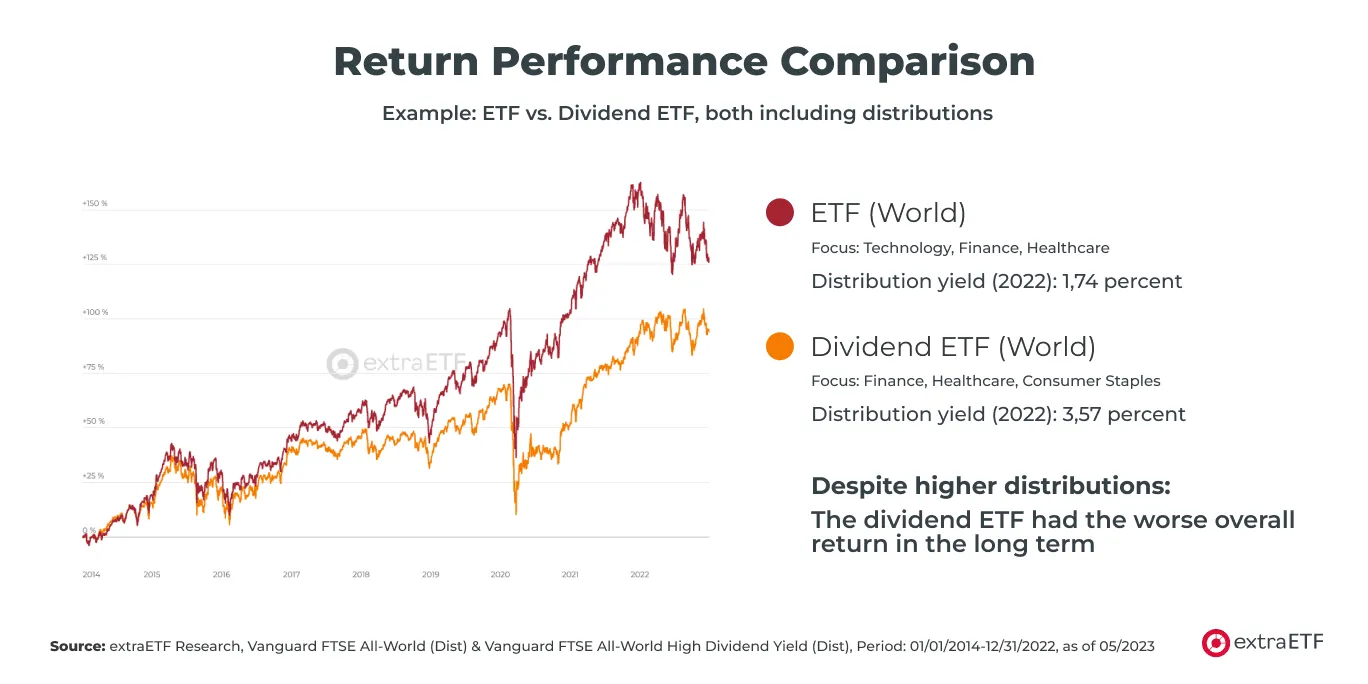
Dividend ETFs invest in companies that have historically paid high dividends. As a result, many growth companies that pay no dividends are excluded and certain sectors carry greater weight, so dividend ETFs may underperform their parent index.
The following chart compares the returns of a standard ETF with those of a dividend ETF:
Who is the dividend strategy suitable for?
The dividend strategy is particularly well suited to investors who want to invest for the long term and seek a stable income from dividends. They should also have the expertise to select suitable shares or ETFs, which can be time-consuming. Enjoying the research into ETFs and individual companies helps, although dividends themselves are a strong motivator for many people. A dividend strategy can also help impulsive investors avoid panic selling during prolonged bear markets or a stock market crash, thanks to the steady inflow of dividends.
In the long term, a dividend strategy may be particularly well suited to:
- Retirees
- People who are wary of stock market volatility
- People aiming for early financial freedom
By contrast, a dividend strategy is not suitable if the goal is to generate returns very quickly with minimal effort. It is also less practical for small investors, since you need to invest a significant amount to generate a high level of passive income.
An Overview of the Advantages and Disadvantages of the Dividend Strategy
Whether a dividend strategy is right for you depends on individual factors, so let’s compare its pros and cons in more detail.

Advantages of the Dividend Strategy
- Regular dividends: You can use passive income from dividends to cover everyday expenses or reinvest it, without selling any shares or ETF units.
- Dividends as a quality indicator: If a profitable company can keep increasing its earnings and use them to pay dividends, this can indicate quality.
- Rising dividends: Many dividend-paying companies increase their payouts over time, which raises your personal dividend yield.
- Dividends are motivating: Receiving dividends builds interest in investing, provides a sense of accomplishment and helps investors stay the course.
- Cash flow even in times of crisis: Bear markets and crashes are a natural part of investing. Many companies keep paying dividends regardless, which helps investors weather crises or take advantage of them by buying against the trend.

Disadvantages of the Dividend Strategy
- Dividends are voluntary: Companies are not obliged to pay dividends and can reduce or scrap them at any time. Many growth-oriented companies pay none at all.
- Dividends are taxable: Outside an ISA or SIPP, dividends above your annual Dividend Allowance are taxed. You cannot reinvest the money paid in tax, which reduces the benefit of compounding.
- Dividend adjustment to the share price: On the ex-dividend date, the share price falls by the amount of the dividend, which can reduce the total value of the portfolio.
- Higher costs when reinvesting: Reinvesting dividends can incur additional costs, such as transaction fees and the spread.
Conclusion: Dividend Strategy – Does It Make Sense or Not?
A dividend strategy can make sense in the long term because it offers many advantages. These include regular, reliable payouts that often increase over time and provide a source of passive income. They can also indicate a company’s quality, and they act as a strong motivator, encouraging many people to start investing and to stick with it even in times of crisis.
However, dividends are discretionary payments that can be reduced or scrapped at any time. They can also drag on returns, as they are generally taxable and reinvesting them can incur additional costs.
Nevertheless, a portfolio does not have to consist exclusively of dividend-paying shares and distributing ETFs; you can also mix in non-distributing securities.
We'll answer any other questions you may have about dividend strategies
- Everything You Need to Know About Dividend Strategies at a Glance
- What is a dividend strategy?
- How does the dividend strategy work?
- Dividend Yield: Which shares are worth considering for a dividend strategy?
- Additional Key Metrics for Selecting the Best Dividend Stocks and ETFs
- Which sectors suit a dividend strategy?
- Capital gains tax prevents compound interest
- What are the costs associated with a dividend strategy?
- ETFs or Individual Shares for a Dividend Strategy?
- Who is the dividend strategy suitable for?
- An Overview of the Advantages and Disadvantages of the Dividend Strategy
- Dividend Strategy – Does It Make Sense or Not?
- We'll answer any other questions you may have about dividend strategies
