



Passive Income
Regular Income from ETFs and Dividends
Many people dream of earning money without having to work for it every day. Passive income can make this dream a reality – whether through shares, property, affiliate marketing or a YouTube channel.
Particularly effective: a broadly diversified portfolio of income-paying ETFs or dividend-paying shares. With a dividend strategy, you can build an additional stream of income over the long term with minimal effort – ideal as a side income or as a step towards financial freedom.
But how does passive income work with ETFs? What should you keep in mind when getting started? And why are dividend-paying global ETFs so well suited?
This article shows you how to build passive income strategically using an investment account, and looks at other ways to build wealth.
The essentials in brief: Everything You Need to Know About Passive Income at a Glance
Passive income: Income earned without constant, active work.
Dividends: Many companies regularly distribute a portion of their profits to shareholders as dividends.
Variable income: ETF distributions and dividends can rise steadily over the years. However, they can also fall or, in the case of individual shares, be cut entirely.
Diversify your sources of income: Spread your portfolio across broadly diversified ETFs or a number of solid dividend-paying companies. Sufficient global diversification can reduce investment risk over the long term, and it’s always wise to have more than one source of income.
Risks: Key risks include price falls, dividend cuts, dividend suspensions, tax considerations and concentration risk.
Knowledge, effort, start-up capital and patience: Many types of passive income require specific expertise, upfront effort, start-up capital and a long-term investment horizon.

Find and compare thousands of ETFs. Use powerful filters, detailed analytics, and independent data to discover the right ETF for your portfolio.
What Is Passive Income?
Passive income is income earned without active work or with only a minimal amount of effort. There are many ways to generate passive income, from investing in ETFs or shares to property, digital products or online revenue. Many people look for income streams that offer financial freedom or a passive side income.
Examples include dividend payments, interest from an easy-access or fixed-rate savings account, ETF distributions, and rental income from a flat or a parking space.
How Does Passive Income Work?
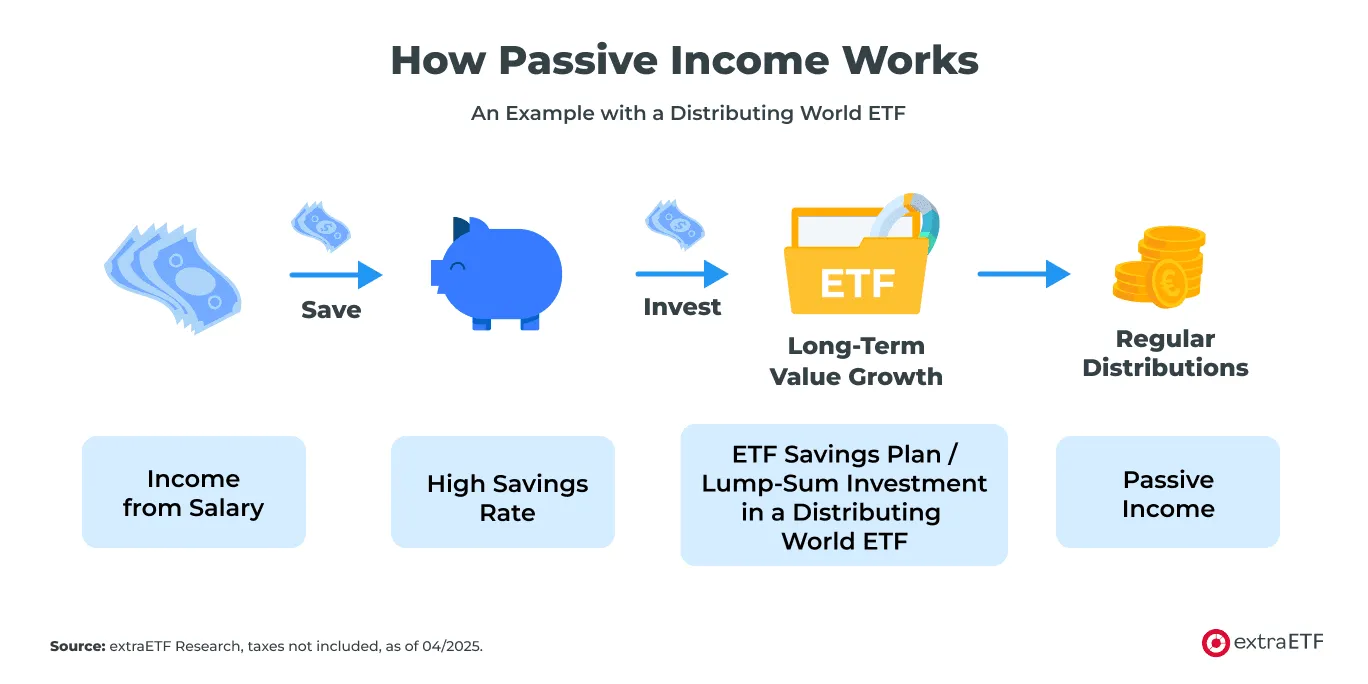
Passive income is generated by increasing your own earnings, maintaining a high savings rate through consistent saving, making smart investments, and building automated sources of income. While some methods require start-up capital, many income sources need no initial investment at all. Either way, a high savings rate, a smart business idea and basic financial knowledge are essential.
The illustration below shows how you can generate passive income with a dividend-paying global ETF:
Why Dividend-Paying ETFs Are Ideal for Passive Income
One of the best-established ways to build passive income is to invest in broadly diversified, income-paying global ETFs or suitable dividend ETFs.
The advantages of ETFs are:
- Low costs and fees
- Risk diversification
- Transparency
- Security, as the fund assets are held separately from the provider’s own assets
- Higher potential returns than traditional savings products
- Suitable for regular investments
- Flexibility and quick access to your money
- Suitable even for small savings amounts
- Can be chosen to match your values, such as sustainability
A sufficiently diversified portfolio of solid dividend-paying shares can also generate passive income. This means buying shares in companies that pay dividends regularly and, ideally, increase them over the long term. However, this demands considerable knowledge, time and analysis. Dividend-paying global ETFs require far less prior knowledge, and broad diversification significantly reduces the long-term risk associated with ETFs.
Join the extraETF community
Explore the world of ETFs and make informed investment decisions.
- Find ETFs that match your criteria with our ETF Search.
- Compare costs, performance, and risk side by side.
- Save your favourites to a watchlist and receive price alerts.
- Explore detailed ETF profiles with key metrics and holdings.
How to Build Passive Income – An Example
Stefan wants to build up a passive income stream over the long term. He decides to use a dividend-paying global ETF as his core investment, which regularly pays out dividends. Each month, he sets aside £400 from his pay and invests it automatically in a broadly diversified global ETF through a regular ETF investment plan.
Over 10 years, Stefan invests a total of £48,000. Thanks to an average annual return of 6 per cent and the power of compounding, his portfolio grows to £65,324.02. With an assumed average dividend yield of 1 per cent, Stefan also receives £480 a year in dividends – that’s £40 a month.
Stefan is delighted with this passive income, but he knows that dividends and capital gains can fluctuate with economic conditions and the profits of the companies in the ETF. He also knows that saving more and reinvesting dividends in the ETF could help him generate higher passive income over the long term.
Note: This example does not take account of tax or the loss of purchasing power due to inflation.
Your Passive Income with ETFs – How to Keep Track of It
Passive income from dividend-paying global ETFs offers a simple way to generate long-term capital gains and regular dividends. It’s important to keep track of your ETF portfolio and the dividends it pays.
A portfolio tracking tool is particularly handy here, as it clearly shows the ETFs you hold and gives you an overview of their distributions. Reviewing your portfolio regularly with a portfolio tracking tool can also motivate you to invest more and increase your passive income over the long term.
Here is an example from a portfolio tracking tool, showing a distributing FTSE All-World ETF and its distributions over time:

The following articles explain the key concepts of passive income with ETFs in more detail, to help you get started.

Step-by-Step Instructions
Here is our step-by-step guide to building passive income.
Analyse Your Current Situation: Get a clear overview of your financial situation, including income, expenses, assets, and debts. Use tools such as household ledgers or budgeting apps to identify potential savings.
Set Goals: Think about how much passive income you want to earn and over what time frame. Clear goals will help you stay motivated and keep your strategy on track.
Build up your savings: Before you invest, you should set aside an emergency fund – ideally at least three months’ salary. That way, you won’t have to give up your investments during tough times, and you won’t be forced to sell securities at a loss due to financial difficulties.
Long-Term Investing: Invest regularly and for the long term in broadly diversified investments, such as ETFs tracking the global stock market, to build wealth. The power of compound interest leads to higher returns over the long term.
Generate passive income: Take advantage of income streams such as global ETFs that pay out dividends, suitable dividend ETFs, rental income, digital products, or affiliate marketing. These can provide you with a steady income over the long term – without having to work actively all the time.
Increase your income and optimise your spending: Try to earn more and cut back on unnecessary spending to boost your savings rate and be able to invest more. Even small pay raises or minor savings in your daily life can make a big difference over the long term.
Types of Passive Income
Strategies for generating passive income vary widely. Here are a few examples.
- Interest: Interest on easy-access or fixed-rate savings accounts is a simple, low-effort source of income, with deposits protected by the FSCS up to £85,000 per person, per authorised firm.
- Dividend-paying ETFs: These exchange-traded funds offer broad diversification and regular, long-term distributions. Be sure to spread your risk globally.
- Solid dividend shares: These regularly pay you a share of the company’s profits, and many increase their payouts over time – a classic way to generate passive income from shares.
- Bonds: Bonds can also contribute to passive income through regular interest payments.
- Crowdfunding and peer-to-peer lending: You invest your capital in projects through crowdfunding, or lend it to individuals via peer-to-peer platforms – with higher risk but also higher potential returns.
- Renting out property: Whether it’s a holiday let through Airbnb, a flat let to tenants, or simply a parking space, all of these require an initial investment but provide regular rental income.
- Digital income streams: Stock photos, information products, dropshipping, YouTube videos, podcasts, or a blog can also pay off in the long term with the right niche, basic know-how and a platform.
Note: Every opportunity to build passive income comes with risks. Before you invest, make sure you have a solid grounding in financial knowledge and understand the type of income involved. The effort required and the potential income can also vary greatly.
Passive Income from Real Estate
Property is a traditional source of income that can provide stable, long-term rental income.
- Renting out flats, commercial properties, holiday lets, garages or parking spaces.
- REITs or investments in suitable property funds that pass rental income on to you.
Digital Products and Online Stores
With the right strategy, the internet can be a source of automated passive income.
Here are a few examples:
- Affiliate marketing: Earnings from commissions on referred purchases.
- Writing and selling e-books: Create digital content once and sell it multiple times.
- Creating online courses: Monetise your knowledge and earn ongoing income.
- Dropshipping: E-commerce without holding your own stock.
- Earning money with apps: Passive income from app downloads and advertising.
Royalties and Intellectual Property
Creatives can generate income through licensing fees:
- Sell music and photos (e.g. on stock image platforms).
- Develop software and license it for a fee.
- License patents and trademarks.
Building Passive Income: With or Without Start-Up Capital?
Depending on the method, building passive income may require some start-up capital, while other approaches need little or none.
With start-up capital
- Shares and ETFs: Investing requires capital, financial knowledge, a solid strategy and some tolerance for risk, but it offers the potential for high returns.
- Property: Rental properties require capital, but can often provide attractive rental income over the long term.
- Crypto mining: Requires investment in the necessary equipment and, depending on the method, cryptocurrency.
Little or no start-up capital required
- Affiliate marketing: Can be started without capital using a website or social media.
- E-books and online courses: Require time rather than money.
- Earning money through YouTube or blogging: Create content once and earn ongoing income.
Pros and Cons of Passive Income
Passive income can help you achieve (greater) financial freedom, but it brings both advantages and challenges.

Benefits of Passive Income
- (More) financial freedom: You aren’t (solely) dependent on a fixed salary and can increase your income regardless of your working hours.
- Less time required in the long run: After an initial investment or savings phase, the income keeps coming in without constant active work.
- Scalability: With the right strategy, many sources of passive income can be expanded, allowing your income to grow.
- More flexibility: You can work from anywhere or pursue other projects and interests while your passive income continues to flow.
- Security for the future: Income sources built up over the long term can provide a stable financial foundation for retirement or times of crisis, such as unemployment.

Disadvantages of Passive Income
- High initial investment: Many sources of passive income require a significant investment of time, money or knowledge before they generate returns.
- No immediate income: Passive income sources can take months or even years to produce profits and a regular income.
- Risks and uncertainties: Market changes, regulation, taxes or technological developments can jeopardise these income sources.
- Ongoing need for optimisation: Even supposedly passive sources, such as property or digital products, need upkeep or updating to keep pace with new trends.
- Tax and legal challenges: Depending on the type of passive income, complex tax obligations or administrative hurdles may arise.
Conclusion: ETFs as the Key to Greater Freedom
A broadly diversified investment in dividend-paying global ETFs is one of the simplest and most efficient ways to build solid passive income over the long term. Regular distributions, low costs, and global risk diversification make this strategy particularly attractive – whether as supplemental income or as a building block on the path to financial freedom. Investors who start early, save consistently and stay invested for the long term can build substantial wealth over time. Some people even practise frugalism to save as much as possible and generate more passive income.
Combining different types of passive income can also help you diversify your income streams further.
With the necessary knowledge, patience, and broad risk diversification – such as that offered by global ETFs – you can gradually become less dependent on paid employment. A portfolio tracking tool can help you keep track of your investments, analyse distributions and align your portfolio with your strategy.
We'll answer any other questions you have about passive income
- Everything You Need to Know About Passive Income at a Glance
- What Is Passive Income?
- How Does Passive Income Work?
- Why Dividend-Paying ETFs Are Ideal for Passive Income
- How to Build Passive Income – An Example
- Your Passive Income with ETFs – How to Keep Track of It
- Step-by-Step Instructions
- Types of Passive Income
- Passive Income from Real Estate
- Digital Products and Online Stores
- Royalties and Intellectual Property
- Building Passive Income: With or Without Start-Up Capital?
- Pros and Cons of Passive Income
- ETFs as the Key to Greater Freedom
- We'll answer any other questions you have about passive income