ETFs and Inflation: How to Protect Your Portfolio
Can ETFs serve as a hedge against inflation?

Wealth often melts away unnoticed. Put £10,000 in a piggy bank today and in ten years you will still have £10,000 in notes, but it will buy far less. Inflation is to blame: it produces a negative real return and steadily erodes purchasing power. In 2022, UK inflation averaged 9.1 per cent, well above the Bank of England's two per cent target. Inflation eats into wealth and reduces the returns on ETFs and other investments. Investors who want to beat inflation have had to – and still have to – seek above-average returns. Many are turning to ETFs in the hope of achieving them.
But are ETFs really suitable for protecting against inflation in times of crisis? How do they perform when inflation is high? This article answers these questions and more.

The essentials in brief: Everything You Need to Know About Inflation and ETFs
Inflation: Inflation refers to the rise in the general price level of goods and services, which causes money to lose its purchasing power. Investors are affected too: the higher inflation is, the less their savings will buy in future.
Inflation Protection with ETFs: There are ETFs that can offer a certain degree of protection against inflation. These primarily include ETFs tracking gold, commodities, and stocks, as well as inflation-protected bond ETFs. Broad diversification provides long-term protection for your portfolio.
Stay calm: High inflation rates can cause uncertainty among investors. However, they are not a reason to overhaul your ETF portfolio. Historically, long-term ETF investment strategies have proven reliable even during periods of high inflation and have outpaced rising prices.

Find and compare thousands of ETFs. Use powerful filters, detailed analytics, and independent data to discover the right ETF for your portfolio.
What Happens to ETFs During Inflation?
It is easy to see why investors want inflation-protected ETFs. Inflation is simply a general rise in the prices of goods and services, which reduces the purchasing power of money. Anyone who saves or invests – in an ETF, for example – is affected. The higher the inflation rate, the less money will be worth in future. Companies are not immune either. Many have to buy raw materials, and in an inflationary environment the prices of those inputs rise too. This puts pressure on corporate profits and, ultimately, on the returns of any ETF that holds the company's shares.
Can an ETF protect against inflation? Yes. The key is to invest in a broadly diversified portfolio across the capital markets, including real assets. Companies face rising costs too, but some are better placed to pass higher prices on to their customers, which helps to limit losses and risk. Companies with strong pricing power include market leaders and those selling products that are hard to replace – such as energy providers, food manufacturers and pharmaceutical companies.
ETFs therefore make sense in times of inflation. Alongside broad, globally diversified risk allocation, a long-term investment horizon is a real advantage: over several years or decades, fluctuations in a portfolio can usually be smoothed out. In times of perceived crisis, pound cost averaging also helps the performance of a regular ETF investment plan. When prices are low, investors receive more ETF shares for the same money if they keep their regular contribution constant.
Join the extraETF community

Explore the world of ETFs and make informed investment decisions.
- Find ETFs that match your criteria with our ETF Search.
- Compare costs, performance, and risk side by side.
- Save your favourites to a watchlist and receive price alerts.
- Explore detailed ETF profiles with key metrics and holdings.

Money kept under the pillow loses value due to inflation
 Markus Jordan, Founder of extraETF
Can ETFs Protect Against Inflation?
Long-term investments in stocks and other tangible assets, such as commodities and real estate, can provide protection against inflation. ETFs and ETCs are particularly well-suited for this purpose. It is important to diversify assets broadly across asset classes, regions, and sectors. In this way, investors mitigate the risk associated with ETFs and ETCs while still benefiting from the fact that, historically, capital markets have been able to offset inflation through higher returns.
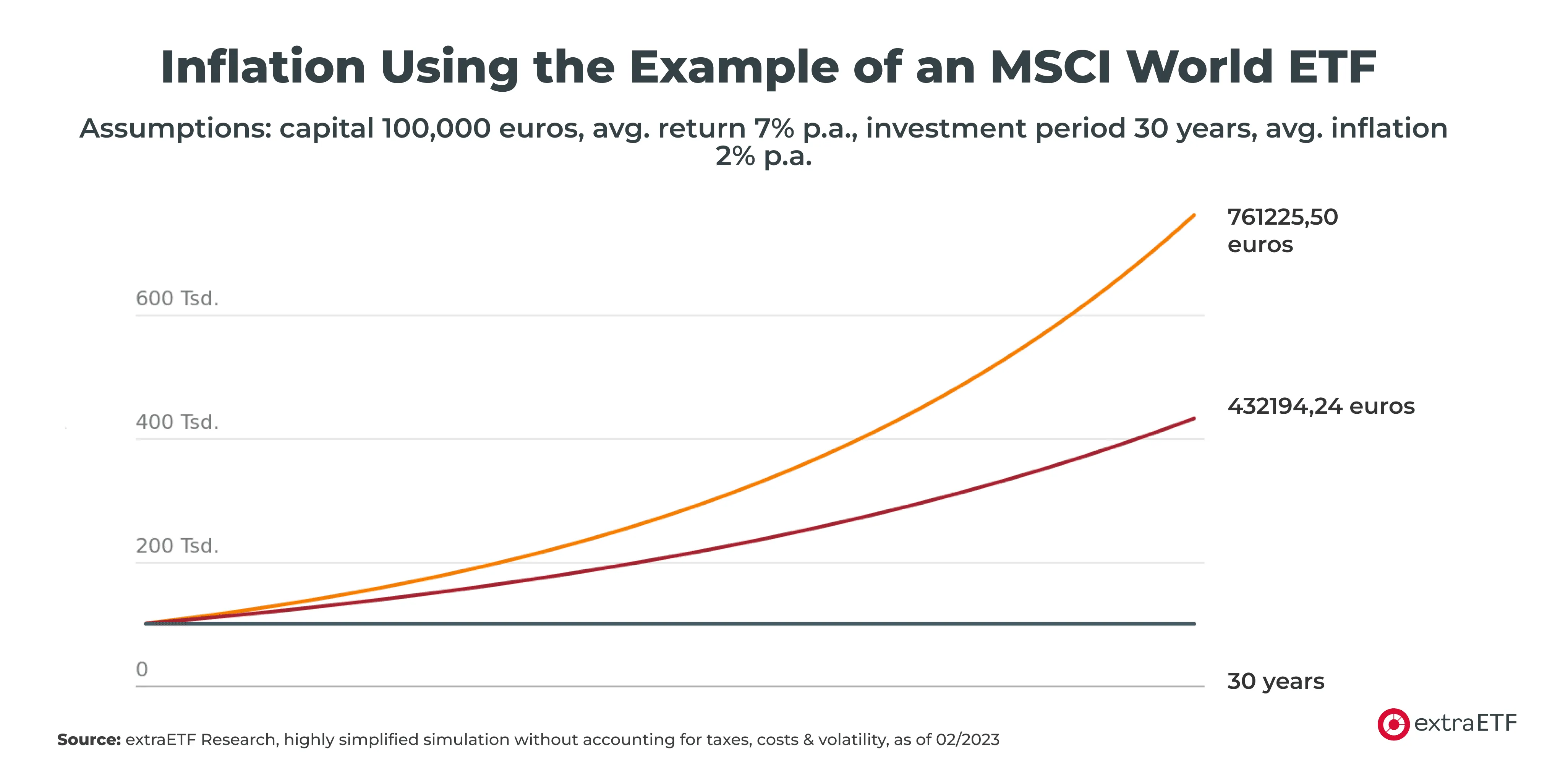
Let's look at an example. Suppose you left £100,000 in a current account for 30 years without earning any interest. With inflation at 2 per cent a year, that amount would have a purchasing power of only £55,207.09.
In the chart below, we use the same assumptions but invest the money in an MSCI World ETF, assuming a long-term average return of 7 per cent a year – a rate that has been realistic, at least in the past. We then subtracted inflation from the ETF's performance to calculate the real return, which clearly shows how much inflation erodes the value of money. The calculation ignores value fluctuations, ETF costs and taxes:
Which ETFs Are Worth Investing In During Inflation?
In an inflationary environment, ETFs tracking stocks or inflation-protected bonds, as well as ETCs tracking commodities or gold, can be worthwhile in the long term. Investors therefore have several ways to offset inflation as far as possible.
The following table shows some examples of ETFs and ETCs from these investment segments.
Here is a closer look at the options for protecting a portfolio against inflation:

Conclusion: How to Effectively Protect Against Inflation with ETFs
ETFs are a good option for counteracting the creeping erosion of purchasing power caused by inflation. They give investors access to securities such as stocks, inflation-protected bonds and – in the form of ETCs – commodities. Over the long term, these asset classes have generated returns that (more than) offset inflation. Investors should therefore adopt a long-term investment horizon and spread risk broadly across asset classes, sectors and regions. Short-term investments do not offer sufficient protection against inflation and more often result in losses. Anti-inflation ETFs can be held for the long term as standalone investments or as part of a regular investment plan.
You can learn how investing in ETFs works in the ETF Guide from extraETF.com. A portfolio tracking tool, meanwhile, is particularly useful for monitoring your portfolio.