









Are commodities a worthwhile investment?
Opportunities & risks
In times of economic uncertainty, many investors are looking for ways to diversify their portfolios and hedge against inflation. With commodity ETFs, you can invest in commodities such as oil, gold, and agricultural commodities without physically holding them.
We’ll explain how commodity ETFs work, what advantages and disadvantages they offer, and how to find the right ETF for your needs.

The essentials in brief: Understanding Commodity ETFs
Definition: Commodity ETFs are exchange-traded funds that allow investors to invest in commodities. They synthetically track the performance of a commodity index rather than investing directly in physical commodities.
Difference from ETCs: Commodity ETFs typically invest in a wide range of commodities or commodity futures, whereas ETCs often directly track the price movements of individual commodities.
Risk: Unlike equity ETFs, commodity ETFs are subject to the risk of price fluctuations in the underlying commodities.
Diversification: By adding commodities to their portfolios, investors can diversify their holdings and reduce overall risk. Commodities are often considered a safe haven in times of crisis, as they can perform independently of the stock and bond markets.
What are commodity ETFs?
Commodity ETFs are exchange-traded funds that track the performance of commodity indices. These indices can be broadly diversified or focus on specific commodities such as gold, oil, or metals. The main advantage of these ETFs is the ability to invest in various commodity markets without actually having to own the physical commodities.
Generally speaking, commodity ETFs can be divided into two types:
What types of raw materials are there?
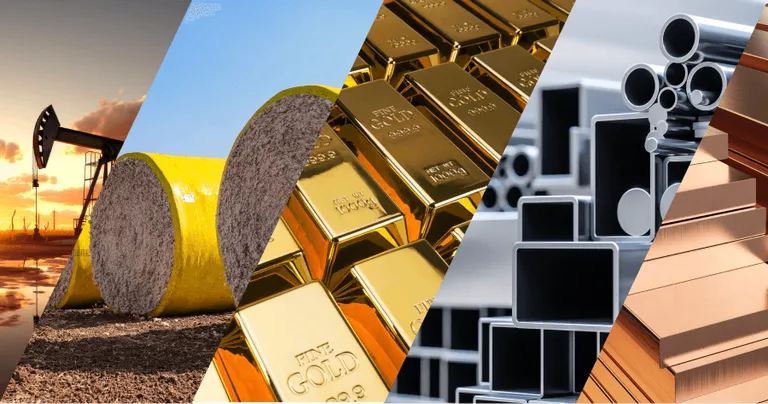
Commodities can be divided into five main categories: fossil fuels, precious metals, industrial metals, agricultural products, and livestock. The characteristics of different commodities can vary greatly, whether in terms of seasonality or storability. Different commodities may differ in their correlation with one another, with other asset classes, and with the inflation rate, as well as in their volatility and future expectations.
Fossil fuels such as oil and natural gas dominate the commodities market and are often the subject of daily news coverage. Precious metals such as gold and silver have served as stores of value for millennia and are easy to store. Industrial metals such as copper and aluminum are indispensable to the construction and manufacturing sectors, while agricultural products such as wheat and coffee are important for both food and trade. The livestock sector includes tradable live cattle and hogs, which are primarily traded on the Chicago Mercantile Exchange (CME). This diversity of commodities offers numerous investment opportunities and plays a crucial role in the global economy.
Join the extraETF community

Explore the world of ETFs and make informed investment decisions.
- Find ETFs that match your criteria with our ETF Search.
- Compare costs, performance, and risk side by side.
- Save your favourites to a watchlist and receive price alerts.
- Explore detailed ETF profiles with key metrics and holdings.
What are the differences between commodity ETFs and ETCs?
Commodity ETFs and ETCs are both exchange-traded products that give investors access to commodities. However, there are key differences between these two investment vehicles that you should understand before investing in them:
- Commodity ETFs (Exchange Traded Funds) are funds that track the performance of a commodity index. These indices can be broadly diversified and include various commodities such as oil, gold, industrial metals, or agricultural commodities.
- ETCs (Exchange Traded Commodities), on the other hand, are exchange-traded securities that typically track the price performance of a single commodity. Legally speaking, ETCs are perpetual debt securities, which distinguishes them from ETFs. This structure allows for direct investment in individual commodities, such as gold, silver, or oil.
In summary: A commodity ETF always tracks an index composed of multiple commodities and is therefore not suitable for tracking the price performance of a single commodity. If you want to invest specifically in a single commodity, a commodity ETC is a suitable alternative.

Advantages of commodity ETFs
- Diversification: Commodity ETFs allow investors to diversify their portfolios and spread risk. Since commodity prices often move independently of stock and bond markets, they can help stabilize the overall portfolio.
- Inflation: Commodities often serve as a good hedge against inflation, as their prices tend to rise when inflation increases. This makes commodity ETFs a sensible addition during times of economic uncertainty.
- Access to hard-to-reach markets: Commodity markets are often difficult to access and require specialized knowledge and infrastructure. Commodity ETFs offer a convenient way to invest in these markets without trading the physical products
- Liquidity: Commodity ETFs are generally liquid, meaning they can be easily bought and sold. This offers flexibility for investors who want to react quickly to market changes

Disadvantages of commodity ETFs
- High volatility: Commodity markets are known for their high volatility. Factors such as geopolitical events, weather conditions, and market sentiment can significantly influence prices, leading to large fluctuations.
- Rollover effects in futures: Many commodity ETFs invest in futures contracts rather than physical commodities. This can lead to so-called rollover losses if the price of the new futures contract is higher than that of the expiring one. These losses can negatively impact the ETF’s performance.
- Currency risk: Since commodities are often traded in U.S. dollars, European investors face an additional currency risk. Exchange rate fluctuations between the euro and the U.S. dollar can affect returns.
- Limited selection of indices: The selection of commodity futures indices is relatively small compared to stock indices. This can limit diversification opportunities and result in some ETFs being heavily concentrated in specific commodities.

Conclusion: Commodity ETFs: diversification and stability in uncertain times
Commodities offer the opportunity to diversify a portfolio by investing in physical assets that have a low correlation with traditional asset classes such as stocks and bonds. This diversification can reduce risk and increase the stability of the portfolio during periods of market volatility.
Commodities such as metals, agricultural products, and energy sources also often have intrinsic value derived from their physical properties and their central role in the economy.
Rising global demand, driven by population growth and industrial development, supports the long-term outlook for many commodities.
Commodity ETFs or ETCs offer a simple and cost-effective way to participate in the price movements of these markets without having to deal with the logistical challenges of physical ownership
Would you like to explore more ETFs?
Further questions about commodity ETFs

Affiliate notice *
Links marked with an asterisk (*) are advertising or affiliate links. If you purchase or sign up through this link, we receive compensation from the provider. This comes at no additional cost or disadvantage to you. We use this revenue to fund our free services. Thank you for your support.