ETFs: Returns & Performance
What kind of return can I expect from ETFs?

Exchange-Traded Funds (ETFs) are the Swiss Army knife of modern investing. They belong in every investor’s toolkit. Why? Because ETFs are flexible, low-cost and offer high returns. In this guide, we’ll focus on the last of these: ETF returns.
You’ll learn what returns ETFs can typically deliver, how to calculate them, which factors influence them and what drives the performance of these exchange-traded index funds.

The essentials in brief: What You Should Know About ETF Returns
ETFs: ETF stands for exchange-traded fund. ETFs passively track an existing index, letting you invest in it without the need for active fund management.
Return: Unlike actively managed funds, ETFs do not aim to outperform the market. Instead, they aim to deliver a return virtually identical to that of the index they track.
Costs: Costs have a significant impact on the returns of ETFs. As with any form of investment, the higher the fees, the lower the return.

Find and compare thousands of ETFs. Use powerful filters, detailed analytics, and independent data to discover the right ETF for your portfolio.
What is the return on ETFs?
ETF returns depend largely on the performance of the underlying index and the costs of the ETF. The investment strategy, investment horizon and asset class also play a role. For example, the average annual return of the MSCI World Index from 1970 to 2020 was 9.21 per cent.
ETFs track an underlying index on a one-to-one basis, so they aim to match the return of that index. Investors know from the outset that their exchange-traded index fund will deliver the market return – no more and no less. This is a key difference between ETFs and actively managed funds.
A management team builds an active fund and continuously adjusts it by buying and selling. The aim is to outperform the market and achieve a higher return. However, very few fund managers manage to do so, especially over the long term.
Passive ETFs and actively managed funds do have one thing in common, however: their returns fluctuate. Returns depend partly on fees and partly on developments in the financial markets – even the order in which returns arrive over the life of an investment can make a difference (sequence-of-returns risk). If both types of fund invest in shares or a share index, for example, returns can rise, but they can also fall. That’s why it’s important to take a long-term view and diversify broadly to make the most of an investment’s potential. Anyone who has invested for the long term – 15 years or more – in a broadly diversified global equity ETF has most likely made a profit by the end.
Did you know? What exactly is a rate of return?
The rate of return is the profit generated by an investment over the course of a year. It is calculated by comparing the profit to the capital invested. Expressed as a percentage, the rate of return lets you compare different investments.
For simple interest investments, the formula is:
Return = (Profit / Capital Invested) × 100
Which ETFs deliver the best returns?
It’s only possible to determine which ETFs generate the best returns in hindsight. However, an ETF’s past returns say nothing about its future performance, which depends on many factors, such as interest rates, market cycles and investors’ expectations. Even so, it can be interesting to look at the ETF “top and flop” list on extraETF.com to see how certain ETFs have performed in the past.
The Long-Term Performance of ETFs Tracking the MSCI World Index
The MSCI World is a global stock index. It tracks the performance of the shares of more than 1,600 companies from 23 developed countries. Its strength – and that of any ETF tracking it – lies in broad diversification. This high degree of diversification forms the basis for a sustainable, long-term investment with relatively low risk, as money is spread globally across sectors, regions and company sizes.
This makes the MSCI World one of the best-known and best-performing indices, and many ETFs track it. The chart below shows an ETF tracking the MSCI World over the past few years. Although past performance is not a reliable guide to future performance, it shows how attractive returns can be from a long-term investment in an ETF offering global diversification and low risk. Even the price declines in 2022 did little to dent the overall positive long-term return over this period.
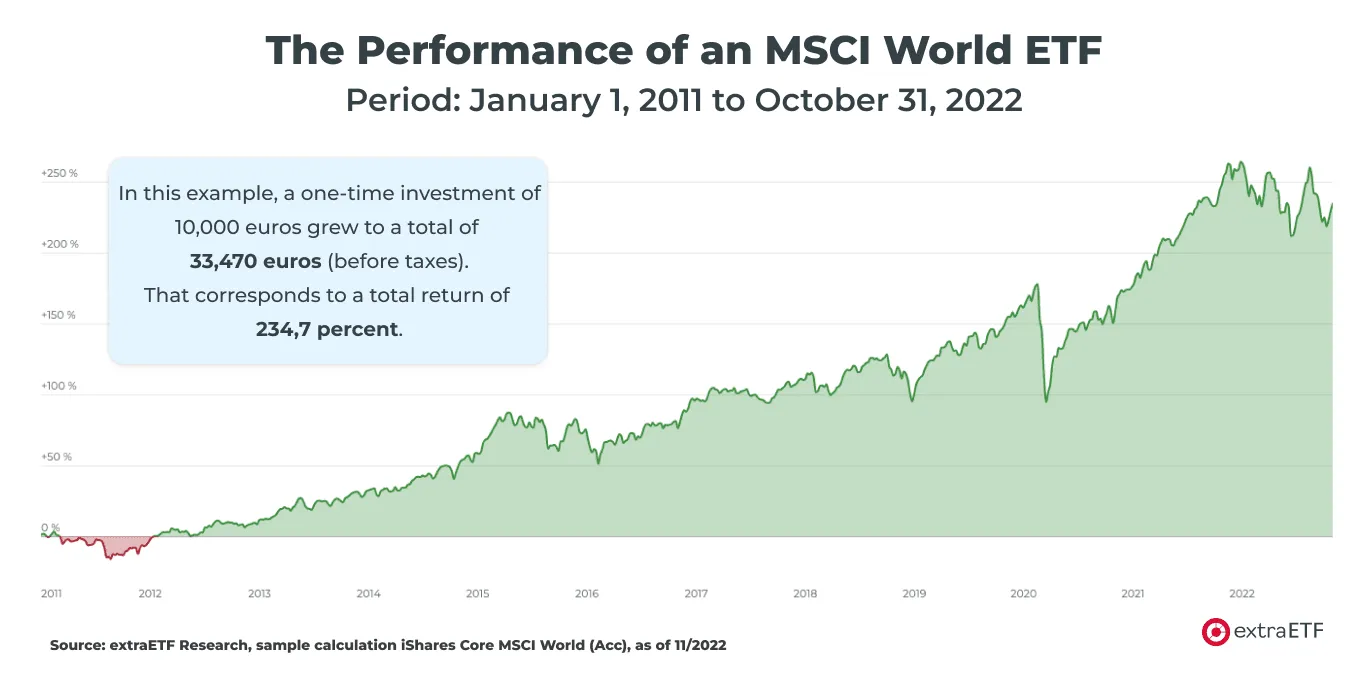
Looking back further, even major crises have not permanently dampened the MSCI World’s performance. The bursting of the dot-com bubble in 2000, the 2008 financial crisis and the 2012 eurozone debt crisis had “only” a temporary impact. The index has consistently recovered from these downturns, delivering high returns over the long term.

Global equity ETFs offer the potential for high returns over the long term
 Martin Vogt, Education & Content Manager
What factors affect the returns on ETFs?
Factors that influence ETF returns include general market trends, asset class, investment horizon, investment strategy and sequence-of-returns risk, but above all which index the ETF tracks and how closely it follows it (tracking difference).
Let’s take a closer look at three factors that have a significant impact on ETF returns:
- Costs
- Taxes
- Inflation
How Costs Affect an ETF’s Return
Investment products come at a price, so it’s important to keep an eye on costs. After all, there’s no point in an investment generating a 1 per cent return if the costs amount to 2 per cent. Costs reduce returns, whether you invest in ETFs, actively managed funds, shares, bonds or gold. That’s why it’s worth comparing fees – not only across asset classes but also within the same class. Even small differences can have a significant impact on an ETF’s return.
One metric often used to assess the costs of ETFs is the total expense ratio (TER). Although other factors also matter, the TER is a useful starting point when comparing ETFs. For example, the annual costs of equity ETFs typically range from 0.04 to 0.95 per cent, while actively managed equity funds often charge 1.5 to 1.8 per cent a year. Over time, these seemingly small differences add up.
As with any investment in securities, account fees, dealing charges and other expenses may apply. When you buy or sell ETFs, your broker will charge for the service. You should also consider factors such as the tracking error and the spread – the difference between the bid and ask prices. Taken together, these costs can all reduce your return.
To find the broker that best suits your needs, a broker comparison service can be particularly useful.
Join the extraETF community

Explore the world of ETFs and make informed investment decisions.
- Find ETFs that match your criteria with our ETF Search.
- Compare costs, performance, and risk side by side.
- Save your favourites to a watchlist and receive price alerts.
- Explore detailed ETF profiles with key metrics and holdings.
Taxes
Tax can also eat into your ETF returns. Gains from selling ETF units may be liable to Capital Gains Tax, and distributions are usually subject to dividend tax or income tax, depending on the type of fund. The rate depends on your income and tax band. Holding ETFs in a tax-efficient wrapper such as a Stocks and Shares ISA or a SIPP can shelter your returns from these taxes.
You can also use your annual tax-free allowances. Each tax year you have an annual exempt amount for Capital Gains Tax (£3,000 in 2024/25) and a dividend allowance (£500 in 2024/25). Interest on cash and some bond fund distributions may fall within your Personal Savings Allowance. Allowances can change, so check the latest figures on GOV.UK.
In the UK, you don’t need to arrange anything with your broker to use these allowances. They apply automatically when you complete a Self Assessment tax return, if you need to file one. Anything held within a Stocks and Shares ISA is tax-free and doesn’t need to be reported.
Investment income from overseas is also usually subject to withholding tax in the country of origin. Investors can often reclaim part of this, although it takes extra effort and refunds can be slow. To prevent investors being taxed twice, the UK has double taxation treaties with many countries.
With accumulating ETFs, income is reinvested within the fund, but it may still be treated as taxable, so check how your fund is reported to HMRC.
Inflation
Inflation is the general rise in prices compared to a previous measurement period. It also affects ETF returns. But how does it work, and how is it measured?
Every month, the Office for National Statistics tracks the average price changes of a representative basket of goods and services, which contains hundreds of everyday items. If prices rise quickly, money loses value and purchasing power falls.
The greater the loss of purchasing power, the lower the real return on an investment. For example, if a savings account pays 1 per cent a year while inflation is 8 per cent, the real return is minus 7 per cent. Inflation would then have eroded the purchasing power of the initial investment. The same applies to ETF returns.
Over the long term, however, equity ETFs generally give investors a better chance of keeping pace with inflation, although there is no guarantee. After all, shares and equity ETFs are considered real assets because they represent a stake in a company. ETF holdings are also kept separate from the provider’s own balance sheet as segregated funds.
Are security and returns mutually exclusive when investing?
Security and returns are not necessarily mutually exclusive. However, as a general rule, the higher the security of an investment, the lower the potential returns. This is also illustrated by the “magic triangle” of investing, which consists of profitability (return), liquidity (availability) and security. Because the three goals conflict, you cannot achieve all of them at once. At best, you can achieve two.
Investment products designed for maximum security generally won’t deliver above-average returns. To achieve those, you have to take on a certain amount of risk. If that investment then yields a higher return, the extra is a kind of reward for the higher risk you accepted.
However, diversification can tip the balance slightly in investors’ favour. By spreading your investments, you spread the risk across multiple assets.
Put simply, investors shouldn’t put all their eggs in one basket – for example, by investing all their savings in a single share. Their wealth would then depend entirely on one company’s business performance. That is closer to a gamble and can result in significant losses, even a total loss. In contrast, a broadly diversified global equity ETF held over the long term offers very good return potential, while benefiting from the comparatively low risk associated with ETFs.
How can I calculate the return on ETFs?
To calculate an ETF’s return, divide the profit by the capital invested, then multiply by 100. This gives you the return as a percentage.
The formula for ETF return is:
Return = (Profit / Capital Invested) × 100
Here’s an example: You invest £1,000 in an equity ETF, such as one tracking the MSCI World. The share price is £20, so you receive 50 shares. Within a year, share prices rise, lifting the ETF’s price to £25.
You realise the profit by selling all your shares. Before costs, you’ve made a profit of £5 per share – £250 in total. To calculate the annual return, divide the £250 profit by the initial investment of £1,000 and multiply by 100. This gives a return of 25 per cent, before costs, taxes and inflation.
With the return calculator from extraETF.com, you can calculate the annual return on ETFs, funds or shares in just a few steps, and factor in income, costs and taxes.
Tip: Our guide to the different methods of calculating returns explains in detail how returns are calculated.

Conclusion: Achieving Attractive Returns with ETFs
ETFs are the Swiss Army knife of modern investing. They offer investors excellent opportunities to achieve high returns over the long term – whether through a regular investment plan or a lump sum.
But just as important as finding the right ETF is understanding what influences its returns and performance. In particular, costs, inflation and taxes can affect an ETF’s returns. That’s why it’s important to compare these and other factors when selecting an ETF, before you invest.
In 2021, providers offered more than 8,500 ETFs worldwide, which can make the market hard to navigate. The tools offered by extraETF.com can help you find and compare ETFs. A portfolio tracking tool can also give you an overview of your portfolio and help you analyse its performance.
Investors often ask themselves the following questions about the returns on ETFs:

- What You Should Know About ETF Returns
- What is the return on ETFs?
- What exactly is a rate of return?
- Which ETFs deliver the best returns?
- The Long-Term Performance of ETFs Tracking the MSCI World Index
- What factors affect the returns on ETFs?
- Are security and returns mutually exclusive when investing?
- How can I calculate the return on ETFs?
- Achieving Attractive Returns with ETFs
- Investors often ask themselves the following questions about the returns on ETFs: