



How ETFs Protect Your Money: Ring-Fencing Explained
Why your ETF investments are protected even if the provider goes bust
Hardly a year passes without turbulence on the financial markets. In extreme cases, as in 2008, it can trigger a serious economic crisis.
Many people wonder whether their ETF portfolios are exposed to default risk (also known as issuer risk). Could you lose your investment if your ETF provider goes bankrupt?
The answer is no. Even in a financial crisis, there is no issuer risk with ETFs, because they are classified as segregated funds and are therefore protected from the issuer's insolvency. The law requires that investors' capital be kept separate from the investment company's own assets.
Bank deposits are different. If a bank fails, the Financial Services Compensation Scheme (FSCS) protects eligible deposits up to £85,000 per person, per institution.
In this article, we explain what a segregated fund is, why swap ETFs carry a small residual default risk, and what investors need to be aware of.
The essentials in brief: Everything you need to know about ETF ring-fencing at a glance
Definition: A segregated fund is the pool of money that investors put into an investment fund, together with the assets bought with it. This capital is raised by issuing fund shares to investors and is legally ring-fenced from the fund company's own assets.
What this means for ETFs: ETFs are classified as segregated funds, so investors' capital is kept separate from the assets of the fund management company. Even if the management company becomes insolvent, the invested capital is protected by law.
Risk: With physically replicating ETFs, the risk of default is virtually nonexistent. With swap ETFs, the default risk is capped at 10 per cent of the fund's assets.
Insolvency: If the ETF provider goes bankrupt, the right to manage the fund's assets is transferred to the depositary. The depositary is required by law to return the fund's assets to the investors.

Find and compare thousands of ETFs. Use powerful filters, detailed analytics, and independent data to discover the right ETF for your portfolio.
Definition: What is a segregated fund?
A segregated fund is the capital that investors have placed in an investment fund. This capital is legally ring-fenced from the assets of the fund management company. If the management company becomes insolvent, neither it nor its creditors can access these funds, so investors' capital is not at risk from the company's failure. Segregated fund status also reduces the overall risk of investing in ETFs.
The following chart provides a simplified illustration of how segregated funds work and how the various parties interact:
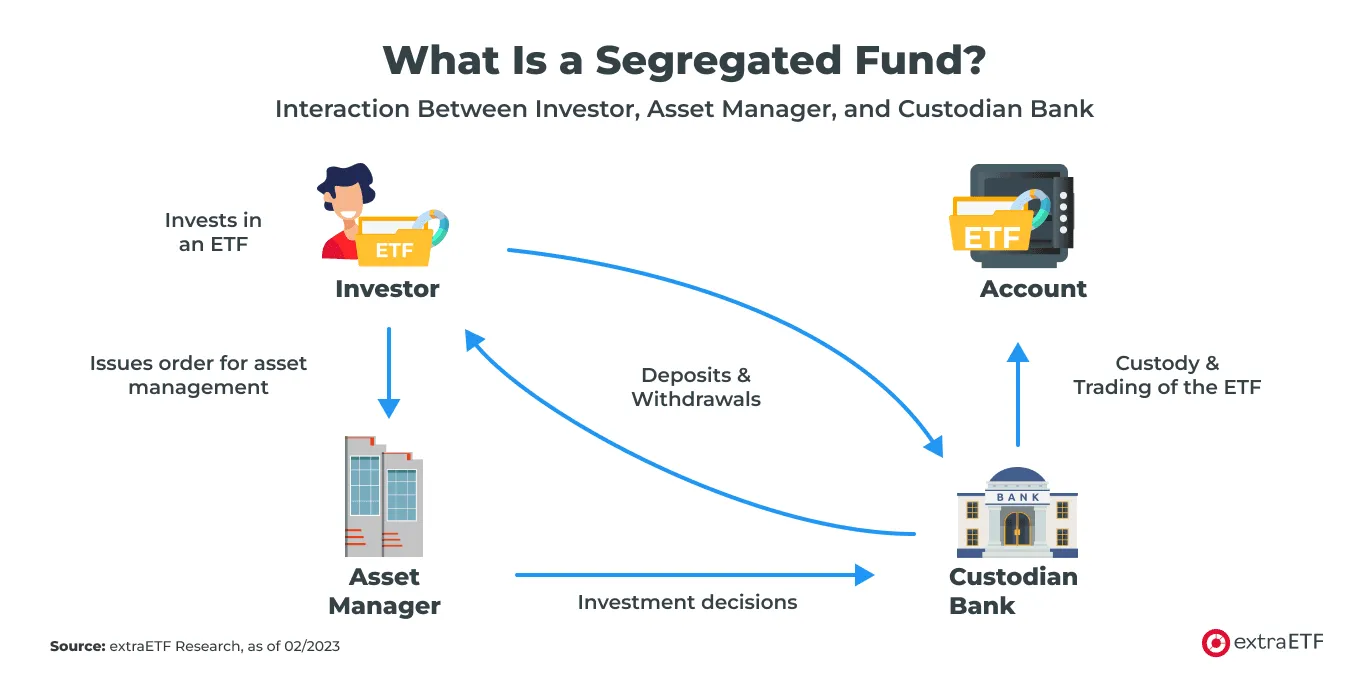
ETFs as Segregated Funds
ETFs offer investors a high degree of security, because ETFs are classified as segregated funds. The capital that investors place in ETFs must be held separately from the assets of the fund management company.
If the fund management company becomes insolvent, the right to manage the assets passes by law to the depositary. This means that ETF shares are protected. However, this rule does not apply to exchange-traded commodities (ETCs) or exchange-traded notes (ETNs), which are not classified as segregated funds.
ETCs, which are backed by commodities and cryptocurrencies, and ETNs, which are often used for leveraged strategies, are treated as debt securities. Both therefore carry default risk (also known as issuer risk).
No Default Risk with Physically Replicating ETFs
Physically replicating ETFs, which track the underlying index by holding the corresponding shares or bonds directly, carry no default risk. The assets held in these funds are also classified as segregated funds, so investors do not need to worry about losing their money if the ETF provider becomes insolvent. However, they remain exposed to normal market risk — the usual fluctuations in the ETF’s value on the stock exchange.
There are also swap-based ETFs, which use a different replication method. We look at these next.
Join the extraETF community
Explore the world of ETFs and make informed investment decisions.
- Find ETFs that match your criteria with our ETF Search.
- Compare costs, performance, and risk side by side.
- Save your favourites to a watchlist and receive price alerts.
- Explore detailed ETF profiles with key metrics and holdings.
Low Default Risk for Swap ETFs
Swap ETFs replicate the underlying index synthetically. Rather than buying the actual shares and bonds in the index, they use a swap agreement — essentially an exchange of returns with a counterparty. Swap ETFs are also segregated funds and benefit from insolvency protection. Creditors cannot make claims against the fund’s assets. The default risk of swap ETFs is capped at 10 per cent of the fund’s net asset value, because UCITS rules limit swap exposure to that level. Once the swap agreement reaches this threshold, it must be settled and the exposure returned to the fund. The rest of the fund is invested in securities, which need not be constituents of the tracked index.

When investing in funds, pay attention to your ETF’s replication method
How the Law Protects ETF Investors
Actively managed funds, ETFs and shares held in custody are all classified as segregated assets. Under the UCITS directive — the regulatory framework that governs most European investment funds — a fund’s assets must be held separately from the management company’s own assets. This strict separation, enforced through an independent depositary, protects investors almost entirely against losses caused by the insolvency of the fund management company. The fund’s assets do not form part of the insolvency estate and are shielded from creditors’ claims. If the management company becomes insolvent, the right to manage the assets passes by law to the depositary, which is legally obligated to return the fund’s assets to investors.
However, the management company retains control over investment decisions. It determines the investment policy and decides how the fund’s capital is invested. Although it has no direct access to the assets or the securities held, the management company initiates buy and sell orders for the fund, and the depositary executes them. The depositary carries out these transactions but has no say over the management company’s investment decisions.
For inspiration on the range of investment strategies available, take a look at our ETF portfolios.
Conclusion: ETF Ring-Fencing — What Does It Mean?
Because the assets of a segregated fund must be legally separated from the management company’s own assets and any other assets it manages, the fund’s assets cannot be used to satisfy the management company’s liabilities. In the event of insolvency, these assets do not form part of the company’s insolvency estate. Neither creditors nor the management company have access to this capital.
Besides the well-known risk of a swap counterparty defaulting — which drew significant attention after the Lehman Brothers collapse — investors also face the theoretical risk of the depositary becoming insolvent. However, segregated fund status gives investors a legal right to have all securities held in custody separated from the depositary’s insolvency estate. The default risk for ETF investors is therefore extremely low. That said, investors do bear the market risk of their ETF and should be prepared for the possibility of negative performance, just as with individual shares.
To learn how to invest confidently in ETFs and build your wealth, read the ETF Guide from extraETF. To keep track of your ETF portfolio at all times, we recommend using a portfolio tracking tool.
Frequently asked questions about ETF ring-fencing
- Everything you need to know about ETF ring-fencing at a glance
- Definition: What is a segregated fund?
- ETFs as Segregated Funds
- No Default Risk with Physically Replicating ETFs
- Low Default Risk for Swap ETFs
- How the Law Protects ETF Investors
- ETF Ring-Fencing — What Does It Mean?
- Frequently asked questions about ETF ring-fencing
