Swap ETFs
ETF Swaps for Greater Efficiency

The goal of exchange-traded funds (ETFs) is to track a specific index as closely as possible. To achieve this, there are two types of index tracking: physical tracking and synthetic tracking via swaps.
So-called swap ETFs rely on synthetic index tracking. This method uses index swaps, which make it possible to track the index’s performance very closely. However, replication via an index swap can lead to additional counterparty risk, as it often depends on the creditworthiness of the counterparty.
In this article, we explain what swap ETFs are all about and what risks they entail.

The essentials in brief: Swap ETFs: The Basics
ETFs: ETFs are exchange-traded index funds that track the performance of an index as closely as possible.
Explanation: Swap ETFs, also known as synthetic ETFs, track an index but do not trade in the exact same securities that make up the index.
Swap Transaction: A swap ETF receives the performance of the underlying index from its swap counterparty and, in return, provides the counterparty with the performance of the securities held in the swap ETF.
Counterparty risk: The swap transaction creates the risk that the returns on the swapped investments will differ significantly or that the counterparty will default.

Find and compare thousands of ETFs. Use powerful filters, detailed analytics, and independent data to discover the right ETF for your portfolio.
Explanation: What is a swap ETF?
Like a traditional ETF, a swap ETF tracks the performance of an index. The main difference is that a swap ETF does not invest directly in the underlying assets (e.g., stocks), but instead enters into a swap agreement with a swap counterparty. Through the swap agreement, the exchange-traded index fund gains access to the income and performance of the assets underlying the index without actually investing in them. Swap ETFs can be a good way to invest in certain asset classes or markets that would otherwise be difficult to access.
While synthetically replicated ETFs enter into a swap agreement with a swap counterparty, physically replicated ETFs directly track the index by purchasing the assets underlying the index. The different types of index tracking are explained in detail in another guide.
Join the extraETF community

Explore the world of ETFs and make informed investment decisions.
- Find ETFs that match your criteria with our ETF Search.
- Compare costs, performance, and risk side by side.
- Save your favourites to a watchlist and receive price alerts.
- Explore detailed ETF profiles with key metrics and holdings.
Definition: What does "swap" mean?
A swap is a financial instrument in which two parties agree to exchange cash flows, which are typically calculated based on a specific reference interest rate or exchange rate. There are various types of swaps, such as interest rate swaps, index swaps, currency swaps, and credit swaps. Essentially, they involve the transfer or optimization of risks.
In the case of synthetically replicated ETFs, the ETF provider enters into an index swap agreement with a counterparty to gain exposure to the returns and performance of the underlying index without investing directly in the assets. Index swaps are also frequently used by institutional investors, such as pension funds or hedge funds, to hedge their portfolios.
How can you identify swap ETFs?
A swap ETF can be identified by the following characteristics:
- The ETF states that it uses a synthetic replication strategy.
- The word “swap” is included in the ETF’s name.
- The fact sheet specifies the type of index replication.
- The swap contract is listed among the top holdings.
However, it is important to note that not all exchange-traded index funds that exhibit these characteristics are actually swap ETFs. It is therefore advisable to read the ETF’s official prospectus.
How do swap ETFs work?
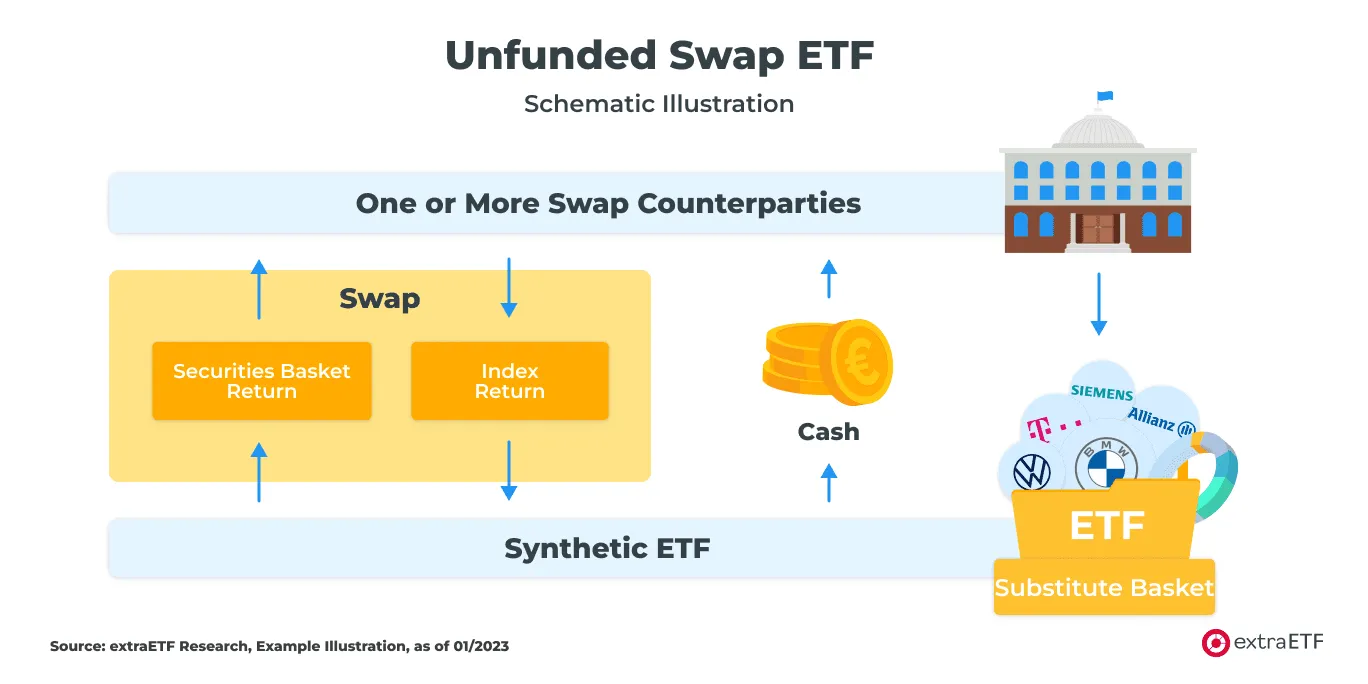
With a swap ETF, the performance of the ETF’s underlying portfolio is swapped for the performance of the index it is designed to track. In this index swap (exchange transaction), the contracting parties agree to exchange predefined cash flows. This is because swap ETFs do not invest in the stocks of the index, but rather in a basket of various stocks, the composition of which generally does not correspond to that of the index. Instead, the basket is constructed with a view to minimizing costs and taxes and, of course, complying with legal requirements for risk diversification.
Thus, an ETF tracking the German Stock Index (DAX) may also contain European stocks, or a European bond ETF may also include foreign-currency bonds. The performance of the basket of stocks is irrelevant to the ETF’s performance, since the performance is ultimately exchanged via the index swap with a bank.
Since institutional investors, in particular, are placing ever-higher demands on the efficiency of ETFs, special attention must be paid to cost burdens and tracking error. Both factors can be optimised through an index swap. However, this also gives rise to new ETF risks.
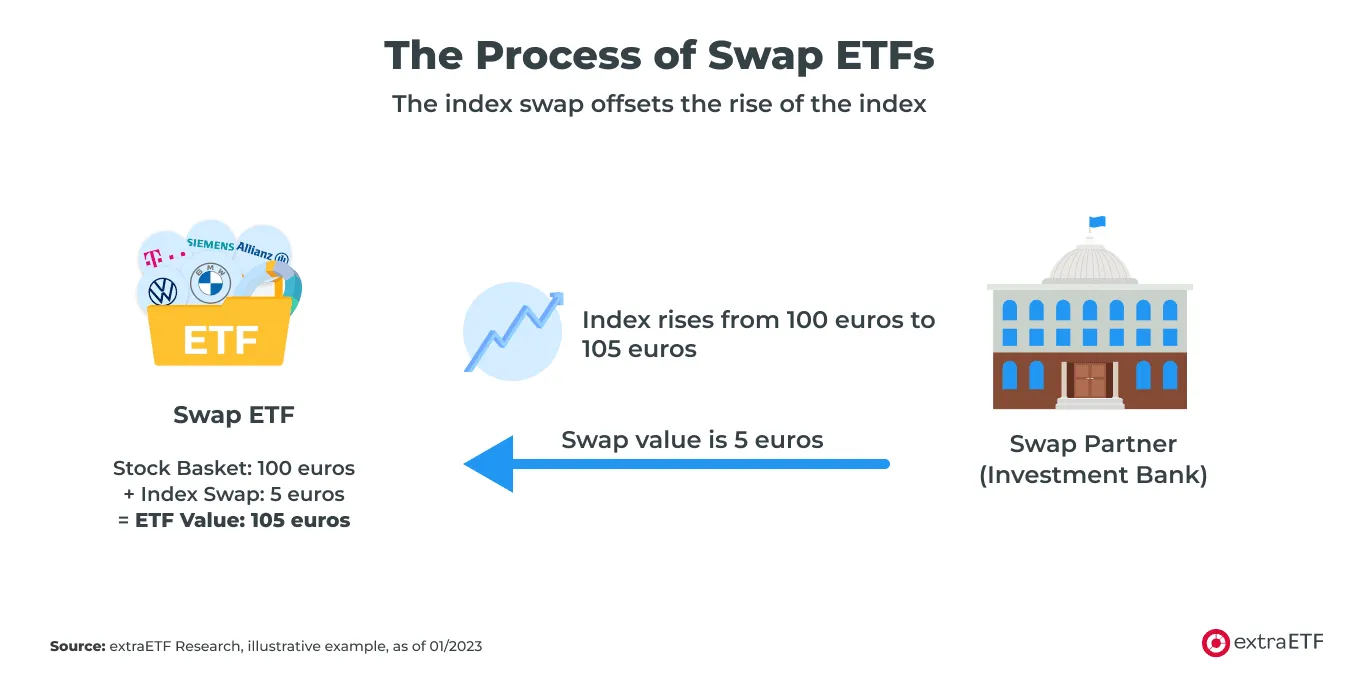
Example: The Process for Swap ETFs
The following example illustrates the role of the index swap in a swap ETF.
A swap ETF has invested in a diversified basket of stocks. The basket of stocks has a value of £100. In addition, the swap ETF has entered into an index swap with an investment bank. The index being tracked rises to £105. The difference between this value and the value of the basket of stocks is offset by the index swap. The value of the index swap rises to 5 euros. If we now add the value of the basket of stocks (£100) and the value of the index swap (£5), the total (£105) equals exactly the value of the index (£105). The swap ETF has therefore tracked the underlying index exactly.
What types of swap ETFs are there?
To minimise counterparty risk in a swap, a 10-per cent threshold is enshrined in European Union law. This stipulates that the difference in yield between the swap parties may not exceed 10 per cent. Once this limit is reached, the difference between the parties must be settled.
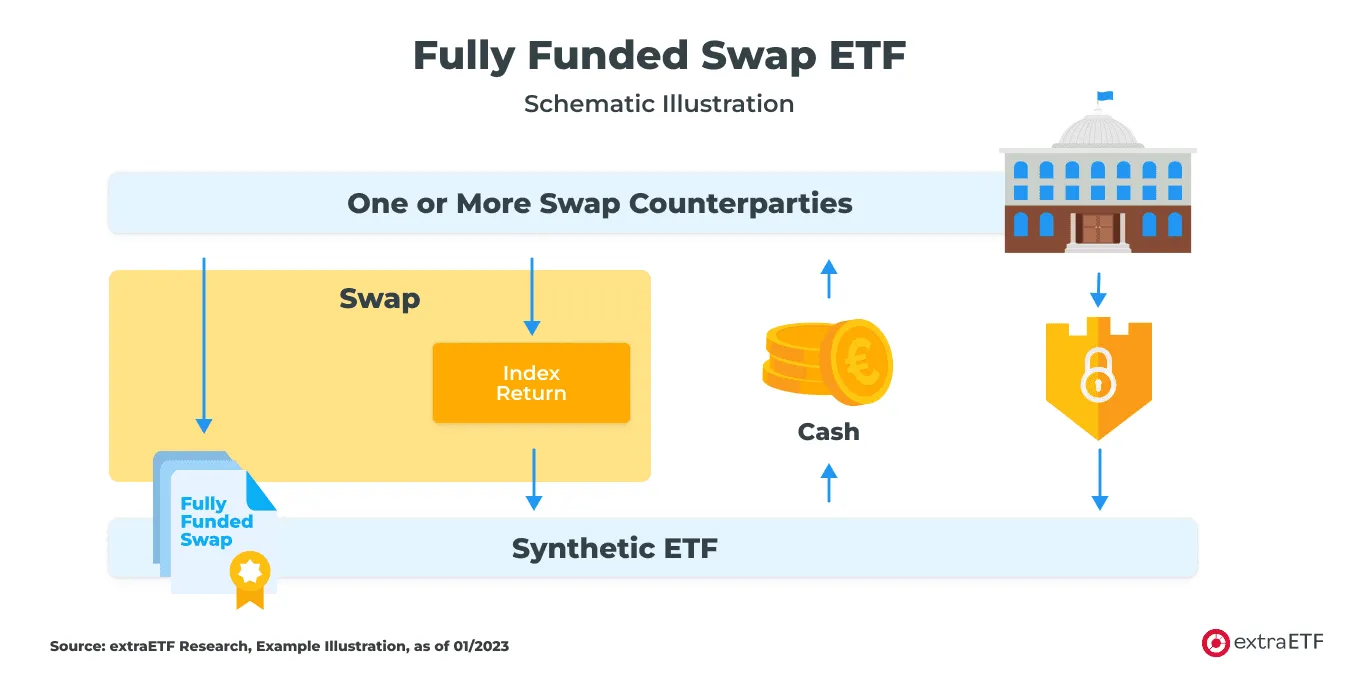
To further minimise counterparty risk, synthetic replication methods distinguish between unfunded swap ETFs, funded swap ETFs, and fully funded swap ETFs.
The differences between these three forms will be discussed in more detail below.
Investing in swap ETFs involves various risks. That is why it is important to stay informed about your portfolio at all times.
How safe are swap ETFs?
Swap ETFs offer a high level of security. Various measures significantly reduce the default risk associated with swap ETFs. Depending on the ETF provider, one or more swap counterparties are used. Furthermore, by law, the value of all index swaps may not exceed 10 per cent. This means that an index swap must be reset once its value reaches 10 per cent. In this process, the value of the swap between the fund and the counterparty is settled in cash. Afterward, a new swap is agreed upon (swap reset).
In practice, however, this risk is further reduced. For most ETF providers, the average swap risk does not exceed two per cent.

Don't Be Afraid of Swap ETFs
 Markus Jordan, Founder of extraETF
Counterparty Risk in a Swap ETF
The counterparty risk associated with swap ETFs arises from the possibility that the swap counterparty may be unable to meet its obligations. If, in the event of financial difficulties or insolvency, the swap counterparty is unable to fulfill its obligations to the ETF, this will result in losses for the ETF, which could extend to a total loss. To protect investors, this counterparty risk is limited by law to a maximum of 10 per cent of the fund’s assets. In addition, ETF providers typically require additional collateral to further reduce counterparty risk.
An Overview of the Pros and Cons of Swap ETFs
Advantages of swap ETFs:
- Swap ETFs generally have a lower tracking error.
- The total expense ratio (TER) is often lower for swap ETFs.
- Swap ETFs can also track indices that are difficult to replicate.
- Swap ETFs can generate yield advantages through tax benefits (U.S. withholding tax).
Disadvantages of swap ETFs:
- Swap ETFs carry additional counterparty risk.
- Lack of transparency (the underlying portfolio is often not disclosed).
- Swap ETFs often require more explanation.

Conclusion: Higher Returns with Swap ETFs
Despite the complexity of swap ETFs, investing in a swap ETF can be worthwhile for investors. Swap ETFs can track an index more efficiently than physically replicated ETFs and often exhibit a lower tracking error. In addition, index swaps allow for the cost-effective implementation of exotic markets and investment strategies, such as emerging market indices or short strategies.
Although index swap ETFs do carry an additional risk, this risk remains manageable due to legal caps and conservative management by ETF providers.
Using our ETF search tool, you can filter ETFs to see whether they are swap ETFs or whether the index is physically tracked.