



ETFs vs Active Funds: What's the Difference?
A direct comparison of passive ETFs and actively managed funds
Active funds and passively managed index funds – that is, ETFs – offer investors the benefits of a broadly diversified portfolio. You can invest in numerous securities from different countries, industries or asset classes at once, which can significantly reduce your risk in the stock market. Both types of fund are also ring-fenced assets, held separately from the provider’s own money.
Despite these similarities, ETFs and actively managed funds differ significantly. ETFs, for example, offer clear long-term advantages, particularly their low costs, high transparency and flexibility.
This overview explains which of the two is the better fit for you.
The essentials in brief: A Summary of the Differences Between Mutual Funds and ETFs
ETFs: Exchange-traded funds are index funds traded on an exchange. They are passively managed and track an underlying index to deliver the market’s return.
Active funds: Actively managed funds, by contrast, aim to outperform the market, with fund managers selecting securities in an effort to boost returns.
Costs: The costs of ETFs are usually only 0.05 to 0.8 per cent a year, making them significantly cheaper than actively managed funds, which often charge 1.5 to 1.8 per cent a year. Active funds may also charge one-off fees.
Returns: Over the long term, returns usually favour ETFs, as very few active funds outperform their benchmark.

Find and compare thousands of ETFs. Use powerful filters, detailed analytics, and independent data to discover the right ETF for your portfolio.
Explained simply: What are the differences between ETFs and active funds?
Even though both are investment funds, the differences between ETFs and actively managed funds lie primarily in their investment strategies and cost structures. For example, ETFs passively track a benchmark index, while in actively managed funds, fund managers attempt to achieve a higher return than the market. The latter involves higher fees.
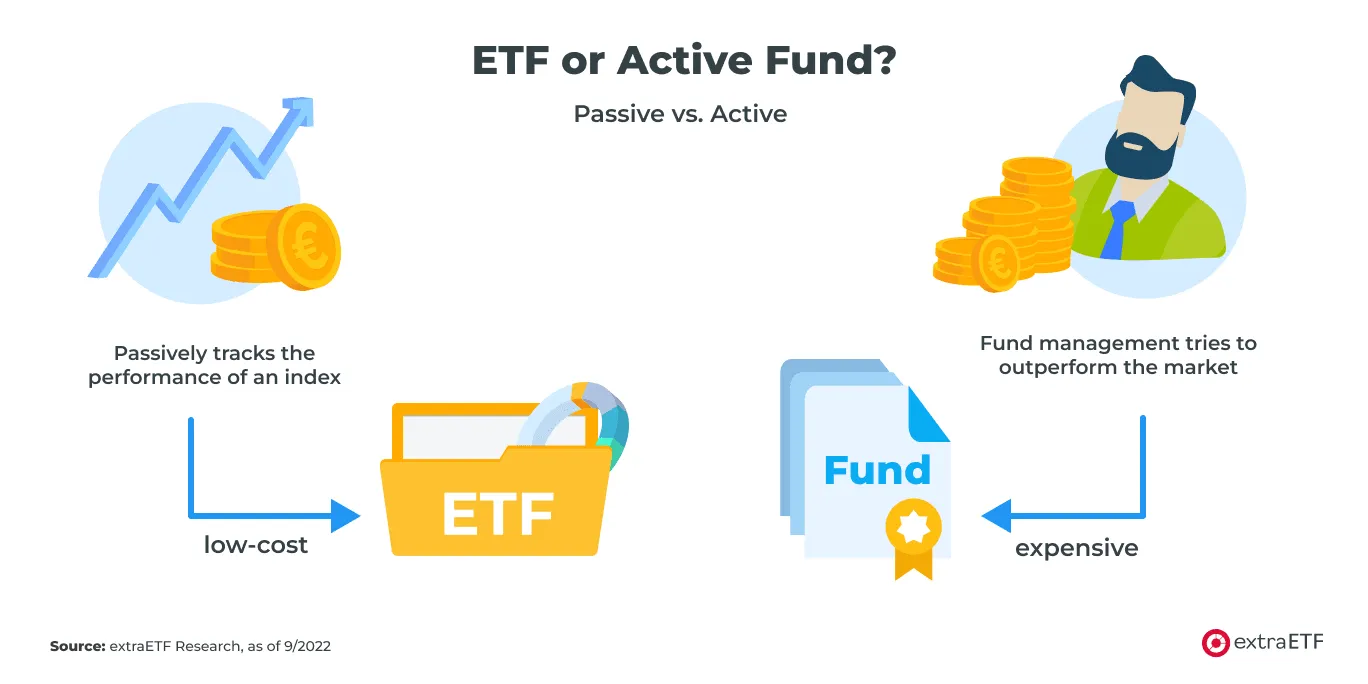
ETFs do not require active fund management, which benefits your returns. These index funds can also be traded flexibly on the stock market, are highly transparent and typically follow clear investment criteria.
In principle, both types of fund share the same goal: to generate the highest possible returns for investors.
But are those goals achieved over the long term, after costs? Do ETFs deliver better returns than other funds? And what are the risks? We look at these questions below.
Join the extraETF community
Explore the world of ETFs and make informed investment decisions.
- Find ETFs that match your criteria with our ETF Search.
- Compare costs, performance, and risk side by side.
- Save your favourites to a watchlist and receive price alerts.
- Explore detailed ETF profiles with key metrics and holdings.
Active and Passive Management – What Exactly Does That Mean?
Active funds are managed by fund managers who analyse the market, make strategic investment decisions and trade actively. This approach costs more, but it is intended to limit risk and generate higher returns than the market. Individual investors can buy fund shares through brokers, banks and fund companies.
ETFs passively track an existing index to deliver the market’s return. Costs are significantly lower as there is no need to pay (expensive) fund managers.
ETFs invest your money transparently, based on purely objective criteria, and can be traded on every trading day. The aim is to track the index as closely as possible. An ETF can replicate the index physically, by buying the securities in the index in line with their weightings, or synthetically, using a swap agreement between a counterparty (usually an investment bank) and the ETF provider.
Clear Differences in Expectations
Who wouldn’t want to outperform the market? Active funds try to do just that, but most fail. After all, higher returns usually come with higher risk, and investors should bear that in mind.
Passive, low-cost investing with ETFs, by contrast, delivers the index return: no more and no less. Over the long term – 15 years or more – a return of around 7 per cent a year is a realistic expectation for an ETF tracking a globally diversified stock index, although returns are never guaranteed. That is far more than you can expect from a savings account or current account, especially when inflation is high and interest rates are low.
Many fund managers also stick very closely to the benchmark index to avoid falling too far behind in a downturn. These managers are known as “index huggers”. If your fund behaves this way, you are paying active fees for something close to an index fund, so switching to an ETF makes sense.
Actively Managed Funds vs ETFs: Costs Compared
Whether it’s an ETF, an actively managed fund, a balanced fund or another type of fund, the same principle applies: compounding can work in both directions, especially over the long term. It can boost your returns, but high overall costs can also erode them significantly.
The comparison below gives you an idea of the costs you might face with ETFs and actively managed funds:
| Passive ETFs | Active Funds | |
| Account fees | From £0 | From £0 |
| Ongoing costs | Approximately 0.05 to 0.8% per year | Approximately 1.5 to 1.8% per year |
| One-off initial charge | No | Up to 5% |
| One-off redemption fee | No | Up to 1% |
| Performance-based fees | No | Possibly |
Besides the costs shown in the table, you should also consider the tax treatment of ETFs and actively managed funds, as this can affect your returns too.
The table shows that total costs can make a significant difference. To see how much, compare regular monthly investments of £150 over 30 years: one in an ETF with annual costs of 0.2 per cent, the other in an actively managed fund with annual costs of 1.8 per cent.
If both funds achieved the same average annual return of 7 per cent before costs, you would end up with £170,013 in the ETF but only £127,239 in the active fund – a full £42,774 less, solely because of the higher costs.
The costs of ETFs can consist of various components. Whether you invest in ETFs or active funds, factors such as trading costs, your choice of broker, management fees and your investment horizon can all affect your return.
Tip: If you already have an investment account with a direct bank, use our broker comparison service to see how its offering stacks up. It may be worth opening a new, more attractive account.
Risks: How Safe Are ETFs and Active Funds?
ETFs and actively managed funds are generally held as ring-fenced assets, separate from the provider’s own, so your money would not form part of the provider’s insolvency estate if it failed. Thanks to broad diversification, your return depends less on the performance of individual securities and currencies.
ETFs do carry risks too, but a single fund or ETF that invests in shares cannot, in principle, go bust. Stock market crashes, crises and prolonged sideways periods are part and parcel of investing, so even with broad, global diversification you remain exposed to general market risk and the resulting fluctuations. Over the long term – a 15- to 20-year horizon – the risk of loss with an ETF tracking a globally diversified stock index is, however, relatively low.
Fund size matters too: a larger fund can be run more efficiently. If your ETF has assets of less than £100 million, for example, it could be closed while you are still invested in it.
Investor behaviour, whether by individual investors or fund managers, can also pose a risk. Synthetic ETFs additionally carry counterparty risk, as the counterparty could become insolvent.

Before you invest, take the time to think about your savings goals
ETFs vs Active Funds: Performance Compared
Active funds have significantly higher costs. That wouldn’t be a problem if their investment decisions delivered correspondingly higher returns.
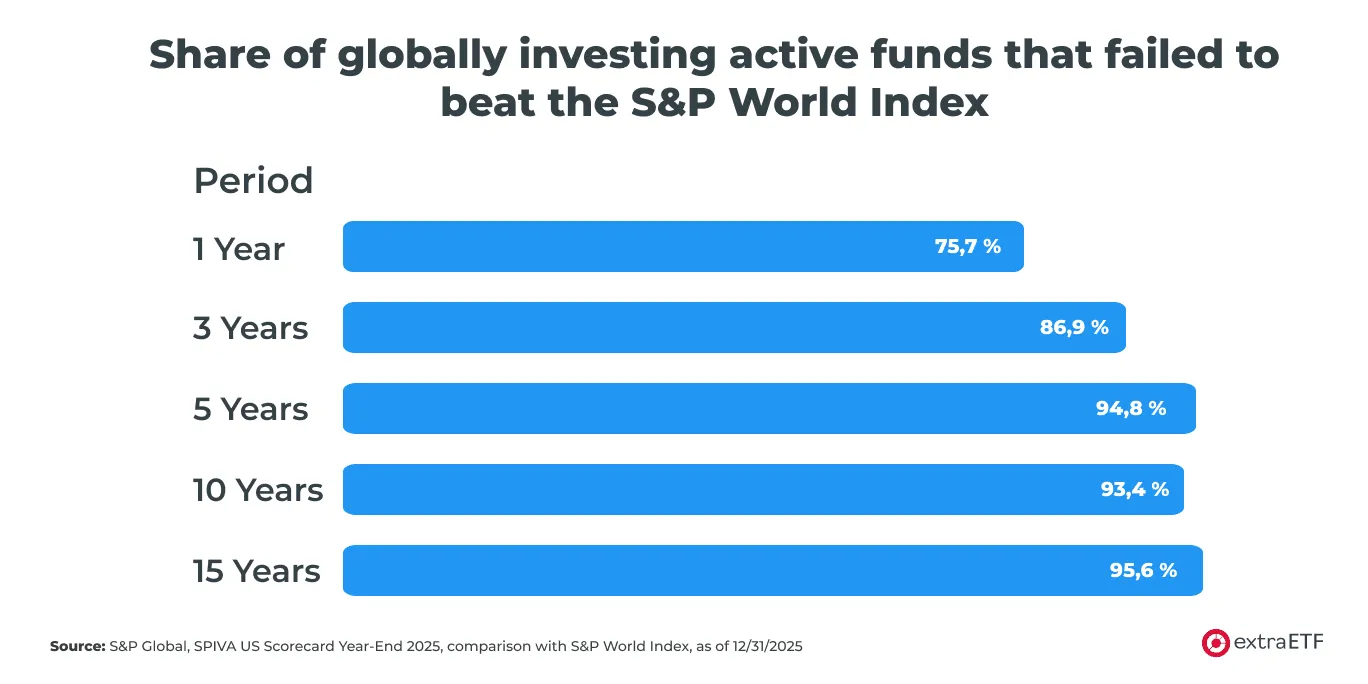
The SPIVA US Scorecard Year-End 2025 shows that 93.41 per cent of globally invested active funds failed to outperform their benchmark index, the S&P World, over ten years.
The results are equally clear for other periods. Over one year, 75.71 per cent of globally invested active funds underperformed their benchmark index; over three years, 86.94 per cent; over five years, 94.81 per cent; over ten years, 93.41 per cent; and over 15 years, 95.63 per cent. Only 24.29, 13.06, 5.19, 6.59 and 4.37 per cent respectively outperformed the S&P World.
The chart below illustrates the performance difference between ETFs and actively managed funds:
ETFs or Mutual Funds? A Clear Summary of the Pros and Cons
Here is how actively managed funds and ETFs compare, including their pros and cons:
| Actively Managed Funds | Passive ETFs | |
| Advantages |
|
|
| Disadvantages |
|
|
Conclusion: ETFs vs. Active Funds – Which Is a Better Fit for Me?
ETFs and actively managed funds can reduce your investment risk because they invest your money in a broadly diversified portfolio. Both are also held as ring-fenced assets, separate from the provider’s own.
Actively managed funds have a management team that seeks to beat the market. However, they usually fail to outperform their benchmark over the long term. ETFs, by contrast, passively track an index to deliver the market return.
Because they do not need a fund management team, ETFs are not only significantly cheaper but also highly transparent and easy to trade on the stock exchange. As a result, ETFs are usually the better choice for long-term investors.
The high transparency of ETFs gives you valuable information for your investment strategy. Together with your financial adviser, you can use it to manage, analyse and monitor your portfolio effectively.
More Questions on the Topic “Differences Between ETFs and Mutual Funds”
- A Summary of the Differences Between Mutual Funds and ETFs
- Explained simply: What are the differences between ETFs and active funds?
- ETFs or Mutual Funds? A Clear Summary of the Pros and Cons
- ETFs vs. Active Funds – Which Is a Better Fit for Me?
- More Questions on the Topic “Differences Between ETFs and Mutual Funds”
