



The Costs of Investing in ETFs
Analysis & Overview of Fees
Unlike active funds, ETFs are known for their extremely low costs. The saying “you get what you pay for” does not apply to them. ETFs involve no active fund management and simply track an index to deliver the market’s return. It is precisely the combination of low costs and low risk – thanks to broad diversification – that can contribute significantly to strong long-term returns. Costs vary from one ETF to another, which makes them an important selection criterion.
Below, we explain the key terms, show how ETF costs are structured and outline what investors should look out for.
The essentials in brief: ETF Costs at a Glance
Total Expense Ratio (TER): The TER represents the annual operating costs of an ETF. Despite its name, it does not cover all costs.
Total Cost of Ownership (TCO): TCO is the total cost of buying and holding ETF shares. Besides the TER, it may include dealing fees and the cost of rebalancing the portfolio.
Average Costs: The average annual cost of ETFs across all asset classes is 0.37 per cent (excluding leveraged ETPs; as at 31 August 2022).
Comparison: The ongoing costs of ETFs are typically significantly lower than those of actively managed funds. For example, equity ETFs charge between 0.04 and 0.95 per cent per year, while the annual costs of actively managed equity funds often range between 1.5 and 1.8 per cent.

Find and compare thousands of ETFs. Use powerful filters, detailed analytics, and independent data to discover the right ETF for your portfolio.
Fees: How much do ETFs cost?
The costs associated with ETFs are primarily determined by the total expense ratio (TER), which for equity ETFs typically ranges from just 0.04 to 0.95 per cent per year and includes, among other things, the ETF’s management fees. Many ETFs also have low trading costs and a narrow spread – the difference between the bid and offer prices. Other costs, such as custody fees, transaction costs and taxes, may also apply.
Unlike many actively managed funds, ETFs carry no one-off initial charge when you buy them, and no exit fee when you sell. With online platforms – many of which charge no custody fee at all – ETFs can often be bought and sold at very low cost.
ETFs are also considerably more cost-efficient than actively managed funds because they involve no ongoing portfolio reshuffling, which keeps transaction costs to a minimum.
In detail: What costs can I expect with ETFs?
There are a number of costs associated with ETFs. The Total Expense Ratio (TER) gives investors a good overview of an ETF’s ongoing costs.
This includes the ETF’s management fees, custody fees, licensing fees and distribution costs.
However, there are also costs that are not included in the TER. These can include, for example, transaction costs or taxes payable on investment income. Swap fees may also apply to swap ETFs or synthetically replicated ETFs.
The table below summarises the costs:
| Costs | Description |
|---|---|
| Included in the Total Expense Ratio (TER) | |
| Administrative fees | Management and operating costs |
| Custody fees | Fees for the safekeeping of the ETF’s assets |
| Licence fees | Licences to replicate the index |
| Distribution costs | Fees for the marketing and distribution of the product (e.g. brochures, exchange listing) |
| Not included in the total expense ratio (TER) | |
| Transaction costs | Costs that may arise when rebalancing the ETF portfolio (e.g. spreads) |
| Swap fees | Costs of the swap transaction in synthetically replicated ETFs |
| Securities lending income | Income generated from lending securities |
| Tax on investment income | Capital Gains Tax on profits above the annual exempt amount and Income Tax on dividends above the Dividend Allowance, for holdings outside an ISA or pension |
Total Cost Ratio: What is the Total Expense Ratio (TER)?
The Total Expense Ratio (TER) provides information about the annual costs of an ETF. The TER includes the following costs:
- Management fees
- Custody fees
- Licensing fees
- Distribution fees
You can find the total expense ratio (TER) in the factsheet for each ETF, which also contains a great deal of other important information. For example, a factsheet may show the TER like this:
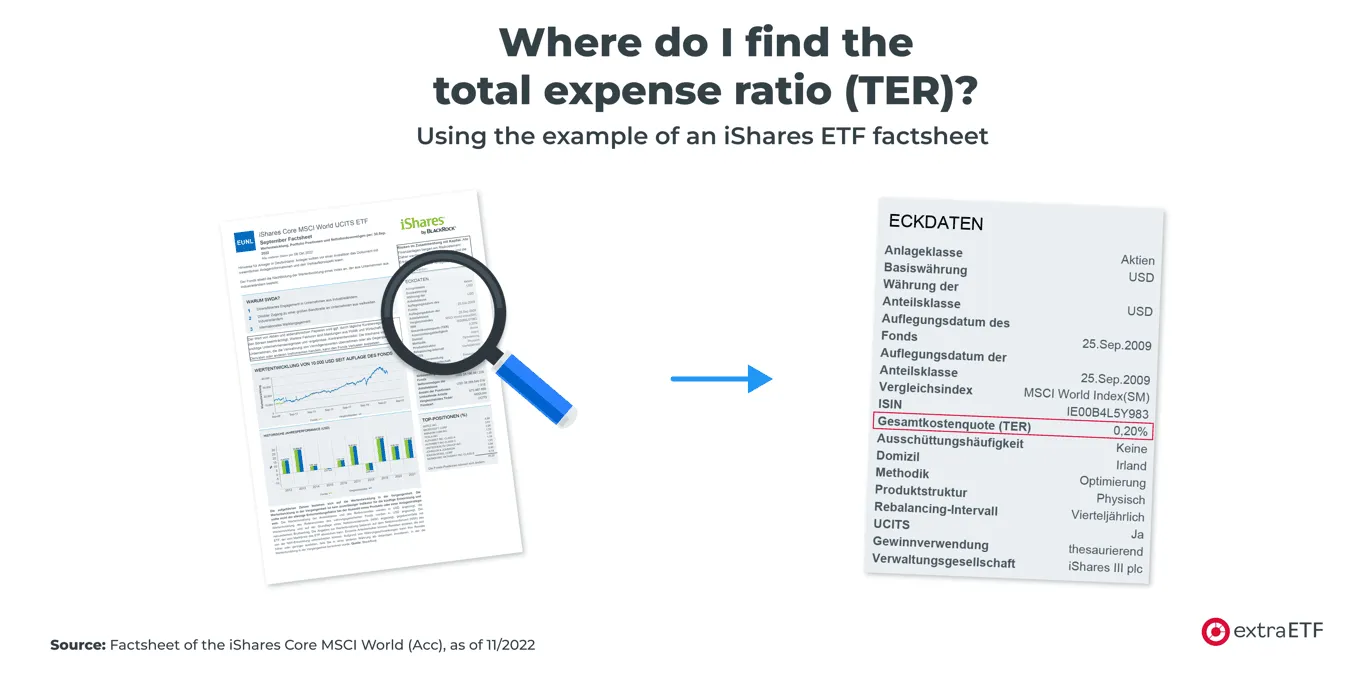
You can also find an ETF’s factsheet on its profile page on extraETF.com. These pages are accessible via the ETF search function, where you can also compare costs such as the TER across different ETFs.
Please note: ETFs with lower TERs do not necessarily yield higher returns.
What costs are not included in the TER?
The Total Expense Ratio (TER) does not include all of an ETF’s cost components. Even though these costs are not reflected in the TER, they still have an impact on the return of the respective ETF.
The following costs are not included in the TER:
- Transaction costs / rebalancing costs
- Swap fees
- Income from securities lending
- Tax optimisations
- Spread (bid-ask spread)
- Dealing fees
- Taxes
Join the extraETF community
Explore the world of ETFs and make informed investment decisions.
- Find ETFs that match your criteria with our ETF Search.
- Compare costs, performance, and risk side by side.
- Save your favourites to a watchlist and receive price alerts.
- Explore detailed ETF profiles with key metrics and holdings.
Total Cost of Ownership (TCO): All ETF Costs in a Single Metric?
The Total Cost of Ownership (TCO) represents the total costs associated with purchasing and holding ETF shares. In addition to an ETF’s internal costs – which include the Total Expense Ratio (TER) – it also takes into account external costs that arise, for example, when trading ETFs. The Total Cost of Ownership is therefore the sum of these internal and external costs of an ETF:
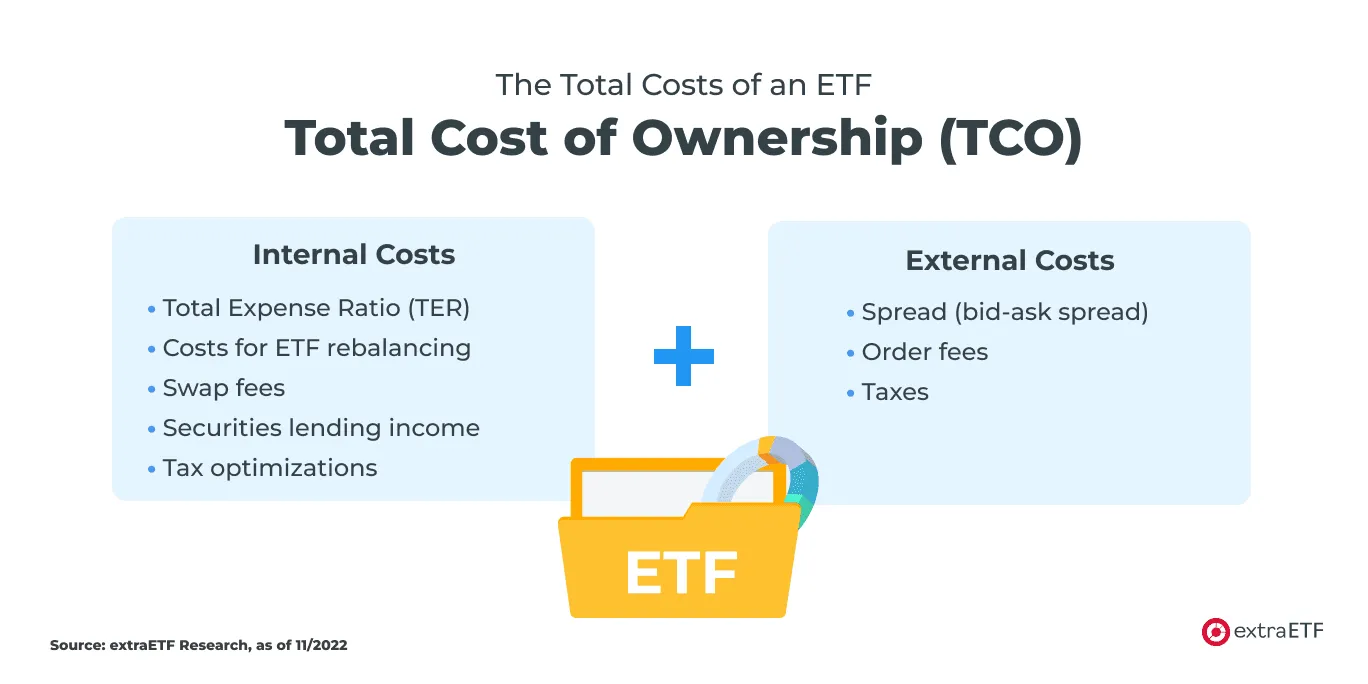
However, the calculation of the total cost of ownership is not regulated by law, so it does not appear in ETF factsheets. Investors should nevertheless familiarise themselves with an ETF’s total costs before buying. The tracking difference, which we explain briefly below, is also a useful guide.

ETFs are particularly low-cost, but they still incur fees
The Tracking Error for ETFs
Anyone choosing an ETF rightly expects two things: low costs and the closest possible tracking of the index.
The total expense ratio, often abbreviated as TER, is easy to find for any ETF, but that is only half the story. An ETF rarely tracks the index exactly one-to-one. Its performance usually ends up slightly above or below the index. This deviation is known as the tracking difference. The main reasons for it are income from securities lending and tax benefits.
extraETF.com departs from the conventional definition and calculates the tracking difference as follows:
Tracking Difference = Index Performance – ETF Performance
This makes it easier to compare the tracking difference with the total expense ratio.
An ETF with a TER of 0.30 per cent and a tracking difference of 0.10 per cent has therefore actually cost an investor only 0.10 per cent – less than the stated TER. The ETF provider earned the 0.20 per cent difference through the methods mentioned earlier, which added to the ETF’s performance.
When choosing an ETF, look at the tracking difference over a longer period, as it can fluctuate significantly.
Example: How can you calculate ETF costs?
It is difficult to give a single figure for the cost of investing in an ETF, because the factors that influence it differ widely from one investor to another. While the Total Expense Ratio (TER) is the same for everyone, dealing fees, account maintenance fees and exchange fees can vary significantly.
The following example illustrates the various costs involved. Suppose you invest £10,000 in an ETF, with purchase fees of £29.90. The value of the investment grows by 5 per cent a year. After five years, the holding, valued at £12,155, is sold, incurring a further £35.29 in sales fees. Including the TER deducted within the ETF, total costs in this example come to £230.96.
| Amount | TER | Costs | |
|---|---|---|---|
| Purchase fees | 0.25% + £4.90 | £29.90 | |
| Year 1 | £10,000 | 0.30% | £30.00 |
| Year 2 | £10,500 | 0.30% | £31.50 |
| Year 3 | £11,025 | 0.30% | £33.08 |
| Year 4 | £11,576 | 0.30% | £34.73 |
| Year 5 | £12,155 | 0.30% | £36.47 |
| Sales fees | 0.25% + £4.90 | £35.29 | |
| Total costs | £230.96 | ||
Costs Vary Depending on the ETF's Replication Method
The total costs of an ETF can vary significantly depending on the replication method. For example, with full replication, additional rebalancing fees are incurred when the index is reweighted. Synthetically replicated ETFs, on the other hand, must pay additional fees to the swap counterparty.
The table below shows average costs, as a percentage, by replication method and asset class:
| Replication Method | All ETFs | Stocks | Bonds | Commodities | Real Estate |
|---|---|---|---|---|---|
| Physical | 0.32% | 0.31% | 0.21% | 0.35% | 0.38% |
| Full | 0.37% | 0.31% | 0.19% | 0.35% | 0.38% |
| Optimised | 0.25% | 0.30% | 0.22% | - | 0.42% |
| Synthetic | 0.41% | 0.33% | 0.27% | 0.58% | 0.37% |
| Funded | 0.43% | 0.27% | - | 0.46% | - |
| Unfunded | 0.32% | 0.33% | 0.27% | 0.32% | 0.37% |
ETF fees vary based on these criteria
ETF costs depend not only on the replication method. The asset class and the market tracked also play a part: the more exotic the market, the harder it is to access, which raises, among other things, the cost of trading the securities and managing the ETF.
Below, we look more closely at how ETF costs vary by asset and asset class:
Conclusion: What Investors Should Look for When It Comes to ETF Costs
As with any investment, costs have a significant impact on ETF returns. Even though ETFs are considerably cheaper than actively managed funds, investors should weigh up the costs carefully before investing.
Investors should compare different ETFs, for example those tracking the same index, such as the MSCI World. However, they should not focus solely on the total expense ratio (TER). As it does not include all costs, it is advisable to look closely at the total cost of ownership (TCO) and the fees charged by the relevant broker or trading venue.
extraETF’s ETF profile pages also contain a wealth of useful information that can influence costs, such as the tracking difference. Once you have bought an ETF, you can use a portfolio tracking tool to manage, analyse and monitor your portfolio.
These are the questions investors ask themselves about ETF costs
- ETF Costs at a Glance
- Fees: How much do ETFs cost?
- In detail: What costs can I expect with ETFs?
- Total Cost Ratio: What is the Total Expense Ratio (TER)?
- What costs are not included in the TER?
- Total Cost of Ownership (TCO): All ETF Costs in a Single Metric?
- The Tracking Error for ETFs
- Example: How can you calculate ETF costs?
- Costs Vary Depending on the ETF's Replication Method
- (Hidden) Costs Associated with Commodity ETCs
- ETF fees vary based on these criteria
- What Investors Should Look for When It Comes to ETF Costs
- These are the questions investors ask themselves about ETF costs
