



ETFs vs Individual Shares: What's the Difference?
Should I invest in ETFs or in individual stocks?
Many investors wonder whether they should invest in ETFs or individual shares. Both options have their pros and cons, so it’s important to understand the differences between shares and ETFs before deciding.
We explain why investing in individual shares and ETFs isn’t mutually exclusive, and what the differences are.
The essentials in brief: Better Understanding the Difference Between Stocks and ETFs
ETFs: Exchange-traded funds (ETFs) are index funds traded on a stock exchange. ETFs passively track the performance of an underlying index, which keeps costs low. One difference between active funds and ETFs is that ETFs aim to replicate market returns rather than beat them.
Shares: A share represents a stake in a company. When you buy shares, you become a part-owner of the company. This often entitles you to a share of the profits (a dividend) and voting rights.
Equity funds: Actively managed funds hold a portfolio of securities – in this case, shares. Fund managers aim to outperform the market through active share selection, but this comes with higher fees.

Find and compare thousands of ETFs. Use powerful filters, detailed analytics, and independent data to discover the right ETF for your portfolio.
What is the difference between ETFs and shares?
The difference between ETFs and shares is that shares are securities that represent an ownership stake in a company. ETFs, on the other hand, are baskets of various assets, such as shares, and can passively track entire indices or markets. Well-known indices include the FTSE 100 and the MSCI World.
The overview below sets out the key differences between ETFs and individual shares:
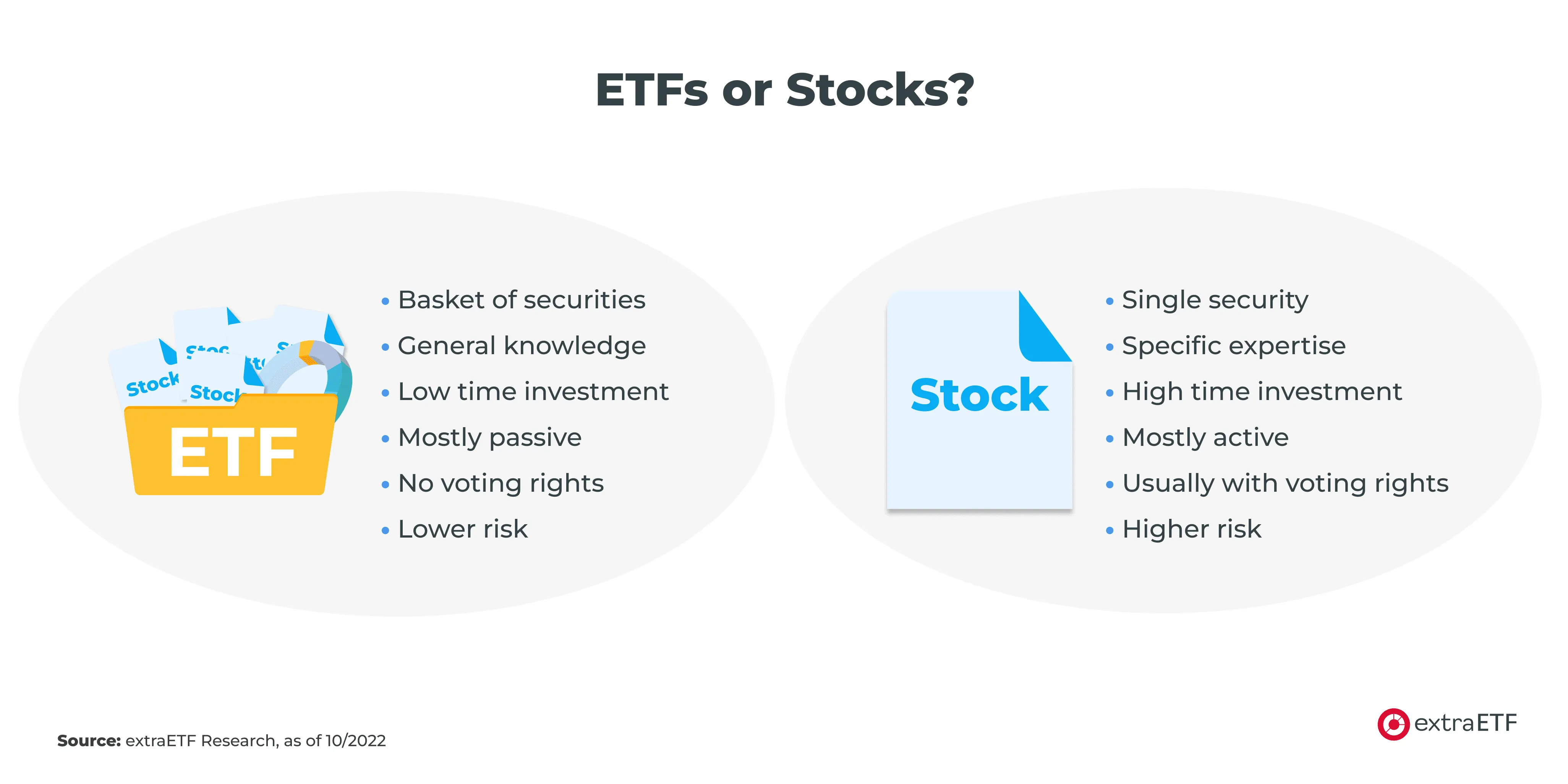
Unlike buying a single share, ETFs let you invest in hundreds or even thousands of companies at once. Because they hold numerous securities, the risk associated with ETFs is spread out and therefore generally lower.
Individual shares, on the other hand, depend on the performance of a single company, so the risk of a total loss is significantly higher if that company goes bust.
| ETFs | Shares |
| ETF stands for “exchange-traded fund”, a fund that tracks an index and is traded on a stock exchange. ETFs can hold shares, bonds, commodities or a combination of these. Their prices reflect the value of their underlying assets. | Shares are units of ownership in a company that are traded on a stock exchange. When you buy a share in a company such as Apple, you become a part-owner. Shareholders usually receive certain rights as a result, such as voting rights. There are different types of shares. |
When is it worth investing in individual shares?
Individual shares can be a worthwhile option for investors who want to target specific industries or companies and have a high risk tolerance. However, you need to be able to devote a significant amount of time to evaluating companies, examining their business models and management closely, and analysing key financial metrics.
To achieve the broad diversification that an ETF provides inherently, investors in individual shares must build it themselves. Otherwise, they risk putting all their eggs in one basket or taking on unnecessary concentration risk. This can happen easily when choosing shares that are correlated with one another.
The risk that ETFs will be insufficiently diversified or too heavily concentrated is far lower because they passively track an existing index. However, as well as global equity ETFs, investors can choose ETFs that track individual sectors, themes or investment strategies. Although these offer broader diversification than a single share, they are still a sector bet, which typically brings higher risk, less diversification, slightly higher fees and concentration risk.
Join the extraETF community
Explore the world of ETFs and make informed investment decisions.
- Find ETFs that match your criteria with our ETF Search.
- Compare costs, performance, and risk side by side.
- Save your favourites to a watchlist and receive price alerts.
- Explore detailed ETF profiles with key metrics and holdings.
Stocks or ETFs? It doesn't always have to be black or white!
Investors don’t necessarily have to choose between shares and ETFs. Savings goals, risk tolerance and investment horizons vary greatly from person to person, and the two approaches, though different, often complement each other well.
Looking at the difference between actively managed funds and ETFs, even professional fund managers – who actively buy and sell shares to beat the market – usually fail to outperform their benchmark ETFs over the long term. Nevertheless, a core-satellite strategy lets you combine a global equity ETF as the core of your investment with one or more satellites of thematic ETFs or individual shares. This allows investors to benefit from the advantages of both approaches, although higher potential returns come with higher risks. The weighting of each component should therefore match your personal risk tolerance. In any case, investors should thoroughly research any investment before committing funds and invest only in what they fully understand.

The core-satellite strategy allows you to combine ETFs and stocks
Before buying shares or ETFs, ask yourself the following questions:
- Do I want to take on higher risk or invest in a diversified portfolio?
- How long do I want to invest my money, and how much time do I want to devote to it?
- How much experience do I already have with the stock market?
Whether ETFs or individual shares are more suitable therefore depends heavily on your individual goals and risk tolerance. The table below summarises the differences between ETFs and individual shares:
| ETFs | Shares | |
|---|---|---|
| Investment horizon | At least 15 years | Flexible |
| Diversification | Already diversified | Exposure to individual companies |
| Potential returns | ETFs track an index and so move in line with the market | Investors aim to beat the market |
| Risk | Diversification significantly reduces risk | Higher risk of total loss due to concentration in individual companies |
| Time commitment and prior knowledge | ETFs are also suitable for beginners | Building wealth with individual shares is more complicated and requires prior knowledge |
| Costs | The costs of ETFs are very low, which makes them well suited to long-term wealth building | Constant buying and selling can make investing in individual shares very expensive |
Conclusion: Are ETFs or individual stocks better?
There is no one-size-fits-all answer to whether ETFs or individual shares are better, as each has its own characteristics, advantages and disadvantages. Investment goals, investment horizons and risk tolerance also vary greatly from person to person.
One argument in favour of buying individual shares is that you can invest specifically in selected companies. The advantage of ETFs is the opposite: built-in diversification. You can diversify with individual shares, but building a portfolio as broad as an ETF takes significantly more effort and costs more.
A share screening tool can help you search for suitable shares for your portfolio.
We'll answer more questions on the topic of "Individual Stocks or ETFs?"
- Better Understanding the Difference Between Stocks and ETFs
- What is the difference between ETFs and shares?
- When is it worth investing in individual shares?
- Stocks or ETFs? It doesn't always have to be black or white!
- Are ETFs or individual stocks better?
- We'll answer more questions on the topic of "Individual Stocks or ETFs?"
