How to Sell ETFs
What you need to know before selling your ETFs

When you sell an ETF, you “realise” a gain or loss. Like shares, ETFs have a market price. If this price is higher at the time of sale than it was when you bought the ETFs, you’ve realised a capital gain.
The sale proceeds, including any profit, are credited to your account. If you sell at a loss, you receive less than you paid. Here is what to bear in mind when selling ETFs.

The essentials in brief: What You Should Know About Selling ETFs.
Reasons: There are various reasons why you might want to sell an ETF – or part of your holding. For example, you may have reached your savings goal and want to access your capital and profits, or the ETF may not have performed as you had hoped.
Timing: There is no single “perfect” time to sell an ETF. The decision depends largely on your personal investment and savings goals, although the ETF’s performance can also play a role.
Costs: Selling an ETF involves costs, such as dealing fees and, potentially, tax. The spread can also vary, so factors such as ETF trading hours can play a role.
Taxes: If you realise a gain on your ETFs, you may owe Capital Gains Tax. Holding ETFs in a Stocks and Shares ISA or SIPP shelters your gains, and outside these accounts you can make use of your annual Capital Gains Tax allowance.

Find and compare thousands of ETFs. Use powerful filters, detailed analytics, and independent data to discover the right ETF for your portfolio.
What are some reasons to sell ETFs?
There are various reasons why you might want to sell your ETFs and turn your investment back into cash.
These include:
- You’ve reached your savings goal
- You’re planning a major investment and need the money
- You’re approaching retirement and want to use the capital to maintain your current standard of living
- The price has risen sharply and you want to take your profits
Of course, an ETF may also fail to perform as well as you had hoped, and you may want to sell for that reason. To limit further losses, it can make sense to sell if prices are falling and there is no prospect of long-term recovery – for example, with thematic ETFs that lack sufficient diversification. Even so, consider this decision carefully: investing in ETFs is typically a long-term strategy.
Investors who diversify sufficiently, take a long-term view – for example, using a buy-and-hold strategy in a global equity ETF – and stay calm during crises may be rewarded over time. Fluctuations in ETF performance are perfectly normal. Nobody can predict exact returns, but falling prices may recover over the long term, making up for losses built up over several years or even decades.

Don't Panic When Investing for the Long Term with ETFs
 Markus
When should I sell ETFs?
There is no one-size-fits-all answer to when you should sell an ETF. Since future performance can never be predicted, there is no single perfect time to sell ETFs. The decision to sell ETFs depends, among other things, on your personal investment goals, your investment strategies involving ETFs, your investment horizon, and the ETF’s performance.
The trading hours of ETFs determine when you can or should sell. This depends on the opening hours of the relevant stock exchange and the ETF’s current liquidity. Bear this in mind to avoid unnecessary costs.
For example, the London Stock Exchange’s main trading session runs from 8am to 4.30pm, Monday to Friday. Investors can still submit an order to their broker when the exchange is closed – for instance, at 11pm or at the weekend. However, this may result in higher costs, and the order will not be executed until the exchange reopens on the next trading day.
How do you sell ETFs?
Selling ETFs is similar to the process used when buying them and is done by placing a sell order through your broker or online investment account. First, however, you should decide how many units of the ETF you want to sell and at what price. You should also consider the trading hours with the highest liquidity and lowest spreads, as well as the tax implications and any additional fees. The chart below illustrates the process of selling ETF units:
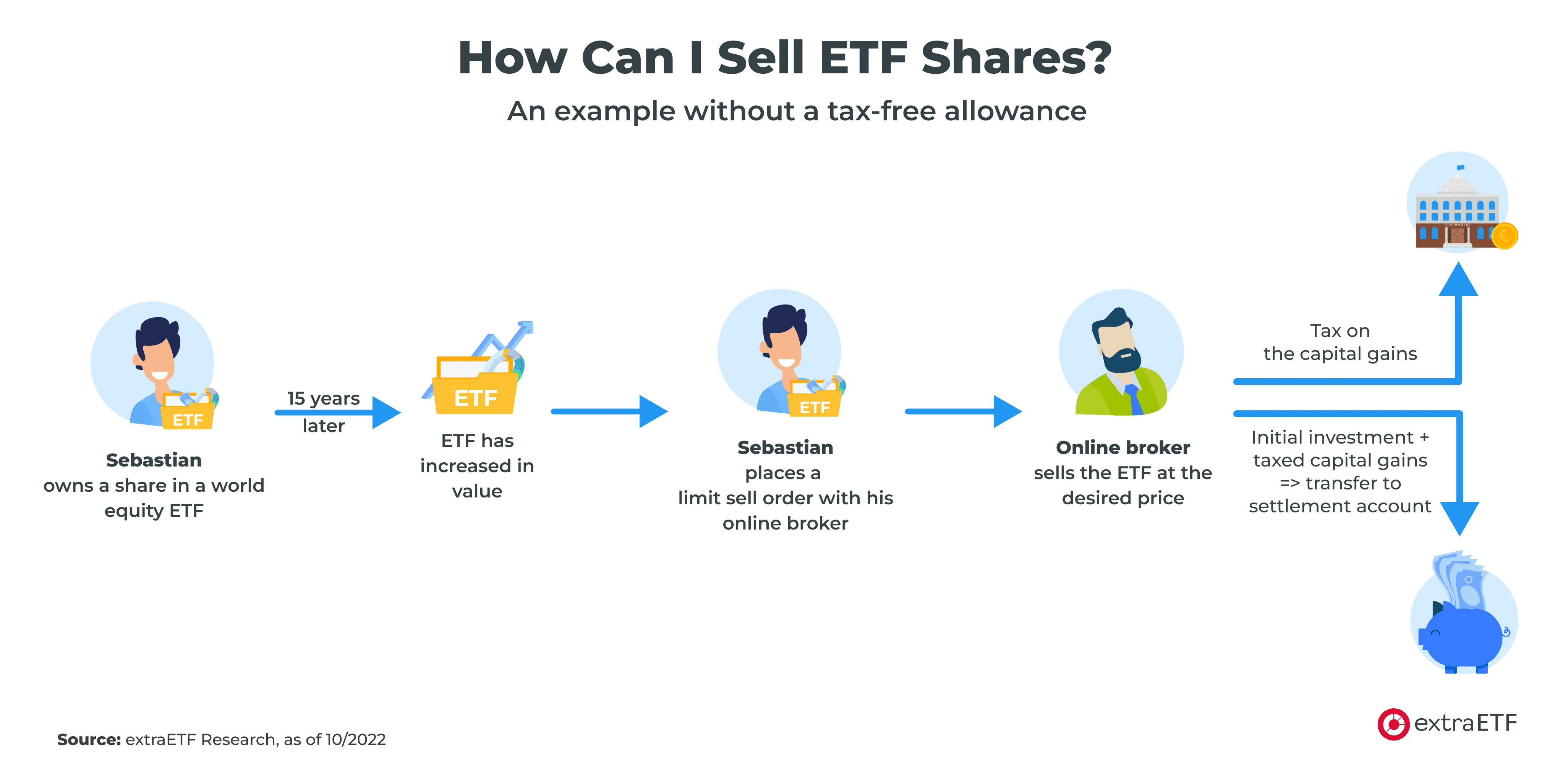
Simply log in to your online investment account or your broker’s platform. There you’ll see the ETFs you own, your average purchase price and each ETF’s current price.
You then place a sell order, entering the number of ETF units you want to sell. As with buying, it’s best to use a limit order so that you don’t sell at too low a price. Some brokers also offer automatic selling plans that sell units at regular intervals.
What costs will I incur when I sell my ETFs?
As when buying ETFs, you should expect to pay dealing fees when selling them, and the amount varies by provider. Your broker will often charge a commission, which may be variable or fixed. An exchange or trading venue fee may also apply.
So, when selling ETFs, you should compare providers and exchanges and keep an eye on the relevant fees and the spread. Realised capital gains may also be reduced by any tax you owe. Overall, when investing in ETFs, it’s important to keep an eye on the costs associated with ETFs.
Join the extraETF community

Explore the world of ETFs and make informed investment decisions.
- Find ETFs that match your criteria with our ETF Search.
- Compare costs, performance, and risk side by side.
- Save your favourites to a watchlist and receive price alerts.
- Explore detailed ETF profiles with key metrics and holdings.
Taxation on the Sale of ETFs
As well as the costs of selling, remember that tax may apply to your ETF returns. Depending on how the ETF performs and when you sell, you may have realised a gain on which tax is due.
Gains from selling ETFs held outside an ISA or pension are subject to Capital Gains Tax. However, you have an annual tax-free allowance of £3,000 per year. Married couples and civil partners each have their own allowance and can transfer assets between them without a tax charge. Gains above the allowance are taxable at 18 per cent for basic-rate taxpayers and 24 per cent for higher and additional-rate taxpayers. Gains on ETFs held in a Stocks and Shares ISA or SIPP are free of Capital Gains Tax.
Losses can be offset against gains made in the same tax year, and unused losses can be carried forward if you report them to HMRC within four years. Dividends from a distributing ETF are taxed as income once you exceed the £500 Dividend Allowance, regardless of any losses on your sales.
Can I also sell ETFs bought through regular investing?
Selling ETFs held in a regular ETF investment plan works the same way as selling ETFs bought as a lump sum. You can use the order form provided by your broker or provider to sell the ETFs in your portfolio. Whether you can sell your entire holding or only part of it may depend on your broker or provider.

Conclusion: What should you keep in mind when selling ETFs?
ETFs are traded on the stock exchange just like shares or actively managed funds. However, you cannot buy or sell these exchange-traded index funds directly on the stock exchange. Instead, you need an investment account with a bank, broker or online platform, through which you place your buy and sell orders. Once you’ve reached your savings goal – ideally after several years – you can sell all or part of your ETF holding through your investment account.
With a portfolio tracking tool, you can easily manage, analyse and monitor your ETF portfolio. This way you can keep track of your ETFs and check at any time whether you’ve reached your investment goal and want to sell.