



Regular ETF Investing: What Is It and How Do You Start?
Everything you need to know about costs, monthly amounts, and choosing the right ETFs
Regular investment plans play a special role in building wealth with ETFs. Even with a small amount of money, ETFs bought through a regular investment plan are an excellent way to invest. Flexibility, low costs and a wide choice of funds are making these plans increasingly popular. Consumer groups also widely recommend them as a suitable way to build long-term wealth.
In this article, we explain how regular ETF investing works and how you can use it to build your wealth.
The essentials in brief: Everything You Need to Know About the Regular ETF Investing at a Glance
Definition: You invest a set amount in ETFs at regular intervals. Some providers let you start from as little as £1 a month.
Comparison: Options vary widely. Use our broker comparison service to see what different providers offer.
Retirement Planning: Regular investment plans are ideal for building wealth over the long term. They offer low-cost, broadly diversified exposure to shares.
Calculator: Use our regular investing calculator to work out how much your investment could be worth at the end of the investment period.

Find and compare thousands of ETFs. Use powerful filters, detailed analytics, and independent data to discover the right ETF for your portfolio.
Explanation: What is a regular ETF investment plan?
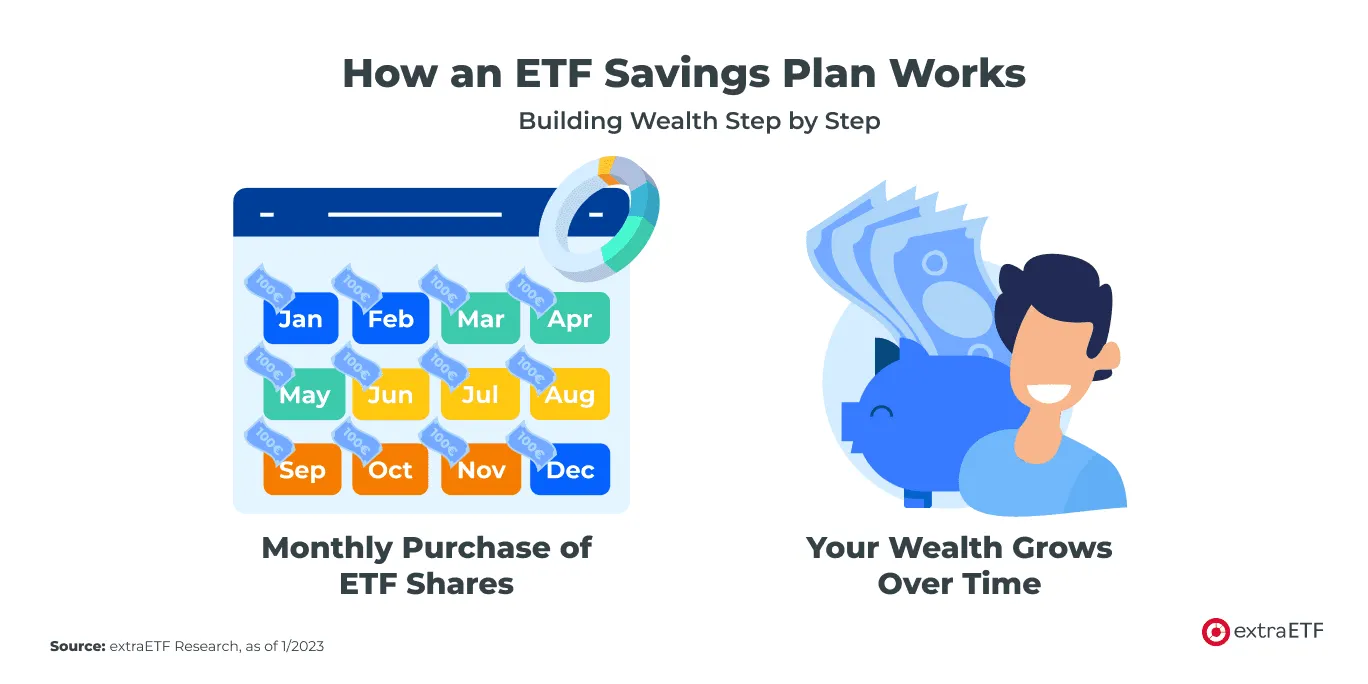
A regular ETF investment plan is a standing order to buy ETFs at regular intervals, in which a set amount is invested in exchange-traded funds (ETFs) on a regular basis. You instruct your broker or bank to buy a set amount of ETF shares for your investment account each month. The amount needed to purchase the ETFs is debited from your linked cash account. Alternatively, you can have it debited from your current account.
A regular investment plan lets you invest steadily in small amounts, rather than putting a larger sum into an ETF all at once. It is a good way to build wealth over the long term, as you invest regularly and benefit from pound-cost averaging.
When does a regular investment plan make sense?
A regular investment plan suits anyone who wants to build wealth over the long term but can only invest a small amount each month. Plans are available from as little as £1 a month, so there’s no reason not to start one.
A regular investment plan is an easy, affordable way to start investing in ETFs. Over a long period, it lets you build up a portfolio of securities for retirement or another goal, and take full advantage of compounding. Depending on your finances, you can invest in ETFs through regular investing or a lump sum.
Join the extraETF community
Explore the world of ETFs and make informed investment decisions.
- Find ETFs that match your criteria with our ETF Search.
- Compare costs, performance, and risk side by side.
- Save your favourites to a watchlist and receive price alerts.
- Explore detailed ETF profiles with key metrics and holdings.
The Benefits of a Regular Investment Plan at a Glance
With a regular investment plan, you can invest in ETFs regularly and automatically. It works with small contributions and can be tailored flexibly to your needs. Costs are low, and with some providers a regular investment plan for ETFs is even free. The other advantages of ETFs – such as significantly lower fees than actively managed funds – also apply to ETFs bought through a regular investment plan.
Are there any downsides to a regular investment plan?
A regular investment plan has only a few drawbacks. One is that ETF investors cannot earn returns above those of the underlying index. Another is that relying solely on shares is risky. It is better to build a broadly diversified portfolio across various asset classes through a regular investment plan – or through several plans.
ETFs cannot beat their indices, but over the long term they still deliver better returns than most active funds, which tend to lag their benchmarks by a wider margin.
What return can I expect from a regular investment plan?
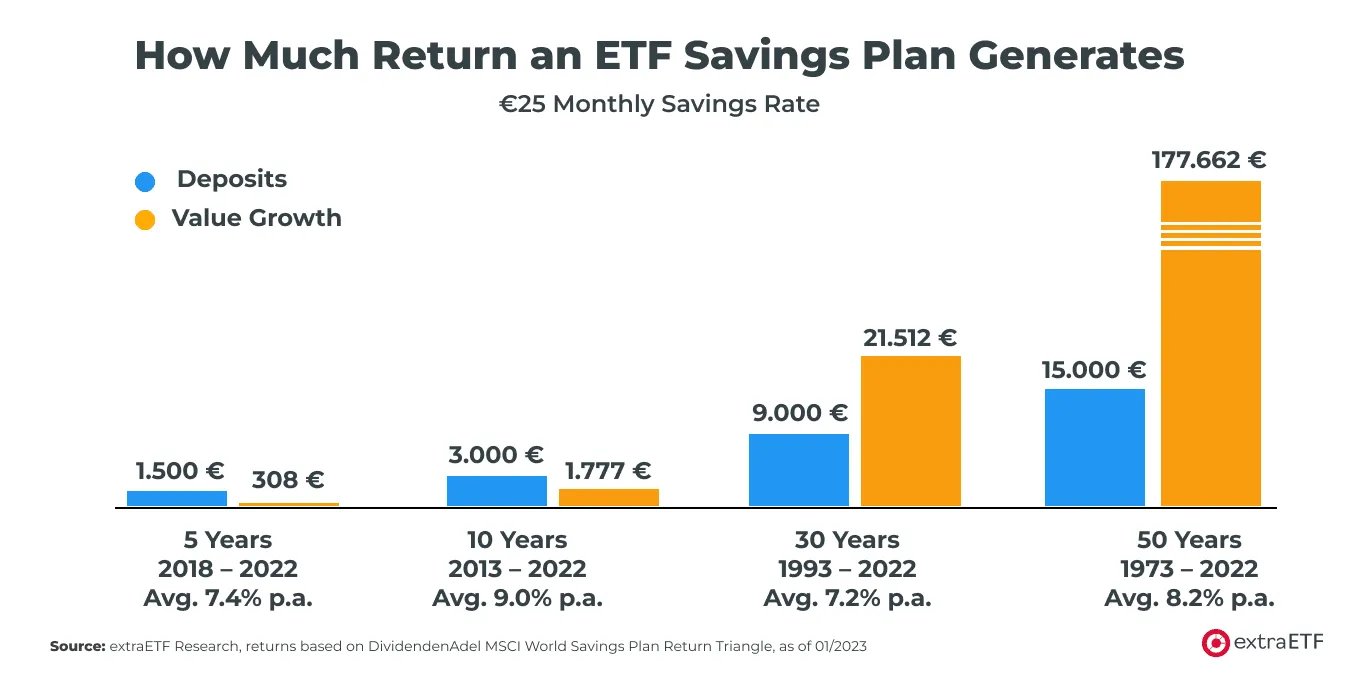
Over the long term, a broadly diversified ETF portfolio can be expected to return an average of 4% to 6% a year. Combined with compounding and a long-term investment horizon, this should help your portfolio grow significantly. Use our regular investing calculator to run through various scenarios.
The DividendenAdel website publishes an annual return triangle for the MSCI World Index, showing returns over various investment horizons. It also calculates a return triangle for a regular investment plan based on the index, showing what investors could have achieved over the long term by investing regularly. Here we summarise the results for 5-, 10-, 30- and 50-year periods.

Use broadly diversified ETFs for your Regular ETF Investing
Fees: How much does a regular investment plan cost?
Standard fees for a regular investment plan range from 0.2% to 2.5% of the monthly contribution. This means a plan with a monthly contribution of £100 costs between £0.20 and £2.50 per transaction. It’s significantly cheaper with online brokers, or if you set up a plan as part of a promotional offer.
The cost of a regular investment plan varies from provider to provider. With an online broker, you can usually set one up for free. Many traditional banks also let you invest in a limited selection of ETFs at no cost. These promotional ETFs are offered in partnership with ETF providers, but usually only for a limited time. As well as low or no fees on the plan itself, choose an investment account with no account fees.
How do I set up an Regular ETF Investing?
Here's how to set up a regular investment plan with your broker in four steps.
First, you'll need a investment account. You can open one for free at many banks. Use our Regular ETF Investing comparison to find the best providers.
In the second step, you’ll select an ETF for your Regular ETF Investing. We recommend ETFs that track broadly diversified indices, such as the MSCI ACWI Index or the FTSE All-World Index. By investing in these ETFs, you’ll be investing in several thousand stocks from around the world.
In the third step, you set up the Regular ETF Investing with your bank. To do this, you’ll need to specify the savings amount, set the frequency of contributions, and select the desired contribution date. You can often also choose whether the savings amount should increase annually through index-linked adjustments.
In the fourth step, you decide which account the savings amount for your Regular ETF Investing should be debited from. On the next execution date, your bank will execute your Regular ETF Investing according to the specified terms.
Recommendation: The Most Popular ETFs for a Regular Investment Plan
Regular investment plans are designed for long-term wealth building, so the most popular ETFs are those best suited to that goal. We recommend ETFs that track broadly diversified indices.
ETFs that track the MSCI World Index or the MSCI Emerging Markets Index – or a combination such as the MSCI ACWI Index or the FTSE All-World Index – are considered broadly diversified. With these ETFs, you invest in several thousand shares, spreading your risk widely.
We have analysed the key characteristics of ETFs in depth. Our recommendation lists feature the best ETFs for the major asset classes.
Conclusion: Here's What You Should Keep in Mind About an Regular ETF Investing
A regular investment plan is an excellent way to build wealth over the long term. Make sure the fees are low. With our broker comparison service, you can find the best offers.
To reduce the risk, invest in a broadly diversified portfolio. ETFs tracking global stock indices such as the MSCI World, MSCI ACWI or FTSE All-World are well suited to this.
By investing in exchange-traded index funds over the long term, you can benefit from compounding and build a substantial nest egg. With a portfolio tracking tool, you can monitor how your portfolio is performing and spot early on if you are falling short of your investment goal.
We'll answer any other questions you may have about the Regular ETF Investing
- Everything You Need to Know About the Regular ETF Investing at a Glance
- Explanation: What is a regular ETF investment plan?
- When does a regular investment plan make sense?
- What return can I expect from a regular investment plan?
- Fees: How much does a regular investment plan cost?
- How do I set up an Regular ETF Investing?
- Recommendation: The Most Popular ETFs for a Regular Investment Plan
- Here's What You Should Keep in Mind About an Regular ETF Investing
- We'll answer any other questions you may have about the Regular ETF Investing
