Advantages and Disadvantages of ETFs
Why are ETFs so popular?
ETFs are becoming increasingly popular and have long since entered the mainstream. Millions of people are already taking advantage of ETFs and investing their money in these low-cost index funds, mostly through regular investing. ETFs are investment funds that passively track an index at very low fees. Investors benefit from the broad diversification and risk spreading offered by ETFs and can achieve very good long-term stock market returns with these products.
Today, this is more important than ever. If you keep your money in a current account or easy-access savings account, you’ll earn little or no interest these days. Some banks have even charged negative interest on savings. On top of that, the recent sharp rise in inflation means the value of your money is steadily declining.
ETFs offer a way out of this predicament. But how can you make the most of them? And what are the potential drawbacks of ETFs?
We outline the pros and cons of ETFs and answer your questions so you can decide whether they are the right investment for you.
The essentials in brief: Summary of the Pros and Cons of ETFs
ETFs: ETFs (Exchange-Traded Funds) are index funds that can be traded on the stock exchange and passively track a specific index, such as the MSCI World or the German Stock Index (DAX). Investors can buy shares in an ETF on the stock exchange.
Advantages: ETFs are low-cost and transparent, can be bought or sold on the stock exchange at any time, and offer greater diversification than individual stocks. You can invest through regular investing, and your money is protected if your ETF provider becomes insolvent, because ETFs are classed as segregated assets that are legally separate from the provider’s own.
Disadvantages: ETFs are subject to the usual stock market price fluctuations. Providers may also lend out the securities held in the fund, which creates a default risk. Although ETFs can be traded at any time, they are less suitable for short-term investing.

Find and compare thousands of ETFs. Use powerful filters, detailed analytics, and independent data to discover the right ETF for your portfolio.
What Are ETFs and How Do They Work?
With ETFs, you can invest your money and build wealth easily and affordably. ETF stands for “Exchange-Traded Fund.” An ETF is an investment fund that tracks a specific securities index. You can invest in stocks, bonds, commodities and even cryptocurrencies with ETFs. An ETF tracks the performance of a stock market index. An index is a basket of securities, often hundreds or even thousands of them. The MSCI World stock index includes approximately 1,600 stocks from about 23 developed countries. An ETF that follows the MSCI World Index tracks the performance of all these individual stocks. So, with an MSCI World ETF, you automatically hold about 1,600 stocks and benefit from their returns. Performance is measured in percentages (for example, +7 per cent).
Another very well-known example of a stock index is the DAX Index (German Stock Index). The DAX comprises Germany’s 40 largest stocks. Another well-known index is the FTSE All World Index. This is an international stock index that tracks the performance of companies from developed and emerging markets.
So what is the difference between actively managed investment funds and ETFs? With actively managed funds, fund managers try to generate the best possible return, choosing which securities to buy and constantly adjusting the portfolio. While this sounds good in theory, it has two major drawbacks.
- Active funds charge much higher fees than ETFs.
- Over the long term, most actively managed funds fail to outperform ETFs. Low fees and attractive returns are two major advantages of ETFs.
Join the extraETF community
Explore the world of ETFs and make informed investment decisions.
- Find ETFs that match your criteria with our ETF Search.
- Compare costs, performance, and risk side by side.
- Save your favourites to a watchlist and receive price alerts.
- Explore detailed ETF profiles with key metrics and holdings.
What are the advantages of ETFs?
The main advantages of ETFs are low fees and broad risk diversification. That’s why ETFs are also ideal for regular investing or a one-off investment. You can keep things simple and avoid high costs while building wealth. Here are the other benefits ETFs offer.
- Low Costs & Fees
- Transparency
- Risk Diversification
- Higher potential returns than traditional savings products
- Security, as they are investment funds
- Flexibility & quick liquidity
- Suitable for regular investments
- Suitable even for smaller savings amounts
- Can be chosen to match your interests, e.g. sustainability
Below, we explain the benefits of ETFs step by step and show why they are an excellent choice for your investments.

That's why ETFs are a must!
Cost Efficiency
ETF costs are very low because passive index tracking removes the need for high management fees. This makes ETFs one of the most popular investment vehicles.
Buying an active fund typically incurs an initial charge of up to 5 per cent of the purchase price. ETFs, on the other hand, have no initial charge. Annual charges for active funds are typically around 1.5 to 2 per cent of the fund’s assets. The costs for ETFs are significantly lower, ranging from 0.05 per cent to a maximum of 0.8 per cent.
Higher fees on active funds mean lower returns for investors. With ETFs, you avoid these costs and improve your chances of earning higher long-term returns than with an active fund – a clear advantage of ETFs.
Looking for tips on choosing ETFs? Check out our ETF recommendations or browse our ETF list, where you'll find all the key information on each ETF.
Transparency
The costs and all other important information about an ETF are clearly set out in factsheets. You can find the factsheets for each ETF on the ETF profile pages at extraETF.
Investors know exactly which securities their ETF holds, because its composition mirrors the index. This transparency lets you invest in line with your personal priorities. For example, if sustainability is particularly important to you, you can invest in sustainable ETFs. If you prefer to invest regionally, there are numerous country and regional ETFs available.
You can also track an ETF’s performance transparently at any time, as we provide real-time prices on the ETF profile pages on extraETF.
Risk Diversification
Compared to individual stocks, ETFs offer greater security for investors. This is because ETFs track the performance of a stock market index, which often contains hundreds, if not thousands, of securities. A single ETF can therefore provide very broad diversification for your portfolio.
This is known as diversification, and it is one of the biggest advantages of ETFs: it spreads risk far more effectively than investing in a single stock.
For example, an equity ETF tracking the MSCI World Index holds approximately 1,600 stocks. This significantly reduces risk compared with investing in a single stock, as that company could go bankrupt or lose significant value in a short time. With an MSCI World ETF, on the other hand, it’s very unlikely that all 1,600 companies would go bankrupt at the same time. This gives ETFs a major advantage over individual stocks.
Return
The returns on an ETF depend on the securities included in the ETF. Many investors use ETFs to invest in stocks. Over several decades, stocks have delivered the best returns. However, there are also ETFs that track other assets such as bonds, commodities or cryptocurrencies.
Earning 3 or 4 per cent on an easy-access savings account? Those days are long gone. Today, you barely earn any interest at the bank. On top of that, inflation erodes the value of your money, reducing your purchasing power and, with it, your wealth. With passively managed index funds, you have a realistic chance of beating inflation over the long term, depending on which ETFs you choose, your investment horizon and your asset allocation.
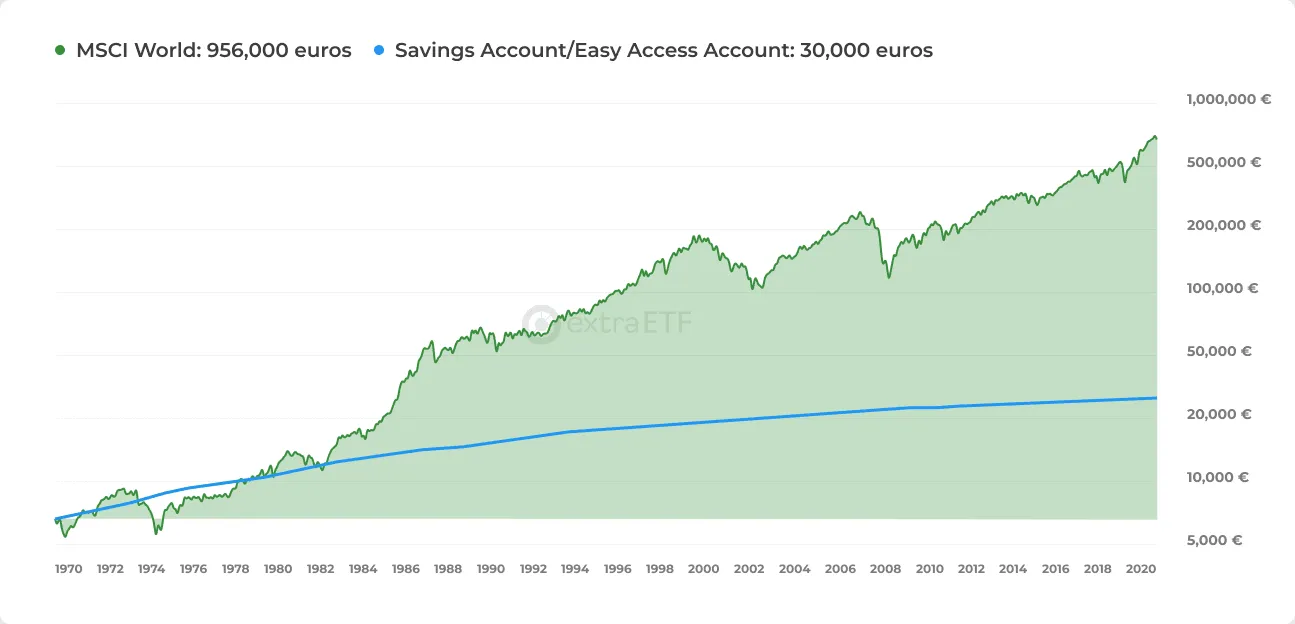
For example, a long-term investment in an equity ETF can yield returns of around 9 per cent. From 1970 to 2020, the MSCI World Index averaged 9.21 per cent per year. These returns came despite periods of market downturns and even stock market crashes.
When it comes to interest and dividends, ETFs are at no disadvantage compared with individual stocks or other securities, as you receive these with ETFs too. ETFs can distribute the interest and dividends they generate directly to your account (a distributing ETF) or reinvest them automatically (an accumulating ETF). If you choose an accumulating ETF, you’ll make the most of the compounding effect.
Here’s how €10,000 would have grown over the past 50 years
Security
ETFs are securities traded on the stock exchange, so their prices fluctuate. In the worst case, this can result in losses, and there is no guarantee that you will get back all the money you invest. Bear this in mind when weighing up the pros and cons of ETFs.
However, ETFs offer a very high level of security in other respects. They are classed as “segregated funds”, meaning the ETF’s assets are held separately from the provider’s own. If the provider becomes insolvent, your ETF holdings are protected. However, this does not apply to so-called ETCs or ETNs, which are specialised exchange-traded products. For more information, read our article “The Difference Between ETFs and ETCs”.
Flexibility and Liquidity
One advantage of ETFs is that they have no fixed term, so you can cash out at any time by simply selling the fund on the stock exchange. ETFs can be bought and sold during trading hours, even several times a day, so you have access to your money whenever you need it. You can also choose whether to invest through regular investing or with a lump sum.
Investing in ETFs is therefore as flexible as life itself. Even so, it’s best to view them as a long-term investment, because their market value can fluctuate. You’ll get the best returns by holding ETFs for the long term, which is the best way to build wealth.
Regular Investing, Even for Small Amounts
Millions of investors have already chosen regular ETF investing as their preferred way to build wealth. Many brokers and banks offer regular ETF investment plans on very favourable terms, often free of charge. You don’t need a large initial investment: you can start with just £1 a month, or choose amounts such as £25, £50, £100 or more.
The advantage of regular ETF investing: You can decide whether your regular ETF investment plan is executed monthly, quarterly or at another interval. You can also choose the execution date to align it with payday. As a result, ETFs and regular investing suit both large and small budgets.
Number of regular ETF investment plans executed in Germany, 2017–2021

What are the disadvantages of ETFs?
The disadvantages and risks of ETFs depend largely on the composition and asset classes of the underlying index. Others include default risk for ETFs that lend securities, counterparty risk for swap ETFs, no excess return over the index, and no voting rights at the annual general meetings of the companies held in the ETF. Although we believe the advantages of ETFs clearly outweigh the disadvantages, we explain the main disadvantages of ETFs in more detail below.
- Not all ETFs are the same: Before investing, research exactly what kind of ETF it is. While ETFs generally offer broad diversification, risk levels vary significantly within the asset class. Crypto ETCs, thematic ETFs and other specialised products carry higher risk and often higher fees than traditional ETFs that track a broadly diversified stock index.
- No excess returns possible: Since an ETF tracks an index as closely as possible, its return can hardly exceed that of the index, and there is no active manager trying to beat it. However, this minor drawback can also be an advantage: by looking at your ETF’s index, you can see exactly how your investment is performing. With an actively managed fund, you have to hope the managers make the right decisions.
- Default risk with lent securities: ETF providers can lend out securities in return for a lending fee, which boosts the ETF’s return. At first glance, this is a clear advantage. However, the downside of securities lending in ETFs is the risk that the borrower becomes insolvent. ETF providers usually require collateral before lending securities, but this risk cannot be completely ruled out.
Conclusion: ETFs Offer Compelling Advantages
ETFs have many advantages and few disadvantages, and the advantages clearly outweigh the drawbacks. They are therefore an excellent choice for investors looking to build wealth.
- ETFs are low-cost investment funds that passively track a stock market index
- ETFs hold many securities and are therefore broadly diversified, which reduces the risk of losses
- Investors remain very flexible with ETFs and can access their money at any time, for example in an emergency
- With ETFs, investors can achieve very good returns over the long term
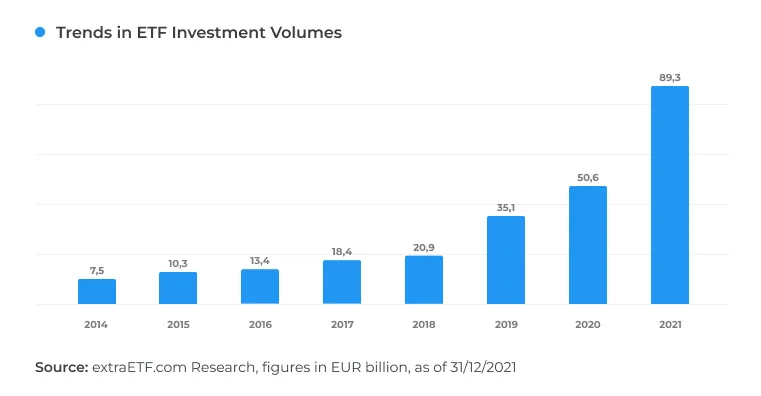
How much retail investors have invested in ETFs
The many advantages of ETFs have attracted a steadily growing number of investors over the years, as our regular ETF market statistics clearly show.