



What Is Pound Cost Averaging?
Does investing a fixed amount regularly boost your returns?
Price swings on the capital markets tempt many investors to try to buy at the very bottom and sell at the very top. But what sounds simple in theory is impossible in practice – and even if it were achieved, it would be down to luck rather than planning.
Instead of investing a lump sum, many investors choose to invest regularly to benefit from the cost-averaging effect. You can track this effect in a portfolio tracking tool. But what exactly is it, and how does it work? Does it lead to higher returns and lower risk?
In this article, we answer the key questions about pound cost averaging and show how investors can benefit from it.
The essentials in brief: Everything You Need to Know About the Pound Cost Averaging at a Glance
Definition: Pound cost averaging means investing a fixed amount at regular intervals in shares, ETFs or funds, either through several separate purchases or a regular investment plan. Over time, this produces an average purchase price.
Price Fluctuations: Investors benefit most from pound cost averaging when prices are volatile or fall over an extended period.
Lump-sum investment: Investing regularly isn't always more profitable than investing a lump sum. In fact, a lump sum often delivers a higher return over the long term.
Criticism: Compared with a lump-sum investment, pound cost averaging is at a particular disadvantage when prices rise over the long term.

Find and compare thousands of ETFs. Use powerful filters, detailed analytics, and independent data to discover the right ETF for your portfolio.
Explained simply: What is pound cost averaging?
Pound cost averaging means buying securities regularly over a period of time, for example through a regular ETF investment plan, so that you pay an average purchase price. This average price may be lower than the price of a one-off investment. Because the same amount buys more shares when prices are low, pound cost averaging can reduce your average purchase price.
If you invest a fixed amount regularly in securities – such as shares, funds or ETFs – regardless of whether the price is high or low, you buy fewer shares when the price is high and more when it is low.
However, in practice the cost-averaging effect does not always produce a lower entry price – and therefore a higher return – than a lump-sum investment. A lump sum may well turn out to be more profitable.
Join the extraETF community
Explore the world of ETFs and make informed investment decisions.
- Find ETFs that match your criteria with our ETF Search.
- Compare costs, performance, and risk side by side.
- Save your favourites to a watchlist and receive price alerts.
- Explore detailed ETF profiles with key metrics and holdings.
Example: How do you calculate the pound cost averaging?
Pound cost averaging can be illustrated with the example of a regular ETF investment plan. Its impact becomes clearest when we compare it with a lump-sum investment.
In our example, we assume a total investment of £1,000, invested through a monthly regular ETF investment plan with contributions of £200 over 5 months. With a lump-sum investment, by contrast, the entire £1,000 is invested in the same ETF immediately, in the first month.
The following chart simplifies the example, using a fictional price trend and unusually high volatility for the ETF:
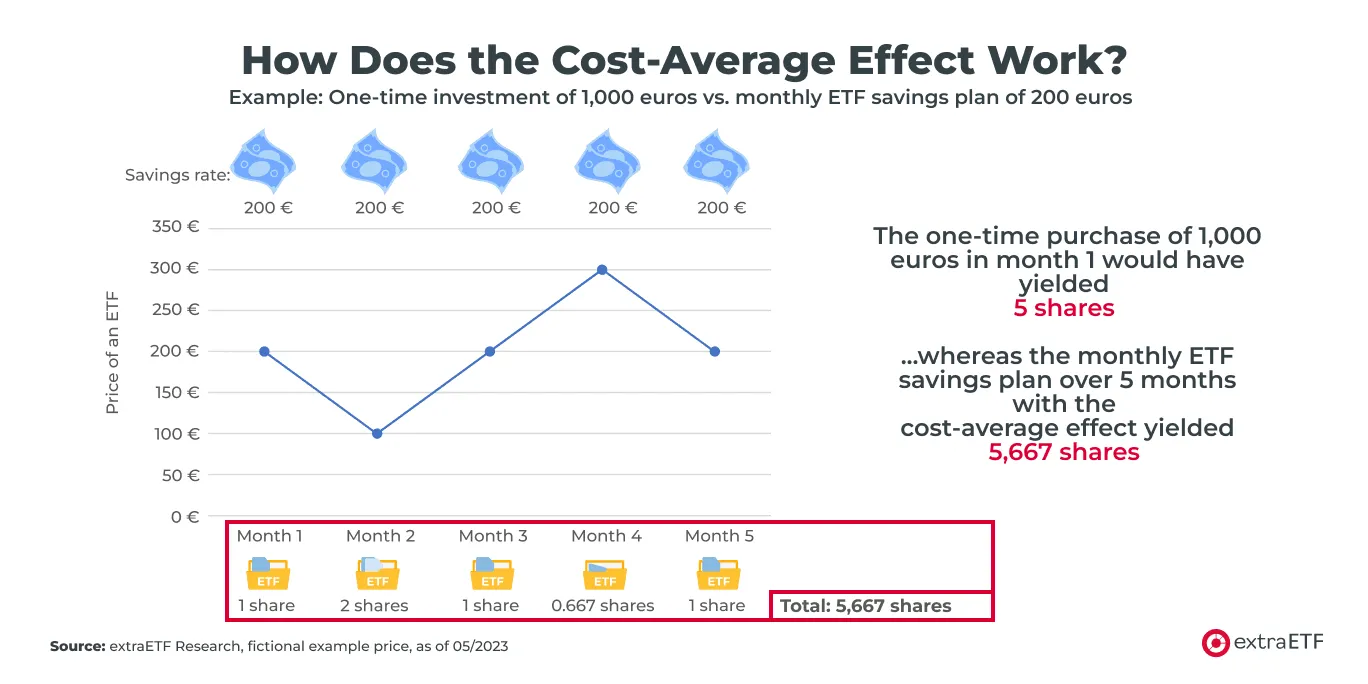
In total, the lump-sum investment of £1,000 bought 5 shares, while regular investing, benefiting from the cost-averaging effect, bought 5.667 shares. This calculation shows that pound cost averaging can lower the average price paid for securities such as ETFs or shares, and so increase the return. However, the effect does not occur in every case, and in some situations a lump-sum investment makes more sense.
Let’s now look more closely at how regular investing compares with a lump-sum investment.
Pound Cost Averaging: Regular Regular Investing vs. One-Time Investment
Pound cost averaging can come into play with a regular ETF investment plan or a lump sum invested in several instalments.
With a lump-sum investment, investors put the entire amount into the fund at once. If the price at the time of purchase is lower than the average price under regular investing, this can lead to a higher return.
However, the problem with a lump sum is that investors must pick the right time to buy, which is rarely achieved in practice given the unpredictability of the markets and the influence of emotions. A lump sum also typically requires a larger amount of money.
With regular investing, on the other hand, you invest at set intervals over a longer period, which can reduce the risk of an excessively high entry price and provides diversification over time. This works even with small amounts.
Whether a lump sum or regular investing is more cost-effective depends on the size of the investment or savings rate relative to transaction costs or regular investment plan fees, as well as the spread.

Using the Pound Cost Averaging to Determine the Average Price
Who benefits from pound cost averaging?
Pound cost averaging is particularly well suited to long-term investors who want to invest regularly in the capital markets through a regular ETF investment plan, for example for retirement planning or wealth building. Smaller investors can also benefit if they do not have a lump sum to invest in one go. So can those who prefer not to follow short-term movements in the financial markets too closely.
Pound cost averaging can, for example, be part of a simple, automated investment strategy – such as regular investing – which typically will not capture the highest or lowest price but can deliver an average price for patient investors. It can also have a psychological benefit, easing anxiety, particularly among those new to regular ETF investing.
However, it is important to consider your individual goals and strategy rather than rely exclusively on pound cost averaging. It is by no means a guarantee of returns: the investment product itself, along with factors such as your strategy, investment horizon and risk tolerance, plays a major role. Losses are therefore still possible.
Criticism of the Pound Cost Averaging
Pound cost averaging is particularly beneficial when prices fall over the long term, compared with a lump sum invested at the wrong time. Over time, regular investing buys more and more shares – in ETFs, stocks or funds, for example – for the same amount of money.
If, on the other hand, prices rise steadily, you buy fewer and fewer shares and so benefit less from further price rises. In this case, a lump sum invested at the start can deliver significantly higher returns. This is particularly true of regular investment plans in sufficiently broadly diversified global equity ETFs, where rising returns and performance are expected over a long investment horizon.
Studies show that, in most cases, a lump sum would have delivered a higher return than a regular ETF investment plan, simply because more capital is invested immediately than if the same amount were invested in small increments.
Furthermore, the cost-averaging effect only works for investments whose prices fluctuate, such as shares, ETFs or funds. Nor does it always apply, since in practice it is not always possible to invest regularly and at equal intervals. Pound cost averaging does not guarantee profits either; ETFs carry risks, and losses can always occur. Investors should therefore make sure they understand the risks before making an investment decision.
An Overview of the Advantages and Disadvantages of the Pound Cost Averaging
Pound cost averaging has both advantages and disadvantages for investors, which we summarise here.

The Advantages of Pound Cost Averaging
- High volatility: The cost-averaging effect can benefit long-term regular investing when prices fluctuate significantly. It reduces the risk of entering the market at the wrong time, despite the unpredictability of price movements.
- When prices fall: The average price can be lowered over the long term.
- Psychological effects: This is particularly helpful with regular ETF investing, as it can ease newcomers’ apprehension about investing.
- Systematic investing: Money is invested regularly and automatically over the long term, which takes emotion out of the investment decision.
- Small amounts: Even without a large initial lump sum, you can steadily build up a substantial nest egg.

The Disadvantages of Pound Cost Averaging
- When prices rise: Over the long run, returns tend to be lower than from a lump-sum investment.
- Low or no volatility: Works best in volatile markets. It has no impact on returns when prices move sideways at a constant level.
- Fear of missing out: You may miss one-off buying opportunities – such as sudden price drops – if the market offers good short-term returns. This fear is known as “fear of missing out” (FOMO).
- Effect diminishes over time: With a constant savings rate, each contribution becomes a smaller share of the amount already invested, so the effect weakens as your portfolio grows.
- Potentially higher transaction costs: Splitting your savings across multiple purchases may incur higher flat-rate transaction costs, depending on the broker.
Conclusion: Benefit from the pound cost averaging in volatile markets
Pound cost averaging can be part of a long-term, broadly diversified ETF investment strategy, helping investors cope with volatile markets. It can be particularly helpful for investors with small amounts to save and limited stock market knowledge, as it can reduce their apprehension about the markets and let them start investing with small, regular contributions.
However, pound cost averaging tends to be most beneficial when prices are falling or highly volatile and, in most cases, delivers lower long-term returns than a lump-sum investment in broadly diversified global equity ETFs.
A portfolio tracking tool is a practical way to monitor pound cost averaging, as it tracks and displays the average entry prices of your investments and gives you a clear overview.
We'll answer any other questions you may have about the pound cost averaging
- Everything You Need to Know About the Pound Cost Averaging at a Glance
- Explained simply: What is pound cost averaging?
- Example: How do you calculate the pound cost averaging?
- Pound Cost Averaging: Regular Regular Investing vs. One-Time Investment
- Who benefits from pound cost averaging?
- Criticism of the Pound Cost Averaging
- An Overview of the Advantages and Disadvantages of the Pound Cost Averaging
- Benefit from the pound cost averaging in volatile markets
- We'll answer any other questions you may have about the pound cost averaging
