



Portfolio Diversification
Minimizing the Risk of Losses When Investing
How can you reduce investment risk? One key strategy is portfolio diversification, which investors use to limit the impact of losses, including the risk of losing everything. To do this, they spread their investments across a wide range of shares and other securities, covering different regions, industries, company sizes, asset classes and currencies.
ETFs are particularly well suited to portfolio diversification. They let you invest cost-effectively in a whole basket of shares or other securities with a single purchase. A portfolio tracking tool can help you monitor your portfolio’s diversification.
This guide explains what diversification is, how to build it into a portfolio and how you can benefit from it.
The essentials in brief: Everything You Need to Know About Portfolio Diversification at a Glance
Diversification: To diversify their portfolios, investors spread their assets across different securities and asset classes.
Risk Diversification: A well-diversified portfolio – one with low correlations and no concentration risk – can significantly reduce the risk of losses.
Asset Classes: You can diversify your risk by investing in different asset classes, such as shares, bonds, property or commodities. ETFs make this easy, and also let you cover different regions or sectors within a single asset class.
ETFs: Investing in an ETF spreads your money across multiple securities, giving you a degree of diversification. You can reduce portfolio risk further if your ETFs span different countries, sectors, asset classes or currency regions.

Find and compare thousands of ETFs. Use powerful filters, detailed analytics, and independent data to discover the right ETF for your portfolio.
What is portfolio diversification?
Portfolio diversification means spreading your investments across different securities, asset classes, sectors, markets, company sizes, currencies and regions. The aim is to reduce the risk of loss from any single holding and to build a balanced mix of investments, so that the return on the whole portfolio is not put at risk.
Diversification should be structured to match your individual investment goals and risk tolerance. The idea is that broadly diversified investments are not all affected by the same factors to the same degree, provided there is little or no correlation between them.
A special case is temporal diversification, in which you buy an investment at different times to reduce the risk of an unfavourable entry price – for example, through a regular ETF investment plan that takes advantage of pound-cost averaging.
Join the extraETF community
Explore the world of ETFs and make informed investment decisions.
- Find ETFs that match your criteria with our ETF Search.
- Compare costs, performance, and risk side by side.
- Save your favourites to a watchlist and receive price alerts.
- Explore detailed ETF profiles with key metrics and holdings.
Why is portfolio diversification so important when investing?
Portfolio diversification is important because it can reduce risk. Without diversification – that is, spreading your money across different securities from various asset classes, countries and industries – you face a high risk of loss, potentially even total loss. If, on the other hand, your portfolio is broadly diversified, with as little correlation as possible among its securities and asset classes, you can reduce risk and volatility and pursue solid, stable long-term returns.
Diversification lets investors take part in the performance of various markets, companies, sectors and regions, and so benefit from a variety of economic conditions. It makes it more likely that losses in one area of the portfolio will be offset by gains elsewhere. For example, if global shares in the portfolio perform poorly for a time, commodities or bonds may do better over the same period and offset those losses.
The Effect of Correlation on Portfolio Diversification – An Example
Diversification is crucial for optimising portfolio risk. The following example illustrates its effect.
Two shares, A and B, each have an expected return of 7% a year and expected volatility of 20% a year. An investor who ignores the correlation between their returns might think the proportion invested in each makes no difference.
As far as expected return goes, that is true: whatever the split between Share A and Share B, the expected return is always 7%. However, the correlation between the two securities strongly influences the portfolio’s risk, and the optimal allocation here is 50% Share A and 50% Share B.
The example shows that when the correlation is below 1, portfolio risk can be partly “diversified away”: the portfolio’s risk is lower than the risks of the individual securities. In theory, the risk disappears completely when the correlation between the securities is -1. With the correlation fixed at 0.4, a 50:50 allocation between Shares A and B has a volatility 0.15 and 1.25 percentage points lower than a 60:40 or 80:20 mix respectively.
The following table uses this example to show why it is important to aim for the lowest possible correlation when diversifying:
| Correlation | Proportion of Share A | Proportion of Share B | Risk (Volatility) |
|---|---|---|---|
| 1.00 | 50% | 50% | 20% |
| 0.40 | 50% | 50% | 16.73% |
| -1.00 | 50% | 50% | 0.00% |
| 0.40 | 60% | 40% | 16.88% |
| 0.40 | 80% | 20% | 17.98% |
How can you diversify your portfolio?
You can diversify a portfolio effectively by holding many different securities for the long term – such as shares from various countries and industries – across multiple asset classes. These holdings should have as little correlation as possible and avoid concentration risk. Suitable ETFs make this particularly easy and cost-effective over the long term.
“Don’t put all your eggs in one basket”
This old adage applies just as much to a portfolio. As a rule of thumb, two securities are generally suitable for diversification if their correlation is below 0.8; negative correlation is better still. In that case, diversification can reduce risk while maintaining the same return or, alternatively, achieve a higher return for the same level of risk.
This approach to diversification is also at the heart of the modern portfolio theory of Nobel laureate Harry M. Markowitz, who ushered in a new era of investing in 1952 with his paper “Portfolio Selection”. His theories remain valid today.
To develop a suitable diversification strategy, first define your investment goals, risk tolerance and investment horizon, and review them regularly. It is also important to diversify broadly within each asset class.

Diversification can reduce investment risk
Risk Diversification by Asset Class
You can increase diversification by investing in various asset classes. For example, you could split your money between shares, bonds, property, commodities and other asset classes, which can reduce the risk of losses.
The following chart shows how a diversified portfolio spanning several asset classes can reduce risk:
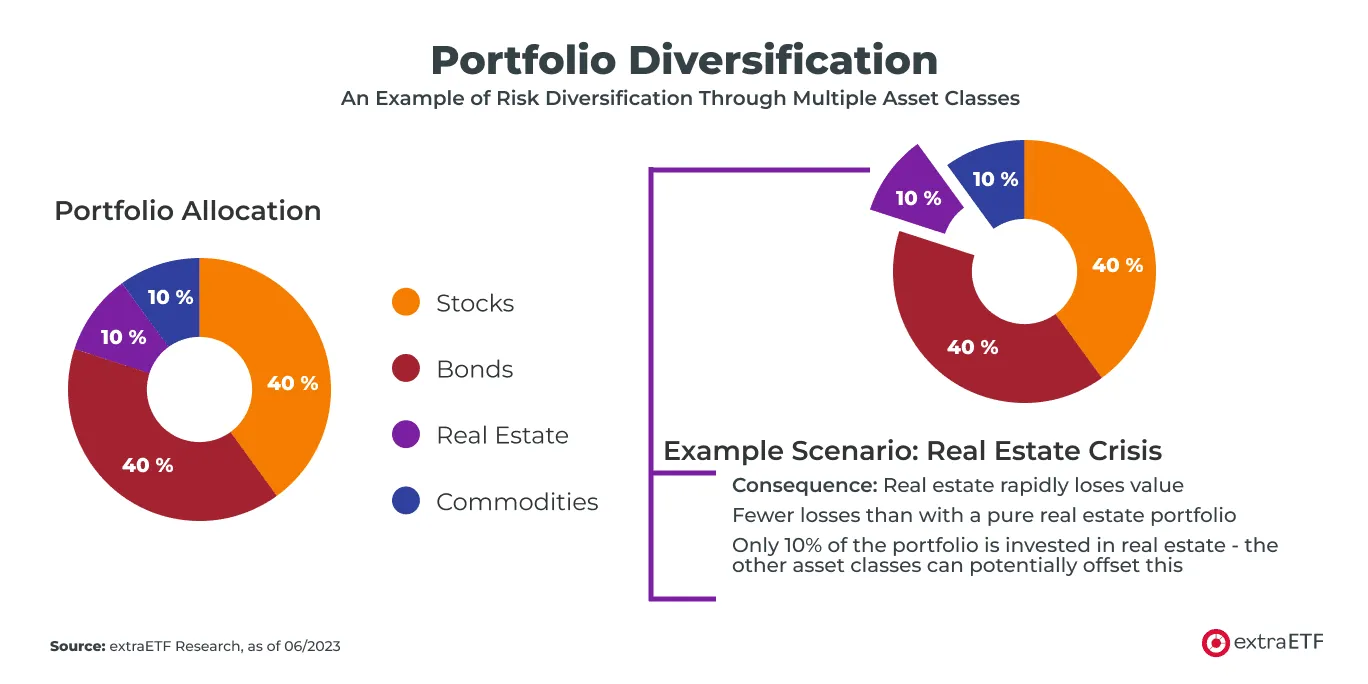
It is important that the asset classes are as weakly correlated with one another as possible, so that they behave differently under various market conditions. A balanced asset allocation spanning several asset classes can therefore make your portfolio more resilient. ETFs are particularly well suited to this, as they let investors increase diversification across asset classes cost-effectively and pursue solid returns over investment horizons of, for example, 15 years.
Diversification Within Asset Classes
Diversification within an asset class is important because the securities it contains may be highly correlated and therefore subject to the same influences. For example, a portfolio of shares should be spread across various companies in different industries. This reduces the risk associated with a single share or a specific industry.
Diversification within asset classes should also extend to different countries, currency regions and company sizes. Global equity ETFs, for example, offer broad geographic diversification, so local crises or political events often have less impact, while you can still benefit from growth opportunities elsewhere.
Diversification with ETFs
ETFs generally invest in multiple securities, so they already provide a degree of diversification. As a result, they carry a lower overall risk of loss than a single share would.
A well-known example is an ETF tracking the MSCI World, which covers around 1,600 companies across a wide range of sectors in 23 developed countries. Although fairly broadly diversified, it is heavily weighted towards the US and excludes emerging markets, among other things. You can increase diversification further by adding another ETF, such as one covering emerging markets.
This comparison of a global ETF tracking the All-Country World Index (which covers many developed and emerging markets) with a technology-heavy, US-focused ETF tracking the Nasdaq-100 Index shows just how much the diversification of ETFs can differ:
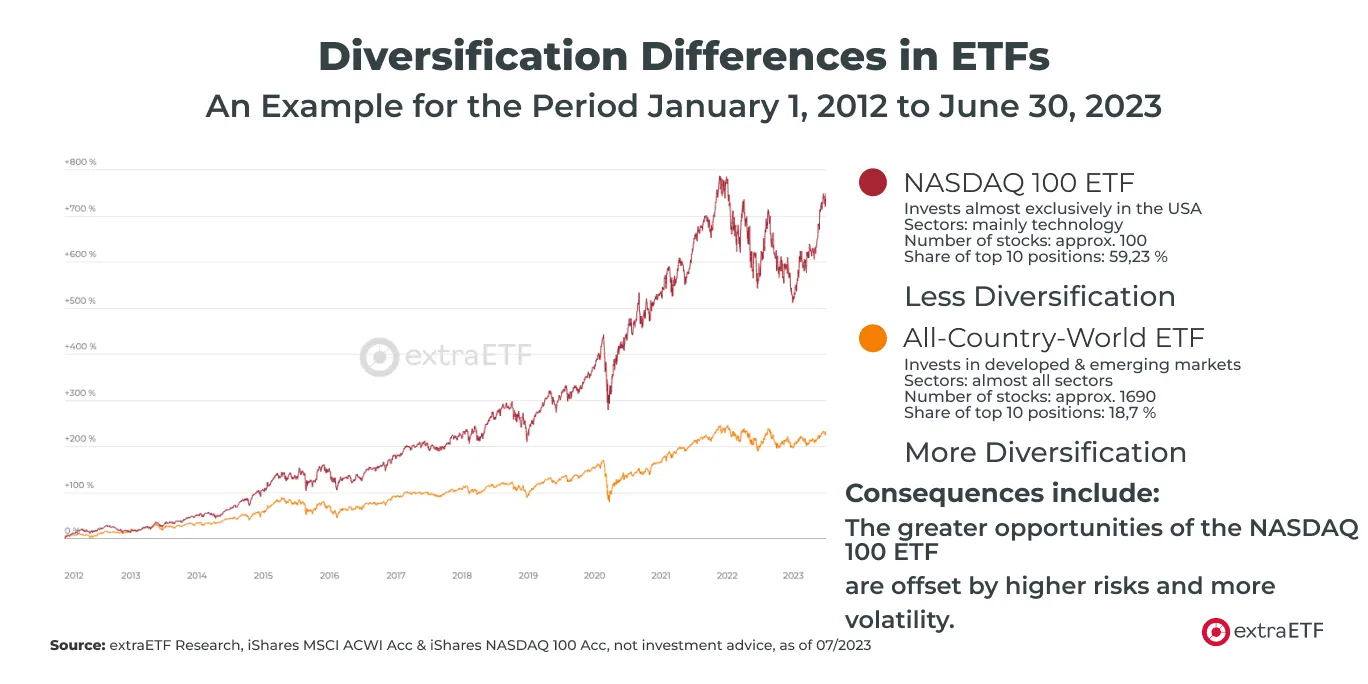
Please note: Holding as many ETFs as possible does not automatically mean greater diversification, higher returns or a lower risk of loss. Overlaps between ETFs, or a portfolio weighted too heavily towards a single sector (such as thematic or country-specific ETFs), can lead to concentration risk. That is why it is worth considering “How many ETFs make sense?” before you invest, and developing a suitable long-term strategy for your portfolio.
Diversification Through Regular ETF Investing
A regular ETF investment plan automatically invests a set amount in an ETF at regular intervals, diversifying your investments over time. It is also a good way to build wealth over the long term, because many providers offer these plans with low or no charges and let you start with small amounts. Because contributions are staggered, investors can benefit from pound-cost averaging and reduce the risk of entering the market at an unfavourable time.
Diversification Among ETF Providers
For safety reasons, it might seem sensible to spread your ETF investments across several ETF providers. However, this kind of diversification matters less, because ETFs are held as segregated funds. Investors therefore need not fear an ETF provider’s insolvency: the fund’s assets are held separately by a depositary, which is legally obliged to return them to investors. There is generally no issuer risk.
It is more important to apply specific criteria when selecting ETFs and to understand the risks involved.
Conclusion: How to Diversify Your Portfolio Properly
Adequate portfolio diversification is crucial for reducing the risk of losses, generating solid long-term returns and building wealth. Instead of investing in a single share, investors should aim for broad diversification across numerous securities, asset classes, sectors, regions and currencies. It is also important that the components of the portfolio are as weakly correlated with one another as possible and that the portfolio matches the investor’s goals and risk tolerance. Markowitz’s modern portfolio theory offers guidance for private investors as well as professionals.
ETFs make it easy, quick and cost-effective to achieve a high degree of diversification, which you can build up gradually through regular ETF investment plans, even with small amounts.
We'll answer any other questions you may have about portfolio diversification
- Everything You Need to Know About Portfolio Diversification at a Glance
- What is portfolio diversification?
- Why is portfolio diversification so important when investing?
- The Effect of Correlation on Portfolio Diversification – An Example
- How can you diversify your portfolio?
- Diversification with ETFs
- How to Diversify Your Portfolio Properly
- We'll answer any other questions you may have about portfolio diversification
