How Many ETFs Should You Own?
How many ETFs do you need for proper diversification?

Putting all your eggs in one basket is a risky way to invest, so it’s better to spread the risk. By diversifying broadly across multiple ETFs, investors can build wealth steadily and sustainably. But how many ETFs does a portfolio need, and how many does it take to diversify effectively? And isn’t one broadly diversified ETF, such as one tracking the MSCI World Index, enough?
We’ve summarised the answers to these questions in the overview below. We’ll also examine why diversification can reduce your portfolio’s risk, and explain how many regular ETF investments you can sensibly run at the same time.

The essentials in brief: Everything You Need to Know About Diversification with ETFs
Number: To diversify sufficiently, you should hold at least two ETFs with different investment focuses. A single-ETF portfolio spreads risk broadly enough only in exceptional cases.
Too many ETFs: A single ETF is usually insufficient for adequate diversification, but having too many is also counterproductive. It becomes easy to lose track of your portfolio, and tasks such as rebalancing take more time.
Choosing ETFs: Which ETFs you choose depends on your personal strategy. You can opt for higher-risk or lower-risk ETFs, and ETFs can have different investment focuses, such as asset classes, sectors, countries or markets.
Asset Classes: As well as deciding how many ETFs make sense, consider adding other asset classes to diversify risk. It is particularly beneficial if these asset classes are as uncorrelated as possible with one another.

Find and compare thousands of ETFs. Use powerful filters, detailed analytics, and independent data to discover the right ETF for your portfolio.
Dispersion: How many ETFs should you have in your portfolio?
A diversified portfolio should consist of at least two ETFs. A single ETF is usually not enough to spread risk adequately. This is true even if investors opt for an MSCI World ETF. Although it holds around 1,600 companies across 23 developed countries, what matters is the weighting of individual companies and countries. For example, the US accounts for more than two-thirds of the fund’s assets, with Japan a distant second at just over 6 per cent. At individual stock level, the top five holdings are all technology stocks.
Let’s look at an example of how concentrated an MSCI World ETF can be in certain countries and sectors:

To avoid such concentration risks, investing in the MSCI World alone is not enough. You should therefore add at least one more ETF with a different country, region or sector focus. Many investors opt for a 70:30 portfolio, with 70 per cent in developed markets (e.g. MSCI World) and 30 per cent in emerging markets (e.g. MSCI Emerging Markets). Others add a further ETF (e.g. MSCI World Small Cap) focused on smaller companies. The goal of this and similar strategies is to mirror the global economy as broadly as possible.

A global ETF that combines developed and emerging markets can serve as a solid foundation for a portfolio. Examples include ETFs tracking the FTSE All-World Index or the MSCI All Country World Index, as both indices cover developed and emerging markets.
Beginners, for example, are advised to hold no more than five ETFs, as it’s easy to lose track of more. Experienced ETF investors can hold more if necessary. Avoid concentration risk and overlap between ETFs, as these can significantly increase your portfolio’s overall risk and reduce diversification.

Avoid concentration risks in your portfolio
 Martin Vogt, Education & Content Manager
In short: there is no single “right” number of ETFs. It depends on your investment goal, risk tolerance and strategy. Two ETFs may be enough for one investor but too few for another, which could increase the risk associated with ETFs.
There are more than 8,500 ETFs worldwide, investing across different sectors, countries and asset classes. Even so, many of them hold shares in the same companies, often with a high weighting.
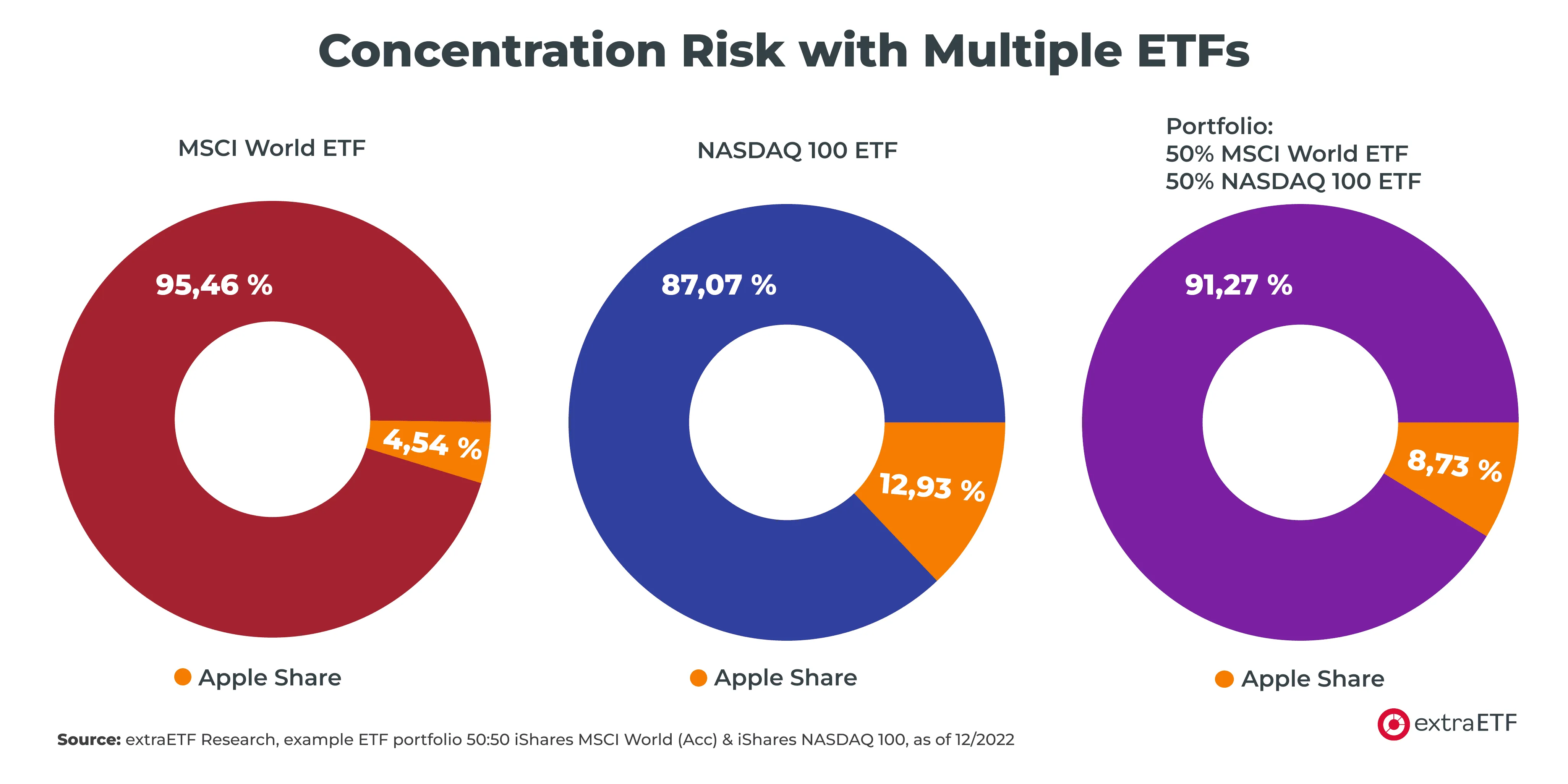
As the example shows, Apple – the largest holding in the iShares MSCI World ETF shown – makes up 4.54 per cent, but 12.93 per cent of the NASDAQ 100 ETF. If you split your portfolio equally between ETFs tracking these two indices, for example, Apple would account for 8.73 per cent of your total portfolio. The return on such a portfolio would therefore depend far more heavily on this one company’s performance than if you had invested only in the MSCI World ETF.
The same type of concentration risk can arise with sectors, regions or countries. Even if you invest in multiple ETFs, you may unknowingly increase your portfolio’s risk.
Join the extraETF community

Explore the world of ETFs and make informed investment decisions.
- Find ETFs that match your criteria with our ETF Search.
- Compare costs, performance, and risk side by side.
- Save your favourites to a watchlist and receive price alerts.
- Explore detailed ETF profiles with key metrics and holdings.
How many regular ETF investments should you run at the same time?
As a general rule, investors should hold at least two ETFs to achieve the broadest possible global diversification and so reduce risk. They should not hold too many, however, or they may lose track of their portfolio. Investors should also avoid overlaps and concentration risks.
Whether you opt for regular ETF investments or a lump-sum investment in ETFs, the key is to diversify as broadly as possible. You can set up regular investing with as little as £25 per month. This might tempt you to invest in as many ETFs as possible. However, it’s better to have fewer regular ETF investments with higher contributions than many ETFs with small ones. After all, investing shouldn’t be more complicated than necessary, and if your provider charges fees on regular investments, they can erode your returns.
What percentage of the total portfolio should ETFs make up?
The percentage of the total portfolio allocated to ETFs depends primarily on an investor’s individual risk tolerance, investment horizon, and investment strategy involving ETFs.
Your total assets should be divided into:
- an emergency fund
- a risk-free portion
- a risky portion
Because of their volatility and the risks associated with ETFs, ETFs belong in the risky portion, while the risk-free portion would be held in an easy-access or fixed-rate savings account. Your emergency fund, worth at least three months’ net salary, should be kept in an easy-access savings account. By adjusting the weighting of these components, you can manage the overall risk of your assets.
Depending on the proportion of ETFs in your portfolio, your investment strategy and horizon, your risk tolerance, savings goals and financial situation, you can take either an aggressive (higher-risk) or a defensive (lower-risk) approach using ETFs. Generally, the safer an investment, the lower its potential returns tend to be. Conversely, higher risk can also bring better returns and performance for ETFs.
Examples of ETF Portfolios
To illustrate, we’ve put together two sample ETF portfolios that differ in their asset allocation – the weighting of asset classes – and their risk. Both sit entirely within the risky portion of the total portfolio.
Aggressive ETF Portfolio
In our example of an aggressive portfolio, equity ETFs dominate with a 70 per cent weighting. Within this portion, you can invest in ETFs with various investment focuses, but you should ensure sufficiently broad diversification, covering developed and emerging markets as well as various sectors and company sizes.
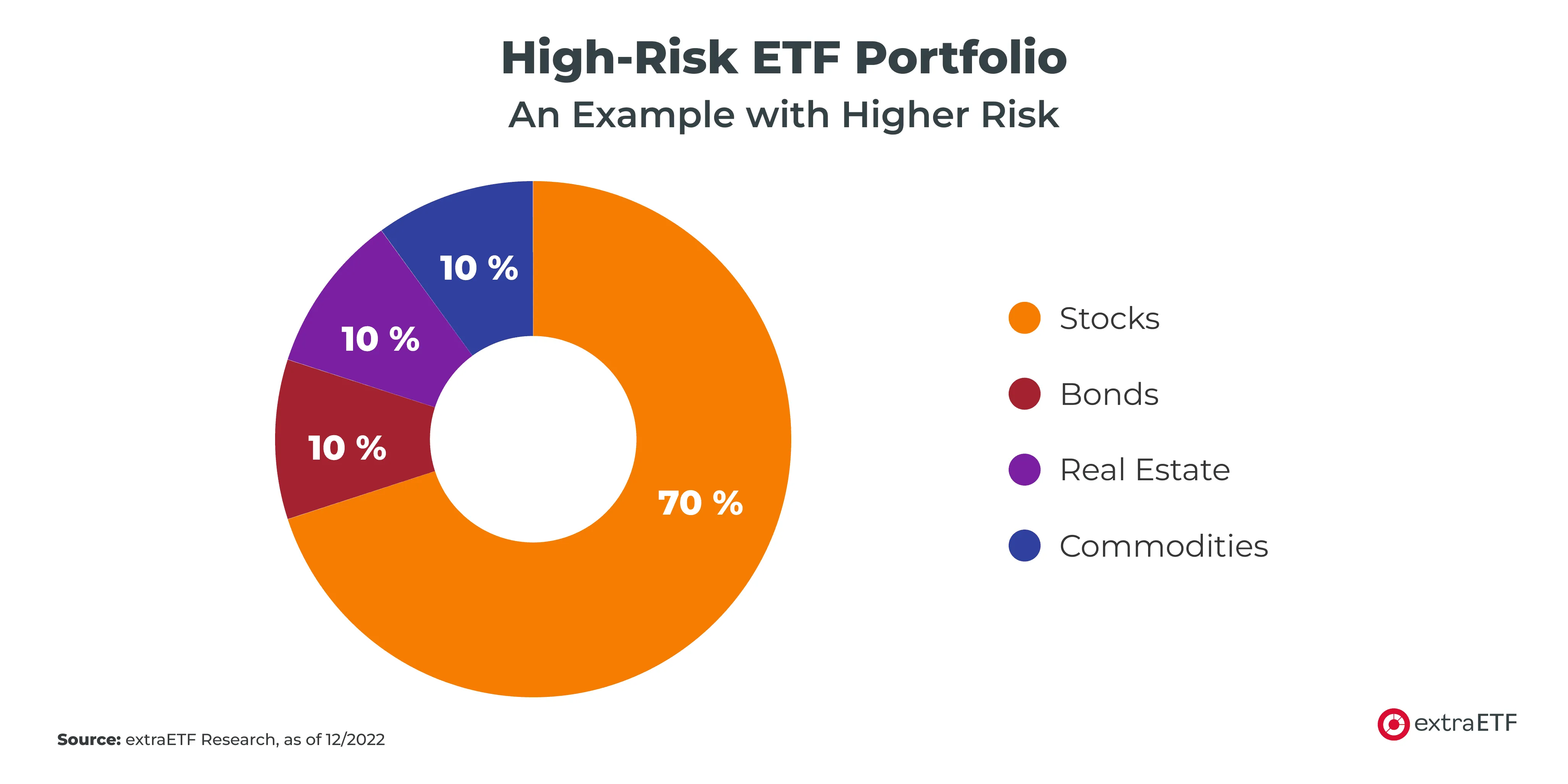
Bonds are also important in an aggressive portfolio, as they help diversify and reduce volatility. In this example, they account for 10 per cent. The higher the bond allocation, the lower the overall risk – but also the lower the return. The remaining 20 per cent is split equally between commodity ETFs and real estate ETFs, which further enhances diversification.
Defensive ETF Portfolio
In our example of a defensive ETF portfolio, bond ETFs are deliberately given a much higher weighting of 40 per cent, while equity ETFs are weighted lower than in the aggressive portfolio. The aim is to keep value fluctuations lower.
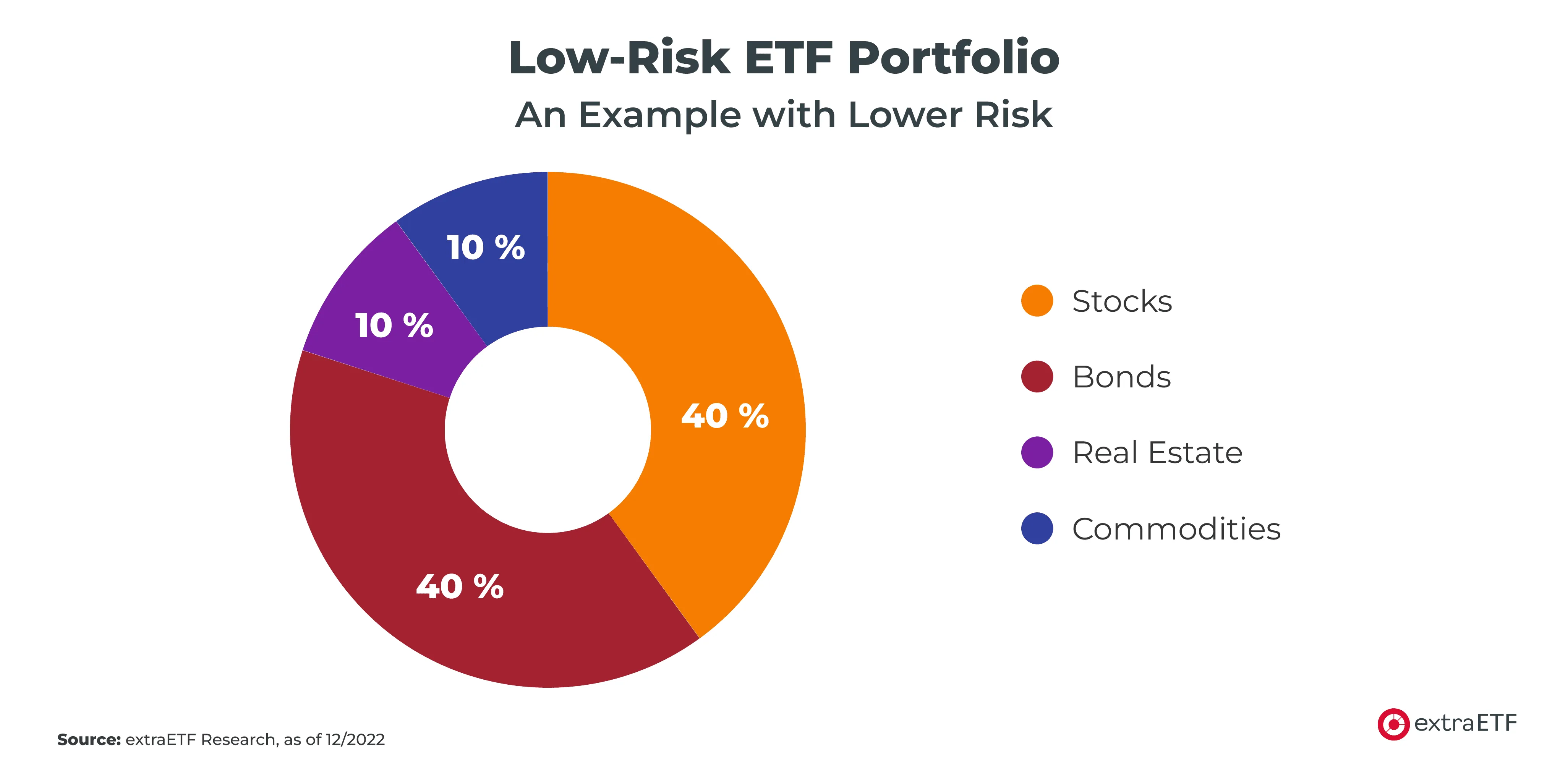
Because of the lower proportion of equity ETFs, however, long-term return potential is likely to be lower. Besides diversification, you can control how defensive your investments are mainly through the size of the risk-free portion of your portfolio and a substantial emergency fund held in one or more easy-access savings accounts.
The following video also explains how to build an ETF portfolio step by step:
How can you achieve good diversification even with just a few ETFs?
Good diversification means spreading your money as broadly as possible, and that depends largely on the investment focus of your ETFs or their underlying indices. Ideally, your overall portfolio should be global, cover broad markets, include companies of various sizes and sectors, and avoid concentration risks. Since ETFs tracking the MSCI World Index invest only in developed markets, it is advisable to also consider ETFs that track emerging markets. ETF fact sheets or the ETF profile pages on extraETF.com can serve as a useful guide.
ETFs that invest in different asset classes can improve diversification because of the low correlations between them. In contrast, thematic ETFs, sector ETFs and ETFs focused on individual countries or regions may leave you insufficiently diversified and increase risk. What’s more, the ongoing costs of these ETFs are usually somewhat higher.

Conclusion: Keep Track of Your Investments with Select ETFs
There’s no one-size-fits-all answer to how many ETFs you should buy. Ideally, though, you should hold at least two. The choice of ETFs, their weighting and your investment strategy depend on many individual factors, including your financial situation, investment horizon and savings goals. In any case, ensure sufficient diversification and avoid concentration risk.
Investing solely in an ETF tracking the MSCI World Index is not enough, as it is heavily weighted towards the US and invests only in developed countries. However, a global ETF – which combines developed and emerging markets – can serve as a solid foundation for your portfolio. As a general rule, the higher the proportion of higher-risk investments, the greater your potential return. To keep your investments in line with your risk tolerance, it’s a good idea to divide your assets into a risky portion, a risk-free portion and an emergency fund. You can then manage your overall risk through the weighting of each.
It’s not just ETF beginners who should thoroughly research suitable ETFs – including their investment focus and diversification – before investing. To keep an overview of your investments and spot overlaps between ETFs early, a portfolio tracking tool is a practical aid.
We'll answer any other questions you may have about diversification within your ETF portfolio
- Everything You Need to Know About Diversification with ETFs
- Dispersion: How many ETFs should you have in your portfolio?
- How many regular ETF investments should you run at the same time?
- What percentage of the total portfolio should ETFs make up?
- Examples of ETF Portfolios
- How can you achieve good diversification even with just a few ETFs?
- Keep Track of Your Investments with Select ETFs
- We'll answer any other questions you may have about diversification within your ETF portfolio