



Global ETFs as a Core Investment
What to consider when choosing a global ETF for your portfolio
A global index ETF is a good choice, especially for beginners but also for experienced investors. This global index should be as broadly diversified as possible, thereby tracking the performance of all investable stocks worldwide.
The goal of this global ETF is to participate in the long-term growth of the economy and to reduce the risk associated with ETFs through broad diversification. The goal, then, is not to “beat” the global market’s returns, but to participate in its performance using simple and low-cost investment products (ETFs).
This article discusses what investors should consider when selecting a global ETF. We explain how global indices are constructed, which ETFs may be relevant for investors, and what index alternatives are available for global investing.
The essentials in brief: Everything You Need to Know About Global ETFs as a Core Investment at a Glance
Definition: A global ETF is an ETF that invests in a maximally diversified portfolio of stocks. The goal is to invest in as many publicly traded companies worldwide as possible.
Diversification: Because of its broad exposure, a global ETF is extremely diversified. This reduces risk and generally results in less volatility than with individual stocks.
Global Portfolio: By skillfully combining ETFs, you can build the perfect global portfolio.

Find and compare thousands of ETFs. Use powerful filters, detailed analytics, and independent data to discover the right ETF for your portfolio.
Global ETFs often do not cover the entire world
Anyone who looks into global ETFs will sooner or later come across the MSCI World Index. However, the name is misleading. Linguistically speaking, the connection is obvious, but the index’s composition doesn’t actually cover the entire world.
A closer look quickly reveals differences: In reality, the MSCI World Index does not represent the entire world, but only 23 developed countries – and even then, only so-called large-cap and mid-cap stocks. Small-cap stocks play no role in the MSCI World Index, nor do stocks from emerging markets.
It quickly becomes clear that the MSCI World Index is not a true “world index.” A world index worthy of the name would have to reflect the entire global market in its composition – that is, both developed and emerging markets, as well as large-, mid-, and small-cap stocks.
Did you know? Classification by Market Capitalization
Large-cap companies are generally defined as corporations with a market capitalization of more than $10 billion. Mid-cap companies are corporations with a market capitalization between $2 billion and $10 billion. Small-cap companies are those with a market capitalization of less than 2 billion U.S. dollars. Note, however, that this categorization based on market capitalization is not always applied consistently everywhere.
How Global Indices Are Compiled
Intuitively, one might assume that a global ETF or an index called “World” is broadly diversified. But if you look at the world’s best-known global index – the MSCI World Index – on a world map, you’ll quickly realise that appearances – in this case, the name – are deceiving. The world map has many gray spots.
So, contrary to what investors rightly assume, the investment does not cover the entire world. As mentioned at the beginning, the MSCI World Index consists only of stocks from 23 developed countries. Furthermore, the index provider only includes large- and mid-cap stocks. This is rightly criticized: there is no true, comprehensive, and global diversification.
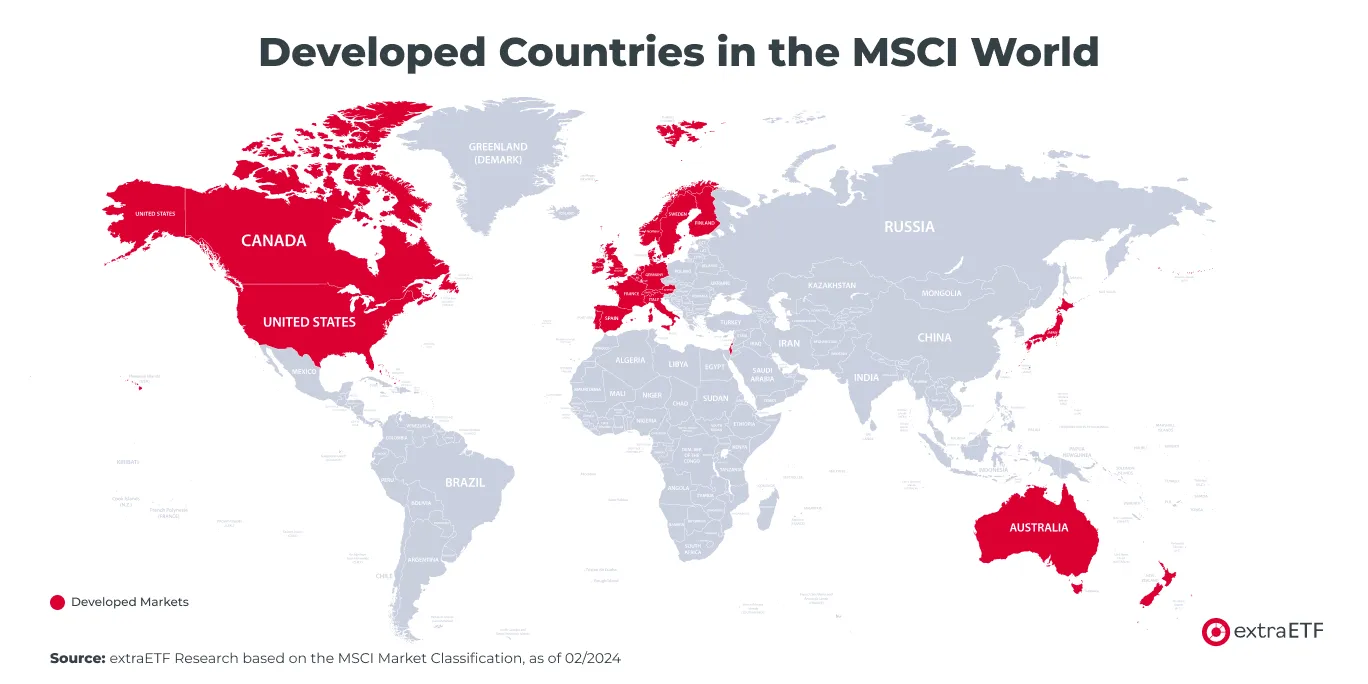
At this point, however, it must be emphasized that the index provider MSCI has launched several global indices. In addition to the MSCI World Index, the MSCI ACWI and the MSCI ACWI IMI are also offered. These global indices cover stocks from both developed and emerging markets. The MSCI ACWI IMI also includes small-cap stocks. And, of course, the index provider MSCI also faces competition, for example, from index providers such as FTSE or Morningstar. These providers also calculate global indices. In the case of FTSE, for example, the FTSE Developed World or the FTSE All-World.
One level below that, ETF providers come into play, offering global ETFs based on these indices under various terms and conditions. We’ll discuss this in more detail later.
Join the extraETF community
Explore the world of ETFs and make informed investment decisions.
- Find ETFs that match your criteria with our ETF Search.
- Compare costs, performance, and risk side by side.
- Save your favourites to a watchlist and receive price alerts.
- Explore detailed ETF profiles with key metrics and holdings.
Composition of the MSCI World Indexes
Let’s stick with the best-known index provider, MSCI, and examine its approach to creating a global index. Broadly speaking, this approach can also be applied to its competitors (FTSE or Morningstar) and broken down into the following two steps:
Step 1: Indexing
The first step in creating an index is always to identify the universe of stocks for each market – that is, developed markets, emerging markets, and frontier markets. How many stocks are there in these markets, and which ones are actually worth investing in? Only then does the index provider take a closer look at market capitalization and create size segments within the investable universe. This last aspect in particular shows that significant differences in weighting can arise right from the start when compiling an index.
Step 2: Index Rules
Developing their own rules gives index providers the flexibility to define their global indices according to their own criteria. These rules include, for example, a specified minimum size (of the companies), the market capitalization of the free float, or the liquidity of the stocks. It is therefore obvious that differences in the composition of global indices can arise depending on the index provider.
| Company | Country | Full Market Capitalization (USD millions) | Free-Float-Adjusted Market Capitalization (USD millions) | Cumulative Free-Float-Adjusted Market Capitalization Coverage | Company Rank |
|---|---|---|---|---|---|
| A | a | 400,000 | 400,000 | 1.29% | 1 |
| B | a | 360,000 | 360,000 | 2.45% | 2 |
| C | a | 275,000 | 250,000 | 3.26% | 3 |
| .. | .. | .. | .. | .. | |
| X | f | 1,000 | 250 | 98.99% | 8,007 |
| X | g | 150 | 130 | 99.00% | 8,008 |
| Z | f | 125 | 125 | 99.01% | 8,009 |
| Total | 31,000,000 | 100.00% |
The composition of the indices is easy to understand, as it is published transparently by the index providers. As the table above shows, all stocks are sorted by size, i.e., by market capitalization. The largest value (400,000 million) is at the very top, and the smallest (125 million) is at the very bottom.
The percentage share – the Free Float Market-Adjusted Market Capitalization Coverage – is calculated by dividing the market capitalization (400,000 million) by the total (31,000,000 million) of all companies (= 1.29%). Finally, a threshold is set, which for the MSCI is 99 per cent. It is important to note that setting the threshold at 99 per cent results in exactly 8,008 companies being included in the corresponding global index. The smallest company that just barely makes the cut in this example has a market capitalization of only 150 million dollars!
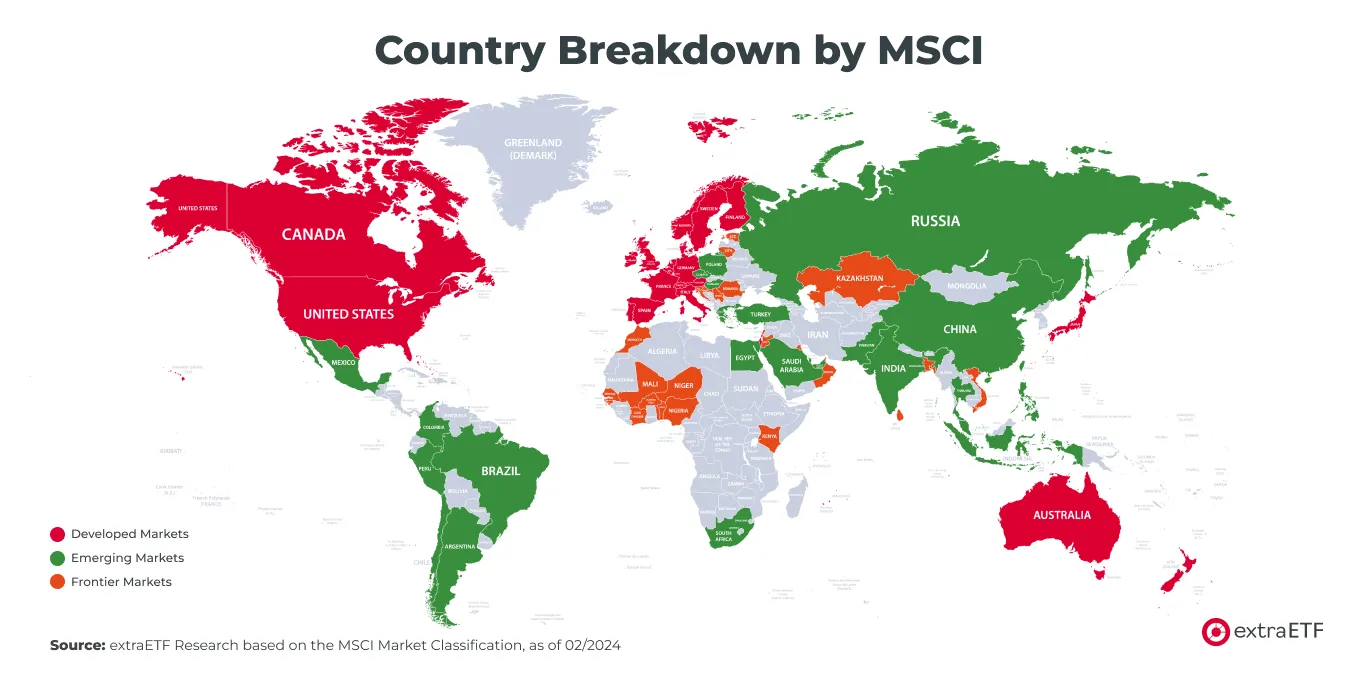
This method can be applied to all kinds of sector, country, and regional indices. Whether developed or emerging markets. While developed markets account for about 86 per cent of the global stock market, emerging markets make up 13 per cent of the global stock market. Although frontier markets comprise 29 countries, they account for only 1 per cent of the global stock market and can therefore be disregarded.
The following chart shows the country allocation of the MSCI World, the MSCI Emerging Markets, and the MSCI Frontier Markets. The world map has become significantly more colorful. Typically, 76 countries account for approximately 99 per cent of the total global stock market.
The MSCI Investment Universe
The following chart clearly illustrates which countries, according to MSCI, are eligible for investment and what index constructions are available for them:
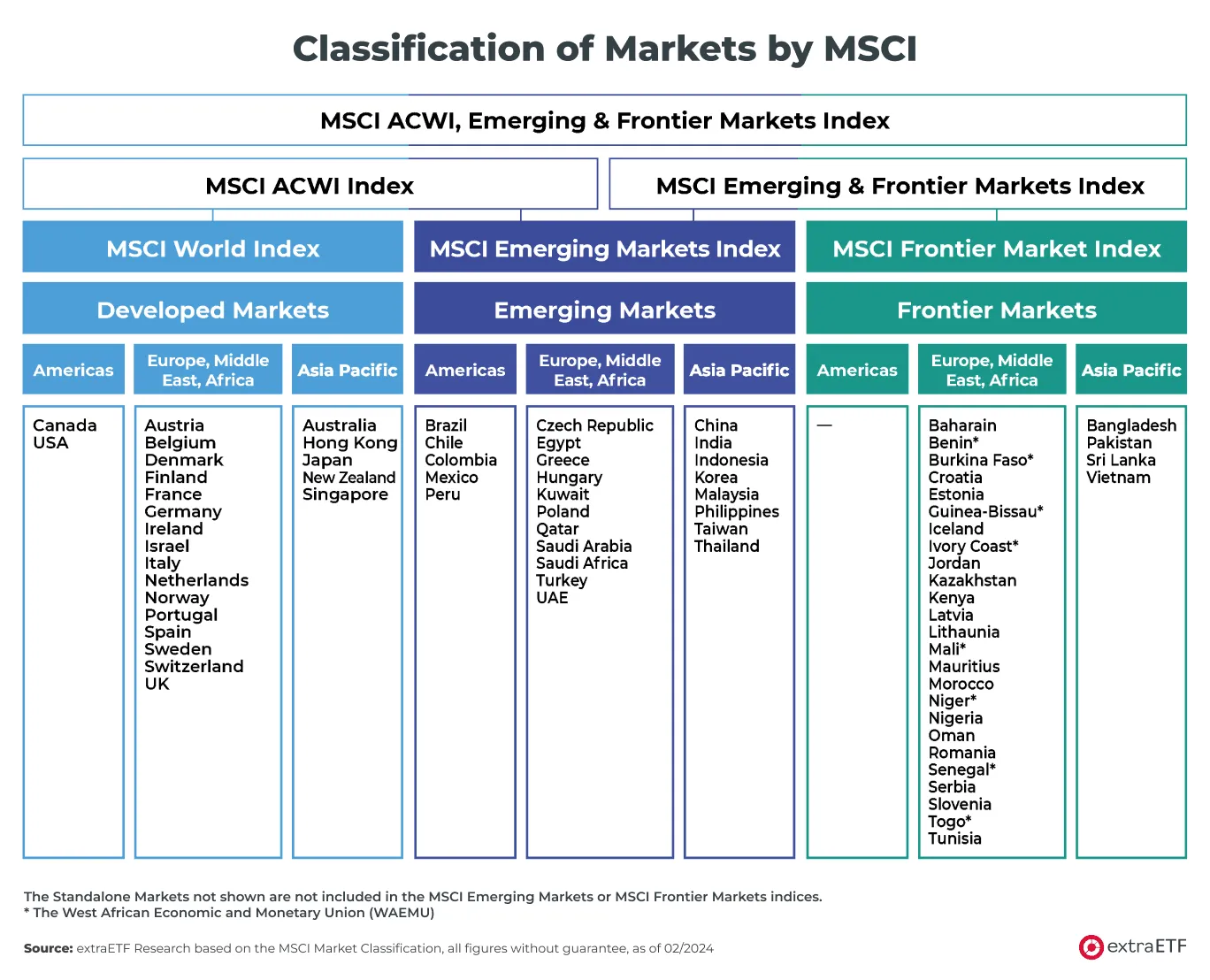
The abbreviation ACWI stands for All Country World Index. So, if you really want to invest globally, the MSCI ACWI & Frontier Markets Index is a good choice. For those who want to invest in 99 per cent (emerging and developing markets) of the global stock market, the MSCI ACWI Index – a combination of the MSCI World Index and the MSCI World Emerging Markets Index – is sufficient.
To simplify things, investors can think of the model as a kind of modular system in which each “box” can be purchased individually and combined with other “boxes.” In addition, MSCI offers a separate country index for each of these countries. Some of these country indices are also accessible via ETFs. Please note that we have not included the standalone markets in the chart for the sake of clarity and due to their limited relevance.
Here’s an example: Suppose you want to expand an MSCI World portfolio to include stocks from emerging markets in order to reduce the overweight in U.S. stocks.
To do this, one could invest in one ETF each for the three regions – the Americas, Europe, and emerging markets – with a weighting of 40% / 30% / 30%. We have described in detail what such a global portfolio might look like in the 40-30-30 ETF Model Portfolio.
Global Indices at a Glance
The following table provides an overview of the most popular global indices. It also presents key metrics such as company size, the number of developed, emerging, and frontier markets, and the number of companies included in each index.
| Index Providers | Index | Company Size | Countries (I / E / F) | Companies |
|---|---|---|---|---|
| MSCI | World | M + L | 23 / - / - | 1,480 |
| MSCI | World IMI | S + M + L | 23 / - / - | 5,649 |
| MSCI | ACWI | M + L | 23 / 24 / - | 2,920 |
| MSCI | ACWI IMI | S + M + L | 23 / 24 / - | 9,070 |
| MSCI | ACWI FM | M + L | 23 / 24 / 29 | 3,131 |
| MSCI | ACWI FM IMI | S + M + L | 23 / 24 / 29 | 9,608 |
| FTSE | Developed World | M + L | 25 / - / - | 2,107 |
| FTSE | All-World | M + L | 25 / 24 / - | 4,292 |

An Overview of the Best Global ETFs
In the following section, we explain which global indices come closest to the ideal of a global equity investment and present the best global ETFs to match.
Almost every ETF provider offers an ETF tracking the MSCI World Index. This high level of competition pays off: the total expense ratio (TER) of these ETFs is significantly lower than that of other global ETFs. But the major problem remains: the index includes only developed markets, not emerging markets or small-cap stocks. An ideal global ETF looks different.
The Perfect Global ETF Portfolio
Unfortunately, the perfect global ETF is not yet available; in many cases, small-cap stocks or stocks from emerging markets are missing. An alternative could therefore be a self-built global ETF portfolio. This portfolio can be assembled from some of the ETFs available on the market.
To build this portfolio, you would need to invest in ETFs tracking the MSCI World, the MSCI World Small-Cap, and the MSCI Emerging Markets IMI Index. Together, they have no overlap and offer broad coverage of developed and emerging markets, including small-cap stocks.
The following related articles are particularly helpful:
Conclusion: Which global ETF is the best core investment?
The best solution for a global investment is an ETF tracking the MSCI ACWI IMI; however, with this ETF, you cannot adjust the weighting between developed and emerging markets yourself.
If you want to do that, you’ll have to forgo small-cap stocks from developed markets and construct your global portfolio using ETFs tracking the MSCI World Index and the MSCI Emerging Markets (IMI) Index.
Another option would be the combination already described, consisting of ETFs tracking the MSCI World Index, the MSCI World Small Cap Index, and the MSCI Emerging Markets (IMI) Index.
ETFs can be traded at particularly favourable terms with numerous brokerage firms. In our brokerage comparison, we have compiled and compared the terms offered by ETF brokers for trading ETFs.
Frequently Asked Questions on the Topic of “A Global ETF as a Core Investment”
- Everything You Need to Know About Global ETFs as a Core Investment at a Glance
- Global ETFs often do not cover the entire world
- Classification by Market Capitalization
- How Global Indices Are Compiled
- Composition of the MSCI World Indexes
- The MSCI Investment Universe
- Global Indices at a Glance
- An Overview of the Best Global ETFs
- The Perfect Global ETF Portfolio
- Which global ETF is the best core investment?
- Frequently Asked Questions on the Topic of “A Global ETF as a Core Investment”