Understanding and Mastering Volatility
Strategies for a Resilient Portfolio

Volatility is a key issue for anyone who invests in the stock market. It describes the range of price fluctuations and can present both opportunities and risks for your portfolio.
Understanding volatility and its effects is crucial for making informed investment decisions and protecting your assets over the long term. High volatility can trigger uncertainty and emotional reactions such as fear and greed, which often lead to impulsive and unfavorable portfolio decisions.
In this guide, we explain what volatility is and what role it plays in your portfolio. We’ll also show you smart strategies for protecting your portfolio from negative effects.

The essentials in brief: What You Should Know About Volatility
Volatility as a Risk and an Opportunity: Volatility describes the range of price fluctuations. It can be calculated for stocks, bonds, ETFs, and other securities.
Risk Assessment Indicator: High volatility means greater price fluctuations and, consequently, higher risks and opportunities.
Risk Mitigation Strategies: Different asset classes exhibit varying levels of volatility. Diversification and the selection of low-risk asset classes help reduce the impact of volatility on the portfolio.
Emotional Challenge: High volatility can trigger emotional reactions such as fear and greed, which can lead to impulsive decisions.

Find and compare thousands of ETFs. Use powerful filters, detailed analytics, and independent data to discover the right ETF for your portfolio.
What is volatility?
Volatility refers to the range of price fluctuations for a financial instrument (e.g., index, stock, ETF) over a specific period of time. Volatility plays a central role in the investment world, as it measures the risk of an investment. A high volatility value indicates greater price fluctuations, which means both higher potential returns and a higher risk of loss.
Volatility can be calculated mathematically, usually using the standard deviation of a security’s or market’s returns. This determines how much the daily, weekly, or monthly returns deviate from their mean.
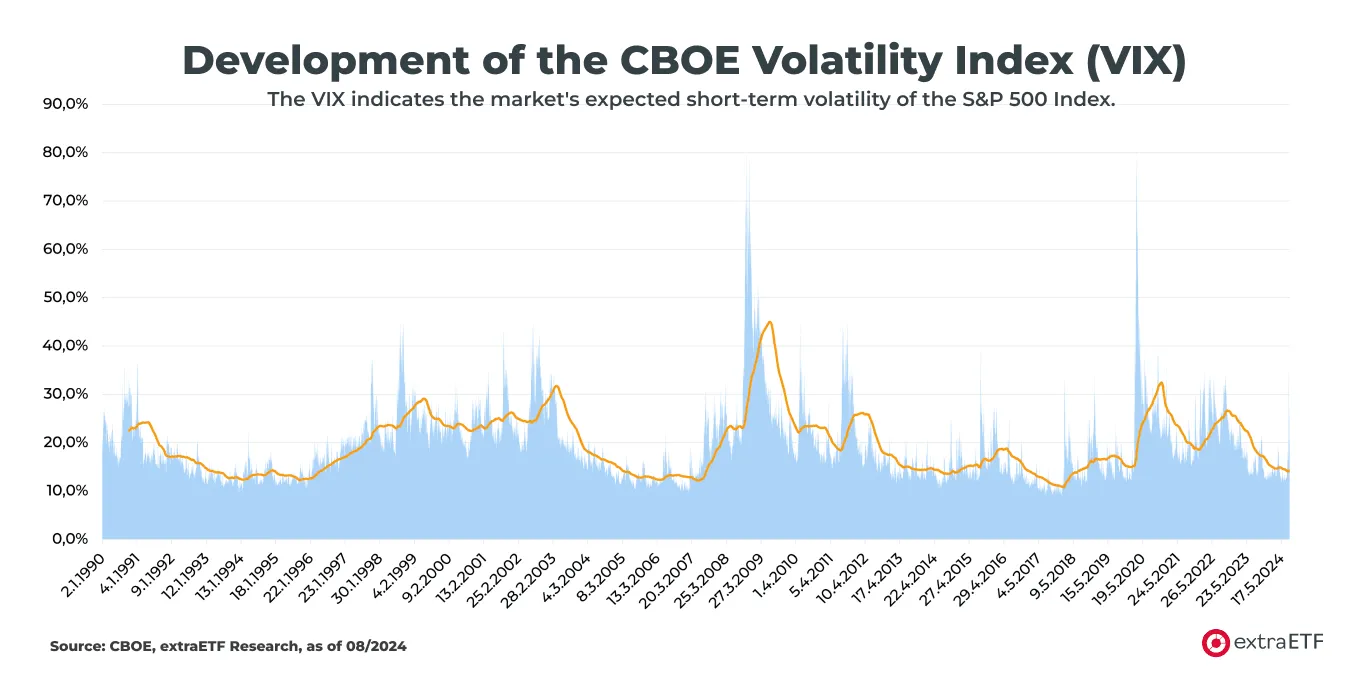
A well-known indicator of volatility is the Volatility Index (VIX), also known as the “fear index.” It measures the expected volatility of the S&P 500 over the next 30 days.
The chart showing the VIX’s performance since 1990 illustrates how market sentiment has changed during various periods of crisis. The VIX typically rises during times of uncertainty and market stress.
By the way: For the German stock market, volatility is measured using the VDAX index.
Volatility as a Measure of Risk
Volatility is an important metric for assessing the risk of an investment or a portfolio. As a measure of risk, it indicates how much the price of a security can fluctuate over a given period. High volatility signals that the price may rise or fall sharply.
In volatile markets, price fluctuations are less predictable, which leads to uncertainty and makes it more difficult to plan investment strategies. It is therefore important for investors to keep an eye on volatility in order to make informed decisions. It helps them better assess the potential risk of an investment and develop strategies to mitigate risks or capitalize on opportunities.
During periods of high volatility, for example, investors can diversify their portfolios to spread risk or use hedging strategies such as options to limit potential losses. In this way, volatility provides valuable information that can help build a balanced and robust portfolio focused on both safety and opportunities.
Join the extraETF community

Explore the world of ETFs and make informed investment decisions.
- Find ETFs that match your criteria with our ETF Search.
- Compare costs, performance, and risk side by side.
- Save your favourites to a watchlist and receive price alerts.
- Explore detailed ETF profiles with key metrics and holdings.
How is volatility calculated?
Volatility is calculated as the standard deviation of an asset’s returns. The calculation is performed in several steps: First, the historical returns are determined; then, the average return is calculated, and the deviations of the individual returns from this average are determined. These deviations are squared and averaged to obtain the variance, and the square root of this variance is then the volatility. Volatility is often annualized to make it comparable across different time periods.
The formula for calculating volatility is:

Calculating volatility may seem complex, but it provides important information about an investment’s risk. To illustrate this, it’s worth taking a look at the volatility of selected ETFs. These funds show how much their prices fluctuate and what different risks are associated with them.
Volatility of Various Asset Classes
Volatility varies significantly across different asset classes and is therefore an important factor in risk assessment. Stocks generally exhibit higher volatility because their prices are subject to greater fluctuations, as the following table shows. In contrast, government bonds and money market ETFs exhibit lower volatility, making them more stable investments, though they generally offer lower returns. By combining different asset classes, a portfolio’s risk can be reduced while simultaneously increasing its potential for returns.
| ETF | 1 year | 3 years | 5 years | 10 years |
|---|---|---|---|---|
| Global Equities | 10.8% | 13.6% | 15.2% | 13.8% |
| Emerging Market Stocks | 12.0% | 13.3% | 15.2% | 14.5% |
| U.S. Equities | 11.4% | 14.9% | 16.0% | 14.6% |
| Government Bonds (£) | 6.4% | 7.8% | 6.6% | 5.5% |
| Emerging Market Government Bonds | 5.7% | 8.0% | 9.8% | 9.1% |
| Money Market € | 0.1% | 0.6% | 0.6% | 0.4% |
How can I protect my portfolio from volatility?
Volatility is an inevitable aspect of financial markets, but it can be effectively managed through smart investment strategies. A well-thought-out portfolio focused on diversification and long-term goals can help minimise the negative effects of market fluctuations. The careful selection and combination of different asset classes, along with a defensive investment strategy, can increase a portfolio’s stability.
Below are some proven approaches to protect your portfolio from volatility:
- Diversification: Spreading investments across different asset classes is the key to risk reduction. The broader the diversification, the lower the overall risk of a portfolio.
- Long-term investment horizon: A long-term investment strategy can help you weather short-term fluctuations and benefit from positive long-term market trends.
- Low-risk asset classes: Investing in less volatile asset classes, such as bonds or money market funds, helps reduce portfolio risk.
- Robust ETF portfolio: Broadly diversified ETFs (e.g., ETFs tracking the MSCI ACWI IMI Index) offer protection against sharp market fluctuations because they cover stocks from many regions, countries, and sectors.
- Defensive sectors and safe-haven assets: Investments in defensive sectors and safe-haven assets such as gold can often stabilize the portfolio during volatile periods.
Volatility affects the psyche
High volatility in the capital markets can have a significant impact on your mental state. Sharp price fluctuations can trigger emotions such as fear and greed, which often lead to impulsive and ill-advised decisions. These emotional reactions can negatively affect your portfolio’s returns.
To avoid such effects, it’s important to develop a strong mental mindset and minimise emotional decision-making. Clear investment strategies with fixed rules and weightings help you stay rational and avoid being distracted by short-term fluctuations.

Conclusion: Navigating Turbulent Markets with Calm and Composure
Volatility is an inevitable part of the stock market, bringing with it both risks and opportunities. A good understanding of volatility and its effects is crucial for making smart investment decisions and protecting your assets over the long term.
By employing targeted strategies such as diversification, a long-term investment horizon, and the selection of defensive asset classes, you can increase the stability of your portfolio and better prepare yourself for market fluctuations. It’s equally important to consider the emotional aspect of investing and to develop a stable mindset to avoid making impulsive decisions.
You can find more information on investing with ETFs and practical tips on how to further optimise your portfolio in our Knowledge Center. There, you’ll find additional guides to help you refine your investment strategy and invest successfully over the long term.
Important Questions About Volatility

- What You Should Know About Volatility
- What is volatility?
- Volatility as a Measure of Risk
- How is volatility calculated?
- Volatility of Various Asset Classes
- How can I protect my portfolio from volatility?
- Volatility affects the psyche
- Navigating Turbulent Markets with Calm and Composure
- Important Questions About Volatility