



Money Market ETFs
A smart alternative to easy access savings accounts
Money market ETFs lost much of their appeal during the years of near-zero interest rates. Since rates rose, however, they have attracted growing attention as a low-volatility alternative to easy access savings accounts. They let investors benefit from higher interest rates and can also be a sensible way to reduce the risk of a bank failure affecting cash held in easy access accounts.
So, are money market ETFs a worthwhile alternative to easy access savings accounts? This guide explains how they work and whether they might suit you.
The essentials in brief: Everything You Need to Know About Money Market ETFs
An attractive alternative to easy access savings: Money market ETFs offer a flexible and relatively secure way to invest cash in the short term, often at higher interest rates than easy access savings accounts.
Automatic adjustment to market interest rates: The returns on euro-denominated money market ETFs are closely linked to the ECB’s deposit facility rate, so they benefit directly when interest rates rise.
Low risk: Money market ETFs invest in short-term money market loans, which makes them a low-risk investment.
No need to constantly shop around for interest rates: Unlike easy access savings accounts, you don’t need to keep searching for the best interest rate, as money market ETFs automatically deliver returns in line with market conditions.

Find and compare thousands of ETFs. Use powerful filters, detailed analytics, and independent data to discover the right ETF for your portfolio.
What is the money market?
The money market is a central component of the financial system that enables banks, companies, and governments to raise short-term funds or invest excess capital for the short term. These loans or deposits are very short-term, usually overnight. Central banks in each currency area calculate and publish the rate daily according to a fixed rule.
For the euro area, the Euro Short-Term Rate (€STR or ESTR) is the relevant reference rate. This interest rate forms the basis for the returns on money market funds and money market ETFs. The ESTR currently stands at 3.66% (as of 20 August 2024). It is published daily on the ECB’s website.
Money market rates are influenced by several factors, including the central bank’s policy rates, inflation, demand for credit and market liquidity. For investors, the money market offers an attractive way to invest capital for the short term with relative security. Like government bonds or money market funds, it can serve as a safe haven within a portfolio.
What is a money market ETF?
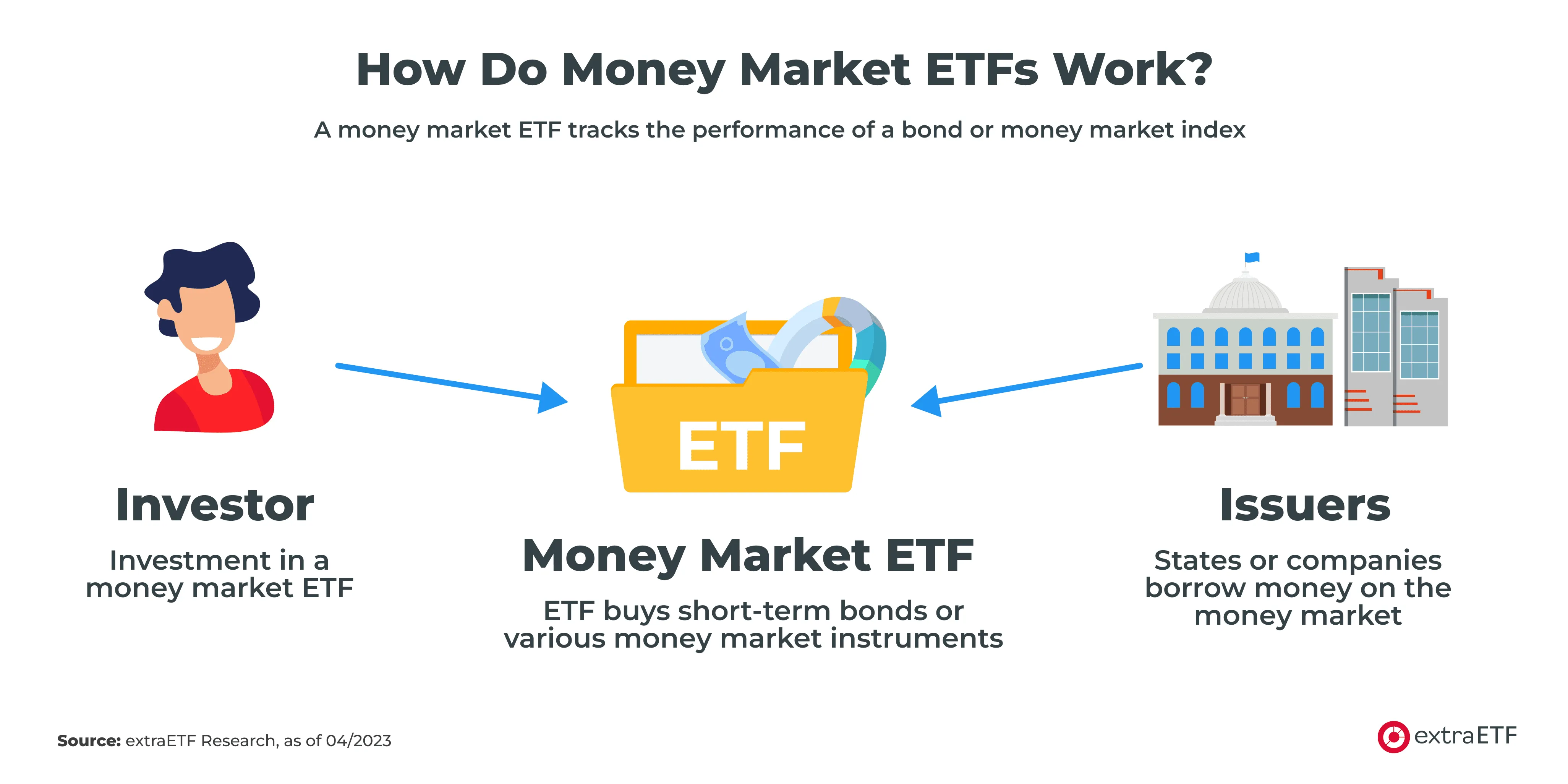
Money market ETFs offer a daily return based on the respective benchmark interest rate. They function similarly to other ETFs by tracking an index. For money market ETFs denominated in euros, the index tracks the daily movement of the Euro Short-Term Rate (ESTR). This means that the index rises daily by the pro-rata ESTR rate. To achieve this target return, the ETF enters into swaps with banks.
Money market ETFs therefore offer an attractive way to invest capital safely and flexibly for the short term, and are an interesting alternative to an easy access savings account.
The graphic below gives a simplified overview of how money market ETFs work:

An alternative to a money market account: Are money market ETFs a good idea?
Money market ETFs can be a sensible alternative to easy access savings accounts, as they offer similar advantages but can generate a higher return. Money market ETFs invest in the money market, which is considered safe and liquid and generally pays more than easy access savings accounts.
However, there are also some disadvantages to consider. Unlike easy access savings accounts, money market ETFs often involve fees, such as management fees or dealing fees, as well as indirect costs like spreads. Furthermore, they are not covered by the FSCS, so investors may suffer losses if an issuer of the bonds held in the ETF defaults.
It’s important to note that money market ETFs do not pay a fixed rate, so their returns can fluctuate. If interest rates fall, the ETF’s return will fall too, whereas a fixed-rate savings account locks in its rate for the term.
Money Market ETFs vs Easy Access Savings Accounts
| Category | Money Market ETF | Easy Access Savings |
|---|---|---|
| Risk | Low, but higher than easy access accounts, as there is no FSCS protection. Subject to credit and interest rate risk. | Very low; deposits are protected by the FSCS up to £85,000 per person, per authorised institution. |
| Return | Usually higher than easy access, as the return is based on the ECB’s deposit facility rate. Fluctuates with market conditions. | Lower, but more predictable. Rates often lag behind current market rates. |
| Liquidity | High; shares can be sold on any trading day, subject to market liquidity. | Very high; funds can be withdrawn at any time without restrictions. |
| Costs | Management fees and potential transaction costs (e.g. the spread), which may slightly reduce the return. | No direct costs, but lower interest rates carry an indirect cost. |
What money market ETFs are available?
There are various types of money market ETFs, which differ in their investment strategy, currency, and underlying index. Below are some of the most common types. Using extraETF’s ETF search tool, you can filter and analyse all available money market ETFs.
Below are the main types of money market ETFs.
How high is the risk associated with money market ETFs?
Money market ETFs are considered relatively low-risk funds because they invest only in short-term money market instruments. The participants in the money market are governments, financial institutions, and large companies with high credit ratings, which significantly reduces counterparty risk. However, they are not risk-free. Like traditional fixed-income investments, they are exposed to the following risks:
- Interest rate risk: The return on money market ETFs depends on the benchmark index and therefore on the benchmark interest rate.
- Credit risk: If a debtor defaults, money market ETFs may also suffer price losses.
- Currency risk: If you buy money market ETFs denominated in a foreign currency, you are exposed to currency risk against sterling.
Join the extraETF community
Explore the world of ETFs and make informed investment decisions.
- Find ETFs that match your criteria with our ETF Search.
- Compare costs, performance, and risk side by side.
- Save your favourites to a watchlist and receive price alerts.
- Explore detailed ETF profiles with key metrics and holdings.
What is the return on money market ETFs?
The returns on money market ETFs are generally lower than those of equity or bond ETFs. This is because money market ETFs track only the short-term interest rate market. For euro-denominated money market ETFs, the European Central Bank’s (ECB) deposit facility rate therefore has a decisive influence on the yield. Since June 2024, this rate has stood at 3.75 per cent. The ESTR interest rate, which is relevant for many eurozone money market ETFs, currently stands at 3.66 per cent (as of 20 August 2024). For US dollar-denominated money market ETFs, the Federal Reserve’s benchmark interest rate is the key factor. In August 2024, its target range was 5.25 to 5.50 per cent. However, key interest rates are not the only influence on the yield: current supply and demand in the money market also play a part. These can deviate from key rates, though not by much.
Performance (in euros) of selected money market ETFs.
| ETF Name | Current Year | 2023 | 2022 | 2021 | 2020 |
|---|---|---|---|---|---|
| Xtrackers EUR Overnight Rate Swap UCITS ETF | +2.49% | +3.27% | -0.03% | -0.50% | -0.57% |
| Xtrackers USD Overnight Rate Swap UCITS ETF | +3.95% | +1.60% | 7.62% | 8.42% | -8.49% |
| Xtrackers GBP Overnight Rate Swap UCITS ETF | +4.97% | +6.73% | -4.22% | 7.63% | -5.51% |
| Amundi EUR Overnight Return UCITS ETF | +2.43% | +3.19% | -0.13% | -0.70% | -0.68% |
| Amundi Fed Funds U.S. Dollar Cash UCITS ETF | +3.90% | +1.57% | 8.25% | +7.56% | -10.34% |
| Lyxor Smart Overnight Return (EUR) | +2.58% | +3.29% | +0.13% | -0.46% | -0.43% |
| Invesco EuroMTS Cash 3 Months UCITS ETF | +2.32% | +2.89% | -0.43% | -0.78% | -0.59% |
Money market returns were negative for several years, and money market ETFs posted negative returns as a result. However, interest rates have since risen significantly, so money market ETFs can once again generate positive returns.
The chart below shows the price of the Xtrackers EUR Overnight Rate Swap UCITS ETF. This ETF tracks an index based on the Euro Short-Term Rate (€STR). The chart clearly shows the ETF’s price rising each day by the pro-rata interest rate.

Money Market ETFs as an Alternative to Overnight Accounts
Who are money market ETFs suitable for?
Money market ETFs are ideal for investors who want a short-term, low-risk investment and the flexibility to park their capital until better opportunities arise. Like regular ETFs, money market ETFs can be held in an investment account and are traded on the stock exchange. A major advantage is that investors do not have to keep searching different banks for the best interest rates. Since money market ETFs offer an interest rate very close to the European Central Bank’s (ECB) deposit facility rate, they provide an attractive return that reflects current market conditions.
Money market ETFs are also particularly appealing to high-net-worth investors who want to protect cash above the £85,000 FSCS protection limit. Rather than sitting in a bank account, the money is invested in the money market, off the bank’s balance sheet. This minimises the risk of loss if a bank fails.
Overall, money market ETFs are an attractive alternative to an easy access savings account.

Advantages of Money Market ETFs
- Attractive returns: Euro money market ETFs pay returns based on the ECB’s deposit facility rate, which are often higher than those on traditional savings accounts.
- Low risk: Since money market ETFs invest in the money market, they carry comparatively low interest rate and credit risk.
- High flexibility: Money market ETFs let investors park cash without being tied to fixed terms, so they can react quickly to better investment opportunities.
- No need to shop around for interest rates: Unlike with easy access savings accounts, investors do not have to keep comparing banks for the best rate, as money market ETFs automatically benefit from current market interest rates.
- Security beyond FSCS limits: For investors with large cash balances, money market ETFs offer a way to hold liquid funds above the £85,000 FSCS protection limit, reducing exposure to a bank failure.

Disadvantages of Money Market ETFs
- Fluctuating returns: Although money market ETFs are considered relatively low-risk, their returns fluctuate with market conditions.
- No FSCS protection: Unlike savings accounts, money market ETFs are not covered by the FSCS. Investors could therefore lose some of their capital, although this is very unlikely.
- Limited return potential: Money market ETFs generally offer lower returns than riskier investments such as shares or bonds.
- Higher costs than savings accounts: Money market ETFs typically charge a management fee, whereas savings accounts do not.
- No protection against inflation: Money market ETFs offer no guaranteed protection against inflation. If inflation exceeds the money market return, your money loses purchasing power.
Tip: Banks often offer special introductory rates on savings balances, though usually only to new customers. In these cases, a savings account is often preferable to a money market ETF, provided your balance is within the FSCS limit.
Conclusion: Money Market ETFs – A Good Alternative to a Money Market Account
In summary, money market ETFs are an attractive option for investing spare cash in the short term. They are a good alternative to easy access savings accounts and in many cases offer a higher return than bank savings. However, they come with costs and slightly higher risk, as they are not protected by the FSCS like bank deposits and their returns can fluctuate.
Even so, money market ETFs may suit investors who want a relatively low-risk investment, wish to diversify their portfolio with an additional asset class, or want to park cash for the short term.
Use the ETF search tool on extraETF to find and analyse all money market ETFs.
Important Questions About Money Market ETFs
- Everything You Need to Know About Money Market ETFs
- What is the money market?
- What is a money market ETF?
- An alternative to a money market account: Are money market ETFs a good idea?
- What money market ETFs are available?
- How high is the risk associated with money market ETFs?
- What is the return on money market ETFs?
- Who are money market ETFs suitable for?
- Money Market ETFs – A Good Alternative to a Money Market Account
- Important Questions About Money Market ETFs