
Understanding Bond ETFs
Everything You Need to Know About Bond ETFs: How to Invest in Them and How Useful They Are

Bond ETFs have become increasingly popular in recent years because they offer the opportunity to invest in a broadly diversified bond portfolio without having to purchase individual bonds.
With interest rates rising in recent months, bonds – with their interest payments – have once again become an attractive asset class for investors.
In this guide, we explain how bond ETFs work, what their advantages and disadvantages are, what a coupon is, and how they can be used as securities in a portfolio.

The essentials in brief: Everything You Need to Know About Bond ETFs
Bonds: With bond ETFs, you can invest in a basket of different bonds, such as government or corporate bonds. The selection of bonds depends on the index that the bond ETF tracks.
Returns: Bond ETFs can generate regular interest income. Depending on how interest rates move, capital gains are also possible. The level of returns also depends on the creditworthiness of the issuers.
Risk: Bond ETFs are considered a safe investment, but they still carry certain risks, such as credit risk, interest rate risk, currency risk, and liquidity risk. Despite their higher level of safety, these funds are also subject to price declines.
Investment Strategy: Bond ETFs are particularly well-suited for adding stability and security to a portfolio. Short-term government bond ETFs from countries with good credit ratings can serve as an alternative to money market funds or fixed-term deposits. Corporate bonds carry a higher risk than government bonds.

Find and compare thousands of ETFs. Use powerful filters, detailed analytics, and independent data to discover the right ETF for your portfolio.
What Are Bond ETFs?
With a bond ETF (also known as a fixed-income ETF), you invest in a basket of various bonds with different maturities, credit ratings, and interest rates. Bond ETFs always specialize in specific types of bonds, such as government bonds, corporate bonds, or convertible bonds. Like other ETFs, they track the performance of an index – in this case, a bond index. Bond ETFs can be traded on the stock exchange at any time, just like stock ETFs.
Investors can use a bond ETF to invest in a broadly diversified bond portfolio without having to select or purchase individual bonds themselves. Bond ETFs thus offer a simple and cost-effective way to invest in bonds without having to take on the risk associated with individual investments.


How do bond ETFs work?
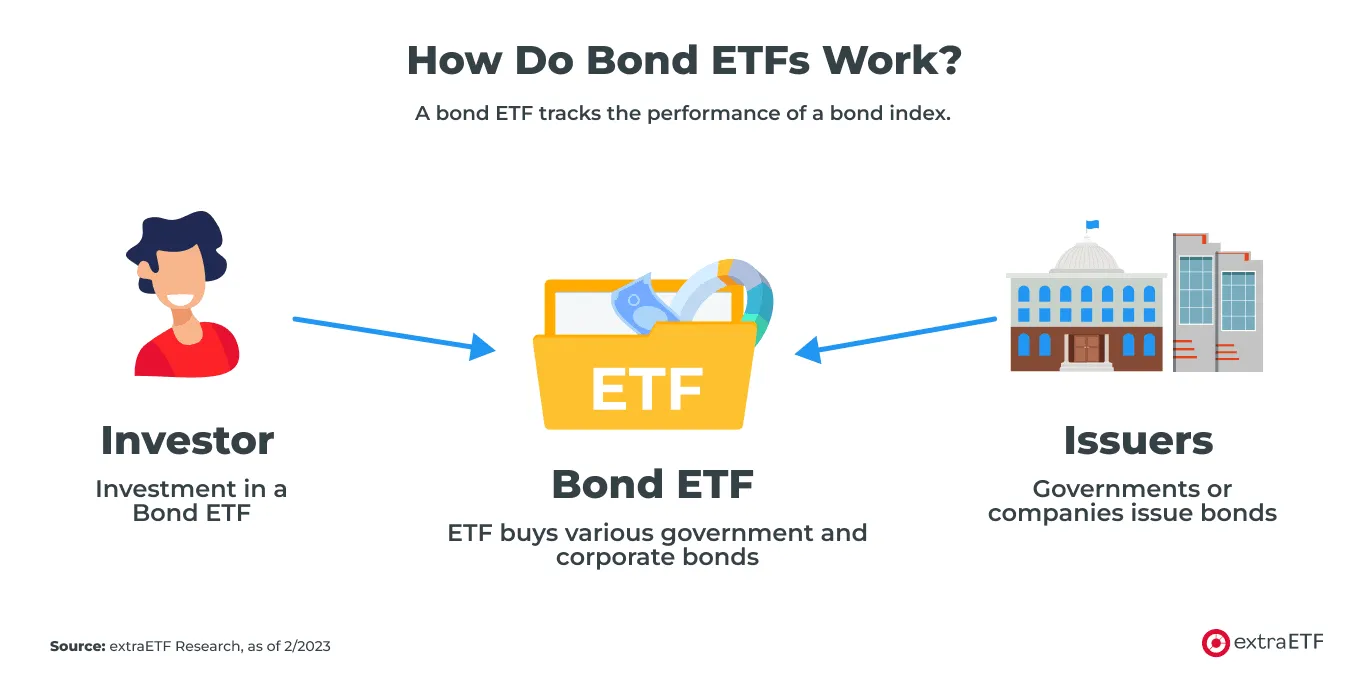
Bond ETFs work like stock market ETFs by tracking the performance of an underlying index. The underlying bond index comprises various types of bonds, such as government bonds, corporate bonds, inflation-protected bonds, or convertible bonds. The bonds included in the ETF may also be denominated in different currencies, such as the euro or the U.S. dollar.
Within a bond index, the criteria that bonds must meet to be included in the index are precisely defined. Bonds have a fixed term; upon maturity, the face value of the bond is paid out in cash to the fund’s settlement account. The available funds are then reinvested in new bonds that meet the index’s criteria. This process ensures that the bond ETF always tracks a bond portfolio that complies with the index rules.
We’ve outlined how bond ETFs work in simple terms here:
What types of bond ETFs are there?
There are currently around 550 bond ETFs available in Germany. The largest group consists of bond ETFs that invest in government bonds. The second-largest segment is made up of index funds that track the performance of corporate bonds. Investors can therefore choose an ETF that suits their investment strategy from a very wide range of options. Using extraETF’s ETF search tool, all bond ETFs can be filtered and analysed.
Below, we present the main types of bond ETFs.
How high is the risk associated with bond ETFs?
Bond ETFs are generally much less risky than stock ETFs because they invest in bonds that, under normal circumstances, are redeemed at face value upon maturity. However, there are some risks that investors should be aware of and take into account when investing in bond ETFs.
- Credit risk: Bond ETFs, particularly those that invest in corporate bonds, are subject to credit risk. If the issuers of the bonds run into financial difficulties or their credit ratings are downgraded, the prices of these bonds may fall, leading to losses in bond ETFs.
- Interest rate risk: Bond ETFs are sensitive to changes in interest rates. When interest rates rise, bond prices may fall, which can lead to losses in bond ETFs. Conversely, bond ETFs can benefit from falling interest rates.
- Currency risk: Bond ETFs that invest in foreign-currency bonds are subject to currency risk. If the currency of a bond’s issuer depreciates against the investor’s currency, this can result in losses for bond ETFs.
- Liquidity risk: Bond ETFs that invest in less liquid bonds, such as high-yield bonds or emerging-market bonds, may be subject to increased liquidity risk. If it is difficult to sell these bonds, their prices may fall, which can result in losses for bond ETFs.
Join the extraETF community

Explore the world of ETFs and make informed investment decisions.
- Find ETFs that match your criteria with our ETF Search.
- Compare costs, performance, and risk side by side.
- Save your favourites to a watchlist and receive price alerts.
- Explore detailed ETF profiles with key metrics and holdings.
What is the return on bond ETFs?
The return on bond ETFs is always made up of the interest paid (coupon) and the price gains or losses on the bonds held in the bond ETFs. In addition, the return depends on other factors, such as the type of bonds in which the ETF invests, the creditworthiness of the bond issuers, the interest rates (coupons), and the general market conditions.
The following table shows the annual returns of various investments in bond ETFs. It is immediately apparent that bond ETFs incurred significant losses in 2022. This is attributable to the sharp rise in interest rates caused by rising inflation. That year serves as a good example of how bond ETFs can also experience price losses. However, returns have risen significantly again over the past year.
| ETF Name | 2023 | 2022 | 2021 | 2020 | 2019 | 2018 |
|---|---|---|---|---|---|---|
| iShares Core € Corp Bond UCITS ETF | +8.02% | -13.85% | -1.15% | 2.52% | 6.14% | -1.41% |
| iShares € High Yield Corp Bond UCITS ETF | +11.33% | -9.72% | 2.96% | 1.00% | 9.37% | -3.53% |
| iShares Global Govt Bond UCITS ETF | +0.44% | -12.65% | 1.09% | -0.23% | 8.23% | 4.02% |
| Xtrackers Eurozone Govt Bond UCITS ETF | +7.06% | -18.55% | -3.59% | 4.86% | 6.56% | 0.57% |
Detailed return analyses can be performed using extraETF’s bond ETF search tool.

Bond ETFs Provide Stability in an ETF Portfolio
 Markus Jordan, founder of extraETF
Comparison: What is the difference between bond ETFs and actively managed bond funds?
The main difference between bond ETFs and bond funds lies in the type of fund management. While bond funds are actively managed by a fund management team, bond ETFs passively and automatically track an index. Since passive index tracking does not require fund management, the costs for bond ETFs are significantly lower than those for bond funds.
- Bond ETFs are passive investment funds that hold a broad range of bonds to achieve a specific return that matches an underlying index. The ETF does not seek to outperform the market but simply tracks the bond index by holding all the bonds included in the index. The advantage of bond ETFs is that they generally offer broad diversification, have lower costs than active funds, and are highly liquid since they are traded on the stock exchange.
- Active bond funds, on the other hand, are investment funds in which a fund manager actively selects bonds and decides which bonds to buy and sell. The goal is to achieve a higher return than the market. Active fund managers try to achieve a higher return by analysing the market and making informed decisions about which bonds to select. The disadvantage of active funds is that they generally have higher fees and may be less diversified than bond ETFs.

Advantages of Bond ETFs
- Cost Efficiency: The costs associated with bond ETFs are low. This often results in higher returns than those offered by actively managed bond funds.
- Diversification: Bond ETFs typically spread capital across many issuers. This can significantly minimise the default risk of any single issuer.
- Wide Selection: There is a wide range of bond ETFs available. This allows you to choose a bond ETF that fits your investment strategy.
- Low minimum investment amount: Bond ETFs allow you to invest in a wide variety of securities with a small amount of money. This would generally not be possible with individual bonds.

Disadvantages of Bond ETFs
- Risks: Bond ETFs can also carry risks if, for example, they invest in bonds issued by issuers with low credit ratings, such as emerging markets or corporations. These bonds often exhibit higher volatility than bonds issued by countries with high credit ratings.
- Complexity: Although bond ETFs track transparent indices just like stock ETFs, these indices can be quite complex and therefore difficult to understand.
- Selection: Selecting bond ETFs is significantly more complex than selecting stock ETFs, as additional parameters such as maturity structure, coupon, currency, or the creditworthiness of the issuers must be taken into account.
- Concentration risk: Bond ETFs often exhibit increased concentration risk with regard to issuers, currencies, or maturities. This should definitely be taken into account when selecting an ETF.
An alternative to a money market account: Are bond ETFs a good investment?
The suitability of bond ETFs depends on various factors, such as the investment objective, risk profile, or investment strategy. In general, bond ETFs are a sensible investment for investors who wish to add a safety-oriented component to their portfolio.
Another argument in favour of buying bond ETFs is the fact that, for bank deposits such as demand deposits or fixed-term deposits, statutory deposit insurance only applies up to an amount of £100,000. Amounts exceeding this limit are subject to default risk if the bank encounters financial difficulties. Anyone with larger amounts in their account should consider whether it might be better to invest them in short-term government bonds.
Tip: Banks frequently offer special interest rates on account balances, which often exceed the yields on short-term bonds. In this case, a money market account is preferable to a bond ETF, provided you disregard the default risk.

Conclusion: Bond ETFs – A Useful Component of a Portfolio
Bond ETFs offer a simple way to invest in a broadly diversified portfolio of various bonds. Adding a bond ETF to a portfolio can significantly reduce its risk, as bonds are generally less risky than investments in stocks.
To achieve a high degree of diversification, stocks and bonds should always be combined in a way that minimizes a portfolio’s overall risk. While stocks – as the riskiest but also the highest-yielding component – typically account for the majority of a portfolio’s returns, bonds – as the lowest-risk component – serve as a kind of safety net within the portfolio.
Since shares in bond ETFs naturally also carry certain risks, close attention should be paid to the specific terms of the underlying bonds when selecting these ETFs. You can find detailed information about the characteristics of bond ETFs using the ETF search function on extraETF and the ETF profile pages.
Important Questions About Bond ETFs

- Everything You Need to Know About Bond ETFs
- What Are Bond ETFs?
- How do bond ETFs work?
- What types of bond ETFs are there?
- How high is the risk associated with bond ETFs?
- What is the return on bond ETFs?
- Comparison: What is the difference between bond ETFs and actively managed bond funds?
- An alternative to a money market account: Are bond ETFs a good investment?
- Bond ETFs – A Useful Component of a Portfolio
- Important Questions About Bond ETFs