



Understanding Government Bonds
A safe haven for investors?
Businesses and individuals often borrow money to make large purchases. Governments do something similar, relying on capital from investors to fund their spending. By issuing government bonds, a country takes on debt and, in return, pays interest over a fixed term and repays the face value at maturity.
These bonds are often considered low-risk investments, especially when issued by countries with high credit ratings. However, returns are also lower than those from higher-risk investments such as shares.
In this guide, we’ll explain exactly what government bonds are, how they work, and more.
The essentials in brief: Basics of Government Bonds
Definition: Government bonds are debt securities issued by governments to finance budget deficits or specific projects.
Interest rates: Government bonds generally offer stable interest rates, although these are often lower than those on other investments.
Risks: Government bonds are generally considered safe, but they still carry risks, depending on the government’s creditworthiness and the currency. A government may be unable to service its debt (default risk), or the currency may weaken.
Government Bond ETFs: Government bond ETFs offer investors a simple way to invest in a diversified portfolio of government bonds, which reduces the risk of relying on any single bond.

Find and compare thousands of ETFs. Use powerful filters, detailed analytics, and independent data to discover the right ETF for your portfolio.
Explanation: What exactly are government bonds?
Government bonds are debt securities issued by governments. In other words, a government borrows money from investors on the financial markets and offers securities in return. These bonds are used to cover short-term budget shortfalls or to finance long-term projects. In exchange, the issuer – the government – commits to repaying the bond’s face value at maturity and making regular interest payments during the bond’s term. The exact terms vary: maturities range from a few years to several decades, and interest rates can be fixed or variable.
How do government bonds work?
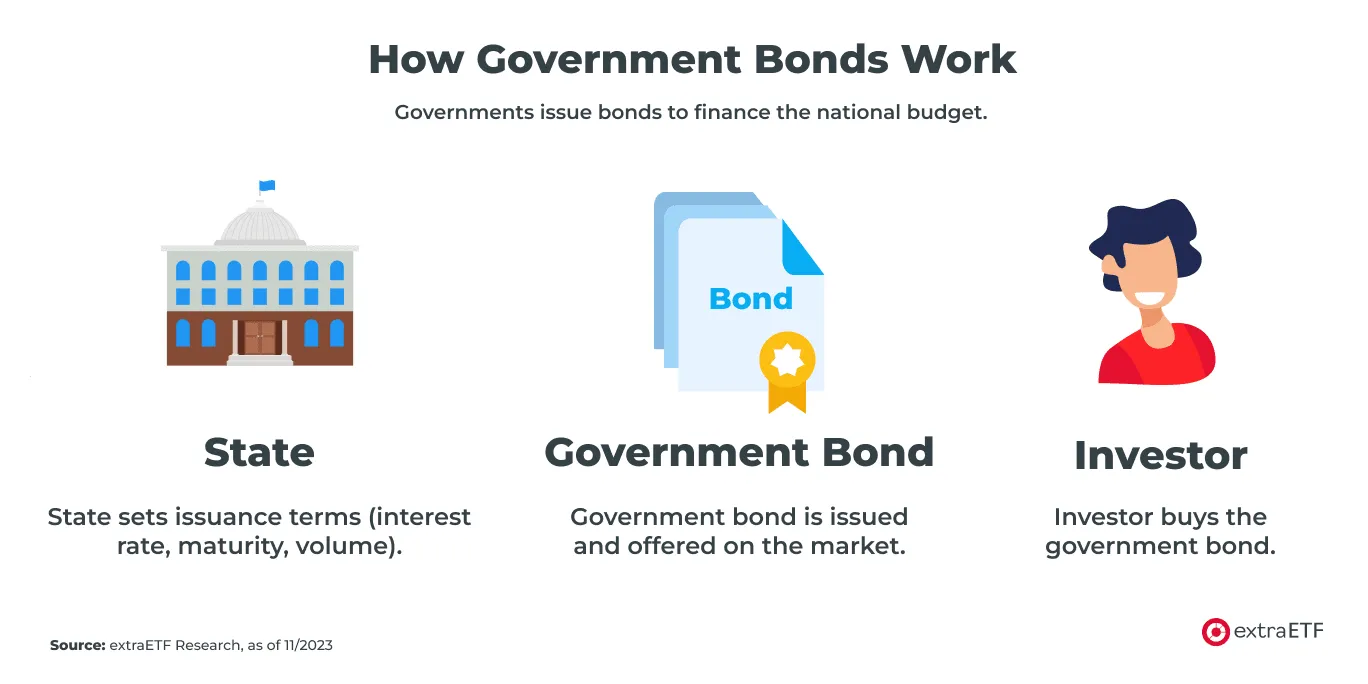
A government issues interest-bearing securities – government bonds – to raise funds for specific projects or to cover budget deficits. Individual investors can purchase these government bonds on the stock exchange and receive regular interest payments from the issuer until maturity, at which point they also receive their principal back.
How and where can you buy government bonds?
Government bonds are exchange-traded securities. This means you can buy government bonds on the stock exchange through a bank or broker – provided you have an investment account. Like other exchange-traded securities, government bonds have an ISIN. You can also sell them on the stock exchange at the current market price before maturity, for example if you need the money or can make a profit. Before investing in a government bond, check the issuer’s credit rating. German government bonds, known as Bunds, are considered a particularly safe investment because Germany ranks among the countries with the highest credit ratings.
Join the extraETF community
Explore the world of ETFs and make informed investment decisions.
- Find ETFs that match your criteria with our ETF Search.
- Compare costs, performance, and risk side by side.
- Save your favourites to a watchlist and receive price alerts.
- Explore detailed ETF profiles with key metrics and holdings.
The Role of Creditworthiness in Government Bonds
It is difficult for individual investors to assess a country’s creditworthiness on their own. That is why independent companies known as rating agencies do it for them. The largest are Standard & Poor’s, Moody’s and Fitch. A country’s credit rating affects both its ability to borrow and what that borrowing costs. A good rating eases access to capital and lowers borrowing costs. As a general rule, the better a country’s credit rating, the lower the interest rate on its bonds. For investors choosing a bond, this means:
- Bonds issued by countries with good credit ratings offer lower yields, but the risk of default is correspondingly low.
- Bonds from countries with lower credit ratings offer higher interest rates, but the risk of default is also higher.
German government bonds (Bunds) are considered very safe, so they often offer lower interest rates than bonds from countries with lower credit ratings.
Why do governments issue bonds?
Governments issue bonds to raise funds needed for various public and economic purposes. There are many reasons for issuing government bonds:
- Financing budget deficits
- Funding infrastructure
- Refinancing debt
- Monetary policy measures
By taking on debt, governments can finance important projects and help stimulate the economy. However, if debt gets out of hand, it can destabilise the economy and leave future generations with a higher tax burden.
Government Bond ETFs – An Alternative?
As well as individual government bonds, investors can also buy government bond ETFs. When you buy one, you acquire a share in a fund that invests in multiple government bonds. This further diversifies the investment risk. You can also easily buy and sell shares in government bond ETFs on the stock exchange.
Government bond ETFs work similarly to stock ETFs, except that they track a bond index rather than a stock index. Because bond ETFs are passively managed, investors also benefit from low running costs. Whether government bond ETFs make sense for you depends on your investment goals and your risk tolerance. Bond ETFs are less risky than stock ETFs and other securities, but they also offer lower return potential. They can certainly make sense for diversifying your portfolio and reducing your overall investment risk.

Advantages of Government Bonds
- Safety: Government bonds are generally considered a safe investment because they are issued by governments that commit to repaying the face value at maturity.
- Stable income: Through regular interest payments, government bonds provide a steady source of income.
- Liquidity: Government bonds are generally easy to buy and sell, making them a relatively liquid investment.
- Simplicity and clarity: Government bonds are relatively easy to understand compared to more complex financial instruments.

Disadvantages of Government Bonds
- Lower returns: Compared to other investments such as stocks or corporate bonds, government bonds generally offer lower returns.
- Inflation risk: High inflation can erode returns, especially when interest rates are low.
- Interest rate risk: When interest rates rise, government bond prices fall, which can lead to capital losses if you sell the bond before maturity.
- Long maturities: Some government bonds have very long maturities, which makes them less attractive to investors seeking short-term gains.
- Credit risk: The issuing government may face financial difficulties and be unable to repay the bond or pay interest.
- Currency risk: Bonds issued in foreign currencies expose investors to exchange-rate fluctuations.
Government bonds offer a high degree of security and are therefore often used as a defensive component in asset allocation. Short-term government bonds are particularly attractive because of their high liquidity and low interest rate risk.
Conclusion: Why Invest in Government Bonds?
The main advantage of government bonds is their relative safety compared with riskier investments such as stocks. They offer a fixed return, delivered through interest payments and repayment of the face value at maturity. The higher the issuer’s credit rating, the lower the risk of default. German government bonds, for example, are considered very safe because Germany has a strong credit rating. Because of this safety, government bonds are well suited to diversifying a portfolio and reducing its overall risk.
To monitor your portfolio comprehensively, use a portfolio tracking tool. It lets you keep track of your stocks, bonds and ETFs at all times and gives you useful analysis of your assets.
We'll answer any other questions you may have about government bonds
- Basics of Government Bonds
- Explanation: What exactly are government bonds?
- How do government bonds work?
- How and where can you buy government bonds?
- The Role of Creditworthiness in Government Bonds
- Why do governments issue bonds?
- Government Bond ETFs – An Alternative?
- Selected Government Bond ETFs
- Why Invest in Government Bonds?
- We'll answer any other questions you may have about government bonds
