



Investing in Securities
Types of investments and how to start buying them
Securities have long been an integral part of the financial world. Originally, they existed in physical paper form as certificates, but even then they represented claims on assets. Today, you can buy and sell securities digitally through an investment account, but their function remains the same: they let investors share in the performance of various assets.
But how do securities work, what types are there, and how can you invest in them?
The essentials in brief: Securities: A Brief Overview
Definition: Securities are financial instruments that represent an asset. They confer rights to dividends, interest payments or the repayment of capital. They are particularly well suited to long-term wealth building, offering the opportunity to generate attractive returns.
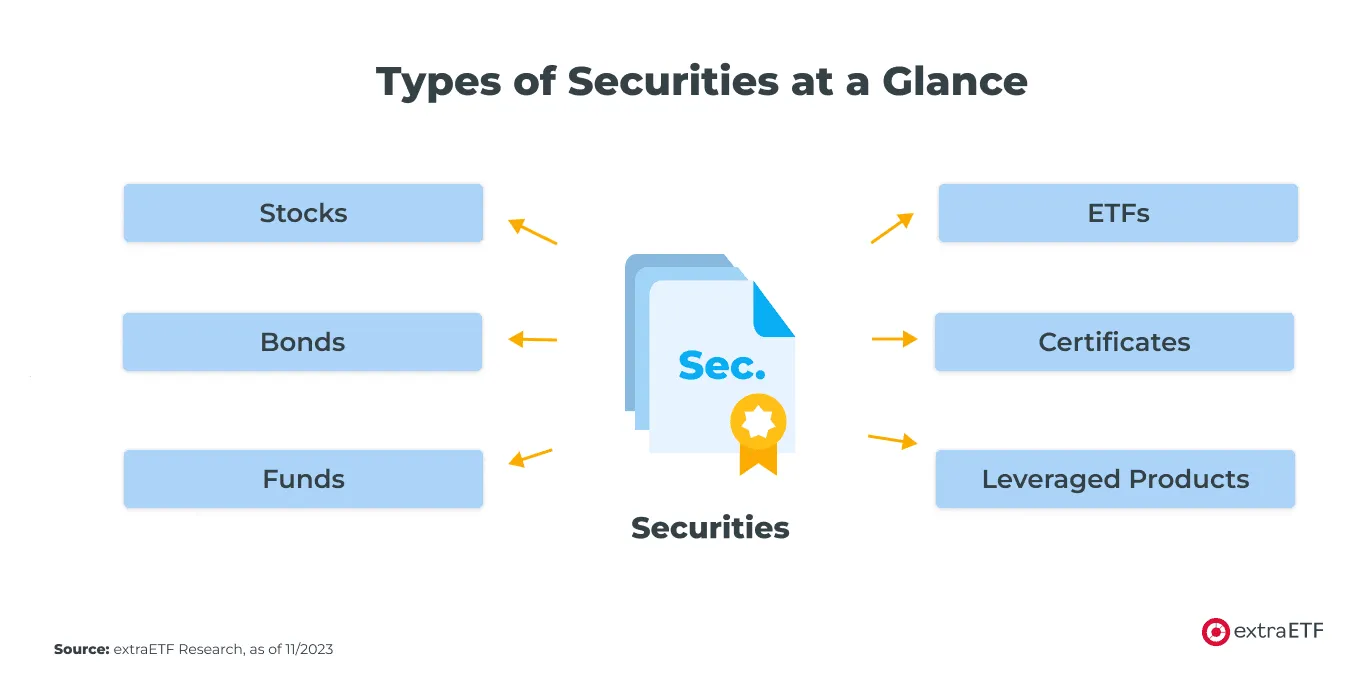
Types: Securities include shares, bonds, investment funds, ETFs and investment certificates. Each type has its own characteristics and risks, giving investors a wide range of options for diversifying their portfolios.
Risk: How risky a security is depends on its type and issuer. Bonds are often considered lower risk, while shares carry higher risk. Diversification, thorough research and a clear understanding of your own risk tolerance are crucial for limiting potential losses.
Investing: You buy securities on a stock exchange or through a broker, and they are then held in your investment account. Before you invest, define your investment goals and research the individual securities.

Find and compare thousands of ETFs. Use powerful filters, detailed analytics, and independent data to discover the right ETF for your portfolio.
Definition: What are securities?
Securities are instruments that allow you, as an investor, to take an ownership stake in a company (shares) or lend money (bonds). Securities therefore represent a legally enforceable claim to certain rights or financial resources. They are traded on stock exchanges and come in several forms, including shares, bonds, funds and certificates.
Securities fall into two categories, each with a different transfer mechanism: bearer securities and registered securities.
- Bearer securities are securities for which physical possession of the document itself establishes ownership and the right to claim the benefits attached to it. Examples include cash (banknotes), bearer bonds and bearer shares. They can generally be transferred simply by handing the document to another person, with no need to record the transfer in a register.
- In contrast, a transfer of registered securities must be recorded in the company’s register of securities, or that of an external custodian, to document the new owner. Only the people named in the register can exercise the rights attached to the security, such as receiving interest and dividends or being repaid the invested capital.
The type of security a company issues depends on its financing objectives and its investors’ needs.
What types of securities are there?
Securities can be fixed-income or variable-return. Fixed-income securities (bonds) pay fixed interest at regular intervals and repay the invested principal at maturity. Variable-return securities are financial instruments whose value (such as a share price) or income (such as interest and dividends) can fluctuate. Below, we explain which investment options count as securities and how they work.
Shares
As proof of ownership in a company, shares give shareholders a claim on the company’s profits, a vote on company decisions and, where applicable, dividend payments. Shares are traded on a stock exchange, where supply and demand determine the price. Investing in shares carries risk: if the share price falls, you could lose your entire investment. If it rises, however, you can achieve high returns.
Investing in shares therefore requires a good understanding of the capital markets and is best suited to those with some investing experience. With so many companies to choose from, shares work well as a higher-risk asset for diversifying your portfolio.
Bonds
Bonds are typically fixed-income securities through which you lend money to a company or government. In return, you receive regular interest payments and, at the end of the term, your original capital is repaid. Compared with shares, bonds are generally considered lower risk because they offer fixed, predictable returns. They are not risk-free, however: the issuer may fail to pay what it owes. A bond rating helps you assess the issuer’s creditworthiness. Bonds can add a lower-risk component to a diversified portfolio.
Funds & ETFs
Funds let you invest in shares, bonds, property and other asset classes. They pool the money of many investors to buy a range of securities at the same time, offering an efficient way to diversify because you automatically invest in a variety of assets. Active funds are run by professional fund managers who make decisions based on the fund’s investment objectives and market analysis.
Exchange-traded funds (ETFs) are a special type of fund. They trade on an exchange and automatically track the performance of a specific index, such as the FTSE 100. Because they are passively managed, ETFs are generally cheaper than active funds. They offer a transparent way to invest broadly across various markets.
Certificates
Certificates are debt securities based on an underlying asset such as shares, indices or commodities. They let you profit from changes in the price of the underlying asset without buying it directly. There are various types of certificates, such as index certificates and participation certificates. Certificates offer flexibility but carry risks, particularly the issuer’s creditworthiness and market volatility. Make sure you understand how they work and the risks involved before investing.
Leveraged Products
Leveraged products come in forms such as certificates, leveraged ETFs or options, and are considered very high-risk securities. They use financial leverage to magnify gains. A leveraged product is based on an underlying asset and amplifies that asset’s price movement by the leverage factor. The same applies in reverse, though: losses are magnified too if the price falls. Although leveraged products offer the potential for high returns, the risk of heavy losses is equally high. Because of their complexity, they are suitable only for experienced investors.
Why should you invest in securities?
Investing in securities offers the opportunity to generate long-term returns and build wealth. Spreading your money across several securities can help reduce risk. Shares give you a stake in companies’ financial success, and securities in general offer a flexible way to invest that you can tailor to your needs and risk tolerance.
Here are the main reasons to invest in securities:
- Return Potential: Securities can generate returns over time, whether through rising share prices, bond interest or company dividends.
- Diversification: Investing in different types of securities spreads your risk. Broad diversification reduces the impact of losses in one market segment, which may be offset by gains in another.
- Sharing in a Company’s Success: When you invest in shares, you acquire a stake in the company and share in its financial success, through dividends or capital gains.
- Offsetting Inflation: Inflation erodes the value of money over time. Securities may generate returns that outpace inflation, helping to preserve the purchasing power of your money.
- Opportunity for Long-Term Wealth Building: Securities are particularly well suited to long-term strategies. By investing consistently over an extended period, you can benefit from compounding and, historically, ride out market fluctuations more easily.
Despite these advantages, remember that any investment in the stock market involves risk. Before investing, do your research, define your investment goals clearly and keep your risk tolerance in mind. Diversifying across different securities and asset classes spreads the risk and can help cushion potential losses.
Join the extraETF community
Explore the world of ETFs and make informed investment decisions.
- Find ETFs that match your criteria with our ETF Search.
- Compare costs, performance, and risk side by side.
- Save your favourites to a watchlist and receive price alerts.
- Explore detailed ETF profiles with key metrics and holdings.
Securities Trading: How can you buy securities?
Securities are available from a range of providers, from high-street banks to neobrokers, so you can choose the one that best suits your needs. Follow the steps below to get started and work towards your financial goals.
Once you have bought securities, you can manage them in your investment account and sell them when you choose. Many providers also let you set up a regular investment plan for shares or ETFs (see regular ETF investing), so you invest a fixed amount at regular intervals, for example every month.
What are the best securities?
There is no one-size-fits-all answer to which securities are best. Whether you should invest in shares, ETFs or certificates depends largely on your investment goals, risk tolerance, financial situation and time horizon. Shares, for example, offer high potential returns but also carry higher risk. If you want to invest broadly across a market, ETFs may be a good option. They let you pursue a diversified strategy and reduce risk. You can use the ETF search or the stock search to find securities that suit your investment needs.
Conclusion: It is impossible to imagine the financial world without securities
From shares to bonds to ETFs, securities offer a wide range of investment opportunities. ETFs in particular are cost-effective and transparent, and give access to various markets and sectors. By spreading risk across a wide range of assets, they provide instant diversification.
Regular investing makes it possible to put money into securities steadily, even in small amounts, and so build wealth over time.
We'll answer any other questions you may have about securities
- Securities: A Brief Overview
- Definition: What are securities?
- What types of securities are there?
- Why should you invest in securities?
- Securities Trading: How can you buy securities?
- It is impossible to imagine the financial world without securities
- We'll answer any other questions you may have about securities
