What Is an Easy Access Savings Account?
Flexible savings with no lock-in period

Easy access accounts have become popular again following the shift in interest rates. They offer clear advantages over current accounts and many traditional savings accounts, and plenty of benefits for savers. Flexible and secure, they are a modern alternative to traditional ways of saving.
Find out exactly what an easy access account is and how it works. We’ll show you why it can be an attractive choice for your finances right now and how it differs from other forms of saving.

The essentials in brief: Everything You Need to Know About Easy Access Accounts at a Glance
Definition: An easy access account is a flexible savings account with a variable interest rate and no fixed term. You can pay money in and withdraw it at any time via your linked current account.
Interest: Your bank pays you interest for keeping your money in an easy access account. The rate is based on prevailing market rates – in particular the Bank of England base rate – and on how much of that the bank chooses to pass on to you.
Security: Easy access savings are classed as bank deposits. Eligible deposits are protected by the Financial Services Compensation Scheme (FSCS) up to £85,000 per person, per authorised bank or building society. Note that protection may differ if your money is held with a provider based outside the UK.
Costs: Easy access accounts are usually free of charge, so you don't pay any fees to open or maintain the account.

Find and compare thousands of ETFs. Use powerful filters, detailed analytics, and independent data to discover the right ETF for your portfolio.
In summary: How does an easy access account work?
An easy access account is a modern savings account. It has no fixed term, so savers can access their entire balance at any time. You earn interest on the money while it stays in the account. The interest rate is variable, which means the bank can adjust it in line with market rates or its own pricing decisions. Savers can therefore often benefit when interest rates rise.
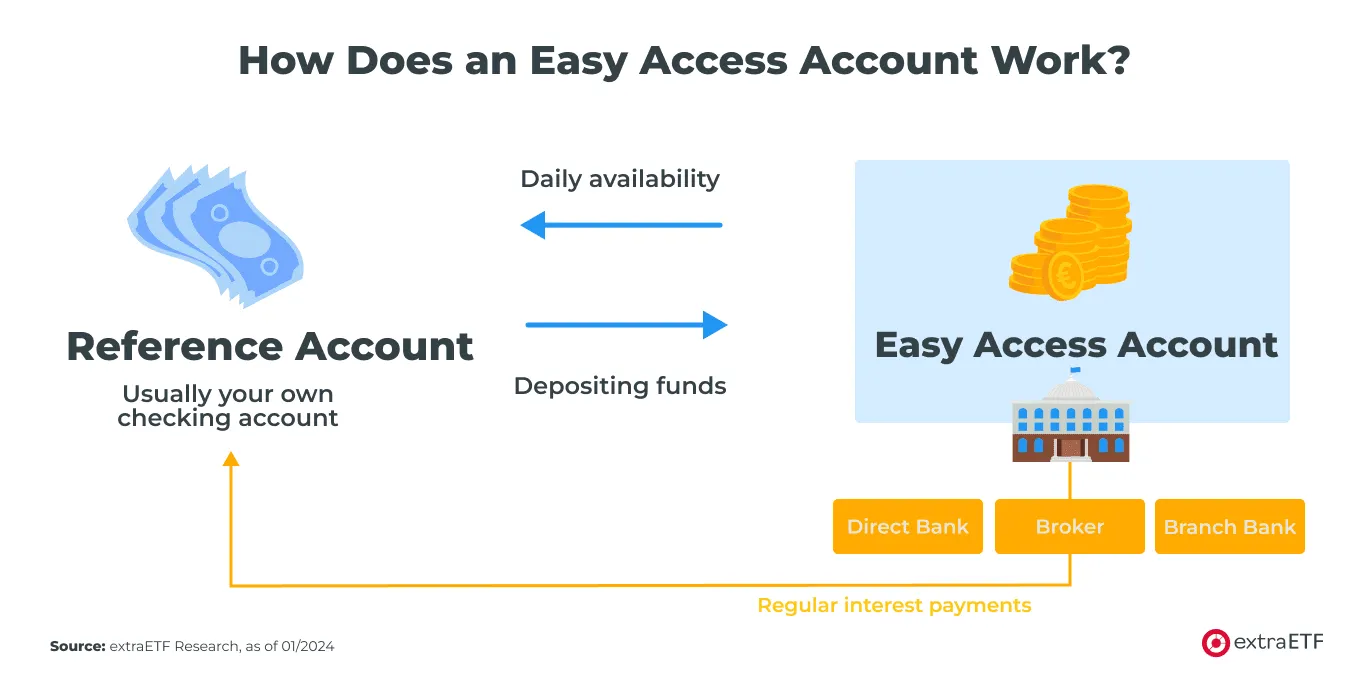
However, an easy access account cannot be used for day-to-day transactions. You can’t simply withdraw cash from it as you would from your current account or a savings account. Instead, all deposits and withdrawals go through a linked current account, usually your personal one. To pay money in, you transfer the amount from that account. To spend it on a holiday or invest it in another financial product, such as ETFs, you first transfer it back to your current account and make the payment or investment from there.
Another key feature of an easy access account is that – like a fixed-rate savings account – it is covered by the Financial Services Compensation Scheme (FSCS). This means balances up to £85,000 per person, per authorised firm are protected. If your bank fails, the FSCS will return your money up to that limit. Some banks share a single authorisation, so the limit may apply across the whole group. You can check your bank’s website to see how your money is protected, or simply ask at a branch.
What is the difference between a current account and an easy access account?
A current account handles your everyday finances – salary payments, standing orders, direct debits, card purchases and so on. However, you generally don’t earn interest on your current account. An easy access account, on the other hand, is purely a savings account that offers attractive interest rates, and you can’t use it for day-to-day transactions. It’s simply meant for parking money you don’t currently need – or your nest egg – and earning interest on it.
More articles from our "Saving & Planning for the Future" category
We've listed a few more articles that can help you save and plan for the future:
Join the extraETF community

Explore the world of ETFs and make informed investment decisions.
- Find ETFs that match your criteria with our ETF Search.
- Compare costs, performance, and risk side by side.
- Save your favourites to a watchlist and receive price alerts.
- Explore detailed ETF profiles with key metrics and holdings.




Taxes: How is an easy access account treated for tax purposes?
Interest you earn on savings may be subject to tax – whether it comes from easy access accounts, fixed-rate savings accounts, money market ETFs or other investments. However, most savers pay no tax on their interest thanks to the Personal Savings Allowance: £1,000 a year for basic-rate taxpayers, £500 for higher-rate taxpayers and none for additional-rate taxpayers. Interest earned in an ISA is always tax-free. Any interest above your allowance is taxed at your marginal rate of Income Tax, and you must declare it to HMRC.

Tip: The “Personal Savings Allowance” lets basic-rate taxpayers earn up to £1,000 of savings interest tax-free each year (£500 for higher-rate taxpayers; additional-rate taxpayers get no allowance). Interest earned in an ISA is always tax-free.
What should I look for in an easy access account?
If you want to open an easy access account, here’s a summary of the key points to consider:
- Interest rate
- How often interest is paid
- Introductory offers for new customers
- Additional conditions, such as opening a current account
An easy access account is a very flexible way to save, with generally no notice periods, fixed terms or fees to worry about. However, there are a few things to keep in mind when opening a new account. Interest rates on easy access accounts are easy to compare, and you can use our easy access account comparison tool to do so.
The rate offered can vary depending on the provider and the amount you save. The frequency of interest payments also differs: easy access accounts typically pay interest monthly or annually. As a rule of thumb, the more often interest is paid, the more you benefit from compounding, because each payment increases your balance and then earns interest itself.
Many providers also run introductory offers for new customers, guaranteeing a high rate for several months. After that, the rate drops and may even fall below that of accounts without a new-customer bonus. Additional conditions may also apply. For example, you may have to keep the account open for the whole bonus period, or deposit a minimum amount to qualify for the high rate.
Some providers go further, imposing stricter conditions for opening an account with a guaranteed rate – for example, requiring you to open a current account with them as well. In the past, one bank even tied its high rate to the mandatory purchase of a pension policy without clearly informing customers. It’s therefore essential to read the full terms and conditions of any easy access account offer before you decide.
Who should consider opening an easy access account?
Since interest rates turned in 2022, easy access accounts have once again become a worthwhile option for most savers. They are flexible and offer attractive interest rates, which makes them ideal for temporarily parking your savings. If you leave your financial reserves in your current account, you usually earn little or no interest on them. With an easy access account, your nest egg can earn interest.
For risk-averse savers, an easy access account is a better option than a non-interest-bearing current account. Regular interest payments let you benefit from compounding. However, rates are usually too low to offset the erosion of purchasing power caused by inflation. For return-oriented investors, an easy access account is also a sensible complement to long-term investing – for example, in sufficiently diversified global equity ETFs, which can help you counteract inflation over the long term. An easy access account also works well if you want to watch market trends before deciding which ETFs to invest in: during that decision-making phase, your money can earn interest.

How popular are easy access accounts?
 Markus Jordan, Founder of extraETF
An Overview of the Pros and Cons of Easy Access Accounts
Easy access accounts are a popular option for savers who want flexibility and security. They are an attractive alternative to current accounts and other traditional savings methods, and are considered a classic, safe investment. But what makes them appealing, and what are the drawbacks? The trade-off for flexibility and security is a variable interest rate and comparatively low returns. The overview below summarises the pros and cons of easy access accounts.

Benefits of an Easy Access Account
- Generally higher interest rates than current accounts
- Money available whenever you need it
- Deposits can be made at any time
- Generally no minimum deposit
- No fixed terms or notice periods
- Generally no fees
- FSCS protection up to £85,000

Disadvantages of an Easy Access Account
- The interest rate is variable, so the provider can cut it at any time, whether because market rates fall or at its own discretion
- Lower interest rates than fixed-rate savings accounts and lower returns than capital market investments such as suitable ETFs
- Providers attract new customers with bonus rates that are high only in the short term

Conclusion: Is an easy access account a wise investment?
Easy access accounts are currently a worthwhile choice for emergency funds and short-term savings goals. Security-minded savers, in particular, can keep their money secure and still earn a competitive rate of interest. For long-term wealth building, however, sufficiently diversified global equity ETFs still offer higher potential returns, which are needed to offset the loss of purchasing power caused by inflation. Because these exchange-traded funds (ETFs) invest in a broadly diversified portfolio, they reduce the risk of large losses, and over the long term price fluctuations tend to smooth out. A combination of easy access accounts and ETFs as part of a balanced asset allocation lets you benefit from both today’s high easy access rates and the higher return potential of the capital markets.
We'll answer any other questions you may have about easy access accounts

- Everything You Need to Know About Easy Access Accounts at a Glance
- In summary: How does an easy access account work?
- What is the difference between a current account and an easy access account?
- More articles from our "Saving & Planning for the Future" category
- Taxes: How is an easy access account treated for tax purposes?
- What should I look for in an easy access account?
- Who should consider opening an easy access account?
- An Overview of the Pros and Cons of Easy Access Accounts
- Is an easy access account a wise investment?
- We'll answer any other questions you may have about easy access accounts