What Is a Fixed-Rate Savings Account?
A safe and predictable way to earn interest on your savings

Imagine you’ve received a bonus from your employer and want to invest it in a predictable and secure way, since you plan to use the money to buy a car in three years. A fixed-rate savings account could be one option. It suits savers who want to save for a set period and earn a competitive interest rate in return. Fixed-rate accounts offer a reliable way to grow your savings, especially if you’re happy to put your money aside for the full term.
Find out how fixed-rate savings accounts work, who they suit, and their pros and cons.

The essentials in brief: Everything You Need to Know About Fixed-Term Deposits at a Glance
Definition: You deposit a set amount at a fixed interest rate for an agreed term. At the end of the term, you get your original deposit back plus the interest.
Interest: The interest rate is fixed and does not change during the term. Interest is typically paid at the end of the term, although some accounts pay it monthly or annually.
Term: You can choose the term that suits you. Providers offer terms from a few months to several years. You usually cannot access your money during the term.
Security: Like other savings accounts, fixed-rate savings accounts with UK-authorised providers are protected by the Financial Services Compensation Scheme (FSCS). This means your money is protected up to £85,000 per person per authorised firm. Note that the limit applies per banking licence, so check whether your providers share one.

Find and compare thousands of ETFs. Use powerful filters, detailed analytics, and independent data to discover the right ETF for your portfolio.
Definition: What Is a Fixed-Rate Savings Account, and How Does It Work?
A fixed-rate savings account is a type of savings product in which you deposit a lump sum with a bank or building society for a set term at a fixed interest rate. These accounts are also known as fixed-term savings accounts or fixed-rate bonds. At the end of the term, you receive your original deposit plus the interest earned.
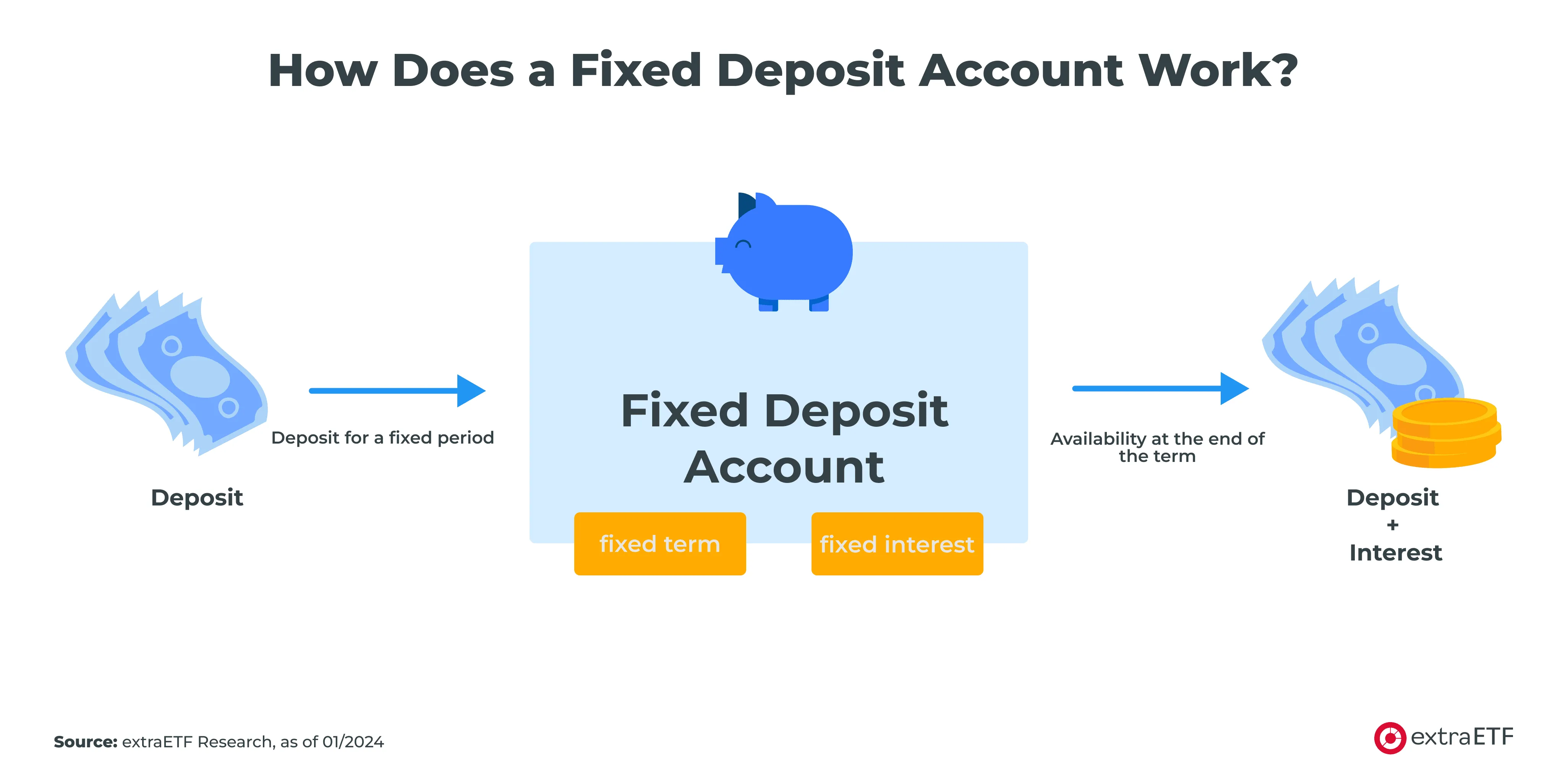
A fixed-rate savings account is defined by its security and predictability. The interest rate stays fixed for the entire term, so even if general interest rates fall, your rate stays the same.
What interest rates do fixed-rate savings accounts pay?
Since interest rates rose in 2022, savers can once again earn attractive rates on fixed-rate savings accounts. Depending on the term, the amount you deposit and the provider, you can currently earn up to 3.0 per cent interest. Because they offer less flexibility than easy-access accounts, fixed-rate accounts generally pay higher interest rates.
Interest rates on fixed-rate savings accounts are influenced by several factors, chiefly the general level of interest rates and the Bank of England’s monetary policy. Changes to Bank Rate can have a direct impact on fixed-rate savings rates. This was evident when the Bank of England raised Bank Rate in a series of steps between 2021 and 2023 to counter inflation following the COVID-19 pandemic, pushing savings rates up again after years of extremely low rates.
A key feature of fixed-rate savings accounts is that the interest rate is set for the entire term and does not change, regardless of market movements. This makes them highly predictable, as you can calculate your total interest at the outset. Locking in a rate for several years is therefore particularly attractive if you expect interest rates to fall, as you’ll keep the higher agreed rate. If rates rise while your money is tied up, however, you’ll still receive only the agreed rate.
Interest is typically paid at the end of the term, although some accounts pay it monthly or annually. Where interest is added to your account during a longer term, it earns further interest. In other words, you earn interest not only on your original deposit but also on the interest already earned. This compound interest effect helps your return keep growing.
What role does the term play in a fixed-rate savings account?
As a general rule, the longer the term, the higher the interest rate. This is because savers who opt for longer terms leave their money with the bank for longer, and are rewarded with higher rates in return. Recently, however, rates across different terms have converged, so good offers are available even for shorter terms.
Unlike easy-access savings accounts, your money in a fixed-rate savings account is tied up for the agreed term. As a rule, you cannot withdraw funds early or close the account during this period without a penalty. Consider carefully in advance how much money you can do without, and for how long. Many providers offer terms from a few months to five years.
To avoid locking up a large sum for several years at once, you can use the “ladder strategy”. Here, you split your savings across several fixed-rate accounts with different terms, so portions of your capital become available at regular intervals. Staggering the terms lets you take advantage of different interest rate cycles.
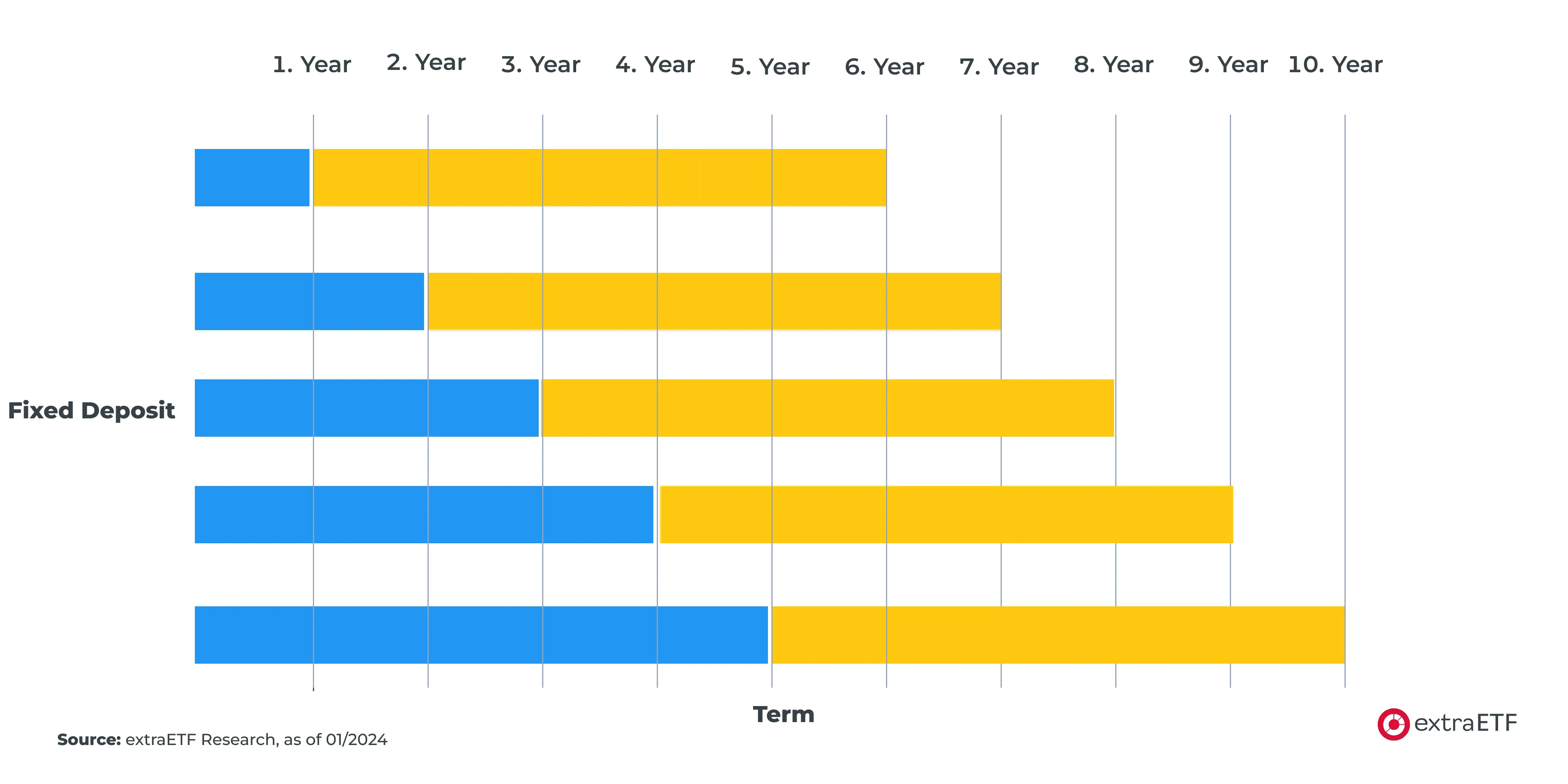
For example, your ladder might look like this: one portion of your savings is locked in for a short term (e.g. six months), another for a medium term (e.g. one year) and a third for a longer term (e.g. 18 months). When a term ends, you can reinvest the money or use it for something else. This strategy combines flexibility with the chance to optimise your interest rate.
More on Saving
We've listed a few more articles that can help you save and plan for the future:



Risk: How safe are fixed-rate savings accounts?
A fixed-rate savings account is considered a safe way to save, particularly because of deposit protection. In the UK, the Financial Services Compensation Scheme (FSCS) protects eligible deposits held with authorised banks and building societies.
This means your savings are protected up to the FSCS limit of £85,000 per person per authorised firm, even if the bank or building society fails. This applies to UK-authorised firms. A country’s economic and financial stability can be an indicator of how reliable its deposit protection scheme is. Countries with strong economies and stable financial systems generally offer greater security. If you are considering a foreign provider, make sure you understand the terms and limits of that country’s deposit protection scheme, research it thoroughly and seek professional advice if necessary.
If you’d like to save a larger amount in fixed-rate accounts, you can spread it across different banks. Because FSCS protection applies per authorised firm, using several institutions offers additional protection. In some other countries, private deposit protection schemes cover even higher amounts. Check the exact coverage in the provider’s terms.
Did you know? Fixed-term deposits cannot offset inflation in the long term
Over the long term, fixed-rate savings accounts often fail to offset the loss of purchasing power caused by inflation, which can erode the real value of your money. ETFs, which track a diversified portfolio of shares or other asset classes, offer the potential for higher returns that are more likely to keep pace with inflation over the long term.
Fixed-Term Deposits vs. Call Deposits: A Direct Comparison
If you want to save safely, you may need to choose between a fixed-rate savings account and an easy-access savings account. Both offer a degree of security, but they differ in several key ways.
Fixed-rate savings accounts often offer higher interest rates than easy-access accounts because you commit your money for a set term. However, this also means less flexibility, as you cannot easily access your money during that time. An easy-access account, on the other hand, gives you quick access to your money, but interest rates are generally lower.
The right choice therefore depends largely on your individual needs and time horizon. For example, an emergency fund that needs to be readily available can be kept in an easy-access account. If, on the other hand, you’ve already saved a specific amount that you plan to spend on a car in three years, you can put it in a fixed-rate account and benefit from the higher interest rate.
Besides an easy-access savings account, money market ETFs can be another alternative to a fixed-rate savings account. Money market exchange-traded funds (ETFs) invest in the money market. Unlike fixed-rate accounts, they track a reference interest rate and offer the potential for higher returns, but without a guaranteed rate or FSCS protection.
Are ETFs, the stock market and capital markets new territory for you? Then find out more in our guide for ETF beginners.
Join the extraETF community

Explore the world of ETFs and make informed investment decisions.
- Find ETFs that match your criteria with our ETF Search.
- Compare costs, performance, and risk side by side.
- Save your favourites to a watchlist and receive price alerts.
- Explore detailed ETF profiles with key metrics and holdings.
Selection: How do I find the best fixed-rate savings account for me?
Before you start looking for the best fixed-rate savings account, define your individual needs and financial goals. You can then compare different fixed-rate savings accounts to find the one that best suits them.
When comparing accounts, look at the following:
- Interest rate
- Available terms
- Whether the account renews automatically
- FSCS protection
- Minimum and maximum deposits
Comparing fixed-rate savings accounts is therefore crucial not only for finding the best interest rates on the market, but also for finding the right account for your savings goals. Online comparison sites let you compare different accounts side by side. You can filter by the most important terms and see straight away which account best meets your needs.

Your own needs are what matter most
 Markus Jordan, Founder of extraETF
How do you open a fixed-rate savings account?
Opening a fixed-rate savings account is usually straightforward. Follow these steps:
What happens after the term ends?
When your fixed-rate account matures, you have several options:
- You can spend the whole amount, including the interest earned, on something you have long wanted, for example.
- You can renew the account with the same provider, or move the money into a new fixed-rate account elsewhere, potentially on better terms.
Another approach is to use the end of the term to review your strategy and adjust it if necessary. If your personal or economic circumstances have changed, this may be a good time to move your money into other investments that better suit your current needs.
If your goal is long-term wealth building, it may be worth investing the money in suitable ETFs, for example within a stocks and shares ISA. Investing in the capital markets offers higher potential returns than a fixed-rate savings account. However, your money is no longer covered by FSCS deposit protection and is subject to market price fluctuations. You can reduce these risks by diversifying your portfolio. Our guides explain more about building wealth with ETFs and the role diversification plays.
What are the pros and cons of a fixed-term deposit?
Before you open a fixed-rate savings account, it's important to weigh up the pros and cons. We've set them out side by side for you:

Advantages
- Predictability thanks to a fixed interest rate for the entire term
- Security through FSCS protection
- Higher interest rates than on current accounts or easy-access accounts
- No impact from falling interest rates during the term
- Account opening is generally free
- A safety net for your portfolio

Disadvantages
- Your money is locked in for the term
- Early withdrawal is often not possible, or only with a penalty
- Your rate doesn’t improve if market interest rates rise
- Real returns may be eroded by inflation
- Some accounts renew automatically
Taxation of Fixed-Term Deposit Accounts
In the UK, interest from savings accounts is paid gross, without tax deducted, and is taxed as income. Most people can earn some interest tax-free thanks to the Personal Savings Allowance: £1,000 for basic-rate taxpayers and £500 for higher-rate taxpayers. Additional-rate taxpayers do not receive an allowance. Some lower earners may also benefit from the starting rate for savings. Interest on savings held in an ISA is always tax-free.
For fixed-rate accounts held abroad, withholding tax may also apply. This is deducted by the foreign tax authority, and the rate varies by country. In some cases, the foreign tax paid can be offset against your UK tax liability to avoid double taxation. You will generally need to report foreign interest on your Self Assessment tax return and pay tax on it under UK rules.
Before saving money abroad, familiarise yourself with the tax rules in both the country where the account is held and the UK, and seek expert tax advice if necessary.
To make the most of your tax-free allowances and minimise your tax bill, consider holding savings in an ISA, where interest is tax-free and doesn’t count towards your Personal Savings Allowance. Each partner in a couple has their own allowance, so splitting savings between you can also help. Review your position each year to account for changes in your income or savings.

Conclusion: Who is a fixed-term deposit account suitable for?
A fixed-rate savings account is particularly suitable if you’re looking for a safe and predictable way to save. It suits people who are willing to tie up their money for a set term in return for interest. It is less suitable if you may need to access your savings in the short term, as these accounts offer low liquidity.
A fixed-rate savings account can add a layer of security to your portfolio. A diversified strategy that combines safe savings products with higher-potential investments in the capital markets can help you achieve your financial goals over the long term.
While fixed-rate savings accounts provide a solid foundation for the secure part of your portfolio, it’s also worth considering options that can generate higher returns over the long term, especially when interest rates are low. ETFs or regular ETF investing offer an attractive addition to your portfolio: they allow broad diversification across asset classes and markets, increasing the potential for higher returns while managing risk. ETFs are therefore a good way to capture growth opportunities alongside the security of your fixed-rate savings, helping you build a balanced, forward-looking portfolio.
We'll answer any other questions you may have about fixed-term deposits

- Everything You Need to Know About Fixed-Term Deposits at a Glance
- Definition: What Is a Fixed-Rate Savings Account, and How Does It Work?
- What interest rates do fixed-rate savings accounts pay?
- What role does the term play in a fixed-rate savings account?
- More on Saving
- Risk: How safe are fixed-rate savings accounts?
- Fixed-term deposits cannot offset inflation in the long term
- Fixed-Term Deposits vs. Call Deposits: A Direct Comparison
- Selection: How do I find the best fixed-rate savings account for me?
- How do you open a fixed-rate savings account?
- What happens after the term ends?
- What are the pros and cons of a fixed-term deposit?
- Taxation of Fixed-Term Deposit Accounts
- Who is a fixed-term deposit account suitable for?
- We'll answer any other questions you may have about fixed-term deposits