



Our 10 Tips for Saving Money
What's the best way to save money?
Saving is an important topic that everyone should consider. There are many ways to save money – from building up a nest egg in a money market account, to saving in your daily life, to investing in stocks or ETFs. But every beginning is difficult, and often we don’t know how or where to start.
In this article, we’ll give you tips to help you save money and reach your financial goals.
The essentials in brief: An Overview of Important Information on Saving
Definition: Saving serves to build financial security and to finance goals such as buying a home. Saving is also a form of forgoing consumption or postponing consumption to a later date.
Investing: Unlike saving, where money is set aside in traditional savings accounts, investing involves putting money into the capital markets – for example, in suitable stocks, mutual funds, or ETFs. This is one way to build passive income.
Types: There are many different ways to save, including traditional savings accounts, money market accounts, and certificates of deposit. The choice depends on your savings goals, risk tolerance, and personal preferences.
Tips: Keep track of your income and expenses, set up automatic savings, and always compare offers to save and invest your money as efficiently as possible.

Find and compare thousands of ETFs. Use powerful filters, detailed analytics, and independent data to discover the right ETF for your portfolio.
Why is saving money a good idea in the first place?
Saving money makes sense because it allows you, for example, to have financial security and to achieve your goals and fulfill your wishes.
Here are some reasons why saving makes sense:
- Financial security: When you save money, you should build up an emergency fund of at least 3 months’ net salary to be prepared for emergencies, such as illness, unemployment, or unexpected repairs.
- Achieving Goals: Saving enables you to achieve major goals, such as buying a car or even a home.
- Wealth building: If you save and invest regularly, you can build wealth while taking advantage of the cost-averaging effect and benefiting from the power of compound interest.
Here's everything you need to know about saving money
Below, we've listed a few additional articles that take a closer look at specific aspects of saving:

10 Tips for Saving Money
Our 10 tips, which we've compiled for you below, will show you the best ways to save money:
Get a clear picture of your expenses: Write down all your expenses (e.g., in a household budget book) and try to eliminate unnecessary costs and identify opportunities to save in your daily life. Setting a spending limit can help you keep your expenses under control.
Set specific savings goals: Set precise goals for how much money you want to save each month or each year to stay motivated and make progress.
Build an emergency fund: Save money regularly – at least the equivalent of 3 months' net salary – to build an emergency fund that will protect you in case of an emergency.
Pay off your debts: Do you still have a loan to pay back? Before you invest any money, you should pay off your debts first.
Compare providers: Compare the costs of insurance, electricity, and other fixed expenses with other providers, and switch to a cheaper one if necessary.
Plan your shopping and avoid impulse buys: Plan your shopping and make a shopping list to avoid impulse buys. Take advantage of sales and discounts to reduce your grocery costs.
Save on energy costs: Save energy by turning off appliances and devices in your home that waste electricity and water, and by buying energy-efficient appliances. But changes in your habits – for example, when it comes to heating – can also make a big difference and save you money.
Use a savings account or money market account: Open a savings account or money market account to park your savings and earn higher interest rates than you would on a current account.
Think about whether you should buy or rent things to save money: For example, it might be worth renting tools or electronics instead of buying them.
Invest: ETFs (Exchange-Traded Funds), for example, offer the opportunity to invest in a broader range of companies or industries worldwide and to benefit from long-term appreciation and returns.
How much money should I save?
According to experts, you should save at least 10% – preferably 20% – of your net income every month. A good guideline for this is the 50-30-20 rule. According to this rule, you should allocate 50% of your income to essentials like rent and groceries, 30% to leisure expenses, treats, or other purchases, and 20% to paying down debt or saving.
It’s important to note that these figures are only a rough guideline, and your savings or investment strategy may vary depending on your individual situation. If the 20% rule doesn’t fit your current life situation, it’s perfectly fine to start smaller and adjust your savings goal.
To calculate in advance how much you need to save each month to reach your financial goals, the Financial Goals Calculator from extraETF.com is a handy tool.
Saving or Investing: What's the difference?
Saving and investing have one thing in common: in both cases, money is set aside instead of being spent. When saving, the money usually ends up in traditional savings accounts, savings accounts, or money market accounts – or under the mattress. When investing, on the other hand, the money is placed in the capital market and put into stocks, stock ETFs, and similar investments.
Investments therefore generally enable you to generate a higher return on your capital. We’ve discussed this in more detail – using ETFs as an example – in our article on the returns and performance of ETFs, among other places.
In essence, saving is about not spending your money on consumption, but rather spending less than you earned during the same period. Thus, saving is also a form of forgoing consumption or deferring it to the future.
In most cases, especially in everyday life or even at home, you can identify many opportunities to save money and consume more consciously. We present an example of a particularly frugal lifestyle in our article on frugalism, where we’ve also compiled many valuable money-saving tips and tricks for you.
Types: What are some ways to save money?
There are many ways to save money. Common savings options include savings accounts, home savings plans, life insurance policies, and fixed-term or demand deposit accounts. Since investing, in a broader sense, is also a form of saving, we’ve included some investment options as well.
An Overview of Different Types of Savings:
- Savings account: A savings account is a traditional savings product where you make regular deposits and let the money grow over a specific period of time.
- Easy Access Savings: Easy Access Savings accounts offer greater flexibility than savings accounts, since you can withdraw the money at any time without incurring any losses.
- Fixed-term deposit: Fixed-term deposit accounts are intended for a fixed investment period. The money is typically locked in for several months to several years. They generally offer a higher interest rate than a savings account or money market account.
- Stocks, mutual funds, ETFs: These forms of saving involve investing in securities to benefit from potential capital gains and dividends. With an Regular ETF Investing, for example, you can invest money monthly in a broadly diversified portfolio on the stock market.
- Real estate: A property can be viewed as a form of saving, as it has the potential to appreciate in value while also serving as a place to live.
- Cryptocurrencies: Cryptocurrencies are a relatively new form of saving that has gained popularity in recent years. You can compare different brokers in our crypto comparison.
There are many other forms of saving not listed here, such as life insurance, home savings plans, or investments in precious metals or commodities. Additionally, before making any investment, it’s important to compare the various options and do your research thoroughly so you can make the best choice for your specific situation.
Join the extraETF community
Explore the world of ETFs and make informed investment decisions.
- Find ETFs that match your criteria with our ETF Search.
- Compare costs, performance, and risk side by side.
- Save your favourites to a watchlist and receive price alerts.
- Explore detailed ETF profiles with key metrics and holdings.
Side Note: What Is the "Magic Triangle" of Investing?
Is there an investment that offers high potential returns while being completely safe and accessible at any time? In fact, there is a classic trade-off in investing that you should be aware of. This means that no single product can achieve all three goals at the same time.
The Magic Triangle of Investing illustrates this trade-off. Every investment – whether stocks, real estate, a savings account, or another type of investment – has its own profile across the three dimensions of the Magic Triangle. You’re therefore well advised to carefully evaluate investment products based on these dimensions before deciding on one.
And this is what the “magic triangle of investing” looks like:
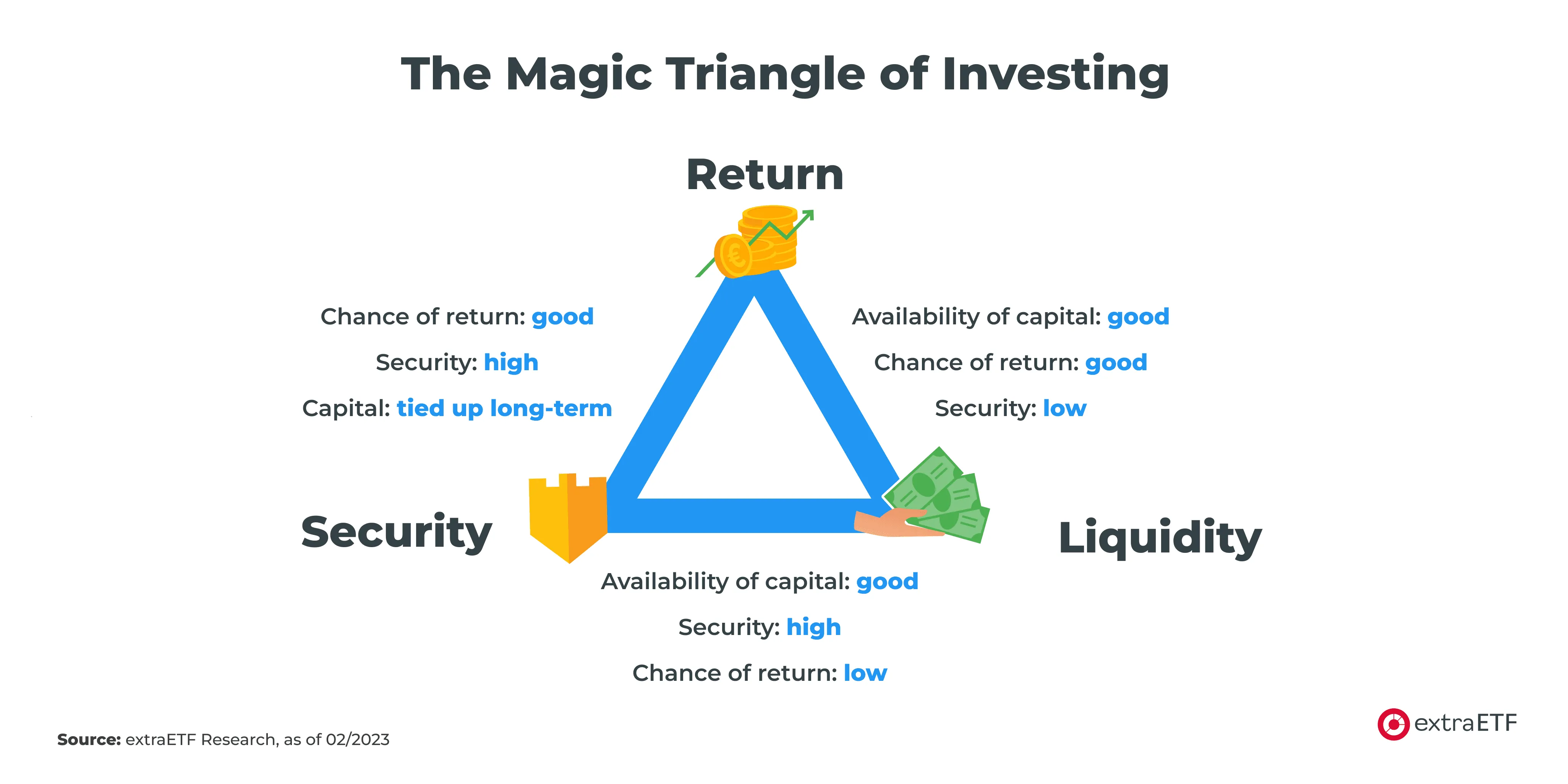
Security: The first dimension refers to the preservation of the value of the money invested. With a completely secure investment, the principal is therefore always repaid in full at the end. If an investment is not completely secure, it carries a certain risk of incurring a loss.
Return: This dimension – return or profitability – refers to the profit that can be generated by an investment. Typically, the return is measured as the ratio of the investment’s profit to the principal invested over a specific period of time.
Availability: Third, we have the dimension of availability or liquidity. This refers to how quickly an investment can be liquidated – that is, converted back into cash. Actively traded, publicly listed investments, such as stocks or ETFs, can generally be sold at any time during trading hours. Similarly, investors can withdraw their funds from a current account at any time. In contrast, real estate – where a sale can take weeks or months – or funds invested in a fixed-term deposit account for a specific term are less liquid.
What's the best way to save money each month?
One of the easiest ways to save money is to set a specific savings goal. Decide on a specific amount per month or per year and make sure you regularly deposit that amount into a savings account or – after thoroughly familiarizing yourself with the subject – invest it, for example, through an Regular ETF Investing that is broadly diversified and invested in global stock ETFs for the long term. An Regular ETF Investing or a standing transfer to your savings account automates your saving.
Another tip for saving is to keep a household budget and track exactly how much money you spend. This not only helps you identify numerous opportunities to save in your daily life, but also gives you a better overall view of your expenses, allowing you to save in a targeted way.
Keeping a household budget often helps you identify where many of your biggest expenses lie, such as unused subscriptions or certain unnecessary insurance policies that you can do without without sacrificing your quality of life.
There are several ways to save money each month, and this can even be made fun through savings challenges, for example. One question is whether it makes more sense to save or to invest. It’s important to find a balance and ensure that enough money is available for emergencies. You can deposit money monthly into a money market account. These accounts usually offer a higher interest rate than current accounts, allowing your money to grow faster. An alternative is a fixed-term deposit account, where you lock in your money for a specific period and earn a higher interest rate during that time.
The problem with these savings options, however, is the low interest rates, which means that the loss in value of your money due to inflation cannot be offset in the long term.
What should I keep in mind when saving money?
If you want to start saving money, you should make sure to choose a savings option that offers the highest possible interest rate. Due to inflation, the money you leave sitting in a current account steadily loses value.
One way to avoid this is to invest your money in a fixed-term deposit or money market account, which typically offer higher interest rates than current accounts. Since these savings options cannot fully offset the loss in value caused by inflation, you should look into ETFs and inflation. Another important factor is the risk-return ratio. High returns are generally associated with higher risks.
However, if you want to save and invest for the long term, you can invest in asset classes such as stocks, real estate, or bonds to achieve higher returns. This can be done easily and cost-effectively, for example, through ETFs.
Conclusion: Smart Saving & Investing
Saving and investing generally have different goals and require different risk preferences. Saving is used to set aside money for short-term purposes or emergencies, while investing aims to grow your money for the future, offset the loss of value due to inflation, and achieve long-term goals.
It’s important to note that saving and investing aren’t mutually exclusive – they should be viewed as complementary. This way, you can ensure the best possible financial security and achieve your goals. Carefully considering your goals and risk preferences can help you make the right choice for your investments.
Investing in ETFs can be a good complement to saving. Would you like to learn more about this investment option? In our article, we’ve explained ETFs in detail for beginners. If you’ve already done your research, you can use our ETF search tool to view all ETFs tradable in Germany.
We'll answer more questions about "saving"
- An Overview of Important Information on Saving
- Why is saving money a good idea in the first place?
- Here's everything you need to know about saving money
- 10 Tips for Saving Money
- How much money should I save?
- Saving or Investing: What's the difference?
- Types: What are some ways to save money?
- Side Note: What Is the "Magic Triangle" of Investing?
- What's the best way to save money each month?
- What should I keep in mind when saving money?
- Smart Saving & Investing
- We'll answer more questions about "saving"