



FIRE Movement
Saving money and taking early retirement with the FIRE approach – does it work?
The goal of the FIRE movement is to achieve financial independence as early as possible – perhaps even retiring as early as 40. FIRE stands for Financial Independence, Retire Early. It involves making certain sacrifices to save a large portion of your income and invest it wisely – and a portfolio tracking tool can help you keep track of everything.
Although the FIRE movement originated in the US, it is attracting growing interest in the UK. But how do you achieve financial independence? And how can you build up enough wealth in a relatively short time?
In this guide, we’ll answer these and other questions, and you’ll learn what the FIRE movement is all about.
The essentials in brief: Everything You Need to Know About the FIRE Movement at a Glance
FIRE: FIRE stands for Financial Independence, Retire Early. The goal is to become financially independent as early as possible and to be able to retire early. To achieve this, followers save and invest a large portion of their income.
Frugalism: The word “frugal” (derived from the Latin frugalis) means “thrifty”. Frugalists’ lifestyle is built on discipline and self-restraint, with the aim of saving money and achieving financial independence at a young age. Like frugalism, the FIRE method involves living frugally.
Cutting back: Followers of the FIRE movement consciously avoid unnecessary spending in daily life – such as unused subscriptions, unnecessary insurance or overpriced holidays – so that they can save and invest more.
Investing: To build wealth, followers invest their money in the capital markets, often starting at a young age. Investing in suitable, sufficiently diversified ETFs is a particularly popular long-term option, as it is low-cost, offers good return potential and carries relatively low risk.
Find and compare thousands of ETFs. Use powerful filters, detailed analytics, and independent data to discover the right ETF for your portfolio.
What is the FIRE movement?
FIRE is an acronym for "Financial Independence, Retire Early", meaning that the movement advocates financial independence and early retirement, even before State Pension age. The FIRE movement is closely linked to frugalism.
People who achieve financial freedom or financial independence can choose whether to keep working for a living. For many, this means a more carefree life, greater independence and peace of mind, as they no longer depend on earned income to get by. To get there, it’s important to save as much as possible and invest using a suitable investment strategy, so that you can eventually live off the returns from your investments, such as dividends and interest.
The idea behind the FIRE movement originated in the United States. In 1992, author Vicki Robin and financial analyst Joe Dominguez published the book Your Money or Your Life. However, the concept only gained real prominence after the 2008 financial crisis. Jacob Lund Fisker’s 2010 book Early Retirement Extreme was influential, but the blog “Mr. Money Mustache”, launched in 2011 by Canadian Peter Adeney, did even more to popularise the idea and attracted a following well beyond Canada.
In the UK, the FIRE movement is still relatively niche, though interest is growing.
Join the extraETF community
Explore the world of ETFs and make informed investment decisions.
- Find ETFs that match your criteria with our ETF Search.
- Compare costs, performance, and risk side by side.
- Save your favourites to a watchlist and receive price alerts.
- Explore detailed ETF profiles with key metrics and holdings.
How to Achieve Financial Independence with the FIRE Concept
You are most likely to achieve financial independence with specific savings goals, a high savings rate, regular contributions, a suitable investment strategy and passive income streams. A high, steady income helps a great deal, as do discipline and perseverance. However, being frugal is usually not enough on its own. It’s better to increase your income and invest your savings over the long term in a broadly diversified portfolio. You can do this easily and cost-effectively with suitable ETFs that track the global stock market.
Strategic financial planning on the path to financial independence involves the following steps:
- Step 1: Assess Your Current Situation
- Step 2: Set Goals
- Step 3: Build Reserves
- Step 4: Invest for the Long Term
- Step 5: Build Passive Income
- Step 6: Reduce Expenses and Consumption (If You Choose)
We’ve described each of these steps in more detail – as well as the differences between financial freedom and financial independence – in our guide to financial freedom. Both the FIRE movement and frugalism focus on analysing your own financial situation, cutting costs through saving and then investing those savings wisely for the long term. The aim is to reach predefined financial objectives.
Important: Financial independence and early retirement can’t be guaranteed. However, even small lifestyle changes can bring significant financial benefits.
How much money do you need for FIRE?
The amount of money needed to achieve financial independence and early retirement varies from person to person and depends largely on your own goals and planned lifestyle. Other factors include income and expenses. The rule of 25 and the 4% rule can give you a rough guide.
The rule of 25 is a rule of thumb that gives you an idea of how much starting capital you’ll need to achieve financial freedom. To calculate it, multiply your total annual expenses by 25.
According to the 4% rule, if you withdraw 4% of this amount each year, your capital should not run out despite the withdrawals, as the following chart illustrates:
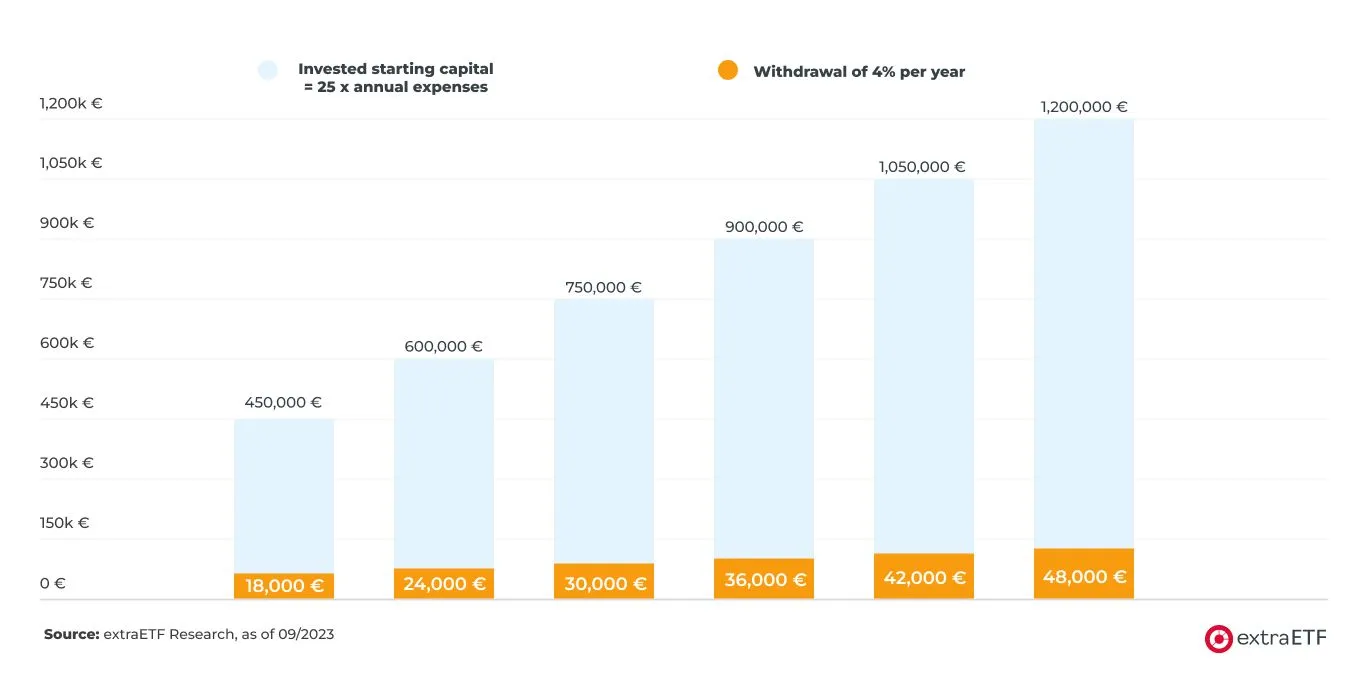
Here’s an example. Total monthly expenses of £1,500 come to annual expenses of £18,000. Multiplying this by 25 gives a starting capital of £450,000, which is the minimum you would need to achieve financial freedom. If this money is invested for the long term in a sufficiently diversified portfolio – for example, globally diversified equity ETFs – you could withdraw 4% of it each year.
Note: these rules are only rough guidelines. They also ignore tax and the fluctuating returns and performance of ETFs, including sequence-of-returns risk.

The FIRE Movement for Greater Independence and Quality of Life
Types of the FIRE Method
Annual expenses – and therefore the target net worth – vary from one follower of the FIRE movement to the next. Essentially, they depend on regional differences in the cost of living, your desired lifestyle, and your savings goals and personal preferences.
The FIRE method comes in several variants, including:
- Lean FIRE: The focus here is on cutting expenses to an absolute minimum. The aim is to retire as early as possible. This requires less capital but means a more minimalist lifestyle.
- Fat FIRE: The aim is to build a larger nest egg to fund a higher standard of living and a degree of luxury in retirement. Fat FIRE is usually realistic only for high earners. It often involves saving up to 75% of income and taking greater risk in pursuit of higher returns.
- Barista FIRE: This approach involves working part-time once you reach a certain point, so you can keep contributing to a pension and building up your National Insurance record. It eases the transition to retirement, gives you more free time and requires less capital. The name comes from the barista – a coffee shop worker, a fairly common part-time job in the US.
These are only a few of the many FIRE variants, which are often distinguished by specific thresholds for the required net worth.
Overall, the choice and implementation of a FIRE approach depend on your financial situation, life circumstances, savings goals, desired lifestyle and personal preferences.
The FIRE Movement: Tips for Living Frugally
Here are some tips to help you live more frugally and get closer to your FIRE goals.
Create an overview of your expenses: Write down all your expenses – for example, in a household budget book. Then try to cut out unnecessary costs and identify ways to save in your daily life. Setting a spending limit is especially helpful. This can help you keep your expenses under control.
Set specific savings goals: How much money do you want to save each month or each year? Set specific goals for yourself. This will make it easier to stay motivated and make progress.
Build up an emergency fund: An emergency fund should amount to at least 3 months' net salary. This cushion protects you in many emergencies, which is why it's especially important to save money regularly to build up your emergency fund.
Pay off your debts: Do you still have a loan hanging over your head that you need to pay off? Before you can start investing money, you should first pay off your debts.
Compare providers: Check your expenses for electricity, insurance, and other fixed costs. Compare them with other providers. If you find a cheaper option, you can switch if necessary.
Plan your purchases and avoid impulse buys: Plan your shopping and make a shopping list. Be sure to avoid impulse buys. You can reduce the cost of groceries and other items by taking advantage of specific sales and discounts.
Reduce your energy costs: Eliminate energy and water wasters in your home and purchase energy-efficient appliances. This can often save a lot of energy. Changes in behaviour – such as how you heat your home – offer further savings potential, leaving you with more money in the end.
Use a money market account: Open a money market account. You can park your savings there for the short term so you can benefit from higher interest rates than those offered by a current account. A money market account is also a good place to keep your emergency fund.
Consider whether you should rent or buy items to save money: Some things, such as tools or electronics, can be rented. This can be more cost-effective than buying them.
Start investing: With the right ETFs (Exchange-Traded Funds), you can invest in a wide variety of companies, industries, regions, and company sizes around the world. This allows you to benefit from long-term appreciation and returns. With an Regular ETF Investing, you can even automate your investing starting at just 1 euro per month.
However, the tips in this article are far from the only ways to save money.
The following articles offer numerous additional tips, background information and ideas for saving – some of which can even be fun:

Achieve the Goals of the FIRE Movement with the Right Investments
The goals of the FIRE movement are hard to achieve through efficient saving alone, or by parking money in current accounts or savings accounts. Interest rates on these are often too low to offset the erosion of purchasing power caused by inflation over time. To earn higher returns, it’s also advisable to invest a large portion of your assets in the capital markets for the long term, using a suitable strategy.
You should start investing as early as possible so that your capital can benefit from the exponential growth of compounding. Regular investing in sufficiently diversified ETFs that track the global stock market is particularly well suited to long-term investors. Once you’ve built up enough financial knowledge – for example, in the extraETF knowledge section – we recommend taking a closer look at our regular ETF investing comparison. It will help you find the ETFs that best suit you and your investment strategy. With regular investing, you can automate your savings and achieve a high degree of diversification even with small monthly amounts. Our ETF guide explains exactly how this works.
When investing, always keep your FIRE savings goals, investments and investment strategy in view – a portfolio tracking tool is a handy way to do just that.
Conclusion: Achieving Financial Independence Through the FIRE Movement
Whether you can achieve the goals of the FIRE movement depends on many highly individual factors. That’s why it’s essential to clarify certain questions in advance – such as your financial situation, income, total annual expenses and savings goals, as well as your desired lifestyle and personal preferences. However, saving alone won’t deliver an attractive long-term return that grows your wealth and offsets the loss of purchasing power caused by inflation. It’s therefore advisable to invest your money in a sufficiently diversified portfolio over the long term, which you can do cost-effectively with suitable ETFs that track the global stock market. The risk associated with ETFs is comparatively low.
Although there is no guarantee that you will achieve financial independence, simply having the goal can bring greater motivation, discipline, a more fulfilling life, and personal and financial growth. A portfolio tracking tool is a practical way to monitor your investments along the way, and it is useful well beyond the FIRE community.
We'll answer any other questions you may have about the FIRE movement
- Everything You Need to Know About the FIRE Movement at a Glance
- What is the FIRE movement?
- Types of the FIRE Method
- The FIRE Movement: Tips for Living Frugally
- Achieve the Goals of the FIRE Movement with the Right Investments
- Achieving Financial Independence Through the FIRE Movement
- We'll answer any other questions you may have about the FIRE movement