



What is frugalism?
Your Path to Financial Freedom
Frugalism is a lifestyle that is attracting a growing number of followers. The ideal is to achieve financial freedom through conscious saving and going without, so that you can invest and grow your money for the future. Many frugalists aim to quit their jobs well before retirement age – at 40, for example – and live off their savings and investments, along with the returns they generate.
But why is frugalism about more than strict saving, austerity and giving up life’s pleasures? What role does investing play for frugalists? And why are ETFs such a popular choice? This guide answers these questions.
The essentials in brief: Everything You Need to Know About Frugalism at a Glance
Definition: Frugalism is a thrifty lifestyle in which the majority of one's income is saved and invested. It involves consciously cutting back on spending.
Goals: Frugalists aim to achieve financial freedom and live fulfilling lives well before reaching State Pension age.
Investments: Frugalists put most of their money into investments such as ETFs, shares, commodities or property. The returns are usually intended to generate passive income.
Pros and cons: Financial freedom can make it possible to retire at 40, for example. However, this requires a high savings rate, sacrifice, discipline, investments and a reasonable salary.

Find and compare thousands of ETFs. Use powerful filters, detailed analytics, and independent data to discover the right ETF for your portfolio.
Definition: What is frugalism?
The word “frugal” (derived from the Latin frugalis) means “thrifty.” Frugalism aims to achieve financial independence through a modest lifestyle, thrift and the long-term investment of savings – for example, through ETFs. In short, it means consciously avoiding unnecessary expenses and simplifying one’s life to the essentials in order to gain more freedom and flexibility. Often, it’s also about retiring early and being able to live solely off one’s savings and the income they generate.
Frugalists often live very frugally, spending money only on the bare necessities. However, they aren’t necessarily stingy or tight-fisted; rather, they try to manage their money consciously and wisely. Living frugally, therefore, means living in line with your own values and needs and avoiding unnecessary spending.
Frugalists often set a target amount to save and invest so that they can be free from financial worries as early as possible. Even after reaching it, though, many frugalists have no intention of spending their days lounging in a hammock, despite the association with early retirement.
If you’re wondering how to invest your savings for the long term in a cost-effective, high-yield, low-risk way, our article on ETFs for beginners has plenty of useful information.
The Principle of Frugalism: A Trend from the US
Although history offers various precursors to frugalism, the modern concept originated in the US with the so-called FIRE movement. FIRE is an acronym that stands for Financial Independence, Retire Early.
The concept dates back to the early 1990s, when author Vicki Robin and financial analyst Joe Dominguez published the book Your Money or Your Life in 1992. But it wasn’t until the 2008 financial crisis that the idea gained real prominence.
Alongside Jacob Lund Fisker’s 2010 book “Early Retirement Extreme”, Canadian Peter Adeney found particular fame in 2011 with his blog “Mr. Money Mustache”, which caused a stir well beyond Canada’s borders.
In Europe, where the frugalism movement is still relatively small, Oliver Noelting is one of the best-known frugalists.
Financial Independence and a Fulfilling Life as the Goals of Frugalism
Frugalism focuses on financial independence, freedom and personal happiness. This means managing your income prudently and spending money in daily life only on the bare necessities. Frugalists consistently set aside a large portion of their income from an early stage for saving and investing, with the goal of achieving financial freedom as quickly as possible.
Although “retirement at 40” – or at least early retirement – often dominates media portrayals of frugalism, what matters most to many frugalists is not retirement itself but financial freedom: the ability to decide for themselves how to spend their time.
The goal of frugalism is to have time for the things that fulfil you.
For many people, this means things like:
- spending more time with family
- volunteering
- pursuing hobbies
- hiking in the countryside
- travelling the world
Ultimately, the ideal of frugalism is a life defined not by financial worries but by freedom and the ability to shape your daily life.
Can anyone become a frugalist?
It’s hard to say whether everyone can become a frugalist and achieve financial freedom within a reasonable time, as it depends on many factors. These include a person’s willingness to adjust their lifestyle and consciously do without luxury goods, as well as their income, the amount they can save, their ability to control expenses and a certain degree of discipline. Investing plays a particularly important role here – not only in light of inflation but also to accelerate wealth accumulation.
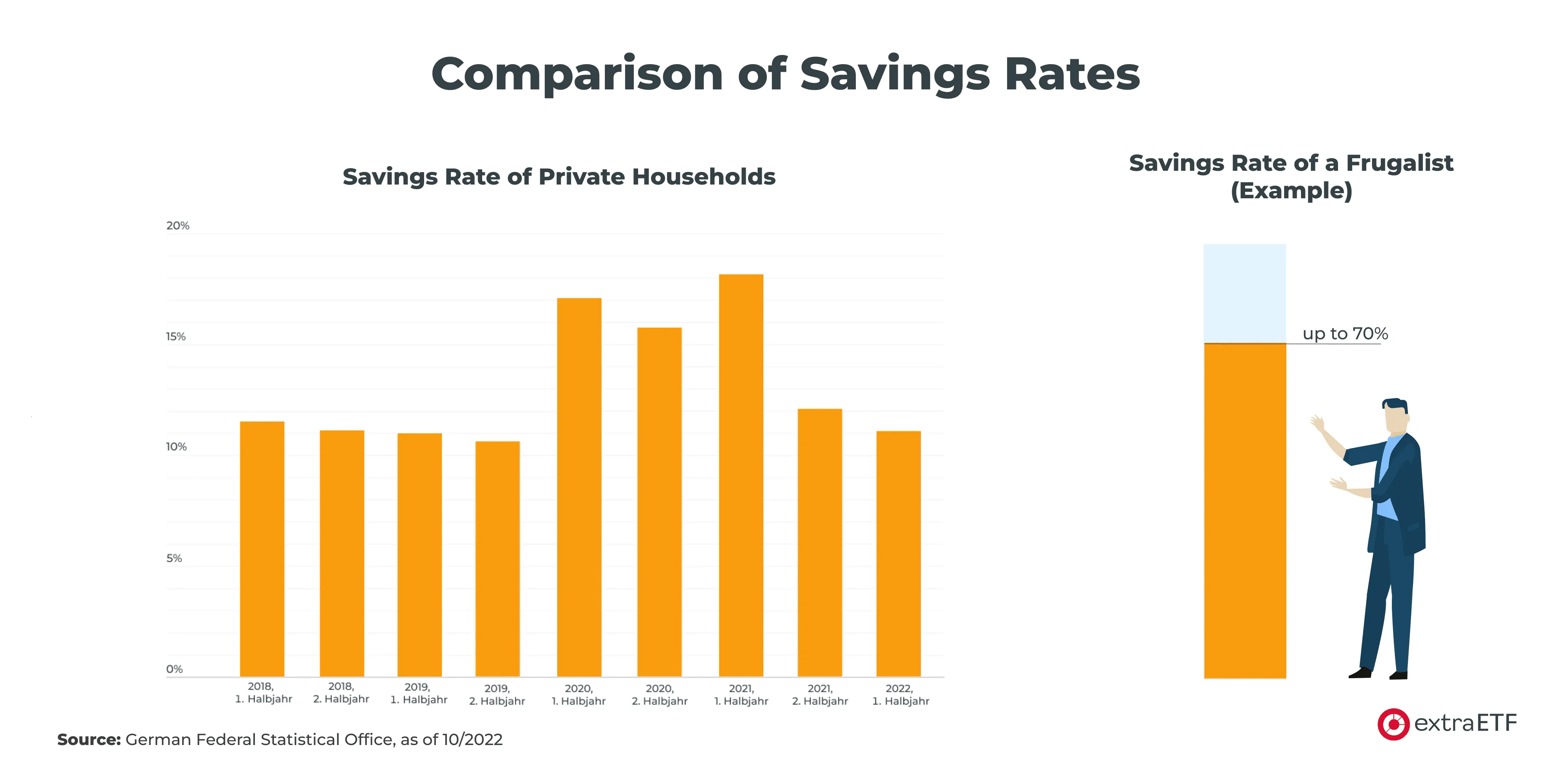
For frugalists, the savings rate is one of the most crucial factors in achieving financial freedom well before State Pension age. To build up significant wealth through regular saving, it helps to have the highest possible income.
After all, the higher the salary, the less people have to cut back on their lifestyle to save the same amount.
Other important factors in building wealth include the return on savings and a suitable, long-term investment strategy. Many frugalists hold globally diversified, low-cost ETFs for the long term to limit the risk of their investments.
The following chart illustrates how much the savings rate of frugalists can differ from that of ordinary households:
Even if not everyone can become a frugalist, many of its principles are worth adopting. Keeping track of your spending, being mindful about it, living frugally and building wealth in a structured, long-term way can all help you become more financially independent and lead a self-determined, happy life.
Frugalism: How much money do you need?
How much money a frugalist needs to achieve financial freedom depends on various factors, such as income, expenses, and their planned lifestyle. The Rule of 25 and the 4 per cent rule can provide a rough guide to how much capital is needed.
For the Rule of 25, you should first get a complete overview of all your monthly expenses and add up the amounts. It’s important to include all costs, such as rent, electricity, service contracts, insurance, food, clothing, car expenses, etc. Since it’s difficult to predict how prices for these items will change in the future, you should add a little extra to this total just to be safe. You should also think about your future self and what additional expenses you might face due to life plans or ageing. This gives you a certain buffer that reduces the risk of having underestimated your future financial needs.
You then multiply the total amount of all expenses by 12 to get your total annual expenses. These are then multiplied by a factor of 25, giving you the minimum amount you’ll need to achieve financial freedom.
In the table below, we’ve calculated the Rule of 25 using example amounts:
| Total Monthly Expenses | Total Annual Expenses | Starting Capital for Financial Freedom |
| £1,500 | £18,000 | £450,000 |
| £2,000 | £24,000 | £600,000 |
| £2,500 | £30,000 | £750,000 |
| £3,000 | £36,000 | £900,000 |
| £3,500 | £42,000 | £1,050,000 |
| £4,000 | £48,000 | £1,200,000 |
Whatever your situation, savings should be invested for the long term in low-cost, globally diversified, high-return investments – ETFs, for example.
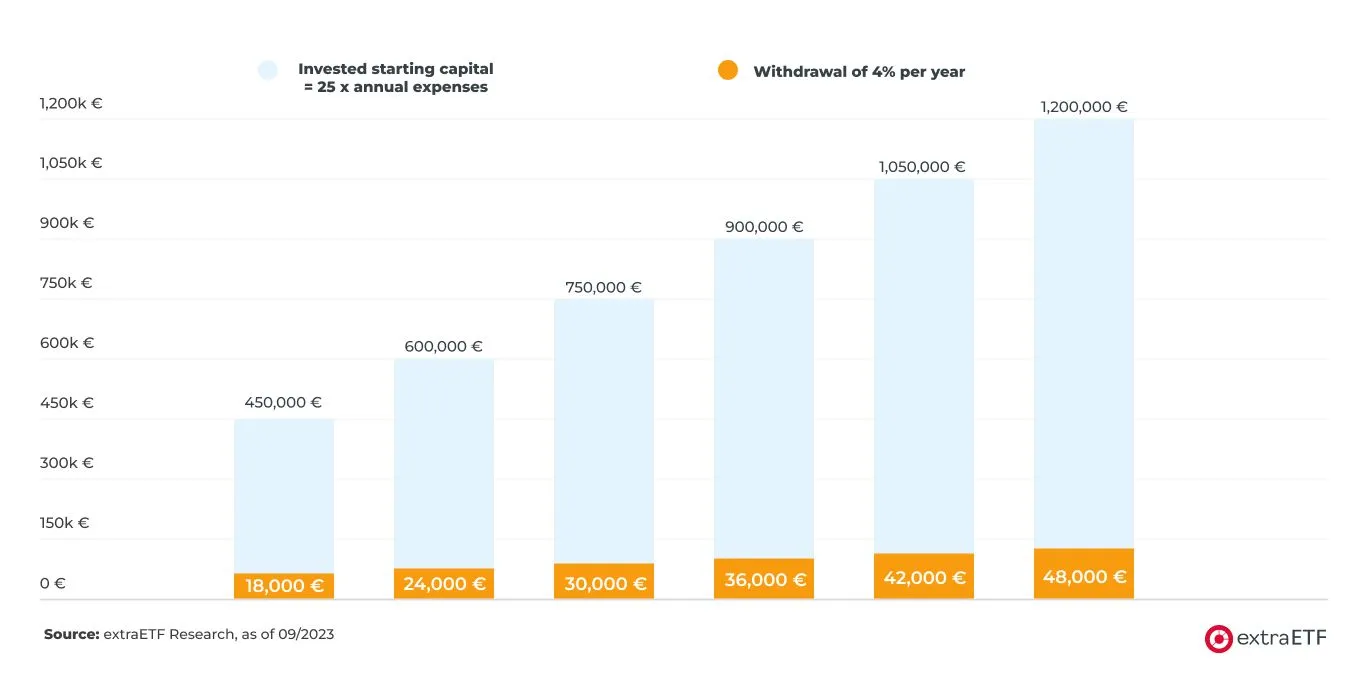
Another useful guideline is the 4 per cent rule, which dates back to the 1998 Trinity Study conducted by Trinity University in Texas. In their simulation, savings were invested in shares and bonds over a 30-year period. The rule states that you can withdraw 4 per cent of your initial capital each year from the invested savings without depleting the principal.
The following chart shows how much could be withdrawn annually in our examples under the 4 per cent rule:
Note that these rules are only rough guidelines. They also do not take account of tax or the fluctuating returns and performance of ETFs, including sequence-of-returns risk.
The Right Investment Strategy for Frugal Living
A high savings rate alone doesn’t achieve much if the money sits for years in an account that pays little or no interest. The money is left exposed to the erosion of purchasing power caused by inflation, making real wealth growth nearly impossible for frugalists.
That’s why it’s crucial to invest your savings systematically and for the long term in high-yield investments. This works particularly well with globally diversified ETFs – that is, exchange-traded funds that passively track an index at low cost. With equity ETFs, for example, you can diversify your savings flexibly and transparently across sectors and countries, which significantly reduces the risk associated with ETFs over the long term.
Investing through a regular ETF investment plan is particularly convenient, as you can start with small amounts from just £1. Whichever option you choose, research it thoroughly before you invest.
Join the extraETF community
Explore the world of ETFs and make informed investment decisions.
- Find ETFs that match your criteria with our ETF Search.
- Compare costs, performance, and risk side by side.
- Save your favourites to a watchlist and receive price alerts.
- Explore detailed ETF profiles with key metrics and holdings.
Frugal Living Tips for Everyday Life
The essence of frugalism is saving money. But which expenses can you realistically do without?
Here are a few money-saving tips for everyday life:
These money-saving tips aren't meant to be exhaustive, but they can inspire you to save more, spend more mindfully and cut back on unnecessary costs.
But don’t forget to strike a healthy balance between saving and enjoying life.

Frugalism is often misunderstood
What are the pros and cons of frugalism?
Many of the pros and cons of frugalism are linked to the direct and indirect effects of a frugal lifestyle. There is often a fine line between sensible frugality and painful sacrifice, depending on the nature and intensity of the lifestyle. All of this determines whether frugalists gain greater independence and freedom in daily life or end up dissatisfied, with a reduced quality of life.
Here are the main advantages and disadvantages of frugalism:

Benefits of Frugalism
- Saving money
- Reducing debt
- Greater independence and financial freedom
- Greater focus on the important things in life
- A financial cushion for retirement
- Reducing unnecessary consumption and minimising environmental impact
- More conscious consumption
- A simpler, happier lifestyle
- Greater self-confidence and satisfaction
- Knowledge and experience with saving and investing
- Setting your own rules
Source: extraETF Research, as of 03/2023

Disadvantages of Frugalism
- Going without things you'd like to have or do
- A lack of variety and fun in everyday life
- A feeling of restriction and a loss of quality of life
- Giving up social activities or expensive hobbies
- Risk of not having saved enough for retirement later in life
- Hard to manage on a low income
- Loneliness
- Saving habits that clash with life circumstances, e.g. starting a family or caring for relatives
- Difficult to put into practice in expensive areas
- Risk of miscalculating
- Unforeseen risks, e.g. job loss, illness or premature death
Source: extraETF Research, as of 03/2023
The advantages and disadvantages listed here are by no means exhaustive and naturally involve many individual, subjective factors. That is precisely why, whether you embrace frugalism fully or only in part, it is important to weigh up the pros and cons and choose a lifestyle that suits you.
What does "Frugal Chic" mean?
Frugal Chic focuses on mindful consumption, financial clarity, and personal priorities. Instead of constantly chasing the latest trends, the idea is to choose only what adds real value to one’s life. People who practise Frugal Chic do treat themselves to a little luxury now and then, but they do so consciously and in moderation. As a result, they still manage to save a significant portion of their income without having to live in poverty.
Frugal Chic focuses on peace of mind, self-determination and quality of life – rather than excess and status-seeking on the one hand, or complete poverty on the other. It does not mean radical deprivation, but making smart choices that bring more freedom, more time and a better long-term quality of life.
Conclusion: How Frugalism Works
The frugal lifestyle that frugalism promotes – characterised by mindful spending, avoiding unnecessary costs and investing savings – can bring greater financial freedom, independence and quality of life. On the other hand, there are drawbacks and risks that can hinder or even undermine its goals.
Ultimately, a frugal lifestyle is a personal choice. Even if not everyone can or wants to become a frugalist, it’s often worth looking at some of these practices and considering how they might apply to your own life.
Frugalist or not, it’s always worth taking a closer look at your finances and considering investing in ETFs. Once you have researched the subject thoroughly and started buying ETFs, you can keep track of your investments with a portfolio tracking tool.
We'll answer any other questions you have about frugalism
- Everything You Need to Know About Frugalism at a Glance
- Definition: What is frugalism?
- Financial Independence and a Fulfilling Life as the Goals of Frugalism
- Can anyone become a frugalist?
- Frugalism: How much money do you need?
- The Right Investment Strategy for Frugal Living
- Frugal Living Tips for Everyday Life
- What are the pros and cons of frugalism?
- What does "Frugal Chic" mean?
- How Frugalism Works
- We'll answer any other questions you have about frugalism
