



8 Savings Challenges to Help You Reach Your Goals
Simple ways to save money — daily, weekly, or monthly
Saving money isn’t easy, especially in times of high inflation and rising energy prices. That’s why it’s all the more practical to explore ways to make saving easier, integrate it into your daily life, and even make it fun.
Many people ask themselves: Which savings method should I choose? How much money can I save? How do I stick with saving? What’s an easy way to save?
In this guide, we aim to provide answers to these questions. But that’s not all: We’ll also introduce you to a series of exciting savings challenges that will help you get closer to your savings goals.
The essentials in brief: Everything You Need to Know About the Savings Challenges
Explanation: A savings challenge can help you reach your personal savings goals, since simple tricks can help you save a lot of money. The challenge is sticking with it.
Options: There are plenty of money-saving tips and tricks you can try out as a challenge for yourself. We’d like to take a closer look at eight of them.
Savings Goal: Some savings challenges set the total amount you'll save in advance. Other savings methods let you set your own goals and amounts.
Account: For your savings challenge, we recommend opening a separate savings account. That way, you won't be tempted to spend your savings right away.

Find and compare thousands of ETFs. Use powerful filters, detailed analytics, and independent data to discover the right ETF for your portfolio.
What are savings challenges?
"Spar-Challenges" literally means "saving challenges." They are financial tricks or games that help you set money aside. These challenges are designed to make saving fun, so you don't even feel like you're missing out.
You don’t need large sums of money to get started on the challenges. In fact, even small amounts are enough to save – they’ll add up over time and, with our tips, bring you closer to your savings goals. Of course, the key is that you take on the challenges and stick with your regular investing. Often, saving money even becomes a habit.
Your top priority at the beginning should be to build up an emergency fund equal to at least 3 months’ net salary. Savings challenges are also a great way to do this, so that you’ll eventually have a sufficient cushion for unexpected expenses (such as back payments for utilities).
What kinds of savings challenges are there?
It's hard to say exactly how many savings challenges there are. One thing is certain, though: there are a great many.
From among these, we’d like to take a closer look at the following 8 savings challenges:
52-Week Savings Challenge
The idea behind the savings challenge is simple: Every week, you put a certain amount of money into a piggy bank. And you do this for 52 weeks.
Here’s how it works:
- Write the numbers 1 through 52 in sequence on a piece of paper.
- Start the savings challenge by putting one pound into the piggy bank in the first week and crossing out the number 1 on your piece of paper.
- In the second week, put £2 in the piggy bank and cross that number off.
- Continue this way week by week until you’ve gone through all the numbers and completed the 52nd week.
- Rejoice in the amount you’ve saved: £1,387.
The advantage of this savings method: Even though the amount increases from week to week, it’s still manageable enough to fit into most budgets.
The following chart illustrates how the 52-Week Savings Challenge works:
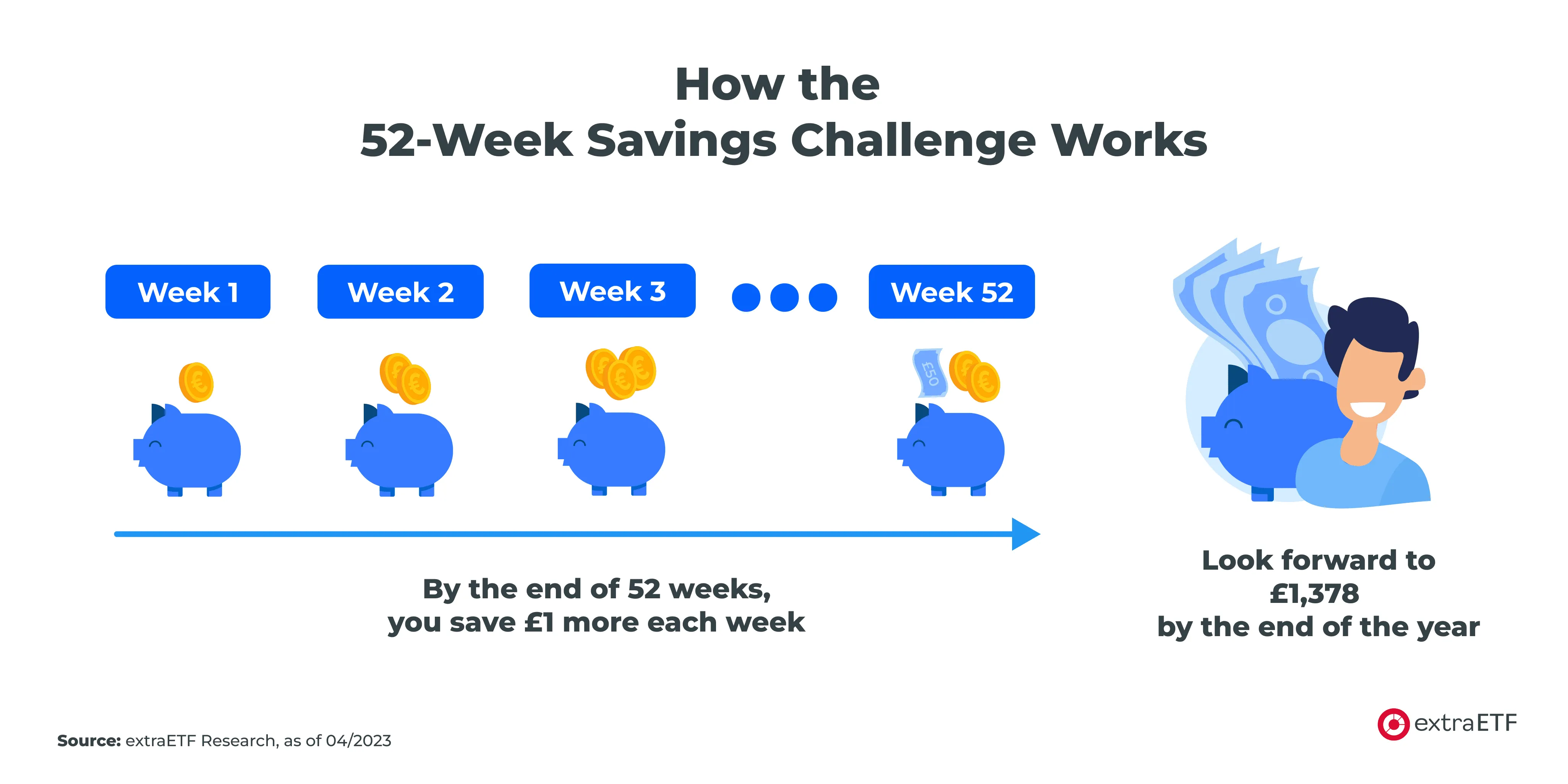
Alternatively, you can save in smaller increments – for example, by increasing the savings amount by just 50 Pence each week instead of £1.
You can eventually transfer the money you’ve saved to a money market account, for example. However, you’ll benefit even more if you invest the amount long-term in globally diversified ETFs that invest in stocks.

Discipline is the be-all and end-all of the 52-Week Savings Challenge
Five-Pound Savings Challenge
The Five-Pound Savings Challenge is a great way to save money – it’s really easy to do.
Here’s how it works:
- Set a savings period and a savings goal for yourself.
- Every time you get small change or change in the form of a five-pound bill while shopping, put it in a piggy bank at home.
- After a while, you’ll be amazed at how much money you’ve accumulated. If you use this savings method regularly, you can save a considerable amount without even noticing it.
It may not seem like much, but if you save, say, five pounds every month, you’ll have saved £60 by the end of the year. If you manage to stick with this savings method over a longer period, you can end up filling your piggy bank with a respectable amount.
It’s impossible to predict exactly how quickly you’ll reach your savings goal. However, the barriers to getting started are extremely low. As an alternative to five-pound bills, you can also start with one- or two-pound coins, for example.
Small Change Challenge
The Small Change Challenge works much like the Five-Pound Savings Challenge. Here, too, the idea is that whenever you receive small change in the form of coins or bills, you put it into a piggy bank.
The difference, however, is that you don’t just collect specific coins or bills – as the name suggests, you save all your loose change. This savings method should be especially easy for those who like to pay in cash but find sorting out change too much of a hassle, given the amount of change they receive.
At the end of each week or at the end of the month, count the money you’ve saved and write down the total. This gives you an overview of how much money you’ve saved.
One-Per cent Savings Challenge
This savings challenge is all about setting aside a specific amount each month. This amount should be one per cent of your income – hence the name.
To successfully complete the challenge, it’s important to consistently transfer this amount to a separate savings account every month. You can easily automate your savings by setting up a standing transfer from your current account.
For example: If you earn £2,000 net per month, your savings amount would be £20.
Alternatively, you’re of course free to adjust the savings percentage to suit your individual needs, depending on your savings goal or income.
Tip: Since you unfortunately earn only low interest rates when saving in a money market account, an Regular ETF Investing is recommended for long-term saving. Once set up, a predefined amount can be invested regularly from your account – conveniently, over the long term, and with broad diversification.
30-Day Savings Challenge
The 30-Day Savings Challenge is largely similar to the 52-Day Savings Challenge, but is focused on just one month instead of 52 weeks. However, since the 30-Day Savings Challenge is based on days, a specific amount is put into a piggy bank every day.
Here’s how it works:
- Write the numbers 1 through 30 in sequence on a piece of paper.
- Start the Savings Challenge by putting one pound into the piggy bank on the first day and crossing out the number 1 on your piece of paper.
- On the second day, put £2 in the jar and cross that number off.
- Continue this way day by day until you’ve gone through all the numbers and completed the 30th day.
- Celebrate the £465 you’ve saved.
Of course, the amount you save increases quite quickly. But in return, you’ll be able to look back on a substantial savings total after just a short time. And if you extend the challenge accordingly for months with 31 days, your total at the end of the month will even be £496.
Overall, the 30-Day Savings Challenge is a great way to improve your saving habits and build a financial cushion. You can do this, for example, with a money market account. However, you’ll benefit even more if you invest the money you’ve saved over the long term in globally diversified ETFs that invest in stocks.
Temperature Savings Challenge
The Temperature Savings Challenge is a fun way to regularly adjust your saving habits based on the temperature on the thermometer.
Here’s how it works:
- Choose one day a week.
- Then, check the thermometer at the same time every day.
- Set aside the amount shown on the thermometer as your savings goal.
For example: On a hot summer day when it’s 32 degrees Celsius, you save £32.
Alternatively, you can also achieve high savings rates in winter if you set a weekly goal and do the Temperature Savings Challenge every day. But be careful – sub-zero temperatures shouldn’t be an excuse to spend money.
Swear Word Challenge
With the Swear Word Savings Challenge, if you swear frequently, you can not only save money but also change your behaviour.
For every swear word or curse you use each day, put money into a piggy bank. You can decide for yourself how much to put in.
What’s especially handy: The Swear Word Challenge is very flexible, as it can be adapted to various negative behaviours or habits. For example, it can be well-suited for households with teenagers who swear a lot. But regardless of whether your children swear or not, it makes sense to start saving for them early on using ETFs.
The Rounding-Up Trick
In the Round-Up Savings Challenge, you round up all your expenses to the next whole amount. Then you put the change into a piggy bank or transfer it to a money market account.
Here’s an example: If you spend £15.50 while shopping, you round it up to £16. That way, you can save 50 Pence.
This trick sounds simple, but it requires discipline and perseverance. However, if you stick with it consistently, you can achieve amazing results. If, as in our example, you save 50 Pence every day for a week, you’ll already have £3.50 by the end of the week. Projected over a year, that would amount to £182.
Alternatively, you can vary this savings challenge by rounding up in increments of five or ten, for example. You can also simply write down the amounts and transfer the total to your current account at the end of the month.
Join the extraETF community
Explore the world of ETFs and make informed investment decisions.
- Find ETFs that match your criteria with our ETF Search.
- Compare costs, performance, and risk side by side.
- Save your favourites to a watchlist and receive price alerts.
- Explore detailed ETF profiles with key metrics and holdings.
Which savings challenge should I choose?
Which savings challenge you choose depends entirely on your individual preferences, as well as your savings goals and financial situation.
When choosing a savings method, you can use the following questions as a guide:
- Do I want to save for the short term or the long term?
- Do I have a specific savings goal, such as a vacation or building an emergency fund?
- Is the focus of the savings challenge more on building a habit or on having some fun and variety?
It’s best to choose a savings challenge that suits you and makes you feel comfortable. For example, the loose-change challenge or the five-pound challenge might be less suitable for people who prefer to pay with a card. And the 30-day challenge might be more appealing to you than the 52-week challenge if you’d rather see short-term success in your savings.
But no matter which savings challenge you choose, it would be a shame if the money you’ve saved lost purchasing power over the long term due to inflation. That’s why we recommend a long-term investment via ETFs that offers high returns, low costs, and sufficient diversification.
You can learn what ETFs are in our guide and read everything you need to know about them in our ETF Guide.
Conclusion: Save Money with Simple Tricks
These savings methods are especially well-suited for you, as they’re tailored to your individual preferences, savings goals, and financial situation.
The savings challenges presented in this article are, of course, just a fraction of all the possible ways to save. But they show you just how varied, fun, flexible, and motivating saving can be.
This way, you can easily and conveniently incorporate these savings tips into your daily routine and achieve many savings goals – for example, at the end of the week, month, or year. What’s more, this can positively influence your behaviour when it comes to managing money or certain habits. To get started, you can, of course, try out a few savings challenges first to see which ones suit you best.
