



Saving for Children with ETFs
Comparison: An Overview of the Best ETFs for Kids
People who have children or grandchildren often ask themselves: Should I save for my child? While it’s still quite easy to answer this question with a simple “yes,” the answer to the next question – “How, and with what type of investment, can I do this most effectively?” – is much more difficult. And then some people may have already heard about investing in ETFs, which are said to generate high returns over the long term even with small savings amounts.
This guide outlines the most important points to consider when saving for children. It also provides specific tips and guidance on which options are particularly well-suited for saving with ETFs for children.
The essentials in brief: Everything You Need to Know About Saving for Children at a Glance
Why? According to the Federal Statistical Office, parents with one child spend an average of 763 euros per month (as of 2018). By the time the child turns 18, that adds up to around 165,000 euros – a substantial amount. Anyone who relies on a piggy bank, a current account, or a fixed-term deposit account runs the risk of seeing their savings severely eroded by inflation.
How? ETFs are a cost-effective way to save money for children. Over the long term, they offer the potential for higher returns than a simple checking or savings account.
When? The sooner you start building wealth for your children, the better. That way, they can benefit from the power of compound interest for as long as possible.
How much? You can start investing in an ETF for your children with small savings amounts starting at just £1.
Tip: Whether it’s a birthday, a baptism, or Christmas – choose an Regular ETF Investing instead of a savings account! With the right junior investment account, your gift will grow over the long term.

Find and compare thousands of ETFs. Use powerful filters, detailed analytics, and independent data to discover the right ETF for your portfolio.
Why Save for Children?
Saving for children is important to foster their financial literacy, provide them with a financial foundation for the future, and prepare them for the challenges of adult life. Moreover, as we all know, children are expensive. In addition to the costs of education, food, housing, supplies, and transportation, there are different major expenses depending on the stage of life. Children should also be financially protected in case of unforeseen emergencies.
Furthermore, it’s especially worthwhile to start building wealth early for children, as the power of compound interest can have a particularly positive effect. An added benefit: The child learns early on to manage money responsibly and independently.
The Federal Statistical Office has calculated the costs associated with raising children from birth until they turn 18.
Babies and Toddlers, Ages 0–6 | School-age children, ages 6–12 | Adolescents, ages 12–18 | |
|---|---|---|---|
| Total costs | 42,264 euros | 49,392 euros | 56,448 euros |
| Monthly cost | 587 euros | 686 euros | 784 euros |
| Typical costs | Baby supplies, clothing, food, stroller, crib, diapers | School supplies, tutoring, pocket money, movie tickets, books | Clothing, smartphone, transportation costs, laptop, driver’s license |
| Total costs | 148,104 euros | ||
But that’s not all. Even after turning 18, additional costs continue to accrue until the children leave home. The Bavarian Consumer Advice Center has calculated that raising a child through college costs around 230,000 euros – an additional 80,000 euros. It’s therefore worth calculating the expenses for your children early on and making financial provisions.
What are some ways to save money for children?
There are many ways for children to save money. While a savings account, a children’s account, or a money market account are simple and safe ways to save money for children, they unfortunately offer little or no interest. Investing in stocks – ideally through a broadly diversified, low-cost ETF – is certainly the strategy with the highest returns for building wealth. An ETF portfolio or an Regular ETF Investing is well-suited for long-term savings goals, but also carries a higher level of risk.
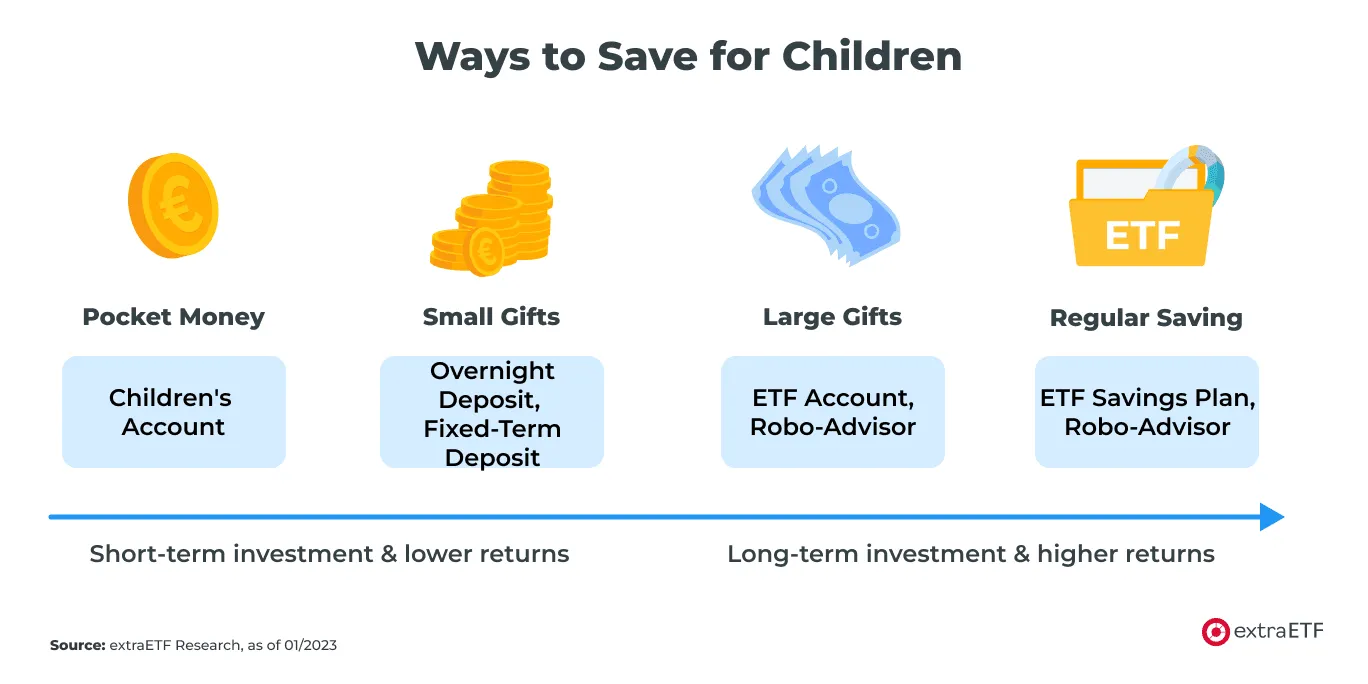
| Type of Savings | Assessment | extraETF recommendation? |
|---|---|---|
| Children’s Account | High security, high liquidity, no return, inflation erodes value | No |
| Savings account, money market account, fixed-term deposit | High security, low return, inflation erodes value | No |
| Education savings plan | High costs, limited availability, low returns, inflation erodes value | No |
| ETF portfolio or Regular ETF Investing | Low costs, high returns, potential for volatility, protection against inflation, requires a high degree of personal initiative | Yes |
| Robo-advisors | Moderate costs, high returns, high transparency, protection against inflation, minimal personal involvement | Yes |
The following section provides a detailed overview of the various savings options available for children.
Join the extraETF community
Explore the world of ETFs and make informed investment decisions.
- Find ETFs that match your criteria with our ETF Search.
- Compare costs, performance, and risk side by side.
- Save your favourites to a watchlist and receive price alerts.
- Explore detailed ETF profiles with key metrics and holdings.
What criteria should an investment for children meet?
A good investment for children should:
- be flexible
- carry low risk
- be cost-effective
- and offer the potential for higher returns
Start saving for your children as early as possible
Most parents want to give their children a good start in life as independent adults. But those who aren’t fortunate enough to be free from financial worries should start early to achieve this goal. Fortunately, even small amounts can grow into a substantial nest egg if you start saving early.
For example, if parents invest less than half of their child’s child benefit – about £100 per month – in a regular investing and achieve an annual return of 5 per cent over an 18-year period, they’ll end up with about £35,000. What’s more, a large portion of the interest income is even tax-free thanks to the child tax credit. Those who don’t save for their children forfeit this tax credit – and that costs real money.
By the way: The government also wants to help children save money through the “Early Start” retirement savings programme.
How much money should I save for my child?
How much money you should save for a child depends largely on your savings goals and investment horizon. But don’t worry: With globally diversified stock ETFs, you can build up a substantial nest egg over the long term, even with small monthly contributions. At some direct banks, Regular ETF Investments start with a minimum contribution of just 1 euro. This means that saving for children can get off to a secure start in building wealth, even with small amounts.
Fulfilling Children's Dreams with ETFs
Making children’s dreams come true can be quite expensive. The following examples therefore clearly demonstrate how even larger expenses – such as a longer stay abroad for the children – can be financed through a long-term investment in globally diversified equity ETFs. Even the high cost of attending Harvard seems affordable and achievable with the low risk associated with ETFs.
| Savings Goal: | Driver’s license | 3 months in Australia | 4 years at Harvard |
|---|---|---|---|
| Savings period: | 18 years | 20 years | 22 years |
| Amount needed: | 1,850 euros | 6,000 euros | 153,000 euros |
| Monthly savings amount: | 3.95 euros | 10.47 euros | 220.36 euros |
| Total savings: | 853.20 euros | 2,512.80 euros | 58,175.04 euros |
These are the legal issues to consider when saving for children
When saving for children, there are several legal issues that parents must decide for themselves and their child. First, they must determine whether the money should be saved in the child’s name or in the parents’ name. This decision has significant tax implications. Both options have advantages and disadvantages. Which option parents ultimately choose depends, among other things, on the family’s personal situation, financial circumstances, savings goals, preferred investment types, and investment horizon.
Questions such as how best to take advantage of the saver’s pocket money and whether to invest via a lump-sum investment or an Regular ETF Investing should also be considered before making any investments.
A Parent's Account or a Child's Account – Which Is Better?
Parents can choose between a parent’s account and a child’s account. Both options have specific advantages and disadvantages.
With a parent’s investment account, the assets intended for the child are saved in the parents’ account – for example, with an online broker – so legally, these assets belong to the parents. Upon reaching the age of majority, the child has no legal claim to the assets. For tax purposes, the assets are also attributed to the parents.
With a child’s investment account, a separate account and investment portfolio are opened for the child. The child is the owner of the accumulated assets. However, until the child reaches the age of majority, the parents act as legal representatives and can manage the funds. For tax purposes, the funds are attributed to the child. This entitles the child to various tax pocket money.
Summary of the Pros and Cons of Parent and Child Accounts:
| Parent Account | Child Investment Account | |
|---|---|---|
| Advantages |
|
|
| Disadvantages |
|
|
Take Advantage of Tax Benefits When Investing in ETFs for Children
A children’s investment account offers significant tax advantages. The child’s tax-free pocket money can be used to receive tax-free income up to certain income limits. In addition, assets can be transferred from parents or grandparents to the child in increments with tax benefits.
Tax Benefits on Investment Returns
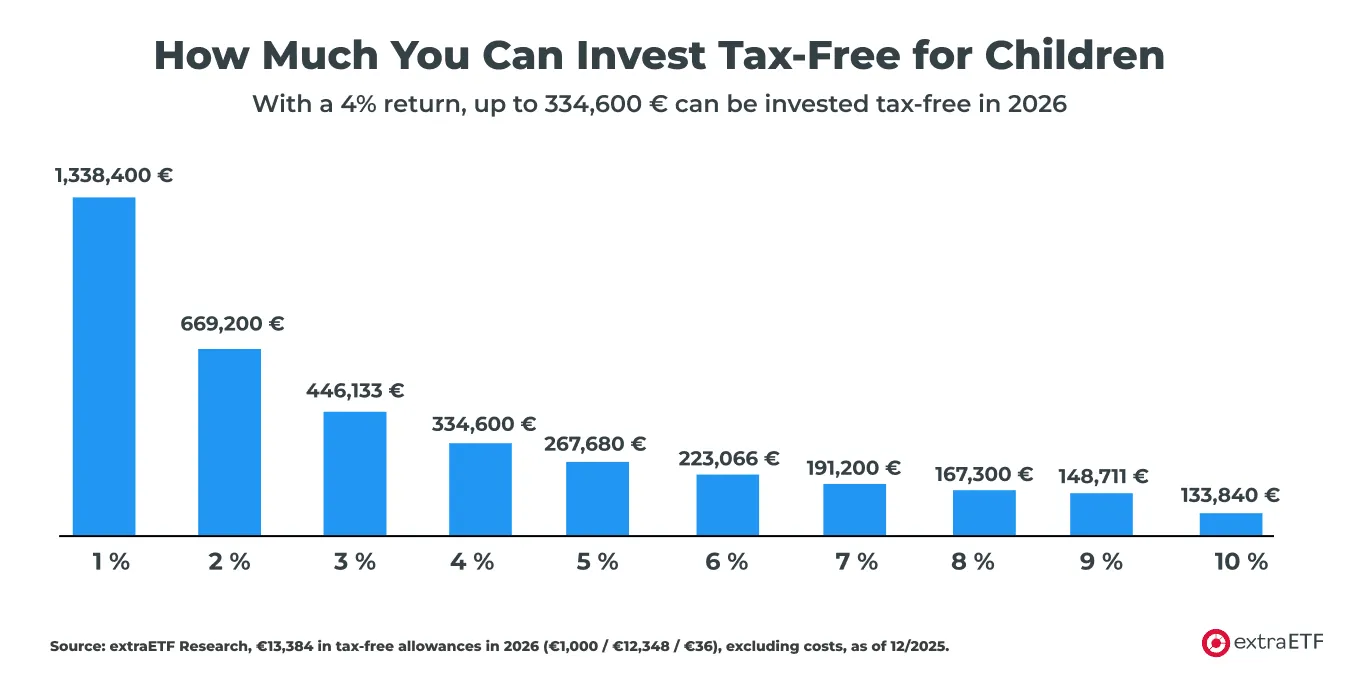
Every child is entitled to a flat-rate savings pocket money of 1,000 euros. Income – such as interest, dividends, or distributions – is paid tax-free into the child’s account up to this amount, provided a tax exemption form has been filed. In addition, the child is entitled to a basic tax exemption of 12,348 euros in 2026. Income up to this amount is also tax-free. If a tax certificate is also submitted for the child, an additional 36-euro flat-rate special expenses pocket money can be claimed. In total, a children’s investment account can thus generate tax-free income of up to 13,384 euros (2026).
Tip: If the child’s income does not exceed the total of the above-mentioned tax-free pocket money, you should apply for a non-assessment certificate (NV certificate) for the child. This saves you the trouble of filing a tax return to get a refund of the tax you paid.
Tax Benefits of Asset Transfers (Gifts)
Through a gift, parents or grandparents can transfer assets to their children or grandchildren while they are still alive. However, certain tax-exempt limits and time frames must be observed. For example, parents can gift their children 400,000 euros tax-free every 10 years. Grandparents can transfer assets worth 200,000 euros to their grandchildren tax-free every 10 years. Asset transfers that exceed the gift tax exemption limits are subject to gift or inheritance tax. In cases of complex financial circumstances or when transferring larger estates, it is advisable to seek advice from a tax advisor in advance.
Tip: Be careful when transferring securities. If a investment account is transferred from parents to a child, this transfer is considered a sale. In this case, the difference between the purchase price and the sale (or transfer) price is subject to withholding tax, the solidarity surcharge, and, if applicable, church tax.
Who owns the money in a child's bank account?
The assets held in a children’s account belong to the child from both a legal and tax perspective. Parents have power of attorney over the account and custody of the assets only until the child reaches the age of majority.
This also means that parents may only use the child’s account for the child’s purposes and needs. Funding an education or a driver’s license would therefore be possible. Withdrawing funds to make a down payment on a new car for the parents, however, would generally not be permitted.
Saving for Children with ETFs: Optimal Investment Strategies
When saving for their children, parents should focus on stocks as the asset class with the highest returns. Short-term price fluctuations can easily be “weathered” thanks to the long investment horizon. ETFs are particularly well-suited for children due to their low-cost structure and broad diversification of investment capital.
In our view, the best options for saving for children are an Regular ETF Investing or investing with a digital wealth manager (robo-advisor).
How can I open a investment account for children?
Opening a junior investment account generally follows the same process as opening a regular investment account. There is also no minimum age requirement for opening a children’s account or a junior account. As long as the child is a minor, the parents are granted access to the account and the authority to manage it. Once the child reaches the age of majority, this authority expires, and the child can manage the account and securities portfolio independently.
Open a investment account with a direct bank or a robo-advisor |
Choose an investment strategy or a broadly diversified ETF |
Submit the tax-exempt amount and, if applicable, the certificate of non-assessment |
Share your bank account information with family members |
What documents are required to open a children's investment account?
When opening an account, the child’s parents must submit or present additional documents to the bank. The specific documents required vary from bank to bank.
Typically, these include the following documents:
- Application to open a investment account (signed by each legal guardian)
- Copy of the birth certificate
- Copy of the child’s ID card (if available)
- The child’s tax identification number (issued by the Federal Central Tax Office after birth)
- Copy of the parents’ ID cards
- Copy of the marriage certificate (if the parents have different last names)
- Custody order for single parents
- Declaration of custody for unmarried parents with joint custody
The Postident verification process must also be completed by both parents (except in the case of single parents). In addition, the bank will ask about the parents’ experience with securities.
Conclusion: Here's What You Should Keep in Mind When Saving for Children Using ETFs
Opening a children’s investment account requires careful consideration, as it will ideally be with you for the next 18 years. Parents should also pay particular attention to ongoing costs, an appropriate investment strategy, and sufficient diversification of the investment. A children’s investment account is a sensible addition to a child’s personal wealth-building plan. After all, those who start saving and investing early need to set aside less each month to reach a savings goal, or – if they save larger amounts – can look forward to a larger nest egg at the end of the savings period.
For the first time, parents can now open a children’s investment account with Trade Republic, Scalable Capital, Finanzen.net Zero, Fidelity, and the ING Direkt-Depot Junior. This allows them to save for their children easily and affordably. Executing Regular ETF Investments is free, allowing assets to grow over the long term and helping to close the retirement gap. Scalable Capital also offers a robo-advisor for children’s investment accounts.
We'll answer any other questions you have about saving for children
Risk Disclosure: The information and representations contained in this article have been prepared to the best of our knowledge and belief. No warranty is given as to their accuracy or completeness. The content is not a substitute for tax and/or legal advice. The content does not constitute such advice and cannot serve as a substitute for it. Therefore, any liability or claims of any kind are excluded.
- Everything You Need to Know About Saving for Children at a Glance
- Why Save for Children?
- What are some ways to save money for children?
- What criteria should an investment for children meet?
- Start saving for your children as early as possible
- How much money should I save for my child?
- Fulfilling Children's Dreams with ETFs
- These are the legal issues to consider when saving for children
- Who owns the money in a child's bank account?
- Saving for Children with ETFs: Optimal Investment Strategies
- How can I open a investment account for children?
- What documents are required to open a children's investment account?
- Here's What You Should Keep in Mind When Saving for Children Using ETFs
- We'll answer any other questions you have about saving for children
