



The 50-30-20 Rule
Save Money Long-Term and Reach Your Savings Goals
It’s easy to lose track of your finances, but keeping a close eye on your monthly income and spending is important. That’s where the 50-30-20 rule comes in. It divides your spending into three categories: basic needs, hobbies and personal needs, and saving and debt repayment. The rule can help you save money and stop you living beyond your means or falling back on an expensive overdraft. But what exactly is the 50-30-20 rule? How does it work? And which expenses fall into which category?
This guide answers these questions and more, and shows you how to use the 50-30-20 rule to set a budget for each category.
The essentials in brief: Everything You Need to Know About the 50-30-20 Rule at a Glance
Saving Method: Its clear structure helps you save money each month, build up savings and reach your financial goals.
Categorisation: The rule splits your net income by percentage across three categories: basic needs, hobbies and personal needs, and saving and debt repayment.
Budget Planning: This budgeting method also gives you a clearer overview of your finances, which often reveals opportunities to save.
Investing: Money you save under the 50-30-20 rule loses purchasing power to inflation, so over the long term it makes sense to invest it, for example in low-cost, well-diversified global equity ETFs.

Find and compare thousands of ETFs. Use powerful filters, detailed analytics, and independent data to discover the right ETF for your portfolio.
What is the 50-30-20 rule?
The 50-30-20 rule is a savings method that helps you achieve a healthy balance between spending, saving, and building wealth.
It splits your monthly income as follows:
- 50 per cent for basic needs
- 30 per cent for hobbies and personal needs
- 20 per cent for saving and paying off debt
The 50-30-20 rule can help you stick to a budget and keep track of your finances. It also lets you build long-term savings and a financial cushion for unexpected expenses. The rule gives you clear guidance on how to allocate your money and helps you balance basic needs, leisure and saving for the future.
How does the 50-30-20 rule work?
The 50-30-20 rule starts with taking time to get an overview of your income and expenses.
You then divide your net income among the following categories:
The 50-30-20 rule suits anyone who wants to keep their finances under control, reach their savings goals and feel financially secure. It is also less extreme than frugalism, as it deliberately builds in spending that improves your quality of life.
Let’s now look at each part of the rule in more detail.
50 per cent for basic needs
The 50-30-20 rule recommends allocating 50 per cent of your net income to basic needs. These are the costs you must cover to live securely and comfortably.
Examples of basic expenses include:
- Rent or mortgage
- Electricity, gas, water
- Groceries
- Personal care and hygiene products
- Phone and internet
- Transport (tickets, petrol, etc.)
- Insurance
It’s best to write down the individual amounts for these expenses, for example in a household budget book. This gives you a good starting point for making sure you have enough money for your most important monthly costs.
30 per cent for hobbies and personal needs
This part of the rule sets aside 30 per cent of your net income for leisure activities, personal needs and wants.
Examples of such expenses include:
- Eating out
- Clothing
- Books
- Sports (gym membership, yoga classes, etc.)
- Accessories
- Holidays
This money is yours to spend on things that improve your quality of life or bring you enjoyment. It allows you to lead a fulfilling life without feeling deprived, while staying financially secure.
Tip: You don’t have to spend the full 30 per cent every month. If you spend less on hobbies and personal needs in a given month, you can save the difference.
20 per cent for savings and debt repayment
The final 20 per cent of your net income goes towards savings or debt repayment. If you have debt, try to pay it off as quickly as possible before you start building wealth, as this saves on interest and makes you more financially independent.
Building wealth requires saving consistently and setting money aside regularly. To stop inflation eroding your savings over the long term, you should invest them. Well-diversified global equity ETFs are a good option: you can invest in them automatically, even with small monthly amounts, through a regular ETF investment plan.
By saving regularly and repaying debt, you can build up wealth over time that serves as a financial cushion in difficult times or as part of your retirement planning.
Join the extraETF community
Explore the world of ETFs and make informed investment decisions.
- Find ETFs that match your criteria with our ETF Search.
- Compare costs, performance, and risk side by side.
- Save your favourites to a watchlist and receive price alerts.
- Explore detailed ETF profiles with key metrics and holdings.
Calculation Example: How to Save Money Using the 50-30-20 Rule
Say you’ve used your bank statements to get a clear picture of your income and expenses, and you have a monthly net income of £2,000. Under the 50-30-20 rule, that gives you £1,000 for basic needs, £600 for hobbies and personal needs and £400 for saving and debt repayment.
Since you set aside £400 a month in our example, you’ll have saved £4,800 after one year.
You could use this money to pay off debt, work towards a specific goal – such as buying a new car – or build your wealth.
One option for investing your savings is a regular ETF investment plan. Contributions of £4,800 a year over 20 years would total £96,000. Assuming an annual return of 7 per cent, your portfolio could be worth £199,283.69 after 20 years, as the following chart from the extraETF regular investing calculator shows:

Such a return has historically been achievable with long-term investments, for example in an MSCI World ETF, although past performance is no guarantee of future results. Since the MSCI World Index covers only developed countries, you may want to diversify more broadly – see our guide “How many ETFs make sense?”
Of course, incomes differ, and not everyone can stick exactly to the 50-30-20 rule. If basic needs take up more than 50 per cent of your salary, for example, you’ll need to adjust the other categories accordingly. What matters far more is that you actively manage your finances and save strategically.

The 50-30-20 rule doesn't apply to every financial situation
Here's How to Apply the 50-30-20 Savings Method Correctly
To apply the rule correctly, you need to know your net income and have a clear overview of your income and expenses.
Follow these steps:
- Calculate your net income
- Determine your expenses and fixed costs
- Categorise your expenses using the 50-30-20 rule
Let’s look at each step in turn.
1. Calculate net income
Calculating your net income is the first step towards an overview of your personal finances. If you’re an employee, a quick look at your monthly payslip is usually enough to see your take-home pay after income tax, National Insurance and pension contributions have been deducted. You should also include any other income, such as rental income or maintenance payments.
Review your net income regularly to stay on top of your finances and adjust your budget as needed.
2. Determine expenses and fixed costs
You can find your regular expenses and fixed costs mainly in your bank statements, banking app or household budget book. Because monthly spending can fluctuate, it makes sense to calculate an average over the past few months, which gives a more realistic picture of what you spend.
Even at this stage, a good overview can help you spot potential savings – for example, by comparing prices for insurance, energy and mobile phone or broadband contracts. However, don’t restrict yourself too much; aim for a healthy balance between saving and quality of life.
3. Categorise expenses according to the 50-30-20 rule
Next, allocate your expenses and fixed costs according to the rule: 50 per cent for basic needs, 30 per cent for hobbies and personal needs and 20 per cent for saving and debt repayment.
The following chart shows which expenses belong in which category:
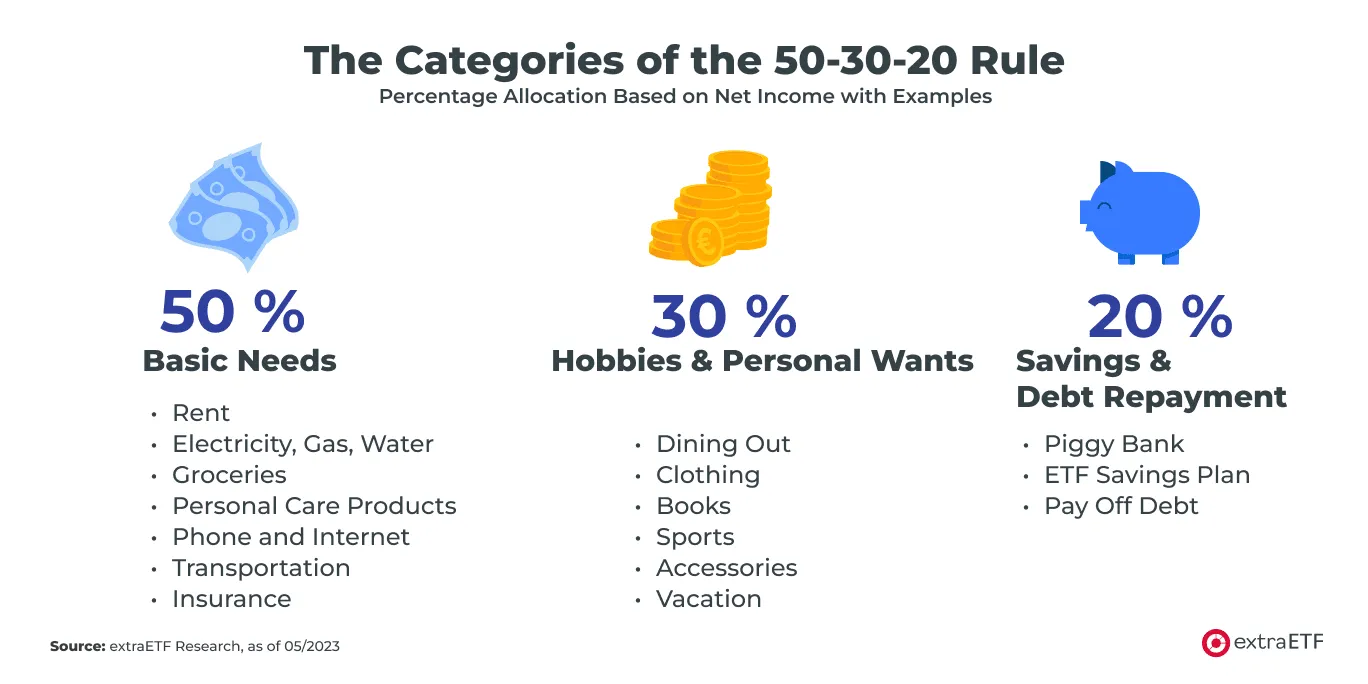
This categorisation shows you at a glance how much of your budget is left for each area, so you can look for extra savings where needed. You can then adjust your budget and focus your saving or debt repayment to reach your financial goals faster.
However, the 50-30-20 rule is only a guideline and should be adapted to your circumstances. Depending on your situation and needs, it may make sense to allocate more or less money to a particular category. Whatever you choose, set a realistic budget and avoid living beyond your means.
Conclusion: Save Money with the 50-30-20 Rule
The 50-30-20 rule is a savings method that helps you achieve a healthy balance between spending, saving and building wealth. To apply it effectively, you’ll first need a comprehensive overview of your income and expenses.
Once that’s done, the rule gives you a clear structure to follow: 50 per cent for basic needs, 30 per cent for hobbies and personal needs, and 20 per cent for saving and debt repayment.
Simply having an overview of your spending and comparing prices can often reveal significant savings. If you want to know more about saving in general, saving for children with ETFs or making saving fun with savings challenges, our guides can help. For investing your savings over the long term, regular ETF investment plans are also a good option, allowing you to invest regularly even with small amounts.
We'll answer any other questions you have about the 50-30-20 rule
- Everything You Need to Know About the 50-30-20 Rule at a Glance
- What is the 50-30-20 rule?
- How does the 50-30-20 rule work?
- Calculation Example: How to Save Money Using the 50-30-20 Rule
- Here's How to Apply the 50-30-20 Savings Method Correctly
- Save Money with the 50-30-20 Rule
- We'll answer any other questions you have about the 50-30-20 rule
