



What Is Concentration Risk?
How to Avoid Concentrated Risks Through Proper Risk Diversification
You’ve probably heard stories of people who put all their money into the shares of a single company and got rich. But on closer inspection, this turns out to be an enormous risk. If the company goes bust, everything you invested is lost.
To avoid this and still achieve attractive long-term returns at low risk, make sure your investments are sufficiently diversified. But even if your stock market investments are spread across different companies, industries, asset classes, currencies and regions, unintended concentrations can still build up in your portfolio. These are known as concentration risks.
This guide explains what concentration risk is, how to recognise it and how to avoid it.
The essentials in brief: Everything You Need to Know About Concentration Risk at a Glance
Definition: Concentration risk is the risk of suffering large losses. It arises when investors put too much of their money into a single investment or type of investment.
Asset classes: Concentration risk can arise in any asset class if diversification is insufficient, whether you invest in shares, ETFs, funds or property.
Avoiding the risk: Adequate diversification – spreading your money across a wide variety of securities, asset classes, sectors, currencies and countries that are not closely correlated – can help you avoid concentration risk.

Find and compare thousands of ETFs. Use powerful filters, detailed analytics, and independent data to discover the right ETF for your portfolio.
Definition: What is concentration risk?
Concentration risk is the heightened risk that comes from investing too much in one area. It arises when investors put too much of their money into individual companies, sectors, regions, currencies or asset classes, which increases the correlation between their investments. As a result, the portfolio’s total value depends too heavily on the performance of a single security or just a few securities.
One example: an investor puts all their money into shares of a single company, the company goes bust and the investor suffers a total loss.
A well-diversified portfolio, as part of a balanced asset allocation, can reduce concentration risk and the risk of loss. A portfolio tracking tool is particularly helpful here, as it lets you monitor the composition of your portfolio and take action if correlations are too high or allocations are uneven.
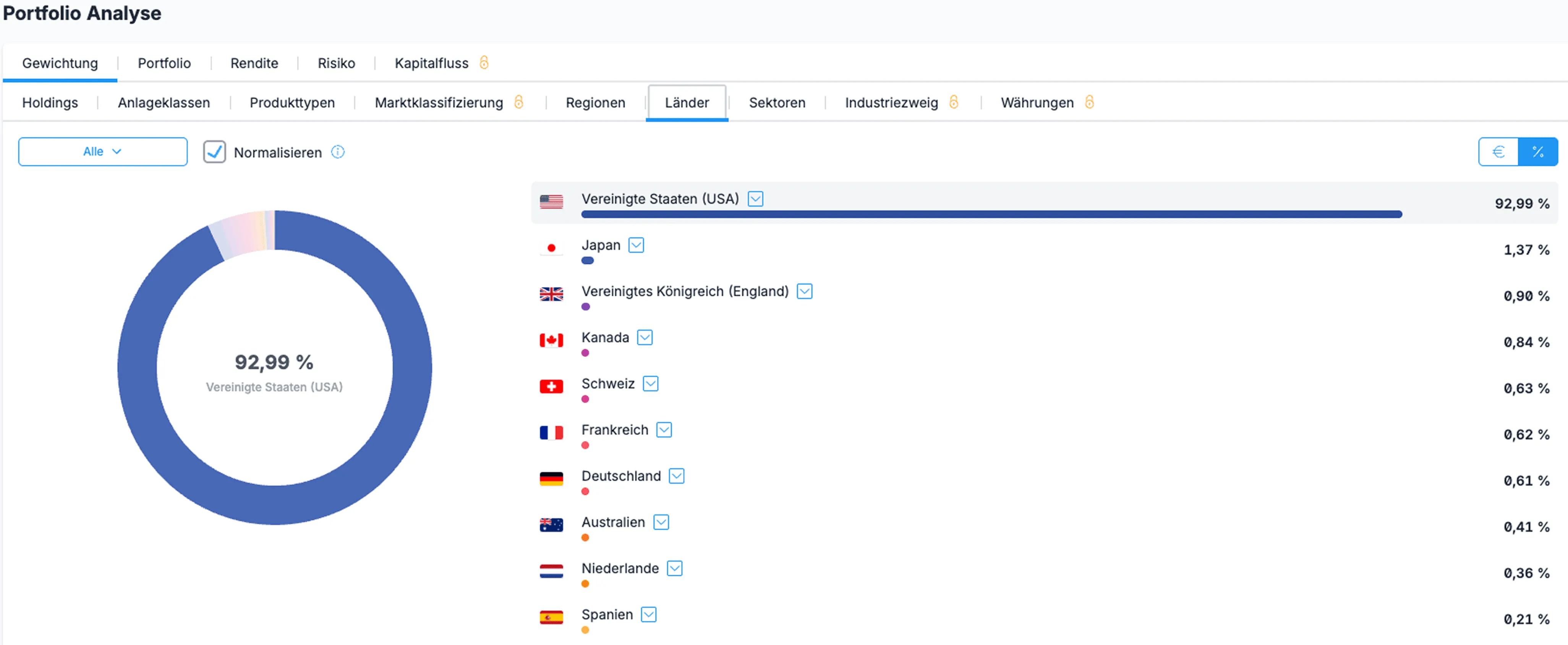
This example shows a portfolio made up largely of US holdings, which is a country-specific concentration risk.
Join the extraETF community
Explore the world of ETFs and make informed investment decisions.
- Find ETFs that match your criteria with our ETF Search.
- Compare costs, performance, and risk side by side.
- Save your favourites to a watchlist and receive price alerts.
- Explore detailed ETF profiles with key metrics and holdings.
Which asset classes can be affected by concentration risk?
Concentration risk can arise in any form of investment if a portfolio is not sufficiently diversified. Too little diversification, or none at all, is therefore the root cause. Many investors underestimate the danger and put too much of their money into individual asset classes or companies.
Below, we look more closely at two of these asset classes:
- Investing in Different Regions: Concentration Risk in Property
- Diversifying Across Sectors and Companies: Concentration Risk in Shares
Since concentration risk can occur anywhere – for example, when investing in shares, ETFs, property, commodities and funds – it is always important to ensure sufficiently broad diversification.

Concentration risks can increase the risk of your overall portfolio
Investing in Different Regions: Concentration Risk in Property
Property is popular with many investors because it is considered a relatively safe and profitable investment. However, it’s important to watch for concentration risk. The risk is greatest when you put your entire portfolio into a single property, or only into properties in the same region or sector.
Here’s an example: Imagine you’ve invested all your money in a flat in a particular city. If it then loses value – because of falling rents, a natural disaster or a long vacancy – your entire investment is at risk.
It is therefore advisable to invest in several properties in different locations and of different types, and to include other asset classes in your portfolio. This spreads your risk significantly. You can achieve a high degree of diversification, for example, with broadly diversified ETFs, funds and property shares, which can usually be bought conveniently and affordably through regular investing.
Diversifying Across Sectors and Companies: Concentration Risk in Shares
Shares are a popular way to generate high returns. However, putting too much of your money into individual companies, regions or sectors can lead to concentration risk. If a company goes bust, or a crisis hits a region or sector, you could suffer disproportionately large losses.
It is therefore important to spread your risk widely, for example by investing in ETFs that offer broad diversification across the stock market. It can also be wise to add other asset classes. With such broad diversification across companies, industries, regions, asset classes and currencies, the risk associated with ETFs can be significantly reduced over the long term.
Is Diversification in Funds and ETFs Enough to Avoid Concentration Risk?
Funds and ETFs are a good way to reduce risk. Compared with individual shares, they make it much easier to achieve a high degree of diversification, which can significantly reduce risk. However, funds and ETFs are still subject to stock market price fluctuations.
For example, investors who put their money only into ETFs focused on specific countries or sectors depend on that country or sector and bear the associated risk. If that country or sector hits a crisis, they may suffer significant losses.
To prevent this, it’s worth identifying concentration risks early – even before committing to a long-term investment such as regular ETF investing – and ensuring sufficiently broad diversification.

Example: Is there concentration risk in the MSCI World Index?
ETFs tracking the popular MSCI World Index carry concentration risks. In particular, the heavy weighting of the US could lead to losses if the country fell into a crisis. Emerging markets and small-cap shares are also not included. It is therefore important to diversify your portfolio more broadly and evenly across the globe to reduce the risk associated with ETFs over the long term.

To reduce this risk, investors should not rely solely on the MSCI World Index but also consider other ETFs that invest more broadly across sectors, countries and currencies. This can improve diversification within the portfolio. It is always advisable to review your portfolio’s diversification and adjust it as necessary to minimise concentration risk.
Identify and Avoid Concentration Risk with the extraETF Portfolio Tracker
Concentration risk can be a major problem for investors who put too much of their money into a single company, asset class, region or currency. The aim is to minimise overall risk, diversify the portfolio as broadly as possible and keep investments evenly balanced. As part of a balanced asset allocation strategy, it’s also advisable to spread your money across asset classes that are as uncorrelated as possible.
A portfolio tracking tool is a good way to protect your portfolio from concentration risks. It lets you analyse your portfolio easily and gives you a comprehensive overview of your investments, so you can identify and avoid concentration risks early and limit potential losses.
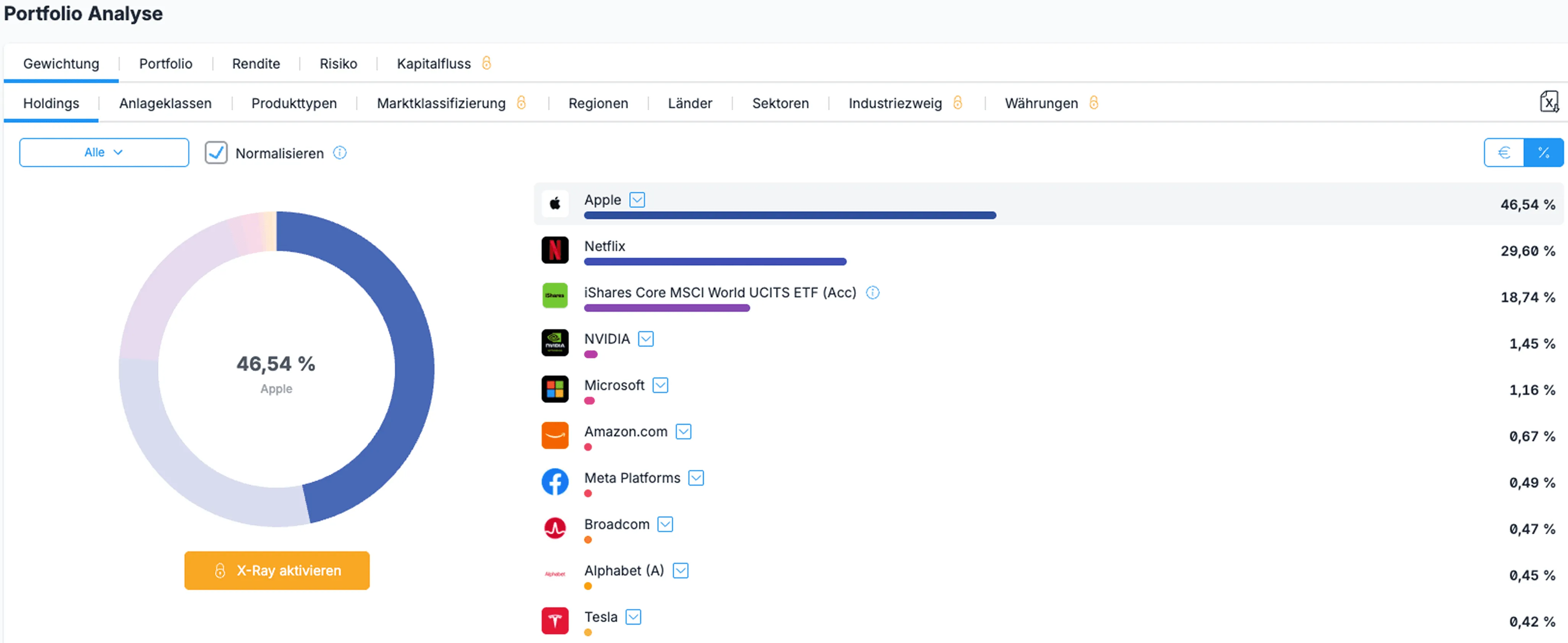
This example shows that the holdings in Apple and Netflix are weighted so heavily that they pose a concentration risk.
Conclusion: Avoiding Concentration Risk in Investing
Concentration risks can build up quickly, often without investors realising it. They can significantly increase a portfolio’s overall risk, so it is important to identify and avoid them early.
Instead of buying shares in individual companies and risking a total loss, investors can diversify their portfolios broadly. This can be done easily, cost-effectively and at relatively low risk with globally invested, broadly diversified ETFs, a long-term investment strategy and a balanced asset allocation.
We'll answer any other questions you may have about cluster risks
- Everything You Need to Know About Concentration Risk at a Glance
- Definition: What is concentration risk?
- Which asset classes can be affected by concentration risk?
- Example: Is there concentration risk in the MSCI World Index?
- Identify and Avoid Concentration Risk with the extraETF Portfolio Tracker
- Avoiding Concentration Risk in Investing
- We'll answer any other questions you may have about cluster risks
