



How to Create a Personal Financial Plan
A step-by-step guide to personal financial planning
Financial goals can guide your saving and investing, but they’re hard to achieve without a personal financial plan. Without a clearly structured, personalised plan, you risk losing track of your income and expenses.
Creating a financial plan may sound tedious, but it’s well worth tackling your finances step by step. You’ll soon have a good grasp of your household finances and realise it’s not nearly as much work as you might think.
In this guide, we’ll show you how to put your personal financial plan into practice and what to bear in mind, including how to build up your retirement savings.
The essentials in brief: Everything You Need to Know About Personal Financial Planning at a Glance
Definition: A personal financial plan gives you an overview of your income, expenses, debts, insurance policies and other assets. It helps you take control of your finances and shows you how to achieve your financial goals.
Time frame: A personal financial plan reflects your current financial situation and can be tailored to your short-, medium- or long-term savings goals.
Process: Creating a personal financial plan involves reviewing all your income and expenses, identifying and reducing risks, and setting personal goals. It also means setting up an account structure and saving and investing for retirement and long-term wealth.
Wealth building: A personal financial plan doesn’t just give you an overview of your finances. It also helps you build wealth over the long term and plan for retirement. Our regular ETF investing comparison service can help you find the right plan for you.

Find and compare thousands of ETFs. Use powerful filters, detailed analytics, and independent data to discover the right ETF for your portfolio.
What is a personal financial plan, and why do I need one?
A personal financial plan is an essential tool that lets you track, present and evaluate every aspect of your personal finances.
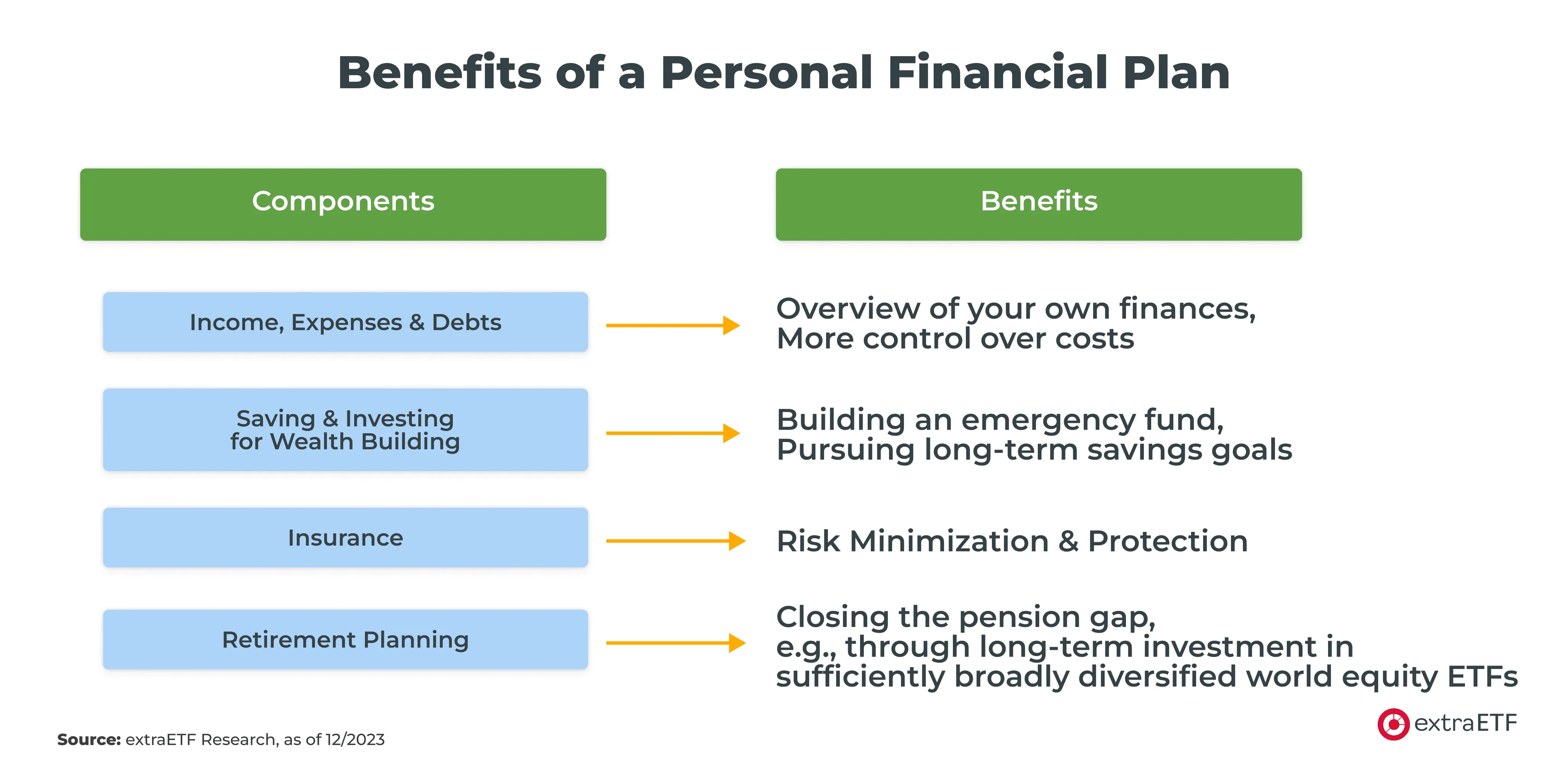
A financial plan includes the following sections:
- Income, expenses and debt
- Saving and investing to build wealth
- Insurance
- Retirement planning
You need a personal financial plan to gain and maintain a clear overview of your finances, identify financial problems early on, pay off debt, achieve your financial goals and build up your personal pension.
A financial plan lets you keep track of both spontaneous spending and fixed costs while building up reserves for a rainy day. Knowing you’re protected in an emergency gives you peace of mind.
The diagram below summarises why a personal financial plan makes sense and the benefits it can offer:
Step by step: How do I create a personal financial plan?
You can create a personal financial plan by following these steps:
Follow the steps below to create a personal financial plan that is forward-looking, sustainable, transparent and well organised.
Get an Overview of Your Income and Expenses
Create a summary that records all your income and expenses. The goal is to give you a clear picture of your current financial situation. Include valuables, fixed costs, cash savings, insurance policies, property, all sources of income (salary, rental income and so on) and any existing debts. Also include any securities, such as shares or ETFs.
Tip: A budgeting notebook or spreadsheet and a portfolio tracking tool are particularly helpful. They let you keep track of your current finances and monitor the performance of your investments.
Identify and Reduce Risks
We and our finances face a range of current and future risks, such as:
- Unemployment
- Illness
- Death of a loved one
- Accident
- Divorce
- Maintenance payments
You can protect yourself financially against many risks with insurance. Sensible options include life insurance, home and contents insurance and private medical insurance, alongside the protection provided through National Insurance contributions, such as the State Pension and contribution-based Jobseeker’s Allowance. In particular, you should take out suitable income protection insurance as early as possible in case illness or injury prevents you from working.
Compare insurance policies and their terms carefully to ensure adequate cover, keep your fixed costs down and protect yourself against unexpected events.
To protect against risks, financial reserves in the form of an emergency fund are essential. This should cover between three and six months’ take-home pay or living expenses. Set this aside before you start investing.
Set Personal Goals
Define your personal financial goals, then categorise them as short-term, medium-term or long-term. For example, building an emergency fund is a short-term goal, buying a new car is a medium-term goal, and retirement planning and building wealth are usually long-term goals. All your goals, including those related to saving and investing, should feature in your personal financial plan.
The emergency fund mentioned above and paying off any existing debt should be your top priorities.
Watch our video to learn how to set financial goals and achieve them:
Review Your Account Structure
When creating your financial plan, it’s essential to keep a close eye on all your accounts, including investment accounts. A clear account structure and methods such as the 50-30-20 rule can also help you achieve your goals, often more easily and automatically.
Think about an account structure that suits you, your financial situation and your goals. You need a current account for your income and expenses, such as monthly fixed costs. You’ll also need at least one easy-access savings account with the highest possible interest rate for your emergency fund or short- to medium-term savings goals. For retirement planning and long-term wealth building, you’ll generally need an investment account, such as a stocks and shares ISA or a SIPP. You can then move money from your current account using standing orders or invest it through regular ETF investment plans. This way, your saving and investing become structured and automated.
This keeps you in control of your finances and makes it easier to track and achieve your goals.
Wealth Building: Saving & Investing
A financial plan that focuses solely on saving is not very effective for long-term wealth building, and may even be counterproductive. Money that isn’t invested loses purchasing power through inflation. Long-term investments, such as sufficiently diversified global equity ETFs, can counteract inflation, as ETFs offer good prospects of returns and capital growth at comparatively low risk.
If unforeseen events do occur, the emergency fund you built up before investing will cushion the financial impact. If you’re not sure how to start investing in ETFs, read our article “ETFs for Beginners” or our ETF guide to get to grips with the basics. You’ll learn, among other things, that ETFs are exchange-traded index funds that passively track an index and so offer a high degree of diversification at low cost.
Join the extraETF community
Explore the world of ETFs and make informed investment decisions.
- Find ETFs that match your criteria with our ETF Search.
- Compare costs, performance, and risk side by side.
- Save your favourites to a watchlist and receive price alerts.
- Explore detailed ETF profiles with key metrics and holdings.
Example: What does a personal financial plan actually look like?
In our example, a 30-year-old man has monthly take-home pay of £2,000, no debt and an emergency fund equal to three months’ take-home pay. Following our step-by-step guide, he creates a personal financial plan based on the 50-30-20 rule.
Our example of a personal financial plan is as follows:
| Monthly Income | £2,000 |
| Monthly Expenses | £1,600 |
| 50 per cent – basic needs (rent, utilities, groceries, etc.) | £1,000 |
| 30 per cent – hobbies and personal needs (clothing, dining out, books, holidays, etc.) | £600 |
| Identify and reduce risks | Already has an emergency fund of £6,000 |
| Set personal goals | Retirement planning with ETFs as a long-term strategy for building wealth for retirement |
| Review account structure | Set up a standing order to the easy-access savings account as soon as your salary is paid in (“pay yourself first”) |
| Current account | For income and expenses |
| Easy-access savings account | For the emergency fund |
| Wealth Building: Saving & Investing | £400 via a monthly regular ETF investment plan |
Tip: This is, of course, just a hypothetical example. A personal financial plan can be as individual as the person and their circumstances, so take the time to create your own. It takes a little more effort at first, but it gets easier over time.
The following articles can help you create your plan:

Staying on Top of Things: The Right Tools for Your Personal Financial Planning
You don’t have to create and implement your personal financial plan, or find the savings and investment products that suit you, on your own.
A portfolio tracking tool provides practical support in monitoring and managing your investments, while our broker comparison service and regular ETF investing comparison service help you find the right products.
Conclusion: Why is it so important to create a personal financial plan?
A personal financial plan matters because it gives you a clear overview of, and control over, your income and expenses, and helps you achieve your saving and investing goals. Effective financial planning can also help you pay off debt as quickly as possible and build up a nest egg which, along with insurance, gives you greater financial security.
A financial plan not only supports your financial goals and brings structure to your investment portfolios and accounts, but can also help with your personal retirement planning using ETFs. This allows you to tackle the pension gap in a structured and effective way.
A portfolio tracking tool is a handy way to monitor your investments and stay on course for the goals set out in your financial plan.
We'll answer any other questions you may have about personal financial planning
- Everything You Need to Know About Personal Financial Planning at a Glance
- What is a personal financial plan, and why do I need one?
- Step by step: How do I create a personal financial plan?
- Example: What does a personal financial plan actually look like?
- Staying on Top of Things: The Right Tools for Your Personal Financial Planning
- Why is it so important to create a personal financial plan?
- We'll answer any other questions you may have about personal financial planning