



ETF Acronyms and Names Explained
How to Decode ETF Names
ETF names aren’t hieroglyphics: they provide important information about an exchange-traded index fund at a glance. For anyone encountering ETF abbreviations for the first time, an ETF name can seem overwhelming.
But don’t worry – ETF names always follow a specific pattern. If you know the individual components and abbreviations of an ETF, you can tell from its name alone what kind of product it is and what its key characteristics are.
This article uses examples to show you how to read and understand ETF names.
The essentials in brief: A Complete Overview of ETF Acronyms
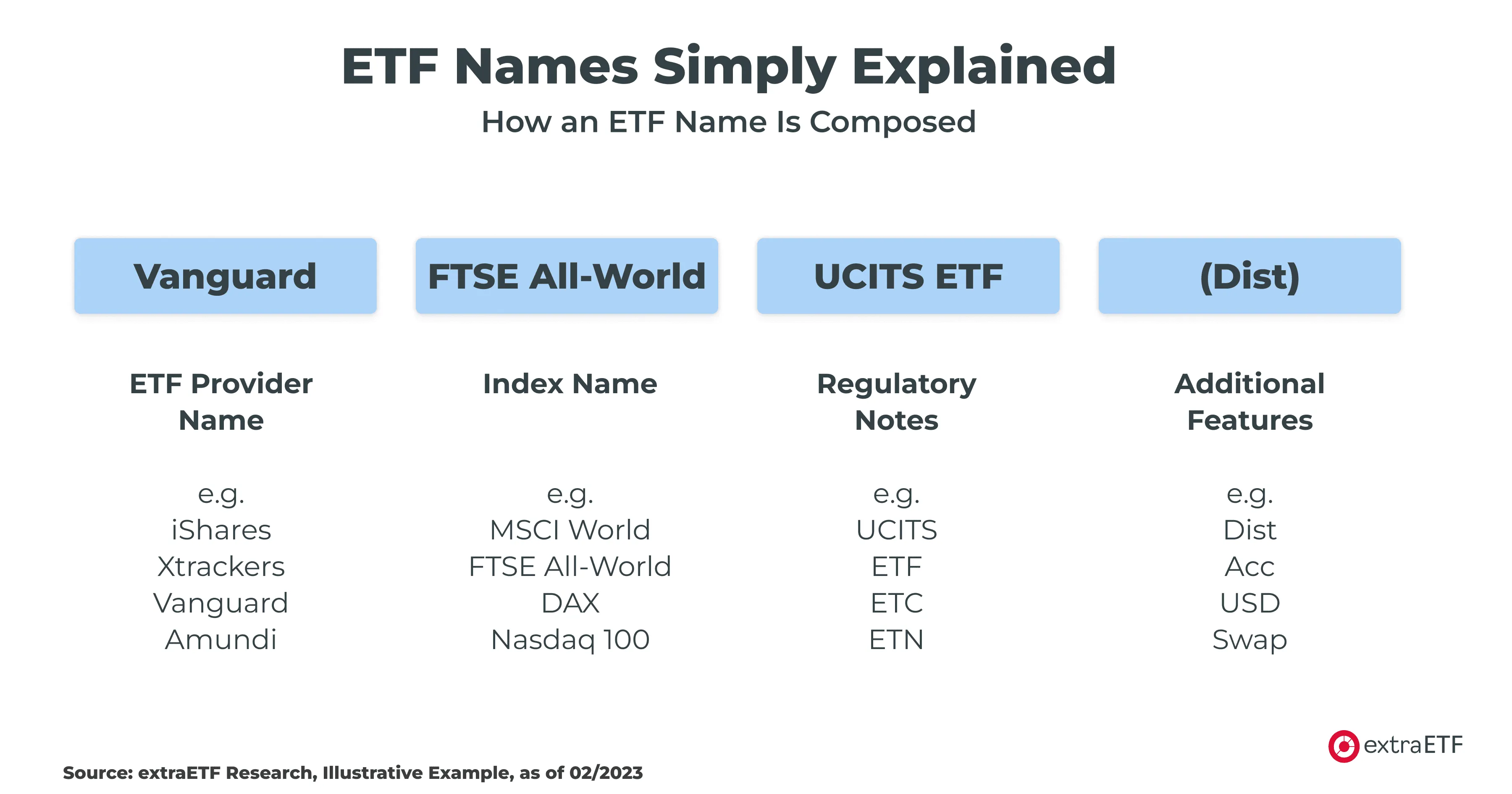
Name of the Provider: The name of the ETF provider always appears at the beginning of an ETF’s name. This shows at a glance who issued the ETF.
Index Name: The index name gives a good indication of an ETF’s investment focus. Well-known index providers include MSCI and FTSE.
Regulatory Characteristics: These characteristics help confirm whether the fund is genuinely an ETF.
Additional Information: An ETF name also contains additional information, such as the ETF’s currency, the method of distributing income and the type of index tracking.
Find and compare thousands of ETFs. Use powerful filters, detailed analytics, and independent data to discover the right ETF for your portfolio.
ETF Names Explained Simply – What the Abbreviations Mean
Name of the ETF Provider
An ETF name is made up of several components, but the name of the ETF provider (issuer) always comes first, making it easy to see which fund company issued the ETF. The largest ETF providers in Europe include iShares, DWS (Xtrackers) and Amundi. Other well-known providers include: BNP Paribas Easy, Deka, Fidelity, Franklin Templeton, HSBC, Invesco, JP Morgan, LGIM, Ossiam, Pimco, State Street (SPDR), UBS, VanEck, Vanguard and WisdomTree.
Which index does the ETF track?
The name of the ETF provider is followed by the index name. The index name consists of various components. It begins with the name of the index provider (e.g., MSCI, FTSE, Solactive), followed by an indication of the region or country to which the index refers (e.g., World, Europe). This is often followed by an indication of the type of securities included in the index (e.g., Value, Momentum, SRI). The index name thus provides a very good overview of the market in which the ETF invests.
Here are a few examples:
- iShares Core MSCI World UCITS ETF (Acc)
- iShares MSCI World SRI UCITS ETF (Acc)
- iShares Edge MSCI World Momentum Factor UCITS ETF
Most investors are likely already familiar with the abbreviation MSCI. MSCI is the name of the index provider. The term “World” describes the index’s coverage: companies from developed countries worldwide. The abbreviation “SRI” stands for Socially Responsible Investment and indicates that the stocks included in the index have been further filtered according to sustainable investment criteria. The term “Momentum Factor” indicates that the index applies a specific filter targeting momentum stocks – that is, stocks in a strong upward trend.
Did you know? Core, Prime, Prime Value
“Core”, “Edge” and “Prime” are marketing terms used by ETF providers. They are meant to suggest that the ETFs are particularly popular, have low costs or offer special advantages. However, there are no binding rules governing their use, and they often cause confusion. Take “Prime Value”, for example: it refers to companies with particularly high-quality characteristics and has nothing to do with Amundi’s “Prime” series.
Regulatory Features: What does UCITS stand for?
The acronym UCITS stands for “Undertakings for Collective Investment in Transferable Securities” and is almost always found in the name of an ETF. UCITS is an EU directive that sets out investor protection rules for funds. The acronym matters to investors because it gives them legal certainty under European standards. Among other things, it sets out which assets a fund may invest in. For example, the maximum weighting of a single stock in the fund is 20 per cent. You may also see country-specific terms for the same type of fund structure, such as OGAW (German), SICAV (French) or OEIC (UK).
OGAW is the German term for UCITS (Undertakings for Collective Investment in Transferable Securities). SICAV is the French term and stands for “Société d’Investissement à Capital Variable” (investment company with variable capital). The UK counterpart, OEIC, stands for “Open-Ended Investment Company”.
The abbreviation “ETF” also appears in the fund’s name, confirming that it is an ETF. If ETC, ETN or ETP appears at the end of the product name instead, it is a different type of financial product.
Did you know? What do the abbreviations ETC, ETN, and ETP stand for?
Abbreviations are often used to classify financial products. Besides ETF, you may come across the abbreviations ETC, ETN and ETP. These are briefly explained below.
- ETC stands for Exchange-Traded Commodities. ETCs are exchange-traded securities that track commodity prices, enabling investment in precious metals, agricultural products and many other commodities. Legally, ETCs are debt securities, whereas ETFs are investment funds.
- ETNs (Exchange-Traded Notes) are bearer debt securities, like ETCs. However, they track other financial instruments, such as a share or an index, rather than commodities. ETNs are not separate investment funds either.
- ETP (Exchange-Traded Product) is an umbrella term for all exchange-traded products and does not appear in the name of an ETF.
Additional designations at the end of the ETF name
Additional abbreviations are often found at the end of an ETF’s name. They provide further details about the fund and make it easier to choose one.
Information on the Currency
Information on the ETF’s currency often follows the index name and may show whether the ETF is currency-hedged. For example, “GBP Hedged” means that the ETF’s currency risk is hedged back into pounds sterling. Some currency-hedged ETFs carry the suffix “Daily” or “Monthly”, which shows how often the hedge is adjusted.
Key currency abbreviations for investors to know include GBP (pound sterling), USD (US dollar), EUR (euro), CHF (Swiss franc) and CNY (Chinese renminbi). Some providers use only symbols, such as $ for the US dollar or € for the euro, to show the trading currency.
Distribution Policy
Abbreviations are often added to the ETF name to show whether the fund pays out income and dividends to investors or reinvests them. D, Dis or Dist indicate a distributing ETF, while C or Acc indicate an accumulating ETF, which reinvests interest and dividends directly into the fund.
Index Replication
The ETF name can often also reveal the replication method. DR stands for direct replication, while synthetic replication is often marked by “Swap”. Our separate article on swap ETFs explains exactly how they work.
Index Type
There are various ways in which an index can account for interest and dividends. Investors should understand these variations and check how the index of their chosen ETF handles them.
- TR, GR: These stand for “Total Return” and “Gross Return” respectively, and indicate a total return index, meaning dividends are included in the index on a gross basis.
- NR, TRN: These stand for Net Return (NR) and Total Return Net (TRN) respectively. These indices include dividends net of withholding tax in the calculation.
- PR: PR stands for Price Return. Interest and dividends are not included in the index calculation at all.
Index Suffixes
ETF names sometimes include other index suffixes.
- Capped: “Capped” indicates an upper limit on the weighting of individual companies, countries or sectors in the index.
- ex: “ex” indicates that certain companies, sectors or countries have been excluded from the index.
Join the extraETF community
Explore the world of ETFs and make informed investment decisions.
- Find ETFs that match your criteria with our ETF Search.
- Compare costs, performance, and risk side by side.
- Save your favourites to a watchlist and receive price alerts.
- Explore detailed ETF profiles with key metrics and holdings.
Long, Short, and Leveraged ETFs
Long, short and leveraged ETFs can be used to implement various investment strategies.
- Long: The ETF tracks the performance of an index 1:1 (factor 1)
- Short: The ETF tracks the performance of an index inversely (factor -1)
- Leveraged: The ETF tracks the performance of the index with a factor greater than 1 or -1
A long ETF is the classic form of an ETF. Investors can use it to invest in markets such as the MSCI World Index or comparable indices. The invested capital is allocated one-to-one to the corresponding market. For example, if the market rises by one per cent, the ETF’s value also rises by one per cent.
Short ETFs move inversely to the index. When the market rises, the ETF falls accordingly. Short ETFs were developed for short-term speculation on a falling market. Note: the term “short” is sometimes also used for bond ETFs, but there it refers to bonds with short maturities. This is entirely different and should not be confused with short ETFs.
Leveraged ETFs come in both long and short versions. Rather than tracking the index with a factor of 1 or -1, they use a higher factor. Numbers such as “2x, 3x or 4x” indicate the degree of leverage, that is, the extent of the bet on the index rising or falling.
A representative example for (almost) all ETF names
iShares Core MSCI Pacific ex-Japan UCITS ETF USD (Acc)
Let’s break down this ETF’s name piece by piece. Once you can decipher the abbreviations, you get a clear picture of what the ETF offers.
- iShares: This is the name of the ETF provider, the issuer.
- Core: This suggests a core product or core investment. It is a marketing term used by the ETF provider.
- MSCI: This is the name of the index provider.
- Pacific: This is the region in which the ETF invests.
- ex-Japan: The ETF does not invest in Japanese shares.
- UCITS: The ETF is regulated under the UCITS framework.
- ETF: Confirms that this is an ETF.
- USD: Indicates the fund’s currency.
- ACC: Indicates that the ETF’s income is reinvested.
Conclusion: Understanding ETF Acronyms Made Easy
Do you need to know every ETF abbreviation straight away to understand what kind of ETF it is? No. Three things are enough to make sense of any ETF name.
First comes the name of the ETF provider. Next is the index name, which essentially tells you which regions, markets or sectors the ETF invests in. If a specific ETF interests you, you can find more detail in the ETF’s factsheet or on its product page on extraETF.com. Finally, check that it really is an ETF: a product that invests in a single commodity is likely to be an ETC.
We'll answer any other questions you may have about ETF abbreviations
- A Complete Overview of ETF Acronyms
- ETF Names Explained Simply – What the Abbreviations Mean
- Name of the ETF Provider
- Which index does the ETF track?
- Core, Prime, Prime Value
- Regulatory Features: What does UCITS stand for?
- What do the abbreviations ETC, ETN, and ETP stand for?
- Additional designations at the end of the ETF name
- Long, Short, and Leveraged ETFs
- Understanding ETF Acronyms Made Easy
- We'll answer any other questions you may have about ETF abbreviations
