
Short ETFs: How Inverse ETFs Work
With short ETFs, you can make a profit when prices fall.

The stock market has its ups and downs, and prolonged downturns can be tough on many investors. Short ETFs offer the opportunity to profit from falling prices or, at the very least, to implement a hedging strategy for one’s portfolio.
In this context, the term “short ETFs” is often used; bankers sometimes also refer to them as inverse ETFs. They are called “inverse” because investors participate in the performance of the underlying index in the opposite direction. If the DAX falls by 10 per cent, the corresponding DAX short ETF rises by 10 per cent. At least roughly speaking – later on, we’ll learn more about the issue of so-called path dependence, which can cause distortions in the inverse index tracking.

The essentials in brief: Everything You Need to Know About Short ETFs
Innovative: Short ETFs offer experienced investors a way to hedge their portfolios against price declines or to bet on a decline in index prices.
Speculative: Unlike traditional ETFs, the price of a short ETF moves in the opposite direction (inversely). If the DAX rises, the price of a short ETF tracking the DAX falls. This makes short ETFs highly speculative instruments.
Path Dependence: Since short ETFs track the underlying index on a one-to-one inverse basis on a daily basis, the performance of a short ETF may deviate from the expected inverse performance over a longer holding period. This effect is called path dependence. You should fully understand the impact of path dependence.
Diverse: A variety of short ETFs are available. Among the most popular are short ETFs tracking the DAX Index, the S&P 500 Index, and the Euro Stoxx 50 Index. Short ETFs tracking bond indices are also available.

Find and compare thousands of ETFs. Use powerful filters, detailed analytics, and independent data to discover the right ETF for your portfolio.
That's why it's risky to bet on falling markets
Buying a short ETF entails significant risks, as investors are speculating against the long-term trend of the stock market. Stock indices such as the DAX, S&P 500, MSCI World, and Nasdaq 100 have posted significant gains on the stock market over the long term. Short investors would therefore have fared significantly worse over the years than so-called long investors, who bet on rising stock prices.
Betting on falling markets becomes particularly risky when additional leverage is involved. However, those who use short ETFs in moderation can certainly employ them for tactical portfolio hedging. Short ETFs are better suited for short-term hedging of equity, bond, or commodity investments.
Ways to Hedge Against Exchange Rate Fluctuations
Short ETFs aren't the only financial instruments investors can use to hedge against stock market losses. That's why we're taking this opportunity to explain the most common instruments used for portfolio hedging.
Definition: How does a short ETF work?
A traditional ETF tracks the performance of an index on a one-to-one basis. A short ETF mirrors that performance in reverse (inversely): So if the index falls by 10 per cent, the short ETF rises by 10 per cent – and vice versa. In this context, investors should be aware of the risks associated with path dependence.
Comparison: Performance of a DAX ETF and a Short-DAX ETF
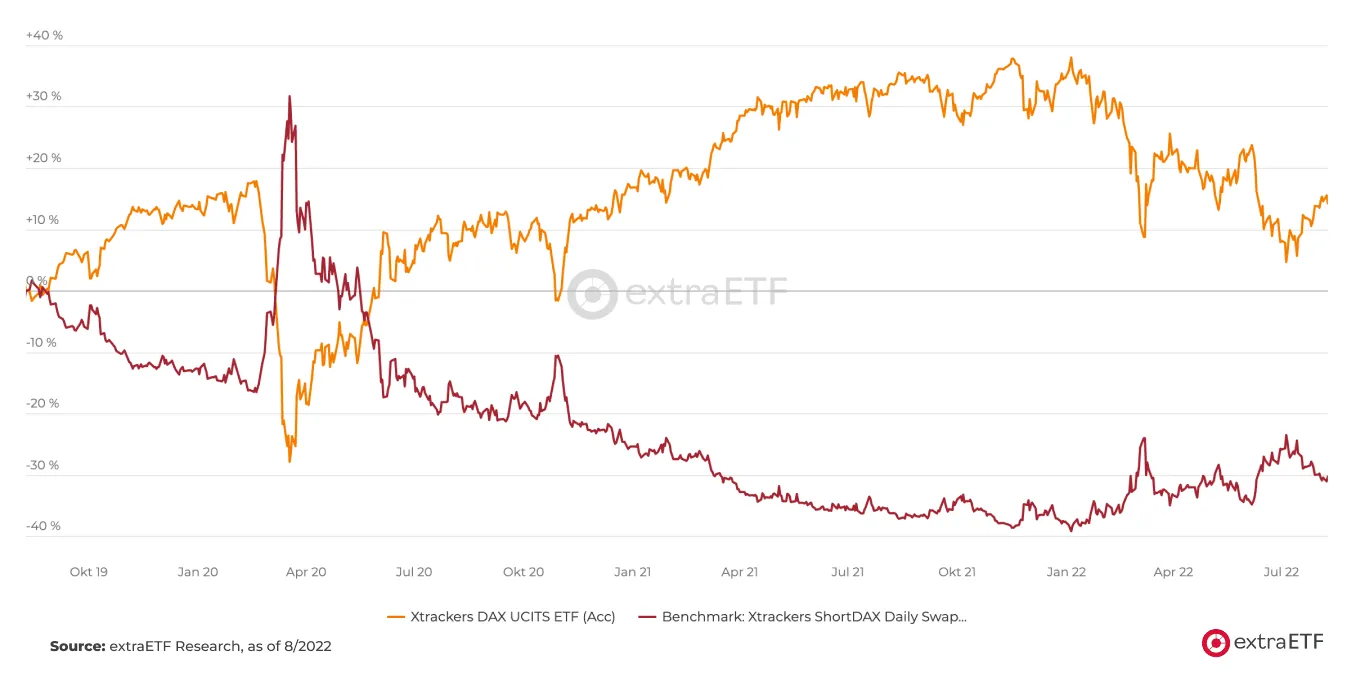
To accurately calculate the performance of a short ETF, it is not enough to simply multiply the index’s performance by minus one. Performance also depends on other factors, such as the money market rate (EONIA), because the performance of the short index is composed of the inverse performance of the long index and twice the EONIA interest rate (money market). The double interest credit results from the fact that investors put money into the ETF, which then sells the stocks in the index and receives a credit for that money as well. These two amounts of money then earn interest at the money market rate. From this, the costs of the short sale (securities lending) and the ETF expenses (TER) are then deducted. The performance of short ETFs is therefore not always easy to understand. Later on, we’ll also learn that even simple math can throw a wrench in the works for short investors (keyword: path dependence).

You should definitely read and fully understand the chapter on path dependence, because the inverse index tracking of short ETFs only works on a daily basis. If short ETFs are held for the long term, their performance may deviate significantly from that of the index.
Examples of the Development of a Short ETF
The way short ETFs work is probably best illustrated by extreme scenarios involving a rising and a falling market. These examples provide a simple way to understand how short ETFs work.
What are the risks associated with short ETFs?
Since stock markets generally perform well over the long term, short ETFs are not suitable for long-term wealth accumulation. The risk of incurring significant losses is therefore particularly high with short ETFs. Financial experts therefore advise retail investors in particular to exercise extreme caution when investing in short ETFs.
However, a 2011 study by the University of Konstanz showed that retail investors in Germany use short and leveraged ETFs very sparingly and are able to assess the risks well.
The key findings of the analysis are as follows: Investors use shorter holding periods and/or lower investment amounts in a way that minimizes the risk associated with leveraged ETFs. The lower the leverage/short factor – that is, the leverage – the more investors invest. To further minimise the risk associated with double-leveraged products, the holding period and/or the investment volume decreases. The study thus documents that investors appear to be aware of the risk when using these products and adjust their behaviour regarding holding periods and investment volumes accordingly to account for the increased risk.
| ETF Type | Holding Period (Days) | Investment Amount | Risk |
|---|---|---|---|
| Standard ETF | 138.7 | £27,364 | 13.42% |
| Short ETF | 78.8 | £25,757 | 13.19% |
| 2x Leveraged ETF | 62.3 | £15,090 | 16.68% |
| 2 x Leveraged Short ETF | 33.6 | £21,717 | 14.41% |
Join the extraETF community

Explore the world of ETFs and make informed investment decisions.
- Find ETFs that match your criteria with our ETF Search.
- Compare costs, performance, and risk side by side.
- Save your favourites to a watchlist and receive price alerts.
- Explore detailed ETF profiles with key metrics and holdings.
Short ETFs: What does "path dependence" mean?
Investors in short ETFs should be aware of the resulting path dependence. This is because, with short ETFs, the inverse index tracking generally applies only on a daily basis, and significant deviations can occur over a longer holding period. The problems arising from path dependence are particularly evident in highly volatile markets.
We’ll explain the concept of path dependence using an example.
| Day | Index Level | Change from Previous Day | Change from Day 0 | Short ETF | Change from Day 0 |
|---|---|---|---|---|---|
| 0 | 7,500 | £100.00 | |||
| 1 | 7,200 | - 4.00% | - 4.00% | £104.00 | + 4.00% |
| 2 | 7,600 | + 5.56% | + 1.33% | £98.22 | - 1.78% |
| 3 | 7,800 | + 2.63% | + 4.00% | £95.64 | - 4.36% |
| 4 | 7,300 | - 6.41% | - 2.67% | £101.77 | + 1.77% |
| 5 | 7,500 | + 2.74% | - 0.00% | £98.98 | - 1.02% |
| 6 | 7,400 | - 1.33% | - 1.33% | £100.30 | + 0.30% |
| 7 | 7,600 | + 2.70% | + 2.70% | £97.59 | - 2.41% |
| 8 | 7,500 | - 1.32% | - 0.00% | £98.88 | - 1.12% |
| 9 | 7,450 | - 0.67% | - 0.67% | £99.54 | - 0.46% |
Let’s first assume that an investor, with the index at 7,500 points, expects prices to fall and wants to profit from this using a short ETF. To do so, they select a short ETF without leverage. The price of one share of the short ETF is £100.
On Day 1, the index falls by 4 per cent; as expected, the value of the ETF shares increases by 4 per cent to £104. The following day, the markets recover significantly. The index rises by 5.56 per cent to 7,600 points. If we now compare the index’s performance since the start date (+1.33%) with that of the short ETF, we would initially expect a return of –1.33%. In fact, however, the short ETF is trading at £98.22, representing a loss of 1.78 per cent. This is due to the higher base (£104) from which the index performance is calculated. This effect can also be observed on the following days.
Formula: £104 × 5.56% = £5.78. £104 – £5.78 = £98.22.
After some lively ups and downs, the index returns to its starting level of 7,500 points on Day 8. However, due to path dependence, the short ETF is trading at £98.88, representing a loss of 1.12 per cent. Although the index has not changed, a short investor would have lost just over one per cent.
On Day 9, the index stands at 7,450 points, which is indeed below the starting level. Nevertheless, the short ETF has resulted in a loss of –0.46% for the investor.
This example was deliberately chosen because the problems arising from path dependence are particularly evident in highly volatile markets. In the case of a steady downward trend, path dependence favors the performance of the short ETF, and larger gains can be achieved.

Short ETFs Enrich the ETF Landscape
 Markus Jordan, Founder of extraETF.com
Advantages and Disadvantages of Short ETFs
Short ETFs have various advantages and disadvantages. For experienced investors, they offer a valuable tool for portfolio hedging or speculative trading. Before adding short ETFs to your portfolio, you should thoroughly familiarize yourself with the specific characteristics of these ETFs.
We explain the key pros and cons.
Advantages
Short ETFs have been available on the market since 2005. They give investors the opportunity to hedge equity positions or bet on a falling market within the framework of a segregated fund. In the event of insolvency, the funds invested in these ETFs are 100 per cent protected by their status as segregated funds.
Until then, hedging was possible only through options, futures, and leveraged certificates. Investors were typically exposed to issuer risk in these cases.
In addition, investors who wish to speculate on falling markets using short ETFs do not have to assume an immediate risk of total loss, as there are no knock-out thresholds. Another positive aspect: When you purchase a short ETF, you are not obligated to buy shares at a later date. Short ETFs are an easy-to-understand product that can be traded on any trading day. Furthermore, there is no time limit on the term of short ETFs.
Disadvantages
As explained, a short ETF – or inverse ETF – is a highly speculative investment. Investors should be aware of the increased risk associated with this investment. As described, they are betting against the long-term positive trend in the stock market. In addition to this consideration, path dependence can also prove to be a disadvantage. The issue of path dependence described above is exacerbated by the fact that short ETFs are generally calculated on a daily basis. Path dependence can lead to significant disadvantages, particularly for medium- to long-term investments in short ETFs.
Portfolio Hedging with Short ETFs
Due to path dependence, short ETFs are only suitable to a limited extent for long-term portfolio hedging. To maintain the effect of this “do-it-yourself insurance,” the short ETF position would have to be reset to its initial value repeatedly. This approach entails a significant time commitment and additional transaction costs. Short ETFs that are calculated on a monthly basis can offer some relief. With these ETFs, the problem of path dependence is somewhat mitigated.
Performance of Short ETFs During Historical Crises
The table shows the historical performance of the DAX Index compared to the Short DAX Index. The difference in how the indices track each other is clearly evident from the highly volatile factors.
| Historical Stress Test | DAX Vol. | DAX % | Short DAX % | Factor |
|---|---|---|---|---|
| 1990 U.S. Recession | 29.2% | - 24.2% | + 40.3% | - 1.67 |
| 1990 Gulf War | 30.4% | - 35.9% | + 54.1% | - 1.51 |
| 1999 Brazilian Economic Crisis | 30.2% | - 7.1% | + 4.5% | - 0.63 |
| 2008–09 Financial Crisis | 42.6% | - 59.9% | + 70.7% | - 1.18 |
What short ETFs are available?
The selection of short ETFs is limited. Particularly popular ETFs include short DAX ETFs and short Euro Stoxx 50 ETFs. However, short ETFs are also available for the S&P 500 Index, the MSCI Emerging Markets Index, the FTSE 100 Index, and the MSCI USA Index. In the bond ETF sector, there are Bund futures short ETFs based on German government bonds. There are also short ETFs based on European government bonds.
The following short ETF lists show the largest short ETFs tracking equity and bond indices.
The selection of short ETFs is fairly limited. The ETF search tool provides a list of all short ETFs. There, you can analyse and compare the short ETFs based on various criteria.

Conclusion: Short ETFs: Suitable Only for Experienced Investors
Short ETFs are high-risk ETFs that should only be included in a portfolio by experienced investors. They are not suitable for long-term wealth accumulation and should only be used in a portfolio on a short-term, tactical basis.
The price of a short ETF moves inversely to the performance of a regular ETF tracking the same index. Because of this characteristic, a short ETF can generate a price gain even when stock market prices fall. Short ETFs are available for the DAX Index, the Euro Stoxx 50 Index, and the S&P 500 Index. Short ETFs tracking bond indices are also offered. These allow investors to profit when bond prices fall as a result of rising interest rates.
Important Questions About Short ETFs

- Everything You Need to Know About Short ETFs
- That's why it's risky to bet on falling markets
- Ways to Hedge Against Exchange Rate Fluctuations
- Definition: How does a short ETF work?
- Examples of the Development of a Short ETF
- What are the risks associated with short ETFs?
- Short ETFs: What does "path dependence" mean?
- Advantages and Disadvantages of Short ETFs
- Portfolio Hedging with Short ETFs
- Performance of Short ETFs During Historical Crises
- What short ETFs are available?
- Short ETFs: Suitable Only for Experienced Investors
- Important Questions About Short ETFs