



Cryptocurrencies in an ETF Portfolio
How does adding cryptocurrencies to a portfolio affect it?
Ardent supporters of cryptocurrencies – who are often opponents of established currencies such as the pound or the euro – would naturally urge investors to convert everything into cryptocurrencies like Bitcoin, because that is the future of money.
But this view may be premature, despite noticeable inflation and a mountain of government debt. Are cryptocurrencies still worth a look, and could they serve as a small component of a broadly diversified buy-and-hold portfolio? Might they even be a new asset class that adds diversification as a passive holding alongside gold or commodities?
Only the numbers can bring clarity to the debate between crypto enthusiasts and sensible ETF investors: past risk and returns, together with some thoughts on future developments.
The essentials in brief: Everything You Need to Know About Including Cryptocurrencies in Your Portfolio
Diversification with Cryptocurrencies: Including cryptocurrencies such as Bitcoin in a portfolio can help diversify it, as they often perform differently from traditional investments. This diversification can reduce the portfolio’s overall risk.
Higher Returns with Cryptocurrencies: A small allocation to cryptocurrencies can significantly increase the return on the overall portfolio. This is especially true when the portfolio is regularly rebalanced to restore its strategic composition.
Tax Considerations: Unlike in some other countries, UK investors cannot realise crypto gains tax-free after a set holding period. Gains are generally subject to Capital Gains Tax above the annual exempt amount, so it is worth factoring tax into any rebalancing.
Cost-Effective Investment with Crypto ETCs: Using crypto ETCs offers a cost-effective way to include cryptocurrencies in a portfolio. Crypto ETCs are easy to manage and do not require a separate wallet or crypto exchange account, making them attractive to passive investors.

Find and compare thousands of ETFs. Use powerful filters, detailed analytics, and independent data to discover the right ETF for your portfolio.
Portfolio Analysis: Cryptocurrencies in a Typical 60/40 Investment Portfolio
To get straight to the point: with a cryptocurrency allocation of 3 or 5 per cent of the total portfolio, the results were surprising. The impact on portfolio risk was manageable, and the return on the overall portfolio was significantly higher. However, this only held true if the portfolio was reset to its strategic composition at least once a year – the keyword being rebalancing. Read the full analysis before deciding whether to venture into crypto. Since mid-2020, it has also been easy to do so through an ordinary investment account, as exchanges such as Xetra now list so-called ETCs that are fully backed by cryptocurrency, with the underlying crypto assets held securely to professional standards. Availability to UK investors depends on your platform.
Join the extraETF community
Explore the world of ETFs and make informed investment decisions.
- Find ETFs that match your criteria with our ETF Search.
- Compare costs, performance, and risk side by side.
- Save your favourites to a watchlist and receive price alerts.
- Explore detailed ETF profiles with key metrics and holdings.
Three Sample Portfolios for Analysis
For the analysis, we simulated a typical 60/40 portfolio, of the kind often held by retail investors. The growth component consists of equity ETFs, some gold ETCs and some commodity ETFs, with developed and emerging market equities split two-thirds to one-third. An ETF tracking euro-denominated government bonds of mixed maturities limits the portfolio’s risk. Many DIY investors hold a portfolio structured along similar lines. As we will see later, the exact composition of the example portfolio has little impact on the result, so it serves only as a starting point – not every portfolio has to look this way.
We then gradually replaced developed-market equities with cryptocurrencies, first by 3 percentage points and then by 5. Because developed-market equity ETFs have recently been heavily weighted towards the US and the tech sector, we funded the new crypto allocation from that portion. A certain correlation between tech and crypto assets is evident, at least in the short term. Because we initially wanted to test over a ten-year period, only Bitcoin had a suitable time series. Other cryptocurrencies have not been around long enough, and their adoption is still lower, making them less representative.
This gave us three portfolios with the following compositions:
| Asset Class | 5% Bitcoin | 3% Bitcoin | 0% Bitcoin | |
|---|---|---|---|---|
| Equities in developed markets | 25% | 27% | 30% | |
| Emerging market equities | 15% | 15% | 15% | |
| Euro-denominated government bonds | 40% | 40% | 40% | |
| Gold | 7% | 7% | 7% | |
| Commodities | 8% | 8% | 8% | |
| Bitcoin (BTC) | 5% | 3% | 0% |
A time series of at least 10 years is available for all portfolio components, so we ran the calculations from 1 January 2013. A longer backtest going back to Bitcoin’s launch would be possible, but it would yield little meaningful insight, as Bitcoin’s early history is too short.
Why is rebalancing important for a crypto portfolio?
A portfolio’s strategic weightings drift over time as the market prices of its components change. To keep the sources of return and risk protection working as intended, a portfolio that follows a buy-and-hold strategy must be rebalanced regularly to its original weightings.
The more the value of the components fluctuates, the more important this becomes. Average fluctuations can be measured – at least for past performance – using a metric called volatility, which in finance is also used as a measure of an investment’s risk.
Cryptocurrencies such as Bitcoin or other altcoins are digital assets whose prices react immediately to changes in investor expectations. Because all cryptocurrencies combined currently account for only about one per cent of the value of all stocks worldwide, shifts in global capital flows have an outsized impact. Bitcoin’s price swings against the US dollar are therefore enormous and, depending on market conditions, can easily be up to four times those of developed-market equities. In financial jargon: cryptocurrencies are highly volatile and carry high risk.
Tax is another consideration. In the UK, HMRC treats cryptoassets as chargeable assets for Capital Gains Tax, so gains above the annual exempt amount are taxable, and there is no tax-free holding period. We simulated annual rebalancing, but UK investors should factor in any tax due on the sales it involves.
You can also find more information in the following articles:

Portfolio Test: 10-Year Period
We conducted the analysis entirely in euros, using euro-denominated ETFs and bonds. We also tracked the performance of a €100,000 investment. For stocks, commodities, and bonds, we used the daily prices of accumulating ETFs, which reflect both reinvested distributions and fees (the so-called daily net asset value). The crypto component is a time series of daily average Bitcoin prices. The costs of holding a crypto ETC were left out of the analysis; as we will see later, they would have had only a very minor effect on the results.
As described, we rebalanced annually, always on 2 January (including 2023, which therefore affects the final result). We did not account for tax on the resulting returns.
The fairy-tale returns of crypto’s early years are also reflected in our test portfolio. We tracked returns from the beginning of 2013 to the end of 2022, a period that includes the “crypto winter”. As a result, an initial investment of €100,000 grew to just under €1 million – with a Bitcoin allocation of only 5 per cent! Around €675,000 in crypto gains were realised through rebalancing transactions, before tax. “To the Moon” was no empty phrase in the early years of cryptocurrencies!
| Portfolio | 1 January 2013 | 2 January 2023 |
|---|---|---|
| 0% Bitcoin portfolio | €100,000 | approx. €200,000 |
| 5% Bitcoin portfolio | €100,000 | approx. €978,000 |
Without Bitcoin, this would have amounted to a solid €200,000. Even so, the portfolio without Bitcoin would have doubled in value over ten years, despite 40 per cent being held in lower-risk government bonds – a useful insight in itself.
However, the volatility of the portfolio with the Bitcoin component over this period was too high for the period to be useful for risk analysis. While these results are encouraging for anyone who held Bitcoin early on, they offer little practical insight for building a buy-and-hold portfolio today.
Portfolio Test: 5-Year Period
Because a ten-year analysis has limited predictive value for future market phases, we shortened the systematic risk and return measurement for the overall portfolio to five years.
Over these five years, Bitcoin went through enough different market phases to draw conclusions: a long lull, two periods of hype and the so-called “crypto winter” that began in the summer of 2022. The other portfolio components also faced significant upheavals: the pandemic, the war in Ukraine, commodity shortages and, finally, the shift in interest rates.
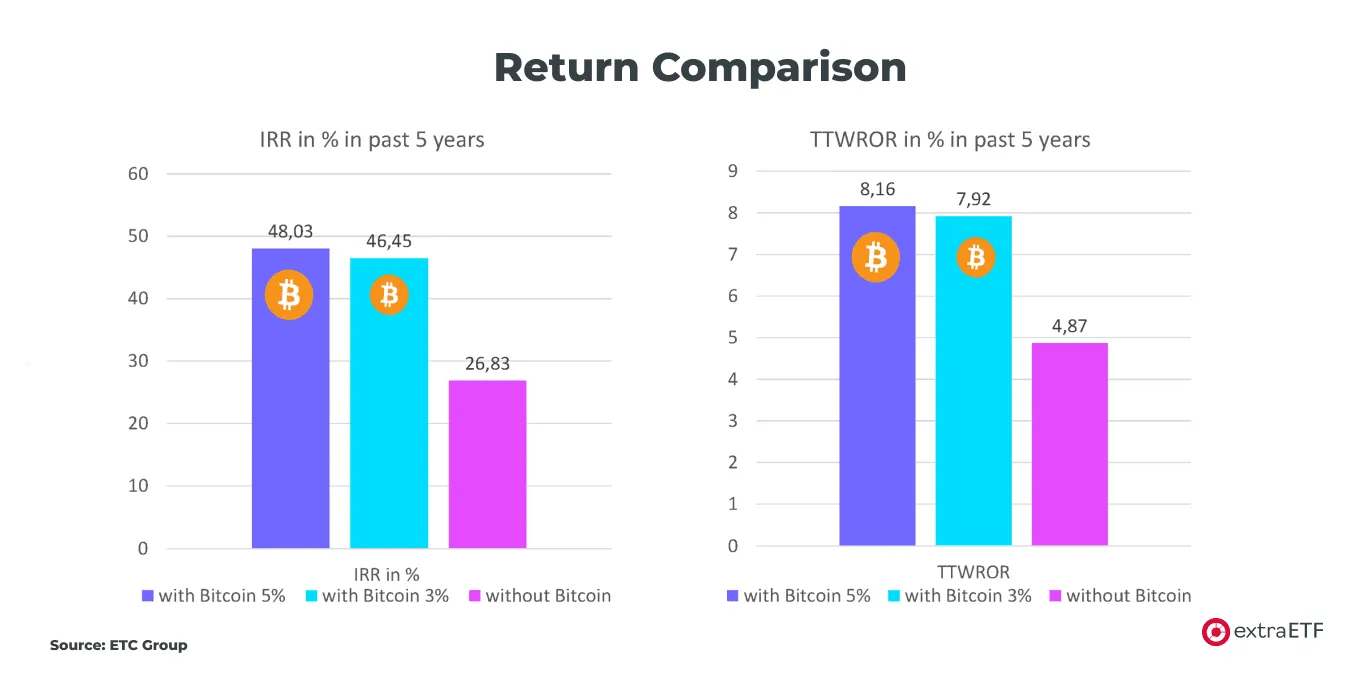
We measured risk and return from early 2018 to early 2023, again rebalancing annually at the start of each year. We looked at the actual growth of the invested €100,000, the time-weighted return, and the risk of the portfolio and its components.
Over the five years, the absolute value growth of the portfolio with a 5 per cent crypto allocation was 21 percentage points higher than that of the portfolio without crypto. The time-weighted return rose from 4.9 per cent to 8.2 per cent per year.
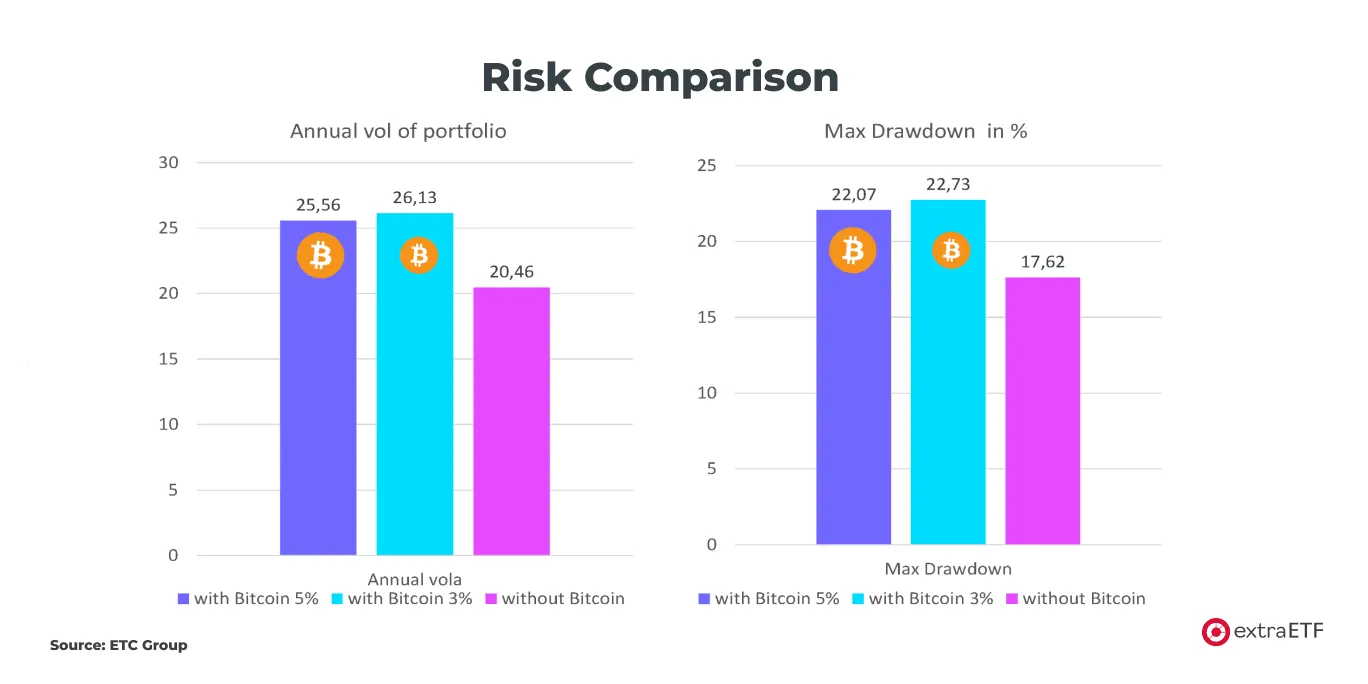
The risk metric for the overall portfolio rose from 20.5 to over 25.5. Put simply, the 5 per cent portfolio fluctuated in value by about 25.5 per cent. Investors must be able to tolerate swings of this size. Even the starting portfolio’s 20.5 is quite high, however, driven by commodities and gold, the concentration of US tech stocks in developed-market equities, and the effect of the interest rate shift on bonds.
The maximum loss for the 5 per cent portfolio was 22.07 per cent and lasted 408 trading days, so investors needed more than a year of patience. The slump after the 2008 financial crisis lasted significantly longer. The 3 per cent allocation actually produced an even higher maximum loss, presumably because cryptocurrencies and US tech stocks moved in step with developed-market equities during certain market phases. However, this higher loss would have been recouped within 276 days.

The Surprising Impact of Cryptocurrencies on a Portfolio
Are cryptocurrencies a good way to diversify?
Keen observers of daily market activity often point out that cryptocurrencies tend to move in tandem with the broader market and, in particular, with tech stocks. Over shorter time periods, a weak correlation can indeed be statistically demonstrated.
The metric used is known as correlation: a value of one indicates the strongest possible relationship – the two time series are then identical. A correlation of zero means there is no statistically significant relationship between the time series. And a correlation of minus one indicates a relationship that is exactly the opposite.
If a correlation of 0.5 is found between Bitcoin and the Nasdaq 100 over a three-month period, a meaningful share of Bitcoin’s price movements can be statistically explained by movements in the Nasdaq 100. The relationship between the two markets is evident, but the movements are far from identical.
| Bitcoin | Ether | MSCI World | MSCI EM | Nasdaq 100 | |
|---|---|---|---|---|---|
| Bitcoin | 1.000 | 0.951 | 0.525 | -0.152 | 0.502 |
| Ether | 0.951 | 1.000 | 0.516 | -0.097 | 0.504 |
| MSCI World | 0.525 | 0.516 | 1.000 | 0.017 | 0.928 |
| MSCI EM | -0.152 | -0.097 | 0.017 | 1.000 | -0.057 |
| Nasdaq 100 | 0.502 | 0.504 | 0.928 | -0.057 | 1.000 |
Over a longer period, however, the close correlation between the tech index and Bitcoin is visibly diminishing. A low correlation suggests a diversification benefit. Diversification spreads opportunities and risks across more asset classes. If the correlation were high (for example, 0.8), adding the asset would offer little diversification benefit.
6 Reasons Why Cryptocurrencies Should Be Included in Your Portfolio
Past performance cannot predict future returns and risk precisely. However, passive buy-and-hold investors and ETF enthusiasts can still draw important insights, and there are several reasons to include cryptocurrencies in ETF portfolios:
Conclusion: Encouraging Results – Cryptocurrencies as a Diversification Option
Our analysis suggests that cryptocurrencies can be viewed as a potentially attractive asset class. Their long-term performance differs fundamentally from that of other asset classes, making them a promising diversification opportunity.
However, investors should understand the volatility of cryptocurrencies and the need for regular rebalancing to reap the full benefit of this allocation. A forward-looking approach could also include other promising cryptocurrencies to diversify further. Crypto ETCs tracking an index are a good option here, as they cover more than a single cryptocurrency.
Key Questions About the Use of Cryptocurrencies in an ETF Portfolio
- Everything You Need to Know About Including Cryptocurrencies in Your Portfolio
- Portfolio Analysis: Cryptocurrencies in a Typical 60/40 Investment Portfolio
- Three Sample Portfolios for Analysis
- Why is rebalancing important for a crypto portfolio?
- Portfolio Test: 10-Year Period
- Portfolio Test: 5-Year Period
- Are cryptocurrencies a good way to diversify?
- 6 Reasons Why Cryptocurrencies Should Be Included in Your Portfolio
- Encouraging Results – Cryptocurrencies as a Diversification Option
- Key Questions About the Use of Cryptocurrencies in an ETF Portfolio