



Invest Like Ray Dalio’s All-Weather Portfolio
How to Build an All-Weather Portfolio with ETFs
Ray Dalio is a well-known hedge fund manager and the founder of Bridgewater Associates. One of his best-known investment strategies is the "all-weather" strategy, which aims to generate stable returns across various market conditions and minimise risk. The strategy is based on a diversified allocation across asset classes such as stocks, bonds, commodities, and gold.
In this guide, we’ll provide a brief introduction to Ray Dalio’s All-Weather Strategy and show you how to build an All-Weather portfolio using just a few ETFs.
The essentials in brief: All About the All-Weather Strategy
Ray Dalio: Ray Dalio is the founder of Bridgewater Associates, one of the world’s largest hedge funds. He is one of the pioneers of the “All Weather” strategy.
Background: The all-weather strategy aims to generate consistent returns across a variety of macroeconomic environments.
Investment Strategy: The All-Weather Strategy invests in four asset classes: bonds, stocks, commodities, and gold. These assets are held in a diversified mix to minimise risk.
Return: extraETF's All-Weather Portfolio generated a return of 4.9 per cent per annum from January 2013 to April 2023 (after accounting for the costs of the ETFs used).
Easy to Replicate: Ray Dalio’s “all-weather” strategy can be easily replicated using just a few broadly diversified ETFs.

Find and compare thousands of ETFs. Use powerful filters, detailed analytics, and independent data to discover the right ETF for your portfolio.
Who is Ray Dalio?
Ray Dalio is an American entrepreneur, hedge fund manager, and philanthropist. With an estimated net worth of around $19 billion, he is one of the richest people in the world.
Ray Dalio founded Bridgewater Associates in 1975, one of the world’s largest hedge funds. His words resonate with investors around the world, so it’s no surprise that he ranks among the 100 most influential people. In 2011, Ray Dalio stepped down as CEO of Bridgewater, but he continues to serve as a mentor to the company.
Since stepping back from day-to-day operations, he has devoted more of his time to charitable causes. Among other things, he joined “The Giving Pledge,” an initiative founded by Bill Gates and Warren Buffett that encourages wealthy individuals to donate a portion of their wealth.
Ray Dalio is one of the pioneers of the “All Weather” investment approach, which involves building a diversified portfolio prepared for various macroeconomic scenarios.
What is the all-weather strategy?
The All-Weather Strategy is an investment strategy developed by Ray Dalio and his hedge fund, Bridgewater Associates. It is a diversified portfolio strategy that aims to generate consistent returns across different macroeconomic environments. The strategy is based on the assumption that the economy and financial markets can be in different phases, such as inflation or deflation, growth or recession. The All-Weather Strategy aims to generate relatively stable returns across all of these phases.
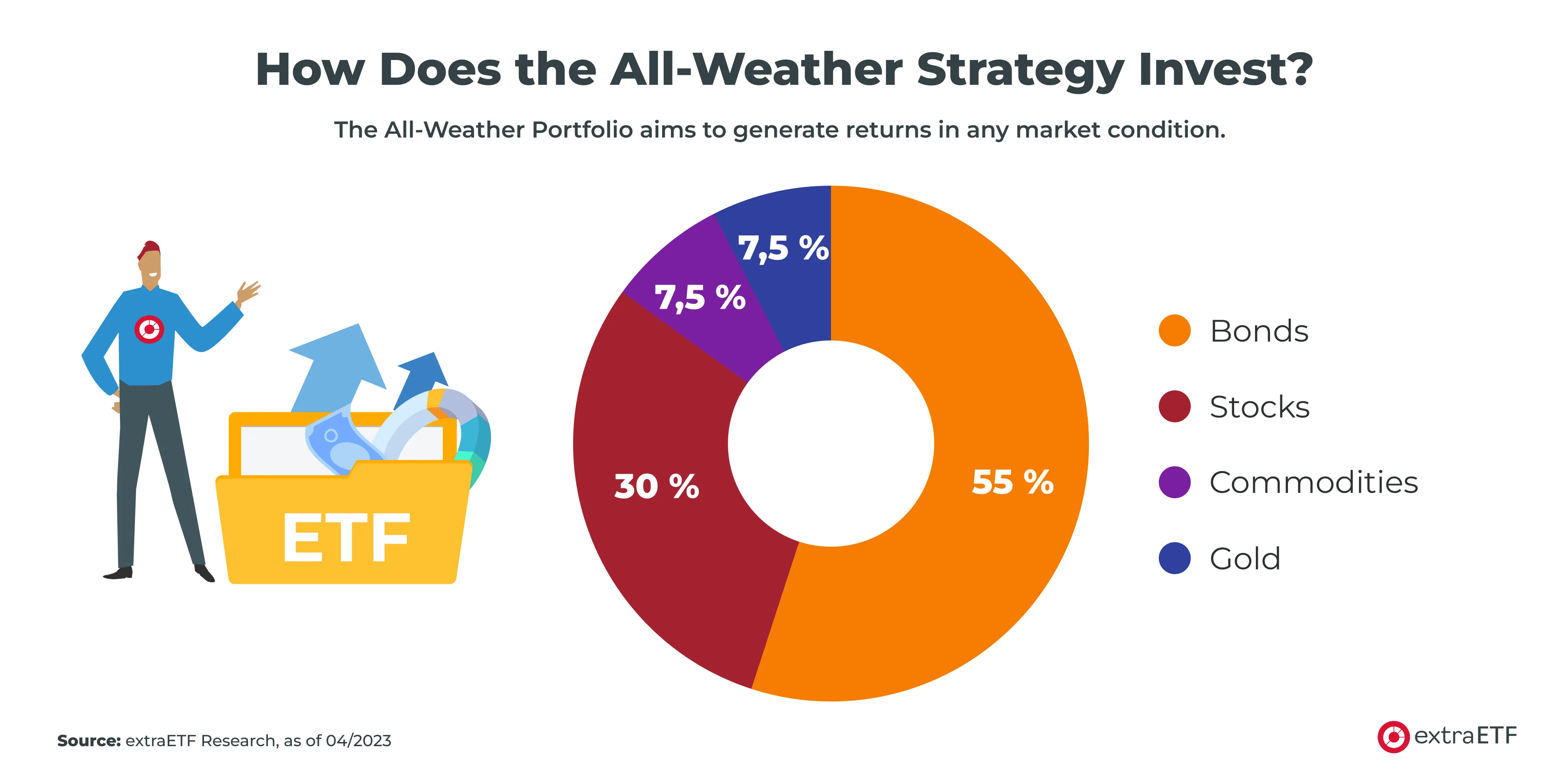
The All-Weather Strategy invests in four asset classes:
- 55% bonds
- 30% stocks
- 7.5% commodities
- 7.5% gold
These asset classes are held in a diversified mix to minimise risk while generating an appropriate return.
The following chart illustrates how funds are allocated across the individual asset classes using the All-Weather Strategy:
Join the extraETF community
Explore the world of ETFs and make informed investment decisions.
- Find ETFs that match your criteria with our ETF Search.
- Compare costs, performance, and risk side by side.
- Save your favourites to a watchlist and receive price alerts.
- Explore detailed ETF profiles with key metrics and holdings.
What is the return on the All-Weather Strategy?
Various financial bloggers and extraETF have recalculated the returns of the All-Weather Strategy for different investment time periods. Despite the varying time periods considered, the experts arrive at fairly similar return figures. In the recent past, however, returns have declined somewhat. One reason for this could be the low interest rates that prevailed until recently.
| Calculation of: | Time Period: | Return: |
|---|---|---|
| Tony Robbins | 1984–2013 | 9.7% p.a. |
| Ben Carlson | 1972–2013 | 9.5% per year |
| Ben Carlson | 1928–2013 | 7.2% per year |
| extraETF | 2013–2023 | 4.9% p.a. |
American bestselling author Tony Robbins has calculated the following returns for the "all-weather" strategy: From 1984 to 2013, there was an average annual return of 9.7 per cent. Investors saw positive returns 86 per cent of the time. In years when there were losses, they averaged 1.9 per cent. In the worst-case scenario, the loss was 3.9 per cent. Volatility over the entire period was 7.6 per cent.
American author and blogger Ben Carlson (A Wealth of Common Sense) has reached similar conclusions. His analyses for the period from 1972 to 2013 show very similar figures. On average, a return of 9.5 per cent per year was achieved, with a volatility of 7.9 per cent. The largest loss was 4.2 per cent. Looking back from 1928 to 2013, the annual return was 7.2 per cent. And this is despite the fact that the greatest stock market crash in history occurred right at the beginning of this period. When reviewing these figures, however, it’s important to note that the asset classes of gold and commodities were not included. These asset classes were not readily investable at that time.
A calculation by extraETF using ETFs demonstrates that the “all-weather” strategy has also worked in the recent past. For example, the ETF model portfolio"Ray Dalio's All-Weather Portfolio” generated a return of 64 per cent and 4.9 per cent per year, respectively, after accounting for the costs of the ETFs used, during the period from January 1, 2013 to April 18, 2023, a return of 64 per cent, or 4.9 per cent per year, after accounting for the costs of the ETFs used.
Investing in the All-Weather Strategy
It is not possible to invest directly in Ray Dalio’s All-Weather Strategy. However, the robo-advisor Scalable Capital offers a special All-Weather Strategy. You can also replicate the strategy yourself using various ETFs. With these ETFs, you can invest in the different asset classes, either as a one-time investment or through an Regular ETF Investing. We’ll explain exactly how this works below.
ETF Recommendations for the Bond Allocation
Bonds make up the largest portion of the All-Weather Portfolio, at 55 per cent. Ray Dalio allocates 40 per cent to U.S. Treasury bonds with long maturities ranging from 10 to 30 years. He also allocates 15 per cent to U.S. Treasury bonds with medium maturities of 7 to 10 years. These bonds are intended to provide steady current income and stabilize the portfolio during weak stock market phases.
Tip: European investors should consider replacing the portion of U.S. Treasury bonds with European or German government bonds. This can eliminate currency risk against the U.S. dollar.
ETF Recommendations for the Equity Allocation
The equity allocation in Ray Dalio’s All-Weather Portfolio is 30 per cent. This allocation is invested in stocks from the U.S., Europe, and emerging markets. Through ETFs, you can invest in the S&P 500, MSCI USA Small Cap, STOXX Europe 600, MSCI Emerging Markets, and MSCI Pacific indices in line with the strategy.
Tip: If allocating across these different ETFs seems too complicated, you can also opt for ETFs that track a global index such as the FTSE All-World, the MSCI ACWI, or the MSCI ACWI IMI. For a portfolio without emerging markets exposure, ETFs tracking the MSCI World or the FTSE Developed Markets are suitable.
ETF Recommendations for the Commodities Allocation
Commodities account for 7.5 per cent of the All-Weather Portfolio. They are intended to further diversify and stabilize the portfolio. Commodities can also serve as a hedge against inflation.
Tip: In our All-Weather model portfolio, we use the iShares Diversified Commodity Swap UCITS ETF. However, other broadly diversified commodity ETFs can also be used.
ETF Recommendations for Gold
Gold also accounts for 7.5 per cent of the All-Weather Portfolio. Here, gold serves as a safe haven and is intended to protect the portfolio, especially during times of crisis or high inflation.
Tip: You can invest in gold through physically backed ETCs. If you prefer not to do so, you can also purchase physical gold in the form of gold coins or gold bars.
In our All-Weather model portfolio, we use Xetra-Gold. However, other gold ETCs with a right to physical delivery of gold (e.g., Euwax Gold 2) can also be selected. With these gold ETCs, you can benefit from tax-free capital gains after holding them for 12 months. For more information on the taxation of gold ETCs, see our guide on the subject.
You can track the performance of an "all-weather" portfolio on extraETF. We've put together a special sample portfolio for this purpose. The "Ray Dalio All-Weather Portfolio" ETF sample portfolio can be viewed here.

Benefits of the All-Weather Portfolio
- Diversification: The All-Weather Strategy invests in various asset classes, such as stocks, bonds, commodities, and gold, to build a diversified portfolio. This broad diversification reduces investment risks.
- Stability: The All-Weather Strategy was developed to generate more stable returns across different economic environments, such as rising or falling interest rates, inflation, or deflation.
- Inflation protection: The All-Weather portfolio invests in commodities, which serve as a potential hedge against inflation. Gold offers additional stability during emerging crises.
- Risk Management: The All-Weather Strategy places great emphasis on risk management. The goal of risk management is to minimise potential losses and control the risks within the portfolio.
- Long-Term Focus: The All-Weather strategy takes a long-term investment perspective and is designed to generate consistent returns over an extended period.

Disadvantages of the All-Weather Portfolio
- Lower Returns: Because the all-weather strategy focuses on risk management and diversification, it may not be able to generate the same returns as higher-risk investment strategies, especially during periods when certain asset classes, such as stocks, perform very well.
- Assumptions: The all-weather strategy is based on the assumption that markets and economic conditions will evolve similarly to how they have in the past. However, if market conditions change or deviate from historical patterns, this can affect the strategy’s performance.
- Volatility: Although the all-weather strategy aims to minimise risk, it may still be subject to fluctuations and losses, particularly during periods of market stress or turbulence.
- Fees: As with other investment strategies, the All-Weather Strategy may incur fees, including management fees, transaction costs, and other expenses. These fees can affect the portfolio’s total return.
Conclusion: The all-weather portfolio is easy to implement using ETFs
The All-Weather Strategy, developed by Ray Dalio, is a diversified investment strategy that aims to generate stable returns across various market conditions while minimizing risk. It utilizes asset classes such as stocks, bonds, commodities, and gold.
The advantages of this strategy include broad diversification, relatively low volatility, and potential protection against inflation. However, there are also disadvantages. These include potentially lower returns compared to riskier investment strategies and dependence on historical market conditions.
With a few select ETFs, you can easily implement the all-weather strategy in your own portfolio. The all-weather strategy is also well-suited for larger investment amounts. However, with an Regular ETF Investing, you can also start building wealth with smaller amounts.
