



ETF Withdrawal Plan: Receive Monthly Payouts
How the ETF Payout Plan Works
A lump sum from a matured pension plan, the sale of a property or an inheritance can leave you with a large amount of money all at once. Whatever the source, it is worth thinking about how to invest it profitably – for example, in ETFs. You will also need to work out how much you can withdraw regularly from your capital to fund a comfortable retirement, build passive income or top up your monthly salary. A withdrawal plan lets you combine an investment with strong return potential and regular payouts.
This guide explains how a withdrawal plan works, how to calculate one, and how you can use it for retirement planning or to generate passive income.
The essentials in brief: Everything You Need to Know About the ETF Withdrawal Plan at a Glance
Definition: A withdrawal plan is essentially the opposite of regular investing: you receive regular payments from your accumulated assets. Withdrawal plans are often used to draw down ETF holdings.
Supplementary income: Many investors use ETFs to boost their retirement savings. With an ETF withdrawal plan, you can receive regular payments from your invested capital in retirement.
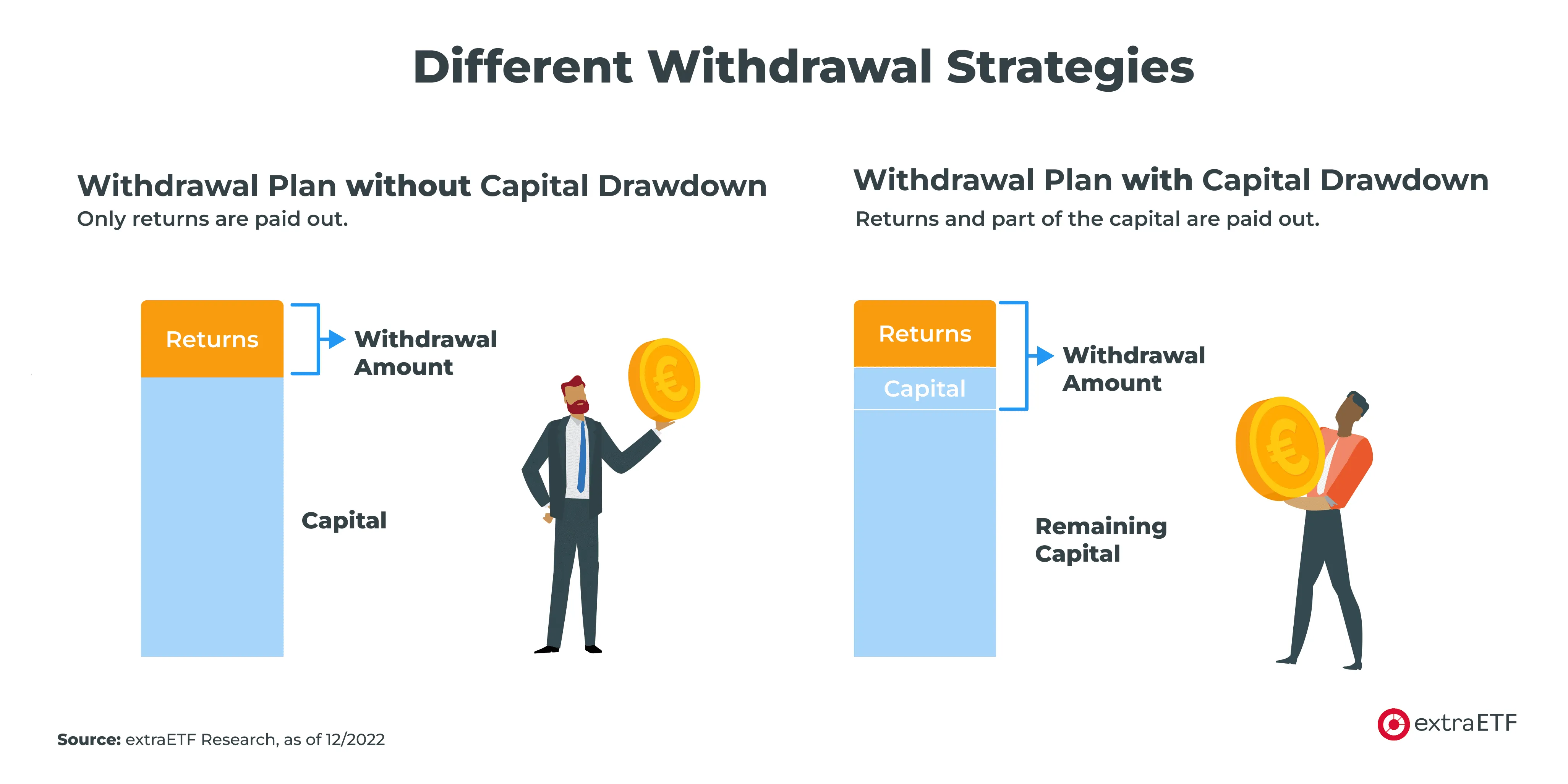
Types of payout: A withdrawal plan that preserves your capital pays out only the income your investments generate. A plan that involves capital depletion also gradually sells part of the invested capital, so the money is used up by the end of the withdrawal period.
Calculator: Various tools can help you calculate an ETF withdrawal plan, including extraETF’s ETF withdrawal plan calculator.

Find and compare thousands of ETFs. Use powerful filters, detailed analytics, and independent data to discover the right ETF for your portfolio.
Explanation: What is a payout plan or withdrawal plan?
A withdrawal plan, also known as a payout plan, is essentially the opposite of regular investing. You have money paid out regularly from your accumulated assets. Withdrawal plans are often used to sell down ETF holdings or to implement a withdrawal strategy during retirement. To start a withdrawal plan, you need a portfolio of investments to draw on. You can set the amount of each withdrawal flexibly. Shares are then sold, typically each month, and the proceeds are credited to your account.
What you invest in is up to you, but ETFs are the simplest and most cost-effective option. You can either build a simple ETF portfolio or invest in ready-made portfolio ETFs. The monthly payouts can top up your regular income or pension. A withdrawal plan can also be an alternative to buying an annuity as a way of funding your retirement.
Join the extraETF community
Explore the world of ETFs and make informed investment decisions.
- Find ETFs that match your criteria with our ETF Search.
- Compare costs, performance, and risk side by side.
- Save your favourites to a watchlist and receive price alerts.
- Explore detailed ETF profiles with key metrics and holdings.
ETF Withdrawal Plan Calculator
With extraETF’s ETF withdrawal plan calculator, you can calculate a personalised ETF withdrawal plan and quickly see the possible withdrawal amounts based on your assets. You can set all the key parameters there, including your starting capital, the withdrawal interval, the rate of return, the remaining capital and the length of the payout period.
For example, you can model a perpetual annuity that leaves the principal untouched. Your invested capital does not shrink, and you receive regular payments from the returns it generates.
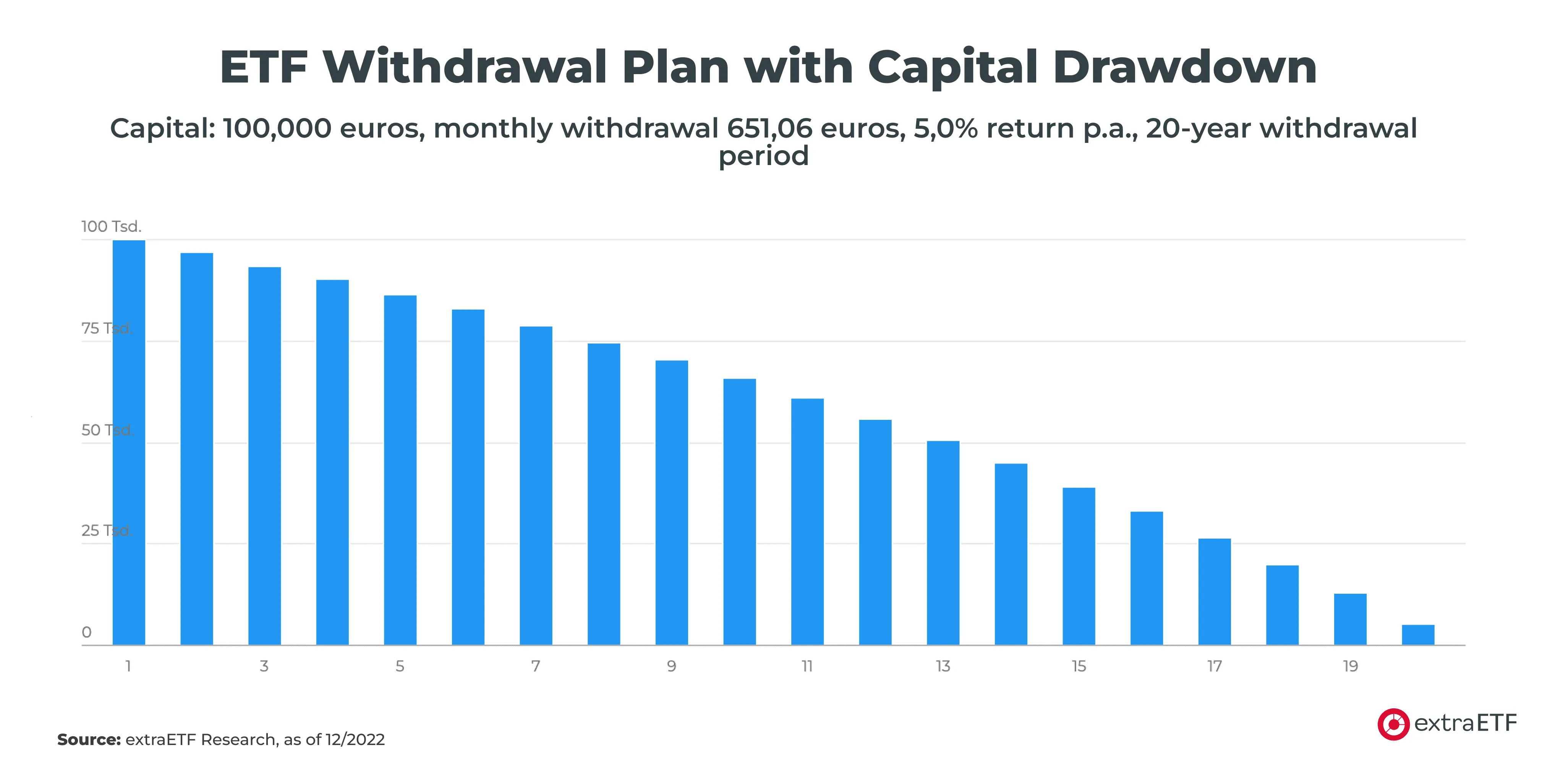
Alternatively, you can choose a limited annuity term or payout period. With this option, however, your capital is eventually used up. This is known as a payout plan with capital depletion.
How does a withdrawal plan work?
A withdrawal plan works like regular investing in reverse. Instead of regularly paying money into an investment account, you have funds paid out from your portfolio at specific intervals, usually monthly. With an ETF withdrawal plan, you sell a certain amount of ETF shares each month. The proceeds from the sale are then credited to your account. A withdrawal plan can supplement your regular income or provide a top-up to your pension. You decide how much to withdraw from your portfolio each time. Setting up a payout or withdrawal plan is as easy as setting up a standing order for rent or other regular payments.
Payout Schedule: Step-by-Step Guide
Here’s how to set up an ETF withdrawal plan.
Select the ETFs you want to sell
One-time investment in the selected ETFs
Setting Up a Withdrawal Plan with Your Broker
Set the withdrawal amount
Set the payment date
Select the account to which the funds should be paid out
With which investment options is a withdrawal plan possible?
Withdrawal plans are available for various investment options. Shares, ETFs and funds offer the highest long-term returns. If you prefer a hands-off approach, you can use a robo-advisor. Withdrawal plans based on a money market fund or a fixed-rate savings account are particularly safe but offer low returns.
Below, we briefly explain what these investment options involve and how they work within a withdrawal plan.
In addition to the payout term, the rate of return has a decisive impact on the amount you can withdraw. For example, with a capital-preserving withdrawal plan and an investment of £100,000, you can withdraw only £1,000 a year if the return is 1 per cent a year. With a 5 per cent annual return, you can withdraw £5,000 without reducing your original capital. The following table shows how large an impact this difference in return can have.
| Principal | 1% Return p.a. | 5% Return p.a. |
|---|---|---|
| £50,000 | £500 | £2,500 |
| £100,000 | £1,000 | £5,000 |
| £250,000 | £2,500 | £12,500 |
| £500,000 | £5,000 | £25,000 |
| £1,000,000 | £10,000 | £50,000 |
Tip: To keep track of your investments while following a withdrawal plan, extraETF’s portfolio tracking tool is particularly useful.
What withdrawal strategies are available?
A withdrawal plan can follow one of two strategies: with capital depletion or without. With a withdrawal plan that involves capital depletion, you receive a higher payout, but your principal will be depleted by the end of the term. With a withdrawal plan that does not deplete your principal, you withdraw only the earnings or interest generated. Your principal therefore stays intact.
Which ETFs are suitable for a payout plan?
Low-cost, broadly diversified global ETFs are particularly well suited to a withdrawal plan. However, multi-ETF portfolios and portfolio ETFs are also worth considering.
Individual ETFs
The wide range of ETFs available gives you numerous ways to create a customised portfolio. A payout plan can be based on a single ETF or several, so the possibilities are virtually unlimited. In our view, however, the portfolio shouldn’t be too complex, as it needs to be maintained – for example, through annual rebalancing. With too many ETFs, things can quickly become complicated.
Our ETF Model Portfolios section features over 100 ETF portfolios, some consisting of just two ETFs. Feel free to draw inspiration from them.
Portfolio ETFs
Portfolio ETFs are a low-maintenance, albeit somewhat more expensive, alternative. These are ready-made ETF portfolios that you can invest in through a single security. The portfolio ETF is held in your investment account, and your broker sells shares in it each month and credits the proceeds to your account.
The provider handles the management of the underlying ETFs, the reinvestment of returns and the annual rebalancing within the portfolio ETF, so you don’t have to worry about any of it.
Portfolio ETFs are now also available with different equity allocations. We list the available products in our separate Multi-Asset ETF Guide. You can also find these ETFs directly through our ETF search tool.
With a robo-advisor, you can easily set up an automatic ETF payout plan without having to sell fund shares yourself. We’ve reviewed the offerings from various robo-advisors – find out which ones offer payout plans.
Supplementary Pension: How much should the withdrawal amount be?
When trying to determine the optimal withdrawal amount, the 4 per cent rule can serve as a useful guide. It is based on a US study by Trinity University in Texas, which sought to determine how much an investor could withdraw each year from an existing portfolio without ever running out of money. The researchers analysed a hypothetical portfolio – half invested in US shares and half in US bonds – over various 30-year periods.
The result: If no more than 4 per cent of the portfolio was withdrawn each year, capital remained at the end of every period examined.
Although the study covered only US securities and a 30-year period, its findings are still a useful guide for UK and European investors.
The 4% rule can also help you estimate how much capital you need. To do this, multiply your annual expenses by 25.
Example: Suppose your living expenses are £3,000 a month (£36,000 a year). According to the 4% rule, you would need capital of £900,000 to withdraw £3,000 a month with a relatively high degree of certainty. Taxes and associated costs are not included in this calculation.
With our ETF payout plan calculator, you can quickly see the possible payout amounts based on different assumptions.
Examples of ETF Withdrawal Plans
The following tables show calculations for different withdrawal plans, illustrating the difference between plans with and without capital depletion. We have also calculated how much you need to save to withdraw a specific target income from your accumulated assets.
Sample Calculation for Monthly Withdrawals
We’ve calculated the following examples using an annual return of 5 per cent and a payout period of 20 years (for the capital depletion example). Taxes and fees are not included. For example, with an investment of £50,000, you can withdraw £325.53 a month for 20 years. After that, however, your principal will be completely used up.
| Principal | Monthly withdrawal with capital depletion | Monthly withdrawal without capital depletion |
|---|---|---|
| £50,000 | £325.53 | £202.84 |
| £100,000 | £651.06 | £405.68 |
Sample Calculations for a Target Pension
We used an annual return of 5 per cent and a payout period of 20 years (for the capital depletion example). Taxes and fees are not included.
How to read the table: If you want a monthly target income of £500 from a payout plan without capital depletion, you need to save £144.19 a month over a 30-year savings period.
| Savings period | £500 target income | £1,000 target income | ||
|---|---|---|---|---|
| with capital depletion | without capital depletion | with capital depletion | without capital depletion | |
| 10 years | £487.90 | £772.79 | £975.81 | £1,545.57 |
| 15 years | £283.45 | £448.95 | £566.90 | £897.90 |
| 20 years | £184.32 | £291.95 | £368.64 | £583.89 |
| 25 years | £127.22 | £201.51 | £254.45 | £403.02 |
| 30 years | £91.03 | £144.19 | £182.07 | £288.37 |
What should you keep in mind when creating an ETF withdrawal plan?
Using your savings to supplement your retirement income sounds quite simple: invest your capital as profitably as possible, have a portion paid out regularly – ideally through an ETF withdrawal plan – and enjoy a peaceful retirement. If you use a withdrawal plan to top up your income or pension, however, you need to work out how much you can withdraw so that the income lasts for the rest of your life. Three risks deserve closer attention: the risk of running out of money, the risk of spending less than you could and the risk of low returns.
How much does an ETF payout plan cost?
The costs for executing an ETF withdrawal plan vary depending on the bank or broker. According to our analysis, for a withdrawal of €500, the costs range from €0 to €12.50. The cheapest ETF withdrawal plan is offered by Flatex, which processes withdrawals free of charge. The most expensive provider in our comparison is S Broker, where a €500 withdrawal costs €12.50. Most brokers offer free account maintenance, but Finvesto charges €36 a year.
The most convenient option is a bank or broker that offers a withdrawal plan as a dedicated feature. Once it is set up, the bank automatically sells the fund shares. However, not every provider offers an automatic withdrawal plan. In that case, you will have to sell ETF shares yourself each month.
What taxes are due under an ETF withdrawal plan?
Tax may also be due on investment income under an ETF withdrawal plan. If you hold your ETFs outside a tax wrapper such as an ISA or SIPP, gains realised when ETF shares are sold may be subject to Capital Gains Tax, while dividends and interest may be subject to Income Tax. Withdrawals from a Stocks and Shares ISA are free of UK tax, whereas withdrawals from a SIPP are generally taxed as income, although up to 25 per cent can usually be taken tax-free.
To reduce your tax bill, make use of your annual Capital Gains Tax allowance, the dividend allowance and the Personal Savings Allowance, and consider holding your investments in an ISA. Any tax due reduces the amount you actually receive, so take this into account when planning your cash flow.
Which banks offer an ETF payout plan?
Virtually all direct banks and neobrokers offer regular ETF investing, but only a few offer an ETF withdrawal plan. The following table lists the providers that currently do. Flatex currently offers the cheapest way to set up an ETF withdrawal plan, while Smartbroker and Finvesto are also worth considering: even with a monthly withdrawal of €1,000, they charge only €2 in execution fees.
Conclusion: Building a Supplemental Pension with an ETF Withdrawal Plan
A payout plan is a convenient way to draw money from an ETF investment. Whether you want to supplement your pension or generate passive income, a payout plan lets you receive a fixed amount on a regular, automated basis. Once it is set up, your bank or broker sells the ETF shares at regular intervals and credits the proceeds to your account.
For a lifelong income stream, choose a withdrawal plan that does not deplete the principal. A withdrawal plan that depletes the principal increases the monthly payout but can only last for a limited period. The 4 per cent rule is a useful guideline for estimating a sustainable payout.
To set up an ETF withdrawal plan, we recommend the broker Flatex, where account maintenance and withdrawal plan execution are free of charge. Smartbroker and Finvesto are good alternatives.
We'll answer any other questions you may have about the ETF withdrawal plan
- Everything You Need to Know About the ETF Withdrawal Plan at a Glance
- Explanation: What is a payout plan or withdrawal plan?
- ETF Withdrawal Plan Calculator
- How does a withdrawal plan work?
- Payout Schedule: Step-by-Step Guide
- Which ETFs are suitable for a payout plan?
- Supplementary Pension: How much should the withdrawal amount be?
- What should you keep in mind when creating an ETF withdrawal plan?
- How much does an ETF payout plan cost?
- What taxes are due under an ETF withdrawal plan?
- Which banks offer an ETF payout plan?
- Building a Supplemental Pension with an ETF Withdrawal Plan
- We'll answer any other questions you may have about the ETF withdrawal plan
