



Socially Responsible Investing
Investing consciously with SRI
Socially Responsible Investing (SRI) represents an evolution in the world of financial investing that goes beyond mere returns. In an era where social responsibility and environmental protection are increasingly coming into focus, SRI offers investors the opportunity to invest their capital in companies and funds that prioritize positive social and environmental impacts.
This article provides an in-depth look at the principles and practices of Socially Responsible Investing in the context of sustainable investing, highlights the differences from other sustainable investment strategies, and explains how investors can effectively integrate SRI into their portfolios.
The essentials in brief: An Overview of Socially Responsible Investing
Definition: Socially Responsible Investing (SRI) combines financial returns with a positive social and environmental impact by investing in assets that meet strict ethical, social, and environmental standards.
Criteria: SRI is based on a set of positive and negative criteria designed to exclude investments that violate ethical or environmental principles and to favour those that contribute positively to a sustainable future.
ESG criteria: While SRI is based more on ethical convictions, ESG criteria provide a framework for evaluating a company’s sustainability practices in the areas of the environment, social issues, and corporate governance.
Investment Opportunities: SRI funds and socially responsible ETFs offer a practical way to invest in responsible companies that meet high sustainability standards.

Find and compare thousands of ETFs. Use powerful filters, detailed analytics, and independent data to discover the right ETF for your portfolio.
Definition: What Is Socially Responsible Investing?
Socially Responsible Investing (SRI) is an investment strategy that enables investors to invest their capital not only profitably but also in accordance with social and environmental values. SRI focuses on investments in companies and funds that have a positive impact on society and the environment by applying strict ethical, social, and environmental criteria when selecting investments.
By excluding certain industries considered harmful – such as the defence or tobacco industries – and favoring companies that promote sustainable practices, SRI helps ensure that capital is invested responsibly while also generating financial returns.
SRI & Sustainable Investing: Is There a Difference?
Although SRI is often mentioned in connection with sustainable investing, the two approaches differ in their focus and methods. SRI places a strong emphasis on excluding investments in companies and industries that are viewed negatively based on ethical, social, or environmental criteria.
Sustainable investing encompasses a broader investment strategy that incorporates both exclusion criteria and a company’s positive contributions to sustainability. Here, ESG (Environmental, Social, Governance) criteria play a central role by providing a comprehensive framework for evaluating a company’s sustainable practices.
The Criteria of the SRI Approach
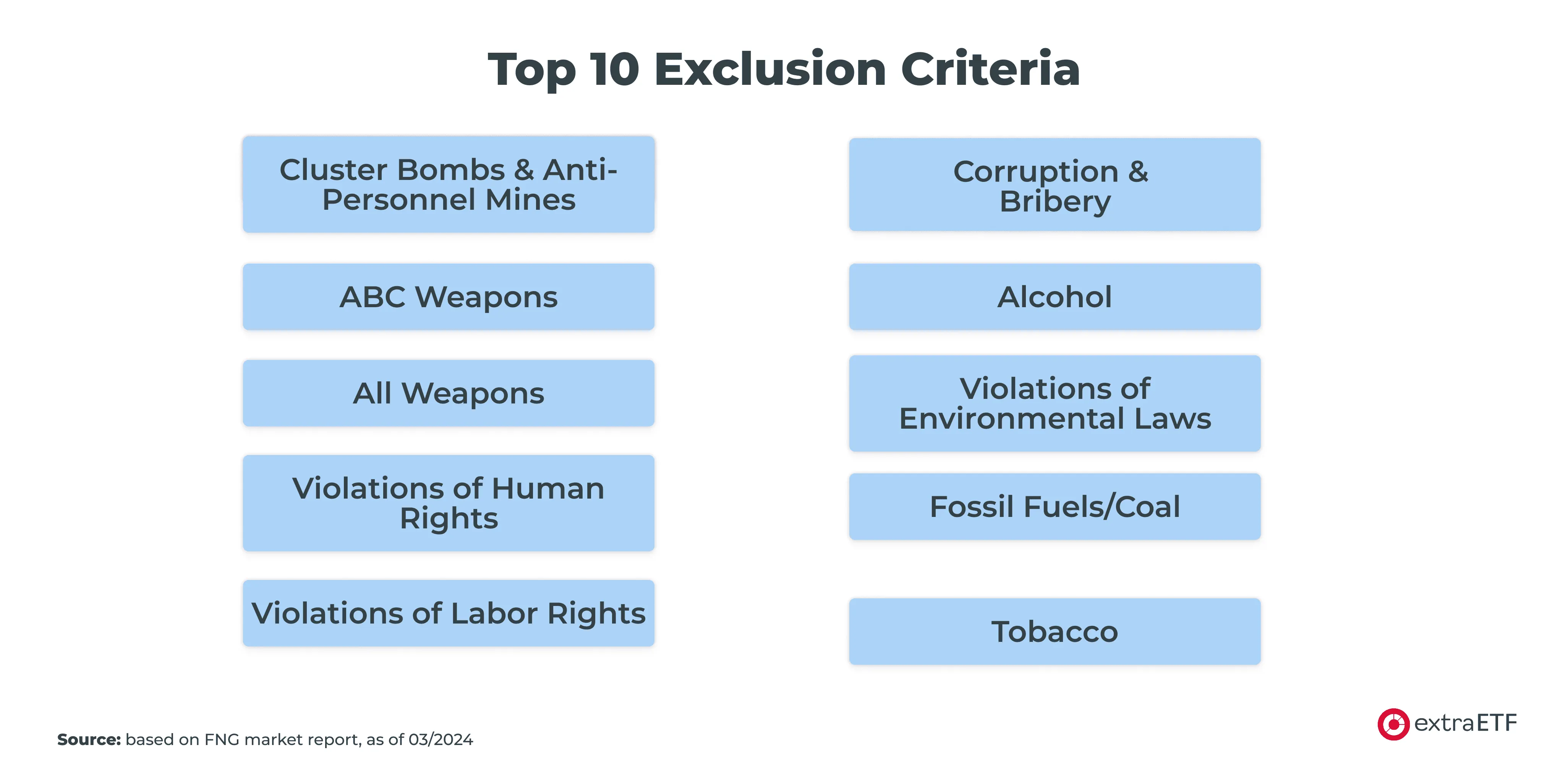
At the heart of the SRI approach is the use of exclusion criteria, which ensure that certain industries that do not meet these standards are not considered for investment from the outset.
Examples of exclusion criteria include:
- the tobacco industry,
- the weapons and defence sector,
- coal mining and coal-fired power generation,
- nuclear power,
- genetic engineering.
This means that SRI focuses less on actively investing in companies that make a positive contribution to environmental or social goals, as would be the case with positive screening criteria.
Examples of positive criteria could include:
- Organic farming,
- renewable energy sources,
- technologies to increase energy efficiency.
Selection of SRI Funds and ETFs
SRI funds and ETFs offer a convenient way to invest in a wide range of socially responsible companies without having to evaluate each company individually. They enable investors to build a diversified portfolio that aligns with their values, while contributing to the promotion of a more sustainable and equitable world.
When selecting SRI funds and ETFs, it is important to carefully examine the underlying criteria and investment strategy. Investors should ensure that the funds and ETFs they select align with their personal ethical convictions and desired social and environmental criteria. It is advisable to thoroughly review the investment policies, reported social and environmental impacts, and performance of the funds and ETFs.
Join the extraETF community
Explore the world of ETFs and make informed investment decisions.
- Find ETFs that match your criteria with our ETF Search.
- Compare costs, performance, and risk side by side.
- Save your favourites to a watchlist and receive price alerts.
- Explore detailed ETF profiles with key metrics and holdings.
Anyone looking for SRI funds and ETFs should carefully verify whether the fund in question actually meets the desired social and environmental criteria. In addition to ethical considerations, the economic aspect naturally plays a role as well, since investors also expect a financial return on their capital. It is important that the SRI fund’s investment strategy aligns with your personal interests.

Investing Consciously & Taking Responsibility
Examples of SRI ETFs
- BNP PARIBAS EASY MSCI EUROPE SRI S-SERIES PAB 5% CAPPED UCITS ETF
- BNP PARIBAS EASY MSCI WORLD SRI S-SERIES PAB 5% CAPPED UCITS ETF
The ETFs from BNP Paribas Asset Management are based on MSCI’s SRI index concept. As a result, companies are subject to specific revenue and production thresholds if they operate in the controversial sectors of alcohol, gambling, tobacco, defence, firearms, pornography, genetically modified organisms, and nuclear energy. The SRI label also excludes genetic research. In a second step, using a best-in-class approach, all companies that meet minimum ESG ratings and are suitable in terms of sector and company size are selected. Finally, minimum standards apply to the analysis and monitoring of controversies such as violations of international United Nations standards.
SRI as an Important Criterion in Companies
In the world of socially responsible investing, leading financial institutions play a key role by developing innovative solutions for investors who wish to combine financial returns with ethical considerations.
One example is BNP Paribas Asset Management, which is known for its comprehensive range of SRI funds and ETFs. These products are specifically designed to enable investors to invest in companies and projects that meet strict social, environmental, and governance criteria. Through BNP Paribas Asset Management’s commitment to SRI, investors gain access to carefully curated investment opportunities aimed at generating both financial and social returns. This demonstrates how BNP Paribas Asset Management equips investors with the tools to make informed and value-driven investment decisions.
The Importance of Socially Responsible Investing for Investors
By deliberately excluding investments that could have a negative impact on society and the environment, SRI investors can be part of a broader movement that promotes sustainable development and social justice.
In addition, SRI can help reduce portfolio risk by investing in companies that, due to their sustainable practices, are less exposed to regulatory risks and reputational issues.
Conclusion: SRI as a Guide to Sustainable Investing
Socially Responsible Investing is at the forefront of a changing investment landscape that recognizes that financial success and social responsibility can go hand in hand. SRI enables investors to play an active role in promoting social justice and environmental protection while simultaneously seeking sustainable returns.
Integrating SRI into your investment portfolio is therefore not only an investment in your financial future, but also a contribution to a broader, global shift toward sustainability and social justice.
We answer additional questions about socially responsible investing
- An Overview of Socially Responsible Investing
- Definition: What Is Socially Responsible Investing?
- The Criteria of the SRI Approach
- Selection of SRI Funds and ETFs
- SRI as an Important Criterion in Companies
- The Importance of Socially Responsible Investing for Investors
- SRI as a Guide to Sustainable Investing
- We answer additional questions about socially responsible investing
