



ESG criteria
Impact on Companies & Investors
For companies, the integration of ESG criteria (environmental, social, and governance) into their business strategy has long since evolved beyond a mere buzzword. Sustainability criteria form an essential foundation that not only contributes to promoting environmental sustainability and social justice but also plays a key role in strengthening a company’s market reputation and ensuring its long-term success.
In this article, we take a detailed look at the individual ESG criteria and their significance for companies and investors.
The essentials in brief: Everything You Need to Know About ESG Criteria at a Glance
Meaning: ESG criteria (environmental, social, and corporate governance) are essential for long-term corporate success and contribute to environmental sustainability, social justice, and responsible leadership.
Measurement: Specialized rating agencies evaluate companies based on ESG criteria, which enables transparent and well-informed investment decisions.
Returns: Companies that meet high ESG standards often demonstrate better financial performance and offer investors attractive return opportunities.
ETF Examples: BNP Paribas Easy ESG Quality Europe ETF, Vanguard ESG Global All Cap ETF

Find and compare thousands of ETFs. Use powerful filters, detailed analytics, and independent data to discover the right ETF for your portfolio.
Definition: What Are the ESG Criteria?
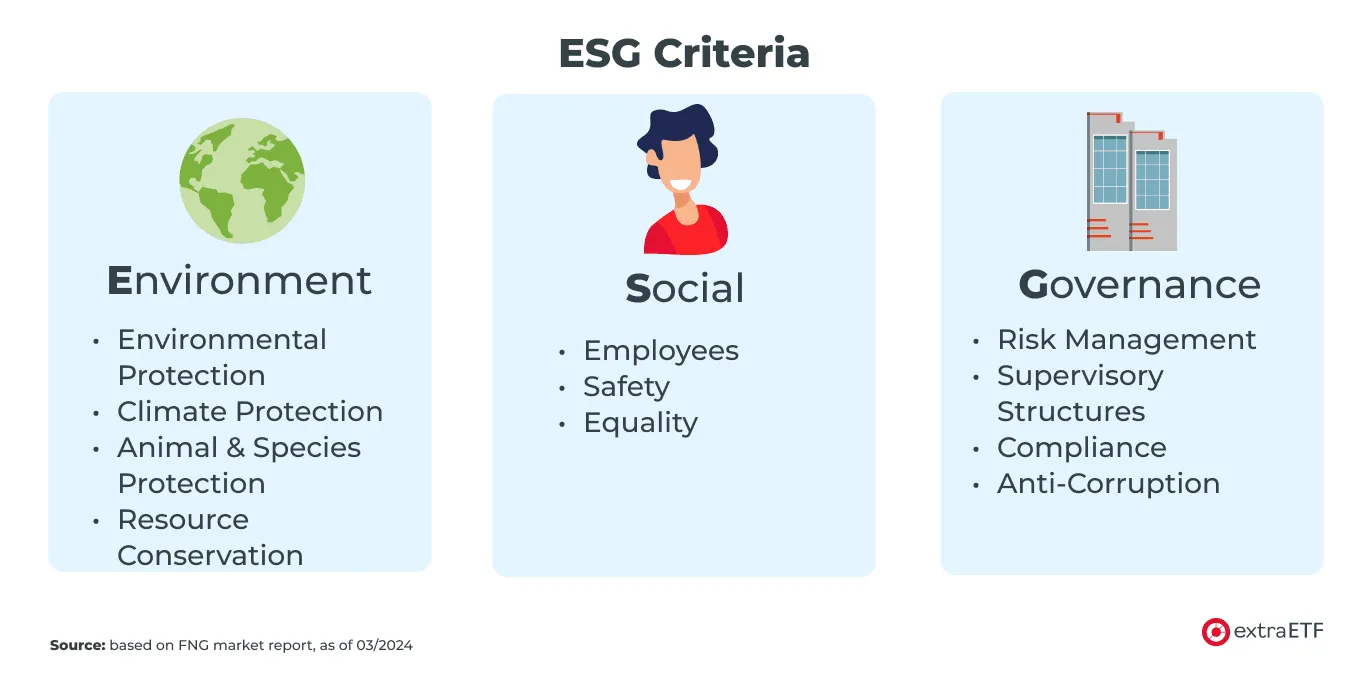
The ESG criteria – Environment, Social, and Governance – form the foundation for a new era of investing. These criteria serve as proven standards for companies to make sustainable and ethical practices in the areas of environment, social issues, and corporate governance measurable. They provide a detailed framework that goes beyond traditional financial metrics and enables a deeper understanding of long-term value creation.
E for Environment
The environmental aspect of ESG focuses on the impact a company has on the natural environment. This includes, among other things, greenhouse gas emissions, resource consumption, energy efficiency, and measures to reduce environmental impact and promote renewable energy.
In summary, it is about actively contributing to environmental protection by minimizing negative impacts on air, water, and soil.
Examples of environmental measures:
- Energy efficiency: Implementing technologies and processes that reduce energy consumption.
- Renewable Energy: Utilizing and promoting renewable energy sources such as solar or wind energy.
- Water management: Efficient use and treatment of water resources.
- Waste management: Strategies for reducing, reusing, and recycling waste products.
S for Social
The social aspect refers to how a company interacts with its employees, suppliers, customers, and the community. This includes fair working conditions, occupational health and safety, diversity and inclusion, as well as contributions to social and societal goals.
Key topics include:
- Working Conditions: Ensuring fair and safe working conditions for all employees.
- Diversity and Inclusion: Promoting a diverse and inclusive work environment.
- Community Engagement: Actively participating in and supporting local projects and initiatives.
- Data Protection and Data Security: Protecting the privacy and personal data of customers and employees.
G for Governance (Corporate Governance)
Corporate governance refers to the way in which a company is managed and supervised. Transparency, anti-corruption measures, appropriate compensation systems, and consideration of the interests of all stakeholders are of central importance here.
Good corporate governance is characterized by:
- Transparency: Open communication about business practices, financial results, and risk management.
- Ethics: Adherence to high ethical standards and the fight against corruption.
- Conflicts of Interest: Effective measures to prevent and manage conflicts of interest.
- Shareholder rights: Protection of shareholders’ rights and interests.
Join the extraETF community
Explore the world of ETFs and make informed investment decisions.
- Find ETFs that match your criteria with our ETF Search.
- Compare costs, performance, and risk side by side.
- Save your favourites to a watchlist and receive price alerts.
- Explore detailed ETF profiles with key metrics and holdings.
The Importance of ESG Criteria for Companies and Investors
For companies, ESG criteria are a key factor in long-term success and competitiveness. They help minimise risk, enhance a company’s image, and increase its appeal to investors, customers, and talent.
Investors are increasingly using ESG criteria as an indicator of the sustainability and future viability of their investments. They recognise that companies that invest in ESG aspects are often better equipped to handle future challenges and can achieve higher returns over the long term.
Sustainability as a Competitive Advantage
Companies that take sustainability and social responsibility seriously often report an improved brand image, which directly leads to increased customer loyalty. Transparency regarding sustainable practices strengthens stakeholders’ trust in the brand. Furthermore, compliance with ESG criteria can lead to cost savings, for example through more efficient use of resources and lower energy costs.
Alignment with Global Standards and Expectations
With increasing globalization and worldwide access to information, consumer and investor expectations of companies are also rising. Alignment with international standards such as the Global Reporting Initiative (GRI) guidelines or the principles of the UN Global Compact is no longer optional but a prerequisite for global business operations. Companies that meet or exceed these global ESG standards position themselves as pioneers in their industry.
Innovation and Sustainability
Taking ESG criteria into account fosters innovation, as companies seek new ways to make their products and services more environmentally friendly and socially responsible. From developing sustainable packaging to investing in clean technologies – the opportunities to differentiate oneself in the market are diverse. Companies that invest in these areas not only secure an innovation advantage but also actively contribute to a more sustainable future.
ESG Criteria and Financial Performance
Studies show that companies with strong performance in terms of ESG criteria tend to be more financially successful as well. This can be attributed, among other things, to reduced risk, improved compliance, increased employee satisfaction, and positive feedback from customers and investors. In a market environment where sustainability is becoming increasingly important, companies that invest in ESG aspects can achieve higher valuations and better financial results.
ESG as a Risk Management Tool?
Market dynamics and the urgency of environmental challenges such as climate change require a new approach to risk assessment. Companies that cling to outdated business models – particularly those based on fossil fuels – are increasingly exposed to economic and operational risks.
The effectiveness of ESG criteria in risk management is supported by numerous studies. For example, an analysis by Morningstar showed that 88 per cent of ESG indices outperformed the market over a five-year period, particularly in terms of the risk-return ratio and the ability to preserve capital during difficult market conditions. Further research reinforces the link between a high ESG rating and a reduction in unsystematic risk events at companies.

We incorporate ESG criteria
From Theory to Practice: How Are ESG Criteria Measured?
The ESG criteria are operationalized by specialized rating agencies that evaluate companies and countries based on their sustainability performance. Using a combination of quantitative metrics and qualitative assessments, these agencies generate ESG scores that provide transparency and enable investors to make informed decisions.
How do ESG criteria differ from other sustainability concepts?
While ESG criteria provide a comprehensive framework for sustainable business practices, there are also other concepts in the field of sustainable investing that emphasise specific aspects or goals. Two such concepts are impact investing and socially responsible investing (SRI). Distinguishing between these approaches is essential to understanding the breadth and depth of sustainable investment opportunities.
Impact investing focuses on investments that aim to generate a positive social or environmental impact in addition to financial returns. In impact investing, the primary goal is to create measurable social or environmental benefits. This approach goes beyond merely avoiding risks and aims to actively contribute to solving global challenges such as climate change or social inequality.
Socially Responsible Investing (SRI), on the other hand, emphasizes excluding investments in companies or industries considered harmful to society or the environment. These include, for example, companies operating in sectors such as tobacco, weapons, fossil fuels, or gambling. SRI investors select their investments based on specific ethical, moral, or religious convictions.
Return Opportunities for Investors
For investors, ESG investments offer not only the opportunity to contribute to a more sustainable and equitable world, but also attractive return potential. In recent years, it has become increasingly clear that companies that meet high standards in the areas of environment, social issues, and corporate governance (ESG) are often more financially successful. These companies are generally better prepared for future challenges, have more stable business models, and are more resilient in the face of crises.
For investors, this means that ESG investments are not only ethically and socially responsible but also offer the potential for above-average returns. The growing demand for ESG-compliant investment products and the increasing integration of ESG criteria into investment analysis underscore the financial markets’ confidence in the long-term financial benefits of sustainable investments.

Benefits of ESG Criteria
- Risk Mitigation: Companies that adhere to ESG criteria are better able to identify and manage risks, particularly those related to environmental, social, and governance issues.
- Long-Term Performance: Studies show that companies with high ESG standards often demonstrate better long-term financial performance.
- Market Opportunities: Incorporating ESG criteria opens up new markets and business opportunities, particularly in sectors that emphasise sustainability and social responsibility.
- Reputation and Brand Value: Companies with strong ESG performance often enjoy a better image and stronger brand loyalty, which leads to customer and employee retention.

Disadvantages of ESG Criteria
- Costs: Implementing ESG measures can involve high costs in the short term, such as those associated with transitioning to renewable energy or introducing new management processes.
- Measurability and Standardization: Evaluating ESG performance can be difficult due to a lack of uniform standards and measurement methods.
- Greenwashing: Some companies may be tempted to portray their ESG performance as better than it actually is, which can undermine the credibility of ESG investments.
- Market volatility: ESG criteria can lead to volatility when markets react to new information or trends in the area of sustainability.
- Complexity: Integrating ESG criteria into corporate governance and analysis can be complex and often requires additional resources and expertise.
Conclusion: ESG Criteria as a Guide to Sustainable Success and Future-Proof Investments
Taking ESG criteria into account is not a trend, but a necessity for any forward-looking company. Companies that take ESG criteria into account are not only better able to manage risks and strengthen their resilience in the face of environmental disasters, social unrest, and governance crises, but they also attract talented employees, loyal customers, and committed investors.
Furthermore, ESG criteria provide investors with a valuable framework for identifying companies that not only strive for economic success but also make positive contributions to the environment, society, and good corporate governance. For investors, this offers the advantage of investing in companies that, due to their sustainability efforts, promise lower risk and potentially higher long-term returns.
We'll answer any additional questions you may have about the ESG criteria
- Everything You Need to Know About ESG Criteria at a Glance
- Definition: What Are the ESG Criteria?
- The Importance of ESG Criteria for Companies and Investors
- From Theory to Practice: How Are ESG Criteria Measured?
- How do ESG criteria differ from other sustainability concepts?
- Return Opportunities for Investors
- ESG Criteria as a Guide to Sustainable Success and Future-Proof Investments
- We'll answer any additional questions you may have about the ESG criteria
