



Impact Investing
Sustainable Investments with a Real Impact
Impact investing is at the heart of the growing interest in sustainable investments. As awareness of the environmental and social impacts of our capital grows, investors are increasingly turning to investments that not only promise attractive returns but also bring about positive change in the world. But what exactly is behind this trend, and how can investors get involved?
This article explores the various aspects of impact investing and shows how you can change not only your portfolio but also the world for the better through mindful investment decisions.
The essentials in brief: Everything You Need to Know About Impact Investing at a Glance
Meaning: Impact investing combines financial returns with social and environmental value. Despite the challenges, impact investing offers potential for sustainable growth.
Measurability: The impact of the investments is measurable, which fosters transparency and trust among investors.
Returns: Impact investments offer the opportunity to achieve market-rate or near-market-rate returns while simultaneously supporting social and environmental goals.

Find and compare thousands of ETFs. Use powerful filters, detailed analytics, and independent data to discover the right ETF for your portfolio.
Definition: What Is Impact Investing?
Impact investing – also known in German as “wirkungsorientiertes Investieren” – aims to combine financial returns with social and environmental improvements.
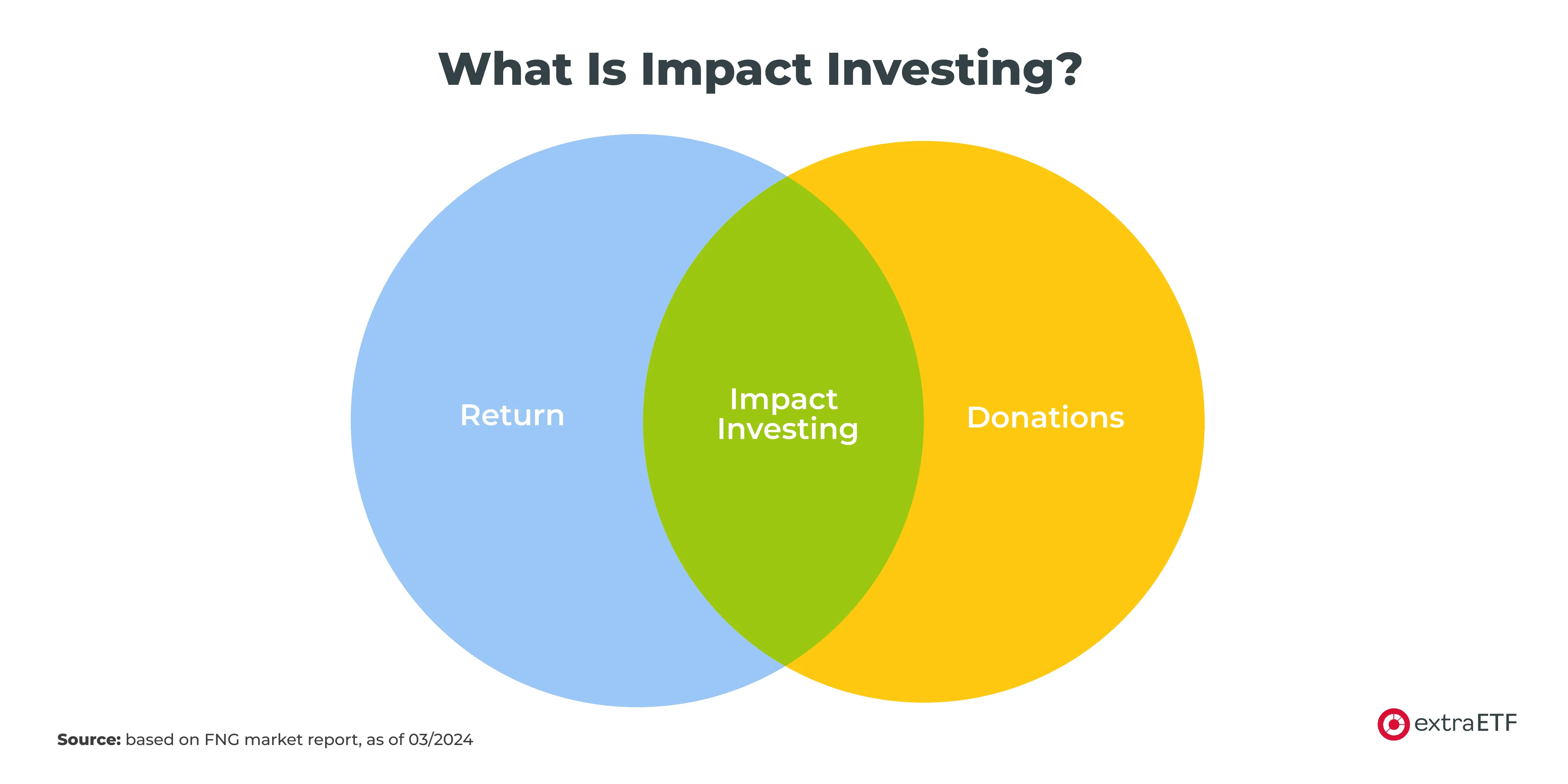
Investments are directed toward companies, organisations, and funds with the intention of achieving not only a financial return but also a positive impact on society or the environment. This impact is measurable and is disclosed transparently to investors. Impact investing thus occupies a middle ground between altruistic action and profit maximization, aiming to achieve measurable positive social and environmental outcomes.
The terms "impact investment" and "impact investing" are often used interchangeably, with the former referring to the products and the latter to the investment process.
Origins and Necessity
The term “impact investing” was introduced in 2007 by the Rockefeller Foundation, which promoted the concept as a symbiosis of economic and social goals. In light of global challenges exacerbated by climate change, demand for such investments has risen in order to improve essential areas such as education, housing, and healthcare.
Global Goals and the Role of Impact Investing
At a time when humanity faces enormous challenges – including water scarcity, soil degradation, biodiversity loss, poverty, and disease, all of which are linked to climate change – solutions to ensure a livable future for all require an effective ecosystem. The United Nations has recognised this and defined 17 Sustainable Development Goals to achieve significant global progress by 2030.
The Sustainable Development Goals (SDGs) are a universal call to action to end poverty, protect the planet, and ensure peace and prosperity for all people. Here are some examples of these goals:
- No Poverty – Ending poverty in all its forms everywhere.
- Zero Hunger – End hunger, achieve food security, improve nutrition, and promote sustainable agriculture.
- Good Health and Well-being – Ensure healthy lives for all people of all ages and promote their well-being.
- Quality Education – Inclusive, equitable, and high-quality education for all and the promotion of lifelong learning.
- Gender Equality – Achieve gender equality and empower all women and girls.
- Clean Water and Sanitation – Ensuring access to and the sustainable management of water and sanitation for all.
- Affordable and Clean Energy – Ensuring access to affordable, reliable, sustainable, and modern energy for all.
- Decent Work and Economic Growth – Promoting sustained, inclusive, and sustainable economic growth, full and productive employment, and decent work for all.
By focusing on investments that, for example, promote renewable energy, support educational initiatives, or advance gender equality, impact investing contributes directly to achieving the Sustainable Development Goals (SDGs). By channeling private investment into areas critical to sustainable development, impact investing helps provide the financial resources needed to address global challenges and foster long-term positive change.
Did you know? A real-world example
BNP Paribas has committed to investing 250 million euros of its own funds by 2025 to support innovative companies that are developing local, environmentally friendly, and socially responsible solutions to the major challenges we currently face. One example is Printemps des Terres, a French company that helps farmers become key players in the energy transition. The Group forms partnerships with such companies, whether by supporting their strategic plans and governance or through direct investments.
Growing Popularity and Diversity in Impact Investing
The latest market study by the Federal Initiative for Impact Investing, published in 2022, shows that the volume of self-declared impact assets stands at 38.9 billion euros, a figure that significantly exceeds the results of previous studies. However, only about one-third of this total can be classified as impact-compatible (3.12 billion euros) or impact-effective investments (9.23 billion euros).
On a global scale, the latest survey by the Global Impact Investing Network (GIIN) shows that the volume of impact investing assets under management amounts to 1.164 trillion U.S. dollars.
The FNG Market Report 2022 shows that impact investments in Germany total 29.9 billion euros. By comparison, the total volume of sustainable investments in Germany stands at 410 billion, according to the FNG study.
However, the latest figures show that the share of impact investing in sustainable investment strategies is declining. Impact investing is now used in only 1 per cent of sustainable investment strategies (compared to 7 per cent in 2021).
The Difference Between Impact-Compatible and Impact-Effective Investments
Impact-aligned and impact-effective investments differ significantly in their approach and impact. Impact-aligned investments primarily encompass ESG-managed investments, such as exclusions, best-in-class approaches, or the integration of ESG criteria. The impact of these investments is often assessed through a benchmark comparison or based on their contribution to the Sustainable Development Goals (SDGs). In this process, impact-relevant information is measured and documented to illustrate how the investments are aligned with positive environmental or social outcomes.
In contrast, impact-generating investments aim to generate a direct and measurable additional impact. This is achieved through capital increases or injections – such as IPOs, private equity investments, or loans – that are explicitly intended to generate social or environmental benefits. Investments are specifically made in companies or projects with clear impact goals, where the impact forms the core of the business model or where the projects are guided by science-based targets. In addition, transformative impact is promoted and documented through a strategic engagement or voting policy, such as through active dialogue with investee companies or the exercise of voting rights.
Join the extraETF community
Explore the world of ETFs and make informed investment decisions.
- Find ETFs that match your criteria with our ETF Search.
- Compare costs, performance, and risk side by side.
- Save your favourites to a watchlist and receive price alerts.
- Explore detailed ETF profiles with key metrics and holdings.

It's the lasting impact that counts
Measuring the Impact of Impact Investments
The impact of impact investments is assessed using criteria and standards based on the United Nations’ Sustainable Development Goals (SDGs). Examples of measurable impacts of impact investments include the number of megawatt-hours generated by renewable energy projects or the number of people reached by educational programs.
Measuring the impact of impact investments requires a continuous process of data collection, analysis, and evaluation to ensure that the investments actually achieve the intended positive social and environmental impacts.
How can I invest in impact investment products?
Impact funds, ELTIFs, ETFs (exchange-traded funds) for impact investing, and social bonds are popular instruments for investors who wish to deploy their capital with the intention of generating a positive social or environmental impact in addition to a financial return. Direct investments in social enterprises or impact-focused startups are another option, but they often require a deeper understanding of the market and more active engagement.
For investors, these instruments offer varying risk and return profiles as well as levels of impact. To ensure that the chosen investments actually generate an impact, investors should look for certifications and ratings from independent institutions.
Who is impact investing suitable for?
Impact investing can be a suitable option for everyone from individual investors who wish to invest through impact investing ETFs or funds to institutional investors who can invest larger sums directly in selected projects or companies.
Given the wide range of impact investment products available, it is possible to create a customized portfolio that meets investors’ personal return expectations as well as their risk profile and impact goals. Impact investments not only offer financial returns but also help address global challenges and promote social and environmental progress, making them a valuable component of a diversified portfolio.

The Benefits of Impact Investing at a Glance
The opportunities presented by impact investing lie in the growing demand for sustainable investment options and the recognition that impact investing is not only ethically valuable but also has the potential to generate stable and attractive returns.
- Social and environmental impact: These investments contribute directly to solving global challenges.
- Financial Returns: Impact investments offer the opportunity to achieve market-rate returns.
- Risk mitigation: Diversification into sustainable sectors can reduce portfolio risk.
- Transparency and measurability: The measurable impact of these investments creates transparency and fosters investor confidence in sustainable financial products.

An Overview of the Challenges
- Despite its considerable potential to bring about positive change, impact investing faces significant challenges. A key issue lies in the often indirect influence exerted on publicly traded companies and the challenge of generating comprehensive and meaningful impact data.
- Another critical issue is “impact washing” – the risk that investments are falsely portrayed as having a positive impact. This criticism is reinforced by reports showing that some funds marketed as sustainable actually invest in conventional industries such as oil, coal, and aviation.
- Measuring the actual environmental and social impacts of impact investments has not yet been standardized and remains a complex undertaking that poses significant challenges for both investors and companies. Although the tightening of ESG guidelines by institutions such as MSCI is a welcome step, the development of clear and reliable assessment standards remains crucial for the credibility and long-term success of impact investing.
Conclusion: Measurable benefits for the environment and society?
Impact investing marks a turning point in the investment strategies of modern investors. It represents not only a financial investment aimed at generating a profit, but also a strong commitment to social responsibility and environmental sustainability. At a time when the planet’s resources are becoming scarce and social inequalities are on the rise, impact investing offers an opportunity to address both issues – through targeted investments that create measurable, positive change. Despite the challenges and the need for standardized methods to measure the impact of these investments, impact investing remains a crucial factor for a sustainable economy and a more equitable society. It is a form of investment that is significant not only for today’s visionary investors but also for future generations.
With a growing number of impact investing products, including ETFs, it is becoming increasingly easier for investors to align their portfolios with their values while contributing to the achievement of global sustainability goals.
We're here to answer any other questions you may have about impact investing
- Everything You Need to Know About Impact Investing at a Glance
- Definition: What Is Impact Investing?
- A real-world example
- Growing Popularity and Diversity in Impact Investing
- Measuring the Impact of Impact Investments
- How can I invest in impact investment products?
- Who is impact investing suitable for?
- Measurable benefits for the environment and society?
- We're here to answer any other questions you may have about impact investing
